
Declaratory Judgment Actions in Royalty Disputes: When and Why Parties Sue for Clarity Before the Money Stops
A declaratory judgment is a court ruling on who is right, with no order to pay or stop. You use it when the cost of uncertainty exceeds the cost of suing.
A declaratory judgment is a court ruling on who is right, with no order to pay or stop. You use it when the cost of uncertainty exceeds the cost of suing.
In royalty finance the uncertainty is expensive. An asset's whole value rests on a chain of obligations running from product sales, through a licence, to a monetization vehicle. When one link is disputed, the cashflow is at risk for years.
Three parties recur, each with the same problem:
- A royalty holder sees the licensee quietly reinterpret the net-sales definition.
- A licensee is billed for products it says fall outside the patent claims.
- A monetization buyer suspects the seller is about to breach a covenant.
In each case the duty to pay is live, the dispute is real, and waiting to be sued means fighting on the other side's clock and in the other side's court. The declaratory judgment action fixes that. It also triggers the hardest procedural questions in the field: is the dispute ripe, and will the court even hear it.
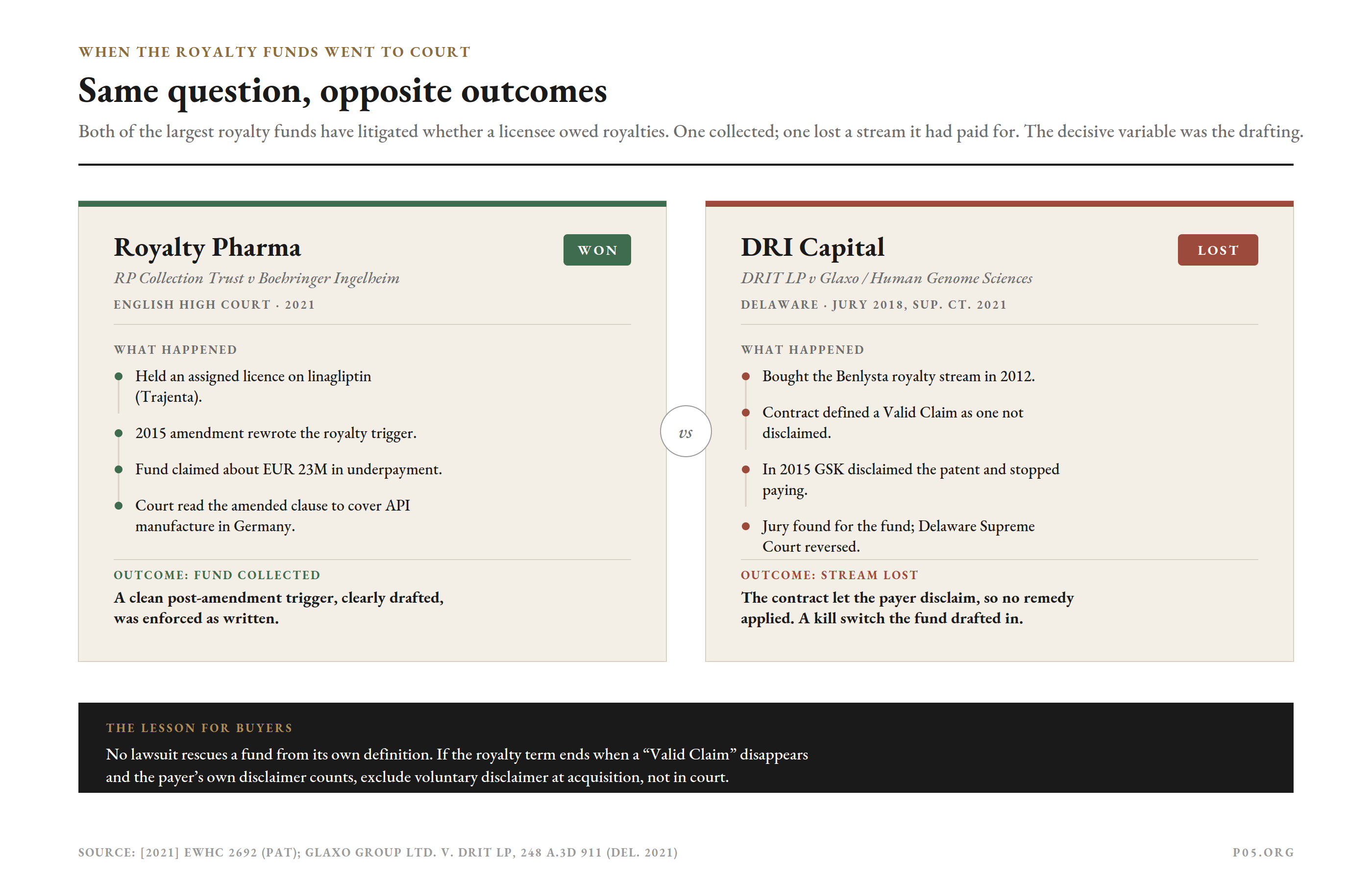
This is not theory. The two largest royalty funds, Royalty Pharma and DRI Capital, have each sued or been sued over whether a licensee owed royalties. One collected. One lost a stream it had paid for. The difference was the drafting, not the doctrine.
What it is, and what it is not
A declaratory judgment binds the parties on their legal rights but orders no coercive relief. It is codified at 28 U.S.C. § 2201: in a case of actual controversy, a federal court may declare the parties' rights, with the force of a final judgment.
The companion section, § 2202, supplies the teeth. Win a declaration, and if the loser does not comply you return for damages or an injunction. The sequence is deliberate: settle the legal question first, enforce only if needed.
Two features matter for royalty disputes.
It is preventative. You need not have breached, stopped paying, or been sued. You can ask the court to construe a net-sales definition, a patent's scope, a milestone trigger, or a surviving audit right before any payment is missed. That is the appeal: certainty on a multi-year cashflow without first wrecking the relationship.
It is discretionary. The statute says a court "may" declare rights, not "must." Even a perfectly valid filing can be turned away. That word is the hinge on which most contested motions turn.
One carveout to note. Section 2201 excludes federal taxes, some bankruptcy proceedings, and drug patents under the Hatch-Waxman framework. ANDA and biosimilar disputes run on their own track, a real boundary for any asset tied to a small-molecule or biologic patent.
The "actual controversy" threshold
Every declaratory action must clear one gate: an actual controversy. The phrase tracks Article III's case-or-controversy requirement. Fail it, and the suit is dismissed for lack of jurisdiction no matter how real the commercial fight feels.
The standard comes from MedImmune v. Genentech (2007), still the key authority here. The test: whether the facts, under all the circumstances, show a substantial controversy between parties with adverse legal interests, of sufficient immediacy and reality to warrant relief.
That is more permissive than the old rule. Before MedImmune, a licensee in good standing had no "reasonable apprehension of suit" and so could not challenge the patent it was paying for. MedImmune scrapped that. Now the question is only whether a real, immediate adverse interest exists.
The gate still has bite. In Mitek v. USAA (Fed. Cir., June 2025), the court held that merely knowing a patent exists, or fearing it, is not enough without some affirmative act by the patentee.
For royalty disputes the threshold is usually crossed by a single letter: a demand for royalties on a new product, a notice that a milestone has or has not triggered, a claim that a covenant is breached. That written assertion is what makes the controversy concrete.
The patent-license trilogy
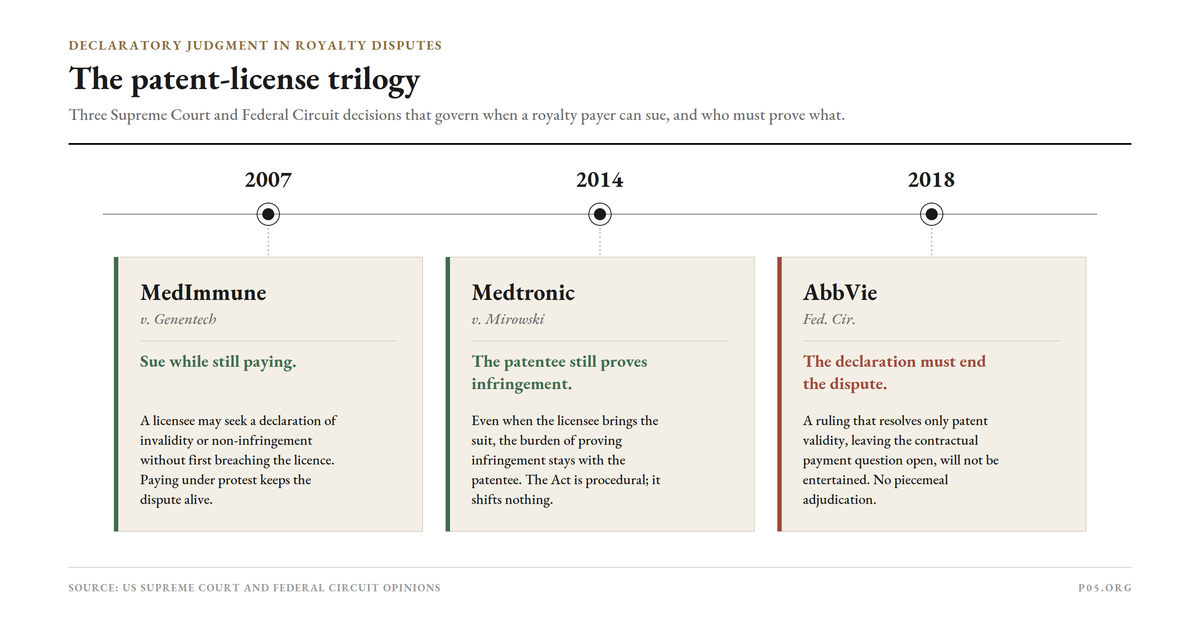
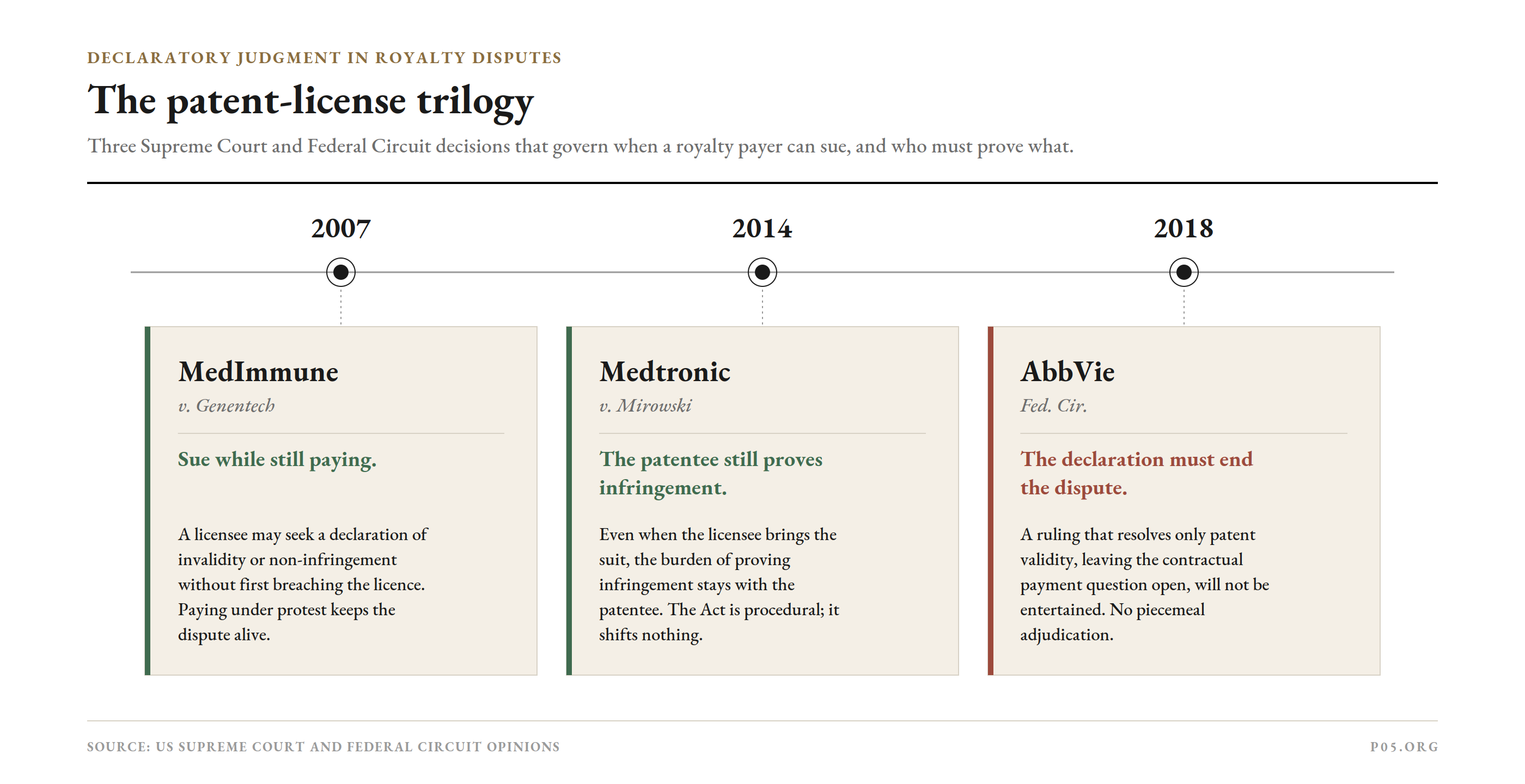
Three cases govern when the royalty rests on a patent licence. Together they answer two questions: can I sue without stopping payment, and who has to prove what.
| Case | Year | Holding for royalty disputes |
|---|---|---|
| MedImmune v. Genentech | 2007 | A licensee may sue for invalidity or non-infringement without breaching. Paying under protest keeps the dispute alive. |
| Medtronic v. Mirowski | 2014 | Even when the licensee sues, the patentee bears the burden of proving infringement. |
| AbbVie (Fed. Cir.) | 2018 | A declaration that resolves only patent validity, leaving the payment question open, will not be heard. |
MedImmune: sue while still paying. MedImmune paid Genentech royalties on Synagis. Genentech said a new patent, Cabilly II, covered the product and demanded more.
MedImmune faced a trap. Stop paying and risk a treble-damages suit and an injunction against a product worth 80%+ of its revenue. Or keep paying forever on a patent it thought worthless.
It found a third way: pay under protest, then sue for a declaration of invalidity. The Federal Circuit dismissed; the Supreme Court reversed. A licensee need not breach its licence first. Paying under coercion does not erase the controversy.
The result reset the leverage in every patent licence. The licensee no longer chooses between paying on a bad patent and risking ruin to challenge it.
Medtronic: the patentee still proves infringement. The open question after MedImmune was the burden of proof. When the licensee sues and the patentee cannot counterclaim for infringement, who proves what?
Medtronic paid disputed royalties into escrow and sued for non-infringement. The Federal Circuit shifted the burden to Medtronic; a unanimous Supreme Court reversed. The patentee bears the burden, exactly as in a normal infringement suit. The Act is procedural; it shifts nothing.
The escrow move is the template: pay in, preserve the licence, kill the threat of suit, keep the cash neutral until the court rules.
AbbVie: the declaration must end the dispute. A declaration that does not conclusively resolve the controversy will not be entertained.
In AbbVie, a patent holder tried to invalidate its own patent to end its royalty obligation. The court refused: even if invalid, it was an open question whether invalidity equalled expiration under the contract, so the payment dispute would survive. No piecemeal adjudication.
The lesson: aim the declaration at the obligation, not at one fact feeding it. This is exactly the maneuver in the DRI Capital case below, where the contract, not the doctrine, decided the outcome.
Contract claims: the larger, quieter category
The trilogy dominates the casebooks, but most real royalty disputes are contractual. Monetized streams live inside dense agreements whose payment mechanics, net-sales definitions, milestone triggers, and diligence covenants are far likelier to break than the patent is to fall.
Courts test these by asking what the mirror-image coercive suit would be. If the dispute is over the duty to pay, the mirror image is a contract claim, and contract disputes confer declaratory jurisdiction on their own.
They cluster around four pressure points:
| Dispute type | What is fought over | Why a declaration helps |
|---|---|---|
| Net-sales / calculation | Permitted deductions, which sales count, rebates and chargebacks | Construing the clause fixes the method for every future period, not just the arrears |
| Milestone trigger | Whether a defined event has occurred | The question is binary and recurring; one ruling settles it |
| Diligence / CRE | Whether the payor used commercially reasonable efforts | Isolates what the standard requires from the fact-heavy breach question |
| Covenant / impairment | Whether a planned amendment, termination, or transfer breaches a covenant | Rules on the conduct before it happens and value is lost |
Recent markers for three of these: the Permian Basin Royalty Trust calculation suit (settled August 2025, $9M); the VYNE / Tay milestone-trigger standoff (2025); and the Delaware Chancery Alexion CRE decision (September 2024), which read the efforts standard as objective.
Have the royalty funds actually litigated this?
Yes. Royalty finance is mostly quiet and settlement-driven, but the largest funds have gone to court as principals over exactly these payment questions. Three cases, three lessons.
| Fund | Matter | Forum / year | Core question | Outcome |
|---|---|---|---|---|
| Royalty Pharma | RP Collection Trust v Boehringer Ingelheim | English High Court, 2021 | Did the amended clause require royalties on API manufacture in Germany? | Fund won |
| DRI Capital | DRIT LP v Glaxo / Human Genome Sciences | Delaware, jury 2018; Sup. Ct. 2021 | Could the payor end royalties by disclaiming the patent? | Fund won at trial, lost on appeal |
| HealthCare Royalty | HCRx / Liquidia financing | Structured deal, 2023 | Not a dispute: tranches tied to third-party patent litigation | Priced around the risk, did not litigate |
Royalty Pharma v Boehringer: the fund as plaintiff on a net-sales question. Royalty Pharma held an assigned licence under which Boehringer paid royalties on linagliptin (Trajenta). A 2015 amendment changed the royalty clause, and its meaning became the fight.
The fund claimed about €23M in underpayment: after the amendment, royalties were due on manufacture of the API in Germany, not just on sales where a patent claim existed. Boehringer counterclaimed for overpayment.
The contract was German law, English jurisdiction, a useful structure to note for cross-border assets. The court held the amended clause covered the manufacturing act. Royalty Pharma won.
This is the textbook contract dispute: no validity question, just what the trigger language meant after an amendment, with every future period riding on the answer.
DRIT v GSK: the fund that won the jury and lost the contract. The most important fund case, because it is the AbbVie maneuver in practice: a payor ending royalties by disclaiming the patent.
The sequence:
- GSK and Biogen settled a patent interference in 2008; GSK paid Biogen royalties on Benlysta.
- The contract defined a "Valid Claim" as one not, among other things, disclaimed.
- In 2012, DRIT, a DRI Capital vehicle, bought the stream.
- In 2015, GSK filed a statutory disclaimer of the patent and stopped paying.
DRIT sued in Delaware. The contract claim was dismissed; the implied-covenant claim went to a jury, which found for DRIT in 2018.
Then the fund lost. In 2021 the Delaware Supreme Court reversed (Glaxo v. DRIT, 248 A.3d 911). Because the contract's own "Valid Claim" definition listed disclaimer as a terminating event, the agreement already addressed the conduct. No gap, so no implied covenant to fill it. GSK had a lawful right to disclaim and switch the royalty off.
The takeaway is blunt: no lawsuit rescues a fund from its own drafting. If the royalty term ends when a "Valid Claim" disappears, and the payor's own disclaimer counts, the payor holds a kill switch. The fix is a definitional carveout at acquisition, not litigation after.
HCRx / Liquidia: pricing around a dispute instead of litigating it. Not a dispute at all, which is the point. When HealthCare Royalty financed Liquidia in 2023, $35M of the funding was tied to the outcome of Liquidia's patent fight with United Therapeutics. The fund tranched around the risk and released capital as it resolved.
This is the normal response to a contested asset. Underwrite the dispute, structure the consideration in tranches or holdbacks, and let the milestone or the court resolve it without ever becoming a party. Litigated cases are visible because they are rare.
The composite lesson: funds do litigate payment disputes, they fight the same net-sales and royalty-term questions as everyone else, and the outcome turns on drafting, not on declaratory doctrine. One fund's loose "Valid Claim" definition cost it a stream; another's clear trigger language won.
Paying while the dispute is pending
The defining feature of a royalty dispute: payment does not pause for the court. Royalties accrue quarterly. A milestone demand does not wait. What you do with the money usually matters more than the legal question.
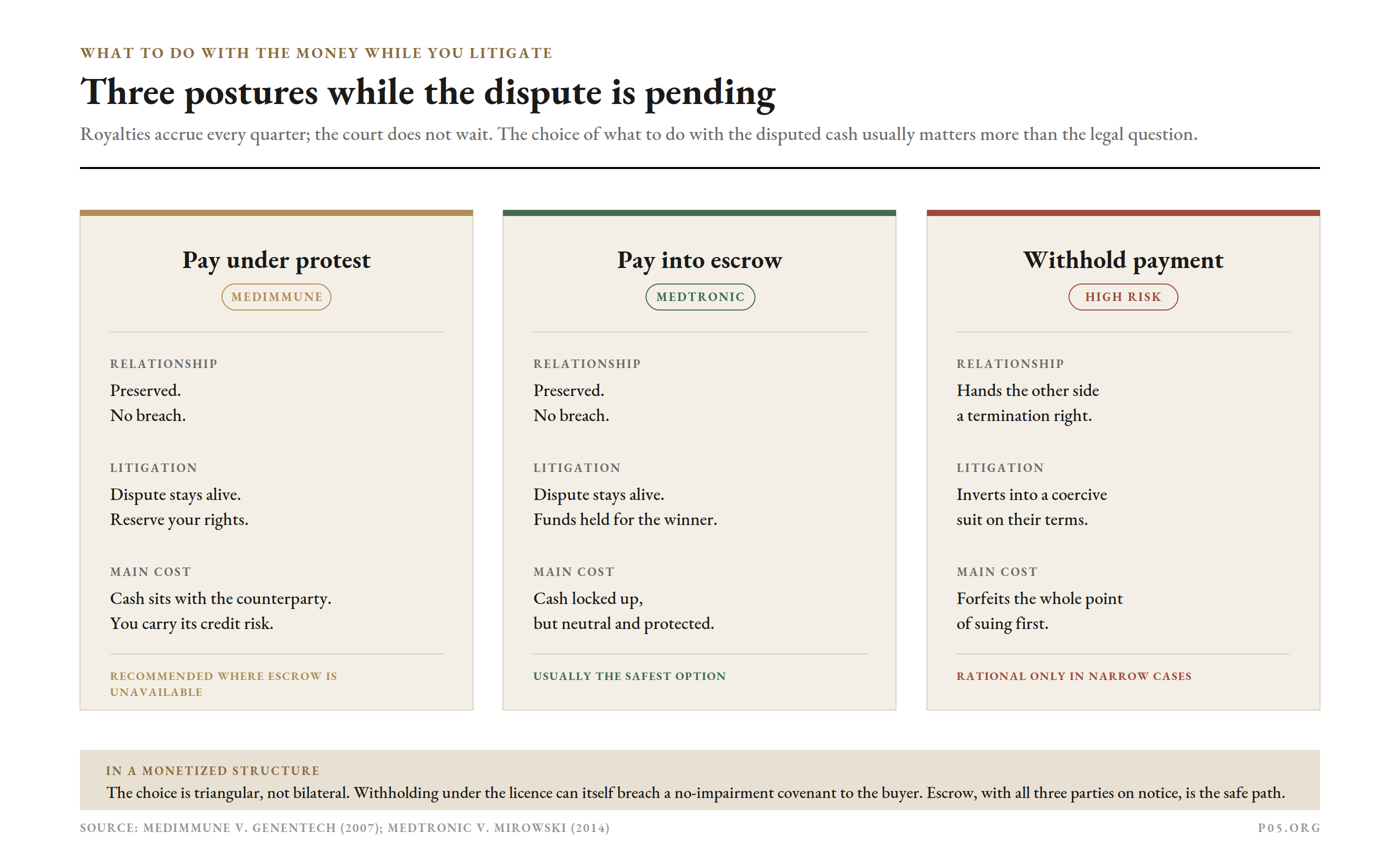
MedImmune and Medtronic set out the three postures.
| Posture | Relationship | Litigation | Main cost |
|---|---|---|---|
| Pay under protest | Preserved; no breach | Dispute stays alive (MedImmune) | Cash sits with the counterparty; you carry its credit risk |
| Pay into escrow | Preserved; no breach | Dispute stays alive (Medtronic) | Cash locked up but neutral; usually the safest |
| Withhold | Hands the other side a termination right | Inverts into a coercive suit on their terms | Forfeits the whole point of suing first |
Withholding is rational only in narrow cases: the contract expressly conditions payment on the disputed event, or the sums are huge and the counterparty's credit is weak. Otherwise it trades away every advantage.
In a monetized structure the choice is triangular, not bilateral. A seller who withholds under the licence while litigating may breach a no-impairment covenant to the buyer, getting hit from both sides. Escrow, with all three parties on notice, is almost always the safe path.
When courts decline to hear it
Jurisdiction is discretionary, so a valid filing can still be refused. For anyone deciding to file, this matters as much as the controversy threshold.
Anticipatory filing. The top reason for dismissal: the court sees a race to a friendly forum ahead of the natural plaintiff's suit. The first-to-file presumption is weaker for declaratory actions. A declaratory suit that is really just an affirmative defense to an imminent coercive suit is the classic target.
What courts punish:
- Filing within hours or days of a demand letter.
- Filing during settlement talks after the other side signals it will sue.
- Filing in a self-serving forum after professing willingness to negotiate.
The Federal Circuit has affirmed dismissals where the plaintiff exploited the patentee's restraint to file first. The mirror case, Harbor Freight (2025): not anticipatory where the plaintiff sued only after the patentee went silent for three months. Build a record of good-faith engagement before filing.
Parallel proceedings and partial declarations. Courts also decline where another suit resolves the matter more fully, or where the declaration would settle only part of it, the AbbVie problem again.
Arbitration clauses. The most decisive practical limit, and contractual. Many royalty agreements force arbitration. The Versamet royalty agreement is typical: any dispute over interpretation, breach, termination, or validity goes to a three-arbitrator panel. Where such a clause governs, the public declaratory remedy may be off the table entirely. Read the dispute-resolution clause first.
What this means for each party
Royalty holders. Where a payor reads the net-sales or reduction clause to suppress payment, a declaration construing it fixes the method for all future periods. Frame the request to dispose of the payment question, document good-faith efforts before filing, and check for an arbitration clause before assuming a court is available.
Licensees. You can challenge a patent, a charge, or a milestone without breaching. Keep performing, ideally into escrow, file for a declaration, and rely on the patentee or claimant carrying the burden. Escrow preserves the relationship and keeps you out of the defendant's chair.
Monetization buyers. If you suspect the seller will amend, terminate, or impair the licence, a declaration on the no-impairment and anti-amendment covenants can rule before value is lost.
But your leverage is contractual and indirect. The licence is between seller and licensee; your covenants run against the seller. Secure direct standing at closing, through a consent letter naming you as enforcer.
And remember DRIT: no remedy repairs a defective definition. Exclude voluntary disclaimer from the events that end the royalty term at acquisition, not in court.
Counsel. The remedy can be widened or shut off by drafting. Some licences now make filing a declaratory action a breach, or terminate on a reopened issue, to raise the cost of a post-MedImmune challenge. An arbitration clause moves everything private. Decide consciously which forum you want, and draft the no-challenge, escrow, and dispute-resolution provisions to match.
The verdict
The declaratory judgment action lets a party resolve a live royalty question before it becomes a missed payment, a dead licence, or a coercive suit on the other side's terms. Its value is structural: payment is continuing, disputes are recurring, and uncertainty on a multi-year cashflow is expensive.
On the central questions the doctrine is settled. Sue without breaching (MedImmune). The patentee proves infringement (Medtronic). The declaration must end the dispute, not one input to it (AbbVie). Pay into escrow while it runs.
The fund record proves the market is real. Royalty Pharma sued in London and collected. DRI Capital won a jury and lost the stream on appeal, because the contract let the payor disclaim the patent. The decisive variable was drafting, not remedy.
What stays contested is procedure: is the controversy ripe, is the filing an honest request or a forum race, and does the dispute belong in court at all or in arbitration. Those questions decide most royalty disputes, on facts of timing, conduct, and drafting rather than the merits.
So the conclusion is the same for everyone. Whether the declaratory remedy is available, where, and on what terms, is decided at signing, not at the dispute. The dispute-resolution clause, the no-challenge provision, the escrow mechanics, the buyer's standing: all locked in years before anyone files.
This article reflects publicly available information as of June 2026. It does not constitute investment, legal, or tax advice. The doctrines and mechanics described are derived from the federal Declaratory Judgment Act, reported US, English, and Delaware judicial decisions, SEC filings, and published legal analysis. Royalty holders, licensees, monetization buyers, and counsel evaluating specific disputes should rely on the underlying contracts, the governing law of the relevant jurisdiction, and qualified counsel. The author is not a lawyer or financial adviser.