The Drug Patent Troll: Why the NPE Model Never Worked in Pharma
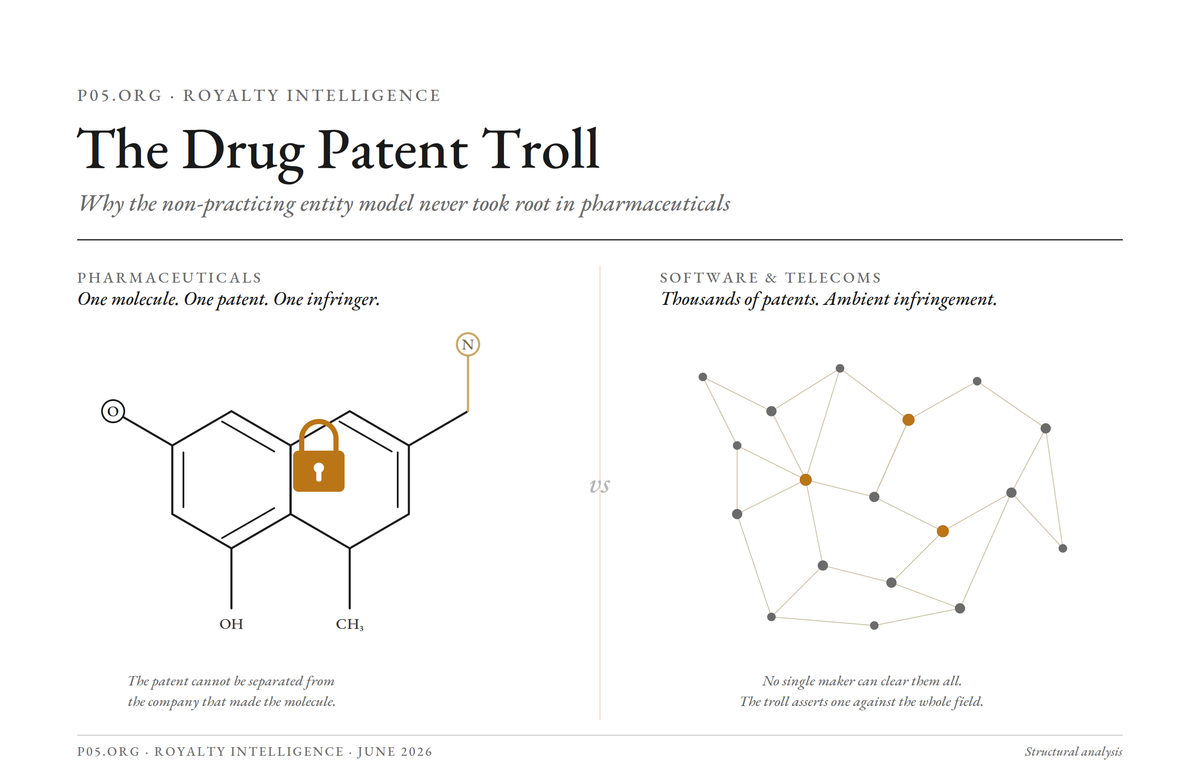
One patent covers one product. The only infringer is the company that deliberately made it. That structural fact makes pharmaceutical molecules almost impossible to troll — and explains why every attempt has failed.
InterDigital generated $834 million in revenue in 2025 from patents it uses only to license. NTP Inc. had no employees and collected $612.5 million from Research in Motion without shipping a device. Acacia Research built a listed company around the same model. None of this happened in pharmaceuticals at the core of the IP stack. This piece explains the structural reasons, maps the jurisdictional picture across the US, EU, China, Japan, and Korea, and identifies where something resembling the NPE model might yet work at the margins.
The short version
- The NPE model needs three things: many uninformed infringers, a credible injunction threat, and low discovery costs. Software and wireless standards provide all three. Pharmaceutical molecule patents provide none.
- In pharma, the primary composition-of-matter patent covers one molecule, made by one company that cleared the patent before committing to clinical development. There is no ambient infringer to surprise.
- In the US, the Hatch-Waxman 30-month automatic stay — the weapon that gives pharmaceutical patent enforcement its commercial force — is locked to the NDA holder. An NPE holding the same patent cannot access it.
- eBay v. MercExchange (2006) removed the automatic injunction for non-practicing entities in US courts. A pharma NPE cannot show irreparable market harm if it has no market. Result: damages only, no ability to block generic entry.
- In Germany, NPEs win infringement findings in 62% of cases versus 27% in the US, and the automatic injunction survived the 2021 Patent Act reform. The UPC, live since June 2023, makes pan-European assertion cheaper. But no EU patent linkage equivalent exists, and the SPC requires the marketing authorisation holder — not a third party.
- China introduced patent linkage in July 2021 under Article 76 of the amended Patent Law, with a 9-month stay triggered by filing at the Beijing IP Court or CNIPA. The stay requires the marketing authorisation holder to hold the listed patent. A third-party NPE cannot list and cannot trigger it.
- Japan's linkage is non-statutory, operated through MHLW administrative guidance with no public patent register, no statutory stay, and injunctions mandatory post-judgment. Korea's K-Hatch-Waxman gives a 9-month sales ban, also locked to the Green List holder.
- Three real attempts: Kyle Bass's Coalition for Affordable Drugs filed 36 IPR petitions against 16 companies, achieved a ~6% full-invalidation rate, and abandoned the campaign under political pressure. Allergan transferred Restasis patents to the St. Regis Mohawk Tribe to block PTAB review — the patents were invalidated in district court anyway. Both failed for structural reasons.
- The viable NPE surface in pharma is peripheral: delivery device technology, API process patents, and the fast-growing diagnostics and digital therapeutics layer, where the patent landscape looks like software.
- The royalty financing market — $6.5 billion in 2025 disclosed volume — is the working functional analog: non-operating entities holding pharmaceutical cash flows cooperatively, with the originator retaining all the regulatory leverage.
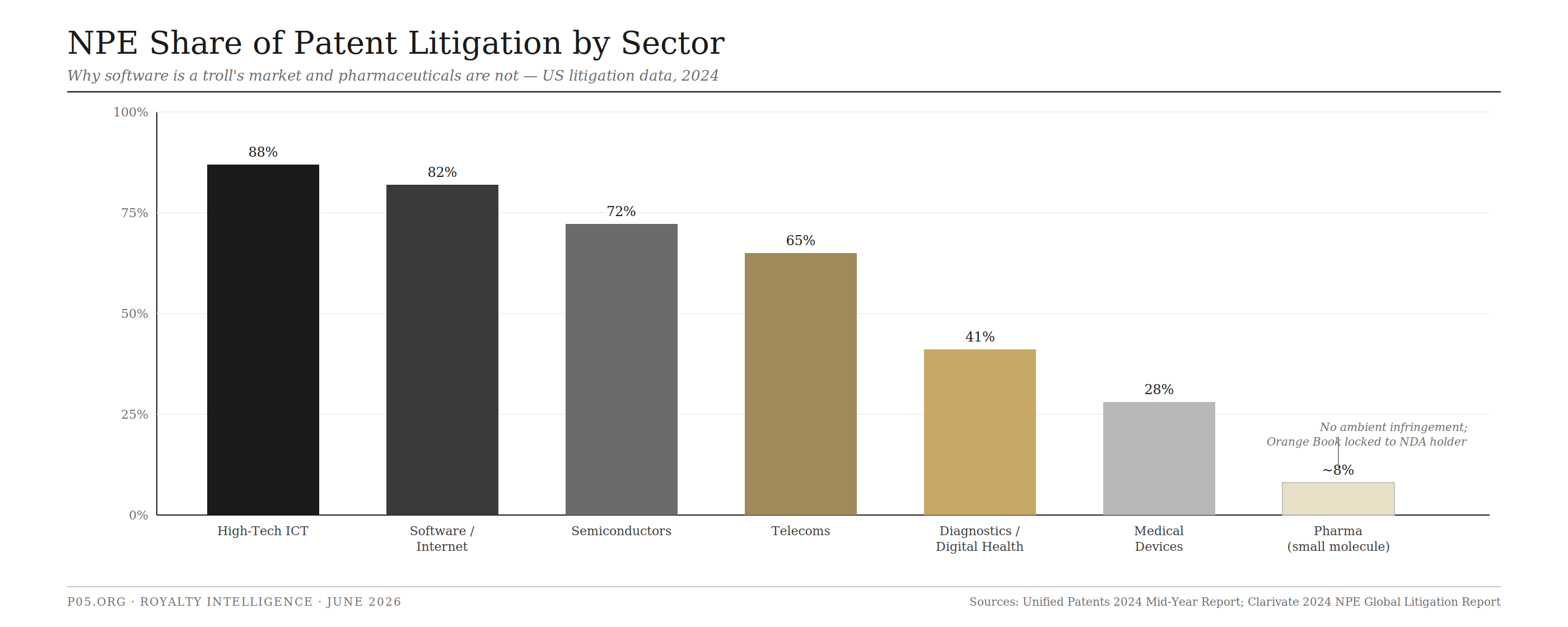
Why the model works in software and telecoms
NTP Inc. had no employees. It held wireless email patents developed in the early 1990s and sued Research in Motion in November 2001. A jury found infringement. The trial judge ordered a permanent injunction that would have shut down the entire BlackBerry service in the US. With that threat credible and its appeals exhausted, RIM paid $612.5 million in March 2006 for a full licence.
What made NTP's leverage work was fragmentation: every wireless email product in the country had independently converged on the same design without knowing NTP's patents existed. The same logic explains InterDigital, which holds over 33,000 patents on cellular standards that every smartphone manufacturer is obliged to implement. Roughly 85% of smartphones shipped in 2025 operated under InterDigital licences or faced litigation.
The NPE model has three prerequisites: a patent covering technology that a large population adopted without knowing the patent existed, an injunction threat large enough to force settlement without a merits fight, and discovery costs low enough that letters to hundreds of defendants are profitable. NBER research found a one-standard-deviation increase in a firm's cash holdings roughly doubles its probability of being targeted — the mechanism is extraction, not merit.
None of these prerequisites hold for pharmaceutical molecule patents.
The three structural brakes
1. Composition of matter: no ambient infringement
A smartphone may be covered by thousands of patents, many unknown to its maker. A pharmaceutical drug is typically protected by one primary patent naming a specific molecular structure. The only infringer is the company that deliberately synthesised or imported that compound. That company conducted freedom-to-operate analysis before committing to Phase I. By the time a molecule reaches commercial scale, every rational competitor either holds a licence or has challenged the patent at the PTAB or in district court.
Harvard Law's Nicholson Price and Robin Feldman identified university patent portfolios as a reservoir of potentially assertable claims, covering active ingredients, dosage forms, and screening methods. Their point holds for the secondary layers. For the primary composition-of-matter claim on an approved molecule, the conventional wisdom stands: the patent is cleared, licensed, or already in litigation.
2. Orange Book / Hatch-Waxman: locked to the NDA holder
The 30-month automatic stay triggered by a Paragraph IV certification is the commercial centrepiece of US pharmaceutical patent enforcement. When a generic files an ANDA and certifies invalidity or non-infringement, that certification is defined by statute as an act of patent infringement, giving the NDA holder an immediate cause of action before any product enters commerce. Filing suit within 45 days triggers an automatic stay on FDA approval for 30 months — no court order required.
This mechanism is what makes AbbVie's 130-patent thicket around Humira rational. AbbVie filed over 130 patents on Humira — 90% after approval — delaying biosimilar entry until 2023, seven years past the original compound patent's expiry, and earning an estimated $114 billion in incremental revenue in that window.
The catch: the stay is only available to the NDA holder. A third-party NPE holding the same patent cannot list it in the Orange Book, cannot trigger the 30-month stay, and must enforce it in ordinary federal court litigation — without the structural leverage that defines pharmaceutical patent enforcement.
3. Post-eBay injunction: no market, no irreparable harm
eBay v. MercExchange (2006) removed the automatic injunction from US patent law, requiring courts to weigh the traditional four-factor equitable test. Courts routinely deny injunctions to non-practicing entities: without a competing product, there is no market share to erode and no price to protect, so irreparable harm cannot be shown.
Branded drug companies facing generic entry regularly obtain preliminary injunctions because irreparable harm is demonstrable — price erosion is immediate and partially unrecoverable. A pharma NPE asserting the same patent cannot make those arguments. No product, no market, no injunction. The result is damages only, and a generic that launches at risk and pays damages often still profits from the launch period.
The jurisdiction map
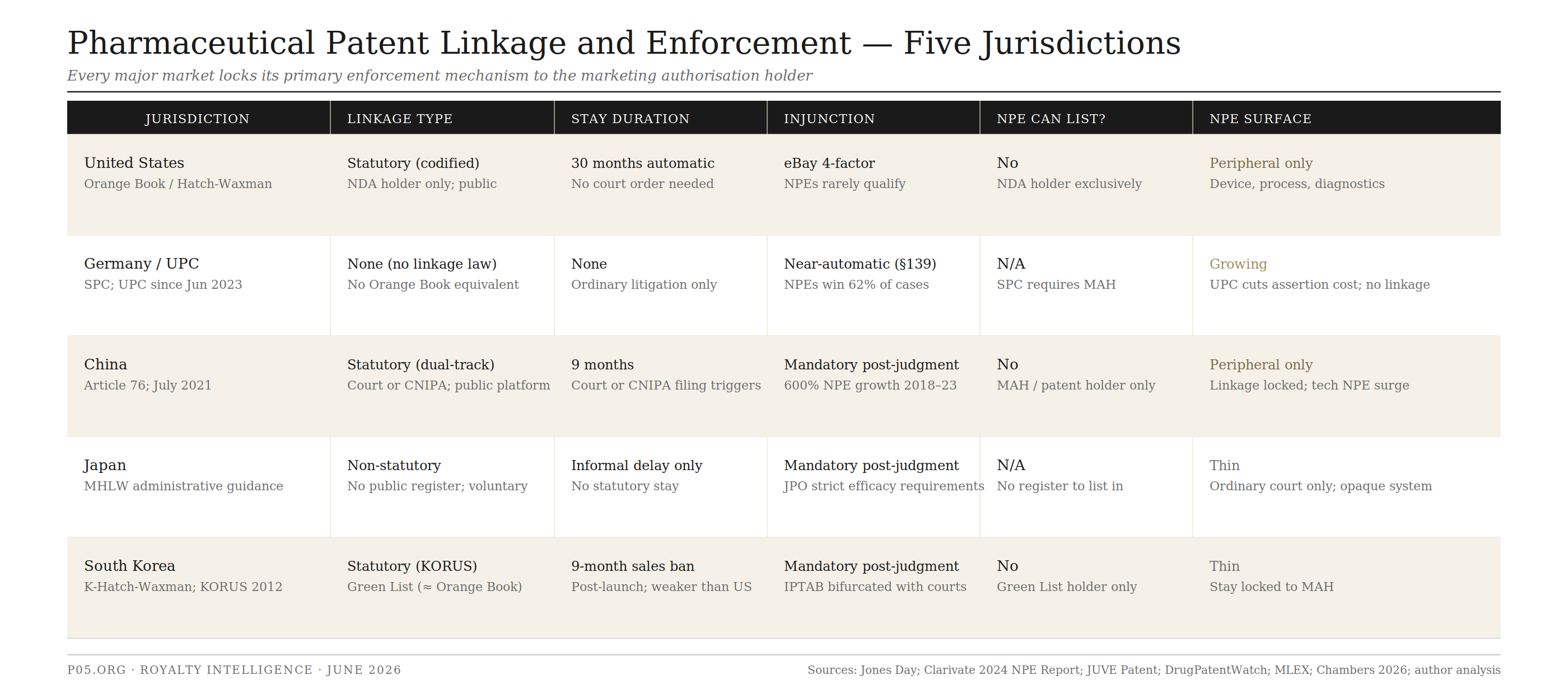
The three US brakes operate together. Across other major markets the individual rules differ, but the conclusion is the same: every jurisdiction locks its primary pharmaceutical enforcement mechanism to the marketing authorisation holder.
| Jurisdiction | Patent linkage | Stay duration | Injunction standard | NPE can list? | NPE surface |
|---|---|---|---|---|---|
| United States | Statutory (Orange Book) | 30 months automatic | eBay 4-factor; NPEs rarely qualify | No — NDA holder only | Peripheral only |
| Germany / UPC | None | None | Near-automatic (§139 PatG) | N/A — no linkage | Growing; UPC expands reach |
| China | Statutory (July 2021) | 9 months (court or CNIPA) | Mandatory post-judgment | No — MAH / patent holder only | Peripheral only |
| Japan | Non-statutory (MHLW guidance) | Informal delay only | Mandatory post-judgment | N/A — no public register | Thin |
| South Korea | Statutory (KORUS, March 2012) | 9-month sales ban | Mandatory post-judgment | No — Green List holder only | Thin |
| United Kingdom | None (no linkage law) | None | Discretionary (balance of convenience) | N/A | Low-moderate |
EU and the UPC
Europe has no pharmaceutical patent linkage equivalent. A generic company can obtain marketing authorisation in the EU before resolving the relevant patent dispute. The Supplementary Protection Certificate extends protection up to five years past the base patent, but requires the marketing authorisation holder or its consent — a third-party NPE cannot hold an SPC on a product it never sought approval for.
Where Europe differs sharply from the US is injunctions. Germany retains a near-automatic injunction under §139 PatG even after the 2021 reform. The Clarivate 2024 NPE Global Litigation Report found NPEs win infringement findings in 62% of German cases, versus 27% in the US. The UPC, live since June 2023, reduces the cost of pan-European assertion. In its first year, NPEs initiated 13% of all cases, rising to 24.6% in the second half and 43% in electrical engineering. No pharma-specific equivalent has materialised, but peripheral device and formulation patents are viable targets in this environment.
China
China introduced pharmaceutical patent linkage in July 2021 via Article 76 of the Fourth Amendment to the Patent Law. Under the dual-track system, a patent holder can file at the Beijing Intellectual Property Court or seek administrative adjudication at the CNIPA within 45 days of a Type IV declaration by a generic applicant. Filing triggers a 9-month stay of NMPA approval. A first-generic challenger that succeeds receives 12 months of market exclusivity. The system explicitly covers chemical drugs, biologics, and traditional Chinese medicine.
The Clarivate 2024 report found a 600% increase in NPE litigation in China from 2018 to 2023, with China now third globally after the US and Germany. But the NPE surge in China is concentrated in technology and semiconductor patents — the same fragmented-infringer dynamic that drives US tech NPEs. The pharmaceutical linkage registration platform is locked to the marketing authorisation holder by the same logic as the US Orange Book: you cannot list a patent on a product you did not seek approval for. The Chinese 9-month stay, like the US 30-month stay, is inaccessible to a third-party NPE.
Japan
Japan's linkage is non-statutory and administratively operated. The PMDA informally delays generic approval when an active patent is asserted, but there is no public patent register and no codified stay period. A patent holder must submit a voluntary Pharma Patent Information Sheet to the MHLW; the JPO has strict pharmacological efficacy requirements at filing — experimental data demonstrating efficacy must be included at the time of application, not post-filed. This makes it harder to hold broad claims than in the US or China. Injunctions are mandatory post-judgment. An NPE asserting pharmaceutical patents in Japan operates through ordinary district court litigation with no administrative enforcement backstop.
South Korea
Korea introduced K-Hatch-Waxman under KORUS FTA in March 2012: a Green List analogous to the Orange Book, a 9-month prohibition on sales (weaker and post-launch relative to the US 30-month pre-approval stay), mandatory injunctions, and 9-month first-generic exclusivity that has created a rush-to-file phenomenon where generic companies simultaneously challenge patents at the IPTAB. The Green List is held by the marketing authorisation holder. An NPE cannot list and cannot trigger the sales ban.
The three attempts that came closest
Kyle Bass and the Coalition for Affordable Drugs
Beginning February 2015, Kyle Bass filed inter partes review petitions against pharmaceutical company patents through the Coalition for Affordable Drugs while shorting those companies' stocks — what he called an "activist short" strategy. His first target was Acorda Therapeutics; its stock fell nearly 10% the day the petition was filed.
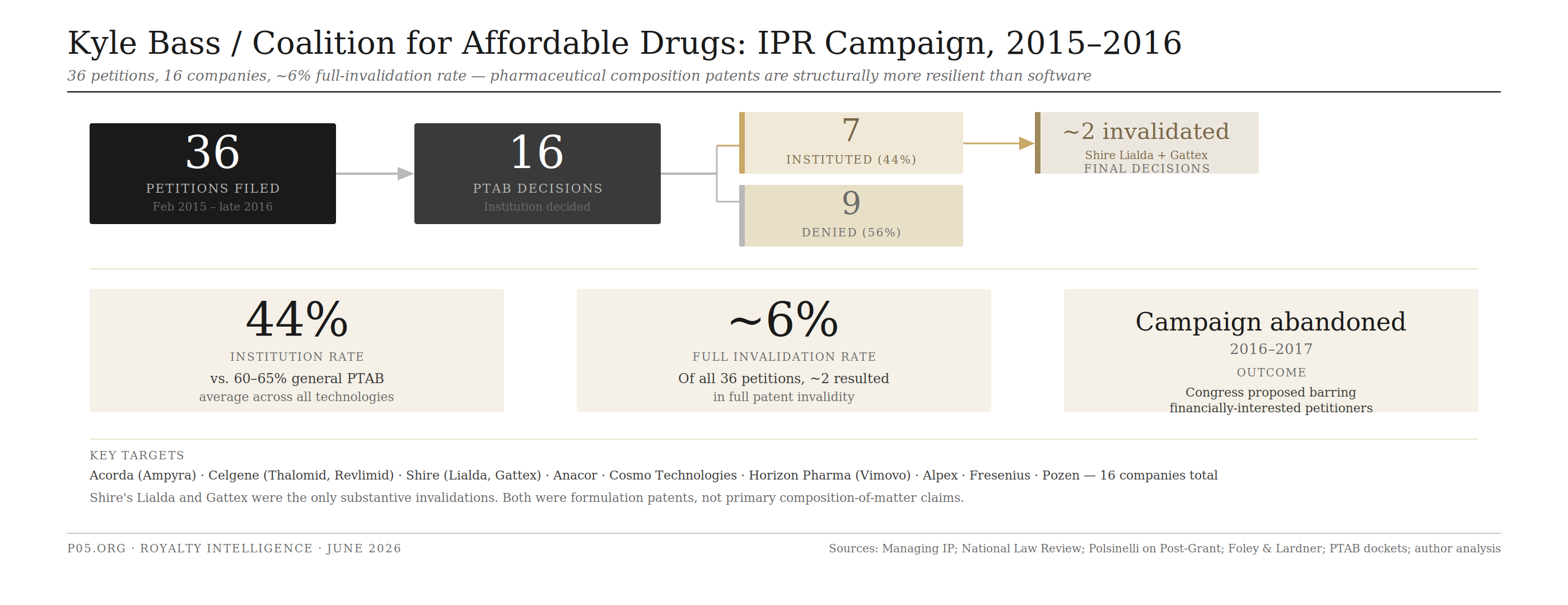
The results against pharmaceutical composition-of-matter patents were poor for structural reasons: the prior art universe for drug molecules is smaller and more precisely defined than for software, and obviousness cases require expert chemistry testimony rather than a Google search.
| Metric | Result |
|---|---|
| Total petitions filed | 36 |
| Companies targeted | 16 |
| Institution decisions made by PTAB | 16 |
| Petitions instituted | 7 (44%) |
| Full invalidity findings | ~2 (Shire Lialda, Shire Gattex) |
| Effective full-invalidation rate | ~6% of all petitions |
| General PTAB institution rate (all tech) | ~60–65% |
| Campaign outcome | Abandoned 2016–2017; Congress proposed barring financially-interested petitioners |
Celgene filed for sanctions. The PTAB declined but signalled awareness. Bass abandoned the campaign. Pharmaceutical composition-of-matter patents are structurally more resilient to IPR challenge than software patents.
Allergan and the St. Regis Mohawk Tribe
In September 2017, Allergan assigned six Orange Book-listed Restasis patents to the St. Regis Mohawk Tribe and licensed them back for $15 million per year. The strategy: invoke the Tribe's sovereign immunity to force dismissal of the 18 pending IPR proceedings from Mylan, Teva, and Akorn. The Tribe held the patents but Allergan continued every operating function.
It failed at every level:
| Event | Date | Outcome |
|---|---|---|
| Texas district court trial | Oct 2017 | 4 of 6 Restasis patents invalidated as obvious |
| PTAB sovereign immunity motion | Feb 2018 | Denied — immunity cannot block PTAB review |
| Federal Circuit appeal | Jul 2018 | Upheld PTAB; tribal immunity not applicable |
| Supreme Court petition | Apr 2019 | Certiorari denied |
The episode illustrates the core structural point. The Allergan-Tribe arrangement transferred the paper but not the regulatory relationship. Every commercial mechanism that made those patents valuable — the Orange Book listing, the 30-month stay, the Hatch-Waxman litigation rights — flowed from Allergan's NDA, which never moved. A holding entity without the NDA cannot replicate those entitlements regardless of what it holds on paper.
The NPE viable surface in pharma
The structural barriers above apply to the primary composition-of-matter layer. They apply less forcefully to the secondary and tertiary IP rings. A map of viability by asset class:
| Asset class | NPE viable? | Key constraint | Best jurisdiction |
|---|---|---|---|
| Composition-of-matter (approved molecule) | No | Orange Book NDA-locked; eBay blocks injunction | Nowhere |
| Method-of-use (licensed indication) | Marginal | §101 risk post-Alice; cleared at licensing stage; Hikma v. Amarin pending | US (marginally) |
| Formulation / delivery device | Partially | No 30-month stay; reasonable royalties only; broader target population | EU / UPC |
| API manufacturing process | Partially | §271(g) import enforcement; niche manufacturing contexts | US, EU |
| Diagnostics / digital therapeutics | Yes | Tech NPE model applies; fragmented patent ownership | US, EU, China |
| Abandoned / expired drug IP | Minimally | Post-Alice §101 risk; small damages base | Limited |
The Hikma v. Amarin case, argued at the Supreme Court on April 29, 2026, will clarify whether method-of-use patents can be enforced based on non-label marketing conduct when the generic's label carves out the patented indication entirely. A ruling favouring Amarin would modestly strengthen method-of-use patents as standalone assets — the most plausible primary-layer NPE target, and one where the UPC's lack of linkage makes European assertion more viable than the US.
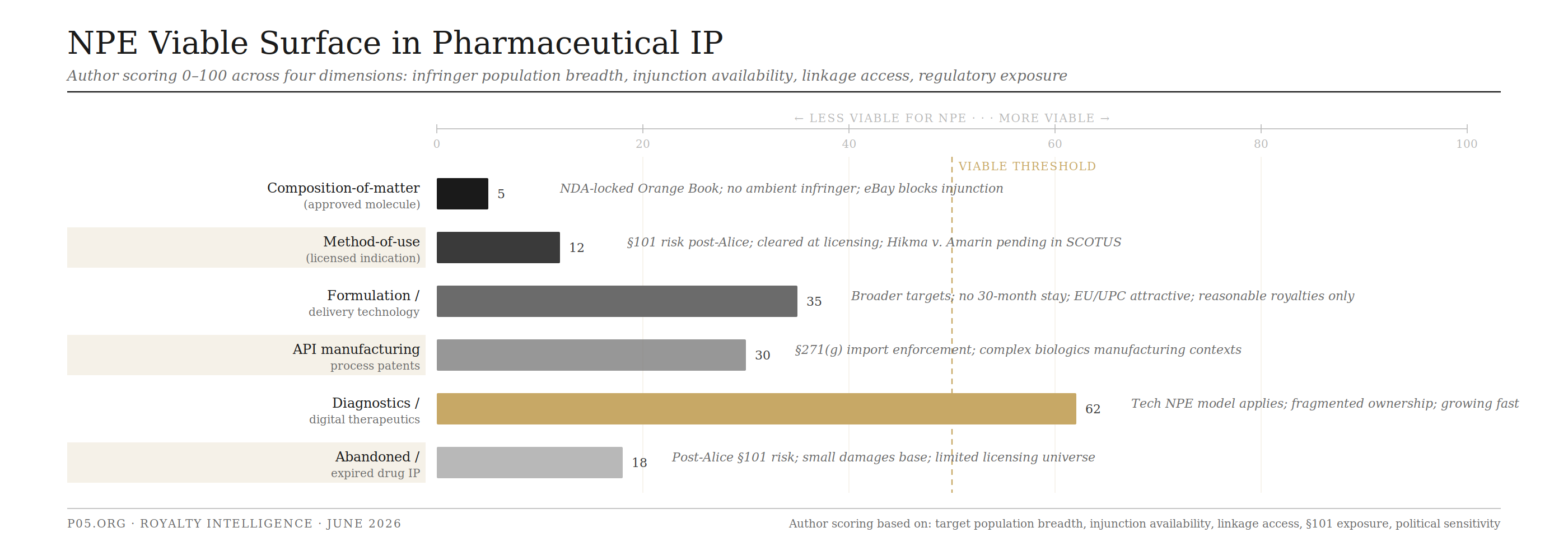
The EU and China are the jurisdictions where peripheral pharmaceutical NPE activity is most likely to grow: Germany and the UPC for the automatic injunction and lower multi-country assertion costs, and China for its 600% NPE litigation growth and improving IP enforcement, though the pharmaceutical linkage system remains locked to the MAH.
The royalty financing market as the working analog
There is one non-operating pharmaceutical IP holding model that works at scale. It is not assertion; it is cooperation.
The pharmaceutical royalty financing market reached approximately $6.5 billion in disclosed deal volume in 2025, with synthetic royalty CAGR above 30% since 2020. Royalty Pharma, HCRx, Sagard Healthcare, and a growing cohort of funds hold economic interests in pharmaceutical revenues without manufacturing. They are, in the definitional sense, non-practicing entities.
The critical difference from the NPE assertion model is the structure: a royalty financier acquires a contractual right to a percentage of revenues in exchange for upfront capital, negotiated cooperatively with the originator. The originator retains the NDA, the Orange Book listings, the SPC filings, the regulatory relationships, and the sales force. The financier holds a cash flow, not a patent. The 30-month stay, the Hatch-Waxman litigation, the patent challenge risk — all remain the operating company's responsibility.
This model works precisely because it does not try to replicate the assertion logic. It answers the same economic question — how do you hold pharmaceutical IP as a financial instrument without owning a drug company? — by avoiding every structural barrier the assertion model runs into.
The verdict
The pharmaceutical patent troll as a systematic model analogous to InterDigital does not exist, and the conditions for it to emerge at the core of pharmaceutical IP are absent in every major jurisdiction. The composition-of-matter patent cannot be separated from the operating relationship that gives it commercial force. In the US, that relationship is the NDA and the Orange Book. In China, it is the NMPA marketing authorisation and the CNIPA registration platform. In Korea, it is the Green List. In Japan, it is the MHLW information sheet. In the EU, it is the marketing authorisation required to hold an SPC.
What grows at the periphery — delivery device technology, diagnostic software, digital therapeutics, manufacturing process patents — increasingly looks like the tech NPE problem, and will attract tech-style assertion entities. The UPC makes European assertion meaningfully cheaper. China's growing NPE population will eventually find pharmaceutical-adjacent technology claims to assert. The secondary ring will see more activity.
The core will not. A pharmaceutical NPE holds a piece of paper whose value depends entirely on relationships it cannot acquire.
All information in this report was accurate as of the research date and is derived from publicly available sources including court opinions, regulatory guidance, academic literature, SEC filings, and financial news reporting. Information may have changed since publication. This content is for informational purposes only and does not constitute investment, legal, or financial advice. The author is not a lawyer or financial adviser.