
No leverage: negotiating royalty terms from a position of weakness

Every royalty negotiation is conducted against a clock, and in most of them only one side can see it. In this one both sides can, because the seller filed it.
The CFO guide on this site set out when royalty capital is the right instrument by development stage and what a well-structured deal looks like. This piece assumes that analysis has already been done, produced the answer that royalty capital is expensive, and been overtaken by events. The company needs the money, the alternatives have closed, and the counterparty knows it. What follows is about what can still be moved in that position, and what cannot.
1. Your position is a filed document
A US-listed biotech must assess whether substantial doubt exists about its ability to continue as a going concern for twelve months from issuance, and disclose the conclusion. Runway guidance appears in the earnings release. Remaining ATM capacity is in the prospectus supplement. Committed facility drawdowns and covenant levels are in the credit agreement exhibit. Burn is derivable from the cash flow statement.
The practical consequence is that the buyer arrives at the first meeting already knowing the latest date on which the seller can walk away, and the seller does not know the buyer's alternatives at all. Nothing in the negotiation restores that symmetry. Recognising it early is what separates a bad deal from a disorderly one.
The population in this position is large. EY's 2026 report found that 33 percent of public US and EU biotechs had less than one year of cash runway at the end of 2025, down from 39 percent in 2024, though the universe itself had fallen from 977 companies in 2021 to 758. EY's own leadership cautioned that the improvement partly reflects companies leaving the sample rather than repairing their balance sheets.
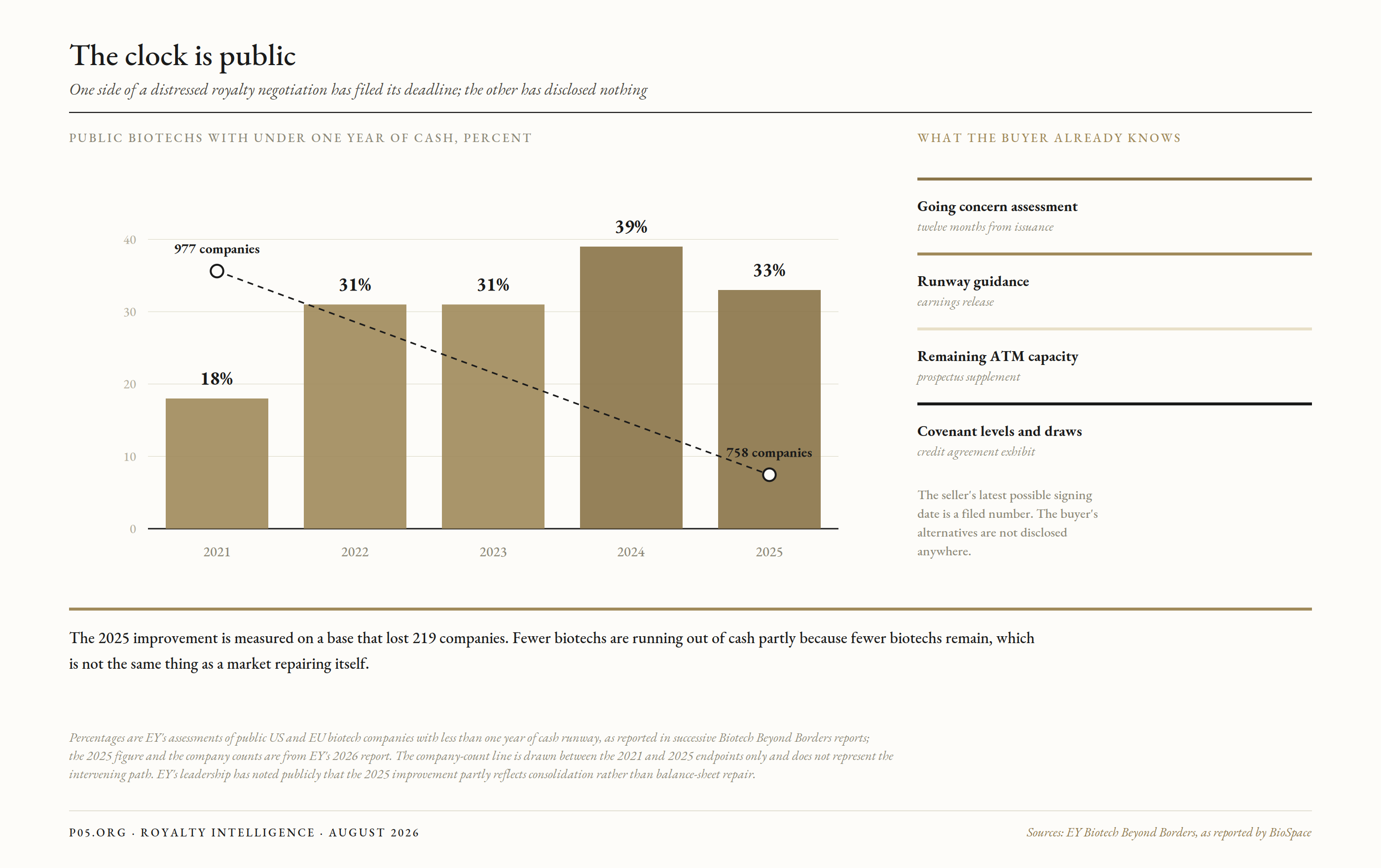
Figure 1. The share of public biotechs with under a year of cash, against a shrinking universe. The 2025 improvement is measured on a base that lost 219 companies since 2021, so the count of companies in distress fell by less than the percentage suggests. Figures are EY's, on public US and EU biotechs.
2. What the market will actually fund in August 2026
Before negotiating, establish whether there is a market for the position at all. Two 2026 studies answer this precisely, and the answer excludes a large share of the companies that seek royalty capital when distressed.
Gibson Dunn's 2026 market update covers 133 life sciences royalty transactions from 2020 through 2025 totalling USD 32.7 billion, with deal count stabilising at 25 to 27 per year from 2023 onward and median deal size trending up to USD 221 million in 2025. Twenty-six deals a year is the whole market. A company seeking USD 20 million is not competing for a slot in it; it is asking a different industry for money, which is the buyer segment mapped previously on this site at the sub-USD 50 million end rather than the aggregators whose names appear in the press releases.
Covington's fourth annual study, published June 2026 and covering 2019 through 2025, adds the harder constraint. No deals in 2025 were funded with respect to products that had not yet completed Phase III trials, and the market has coalesced around a minimum level of bankruptcy protection in the form of security interests over intellectual property and other product assets, though one investor was willing to be unsecured in 2025.
Read together: if the asset has not completed Phase III, the synthetic royalty market did not fund a single comparable transaction last year. A distressed Phase 2 company approaching royalty investors is not negotiating from weakness. It is in the wrong conversation, and the three months spent discovering that are three months of runway. Establishing eligibility before establishing terms is the highest-return hour in the process.
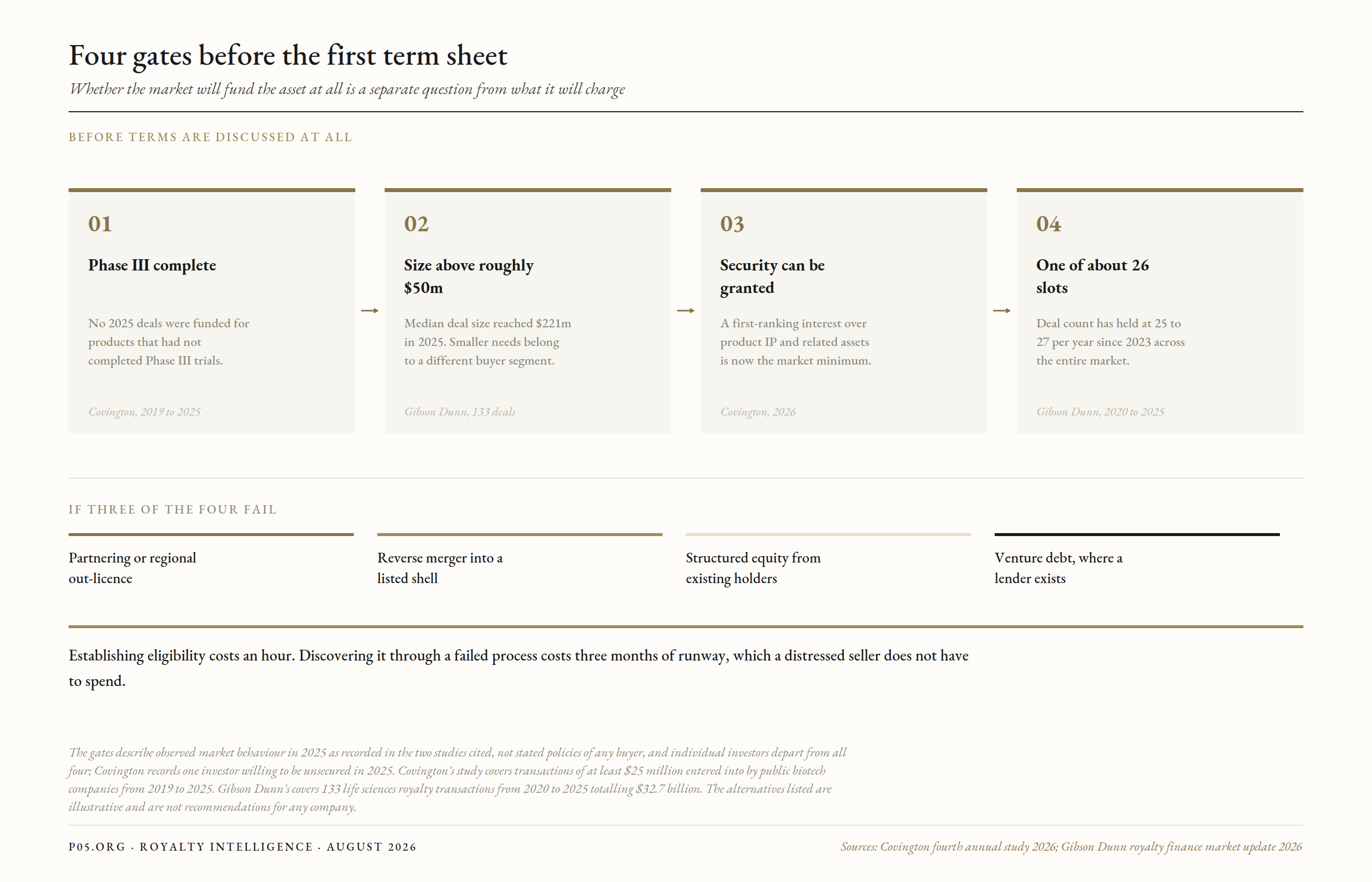
Figure 3. Four gates before terms are discussed at all. Each reflects observed 2025 market behaviour rather than a stated policy, and individual buyers depart from all of them, but a seller failing three of the four should reallocate its time.
3. The buyer is also choosing, and mostly says no
Weakness is usually framed as a problem of price. It is more accurately a problem of access, because the constraint on the other side is not capital but underwriting capacity, and the queue is long.
Start with the arithmetic. Around 250 public biotechs have under a year of cash, on EY's percentage applied to its own company count. The market completes 25 to 27 royalty transactions a year in total. That ratio would be discouraging even if the slots were reserved for companies in difficulty, and they are not.
Look at who took them. Royalty Pharma's 2026 counterparties include a USD 500 million research and development co-funding agreement with Johnson & Johnson across 2026 and 2027 and an arrangement of up to USD 500 million with Teva. A distressed small-cap is not competing against other distressed small-caps for royalty capital. It is competing against Johnson & Johnson, which is using the same instrument as a portfolio management tool and presents none of the counterparty risk.
The selectivity is visible in the buyers' own disclosure. DRI Healthcare has told the market it holds a fully funded USD 800 million to USD 1 billion investment plan for 2026 through 2030 against a pipeline of roughly USD 3 billion. That is an intention to fund something on the order of a third of a pipeline the firm has already curated, over five years. The screen a seller has to pass is not the one applied at the term sheet. It is the one applied before the first call is returned.
The buyer map on this site sets out which archetype plays at which stage and cheque size, and getting that match right is the difference between a process and a wasted quarter. The point here is narrower and less comfortable: even a correctly targeted approach is being declined most of the time, and a seller reading a slow response as negotiating tactics is usually reading a queue.
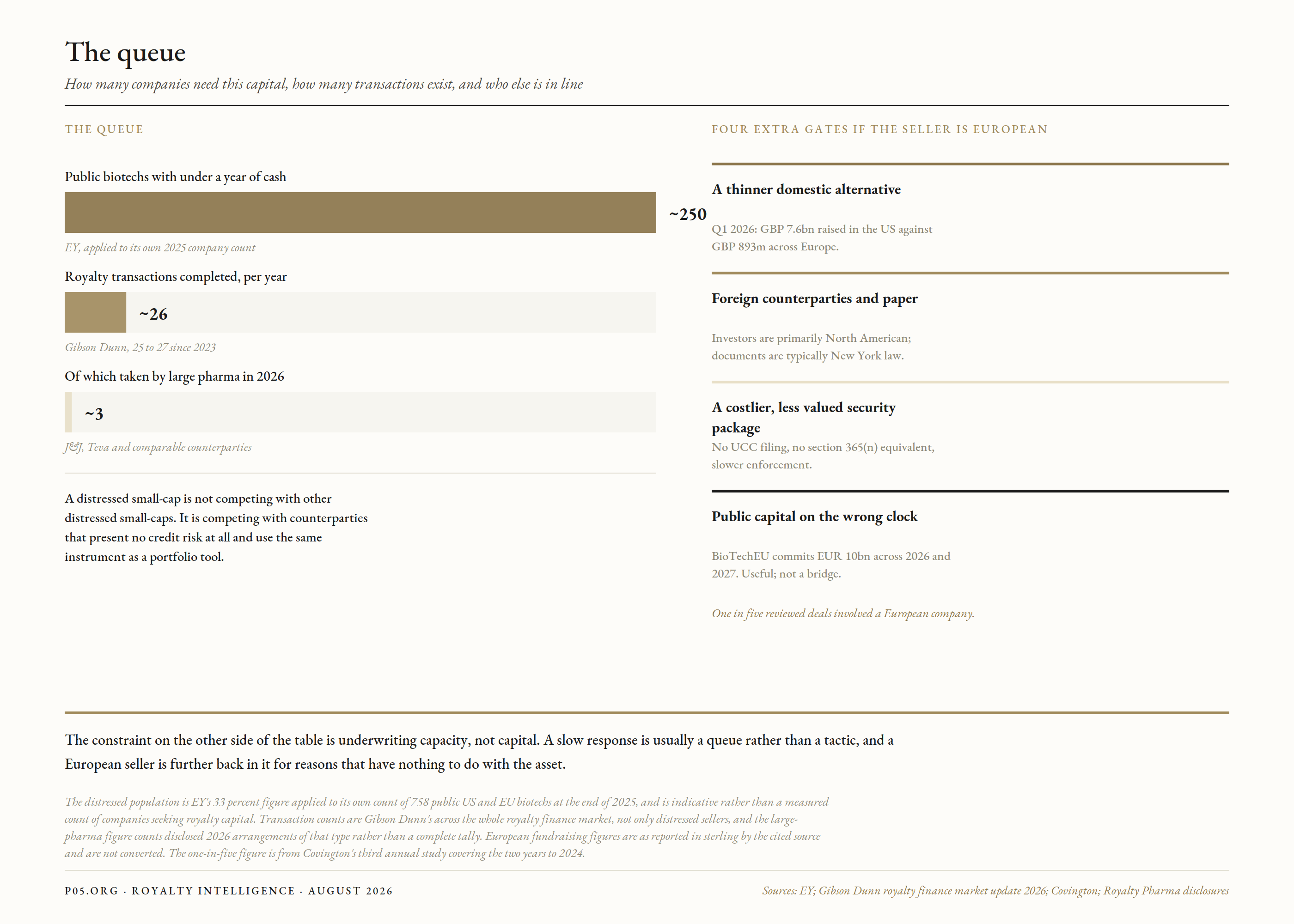
Figure 4. The queue, and the additional gates for a European seller. The left panel sets the population needing capital against the number of transactions the market completes, and against the calibre of counterparty competing for the same slots. Population and slot counts are from separate sources and are indicative rather than a matched sample.
4. If the company is European
Roughly one in five of the synthetic royalty deals Covington reviewed in the two years to 2024 involved European companies, so the instrument travels. What does not travel is everything around it, and four differences matter when negotiating from weakness.
The domestic alternative is thinner, which weakens the position further. In the first quarter of 2026, biotechs in the United States raised around GBP 7.6 billion against about GBP 893 million across the whole of Europe, itself down from GBP 1.8 billion in the preceding quarter, with the United Kingdom the largest single European market at GBP 516 million. Over the past decade the EU attracted roughly EUR 25 billion of health-biotech venture funding against approximately EUR 219 billion in the United States, and 66 of the 67 EU biotech companies that listed in the past six years did so outside Europe. A US seller with no equity option has lost one route. A European seller frequently never had it.
The counterparties and the paper are American. Covington's study notes that investors are primarily based in North America and that documentation is typically governed by New York law. A European management team is therefore negotiating an unfamiliar document, on someone else's law, in someone else's time zone, against a counterparty that has done fifty of them. Local counsel who have not seen the market's standard terms are an expensive place to learn.
The security package is harder to give and worth less when given. Where security over product intellectual property is the market minimum, granting it across civil law jurisdictions is slower, more formal and less certain in enforcement than a UCC Article 9 filing, and there is no direct equivalent of the section 365(n) protection that shapes the US analysis. The practical consequence is that a European seller often incurs more cost and delay to deliver a package the buyer values less, which shows up as a wider spread rather than as a rejected term.
The public alternatives are real but slow. The Commission and the EIB Group launched BioTechEU in December 2025 to mobilise EUR 10 billion into biotech and life sciences across 2026 and 2027, building on roughly EUR 3.5 billion of EIB life sciences venture debt across more than 135 projects. The Biotech Act, proposed in December 2025 with a Staff Working Document published on 27 May 2026, targets a stated EUR 40 billion annual investment gap. None of this operates on the timetable of a company with two quarters of cash. It should be in the plan and it should not be in the bridge.
There is a positive read. European assets do get funded, and by the front rank: HCRx with GENFIT in France and Heidelberg Pharma in Germany, Royalty Pharma with Ferring in Switzerland, BRAIN Biotech and MorphoSys in Germany, and its July 2026 purchase of part of the Swiss company Neurimmune's interest in AstraZeneca's cliramitug. The lesson is not that European companies are excluded. It is that the process is longer, the documentation is foreign, and the sensible sequencing starts earlier than a US peer would need to start it.
5. What the buyer prices when the seller is weak
A royalty buyer underwriting a healthy counterparty prices the base case and treats the downside as a tail. Underwriting a distressed one inverts that. The probability that the seller does not survive to commercialisation is no longer a tail, it is a scenario with meaningful weight, and the analysis moves to what the buyer recovers when the company fails rather than what it earns when the product succeeds.
That shift explains most of what a weak seller experiences as unreasonable behaviour. The buyer is not extracting punishment. It is solving a different problem, and the terms it asks for are the inputs to that problem: security over the product IP, staged funding against objective events, repurchase rights on defined defaults, covenants restricting asset disposals, control over out-licensing.
The seller's error follows directly. Facing a counterparty focused on recovery, the natural instinct is to protect near-term cash and concede in the success case, because the success case feels remote and the cash is due on Friday. That instinct systematically gives away the wrong things. The concessions that improve the buyer's recovery cost the seller little in the scenario where the product works. The concessions that transfer upside cost the seller everything in that scenario and, because they do not improve recovery, buy almost nothing in the negotiation.
6. The concession ladder
The workable frame is a two-axis test applied to every requested term: what does it cost in the base case, and what does it cost if the product succeeds beyond plan.
Cheap in both, and worth conceding early. Security interests over the product IP and related assets, which the Covington data show are now the market minimum and are therefore not a concession at all. Information and inspection rights. Audit rights on net sales. Restrictions on use of proceeds tied to the funded programme. Cash sweeps from disposals of assets outside the funded product. Board observation without consent rights. Notice obligations on regulatory and litigation events. Each of these improves the buyer's position in the recovery scenario and costs a solvent, successful company nothing.
Cheap in the base case, expensive on success. Uncapped structures, or caps set high enough to be theoretical. Gibson Dunn puts the median cap among capped synthetic royalties at 1.9 times, with a range of 1.43 to 4.0 times, and notes that many synthetics remain uncapped. The gap between 1.9 and uncapped is the single largest transfer available in these documents, and it is invisible in any model whose base case has the product performing in line. This is where a seller with limited credibility should spend it.
Expensive later, cheap-looking now. Change of control repurchase multiples. Rights of first refusal or first negotiation over future royalty financings. Cross-default provisions reaching obligations unrelated to the funded product. Minimum net sales covenants. Consent rights over out-licensing or territorial partnering. None of these costs anything at signing. Each of them prices the seller's next transaction rather than this one, and a right of first refusal over future financings permanently removes the only lever a seller has, which is competitive tension.
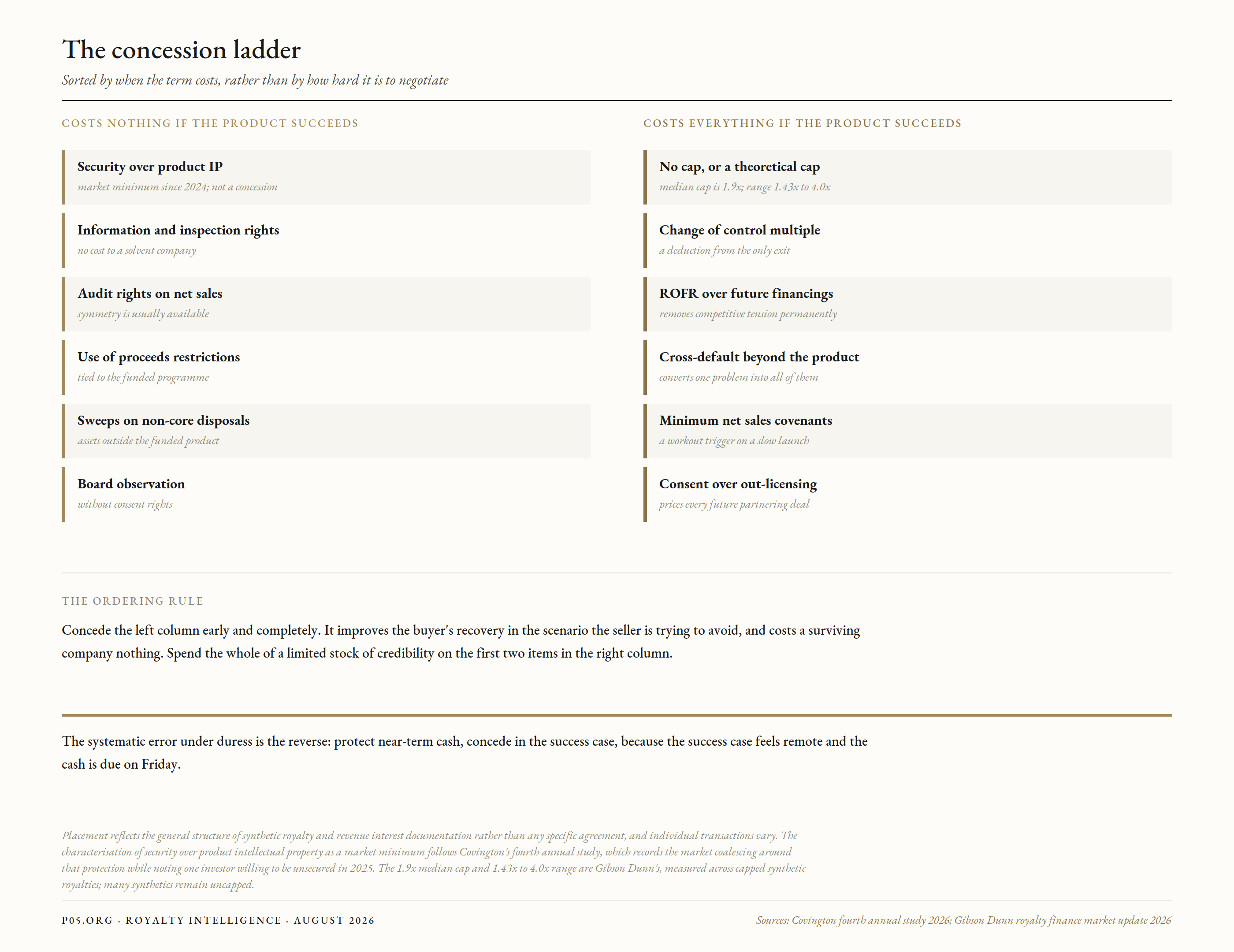
Figure 2. The same requests, sorted by when they cost. Terms in the lower band are close to free for a company that survives and succeeds; terms in the upper band are where the money is. Placement reflects general structure rather than any specific agreement.
One further category deserves separate handling because it is frequently mislabelled as accounting detail. A transaction papered as a purchase and sale may still be a liability on the seller's balance sheet. Syndax accounts for its USD 350 million Royalty Pharma agreement as a sale of future revenue in the form of a debt instrument under ASC 470, with an effective interest rate recalculated quarterly as projected sales change. A seller negotiating covenant headroom elsewhere in its capital structure needs that determination before signing, not after, because the answer moves reported leverage.
7. Process, when there is one bidder
Leverage in this market is almost entirely a function of timing rather than negotiation skill, and the timing decision is made before the first meeting.
Apogee is the clean illustration of the strong-side version. It entered a revenue participation right purchase and sale agreement with a Blackstone affiliate on 26 May 2026 for USD 100 million upfront, up to USD 700 million in milestones and an agreement to negotiate debt financing of up to USD 500 million, and announced the financing on 27 May alongside positive 16-week Phase 2 data. The document was signed while the data were known to the company and not to the market. Whatever one thinks of the terms, the sequencing is the entire lesson: the financing was negotiated against a catalyst the seller still held.
A distressed seller has usually spent its catalysts. What remains is a narrower set of process decisions, and they matter more than the redlines.
Run the eligibility test first. Sections 2 and 3 above. If three of the four gates fail, the answer is a partnering transaction, a reverse merger, or a structured equity, and the time is better spent there.
Do not grant exclusivity for a term sheet. Exclusivity is the one thing a weak seller can withhold at no cost, and it is routinely surrendered in exchange for a non-binding document. Where exclusivity is unavoidable, tie it to a short outside date and to the buyer's continued adherence to the term sheet economics, so that a late repricing releases it.
Stage the data room against confirmed progress. Diligence in these transactions is genuinely intensive and the seller cannot shorten it much, but it can sequence it. Full access on day one converts the buyer's remaining uncertainty into a repricing option at no cost to the buyer.
Keep one real alternative alive, and be honest about which are theatre. A second royalty buyer at an early stage, a partnering discussion, venture debt on the terms mapped in the venture debt piece, or an equity backstop from an existing holder. One credible alternative changes the outcome. Three fictional ones change nothing and consume management time that the runway cannot fund.
Decide the walk-away before the process, and write it down. Not a price, a structure: the cap, the change of control treatment, and the covenants beyond which the board will take a different route. A walk-away decided during a negotiation, against a filed runway, is not a walk-away.
8. The terms that price your next transaction
Two clauses deserve individual attention because their cost falls entirely outside the transaction being negotiated.
Change of control. A repurchase obligation triggered on acquisition, priced at a multiple, is a direct deduction from what an acquirer will pay. The mechanics are covered in the change of control piece; the point here is narrower. A weak seller concedes this early because it is contingent, remote and costs nothing today, and then discovers at the only exit the company will ever have that it has sold a slice of the sale price. If the board's realistic path is acquisition, the change of control multiple is more important than the royalty rate and should be negotiated as though it were the headline term.
Rights over future financings. A right of first refusal or first negotiation on subsequent royalty transactions is the most expensive thing in these documents relative to its apparent weight. It converts every future financing into a bilateral negotiation with a counterparty that knows no one else can bid. A seller that concedes it has agreed that it will never again have leverage on this asset, which is a strange thing to sign while learning what the absence of leverage costs.
9. When the alternative is insolvency
Below a certain point the framework changes and the cost of capital stops being the objective. If the realistic alternative to signing is a filing, the question becomes what maximises residual value for existing stakeholders, and a transaction that would be indefensible on IRR grounds can be correct.
Three things change in that zone. The buyer's diligence turns to whether its interest survives the seller's insolvency, which is the section 365 territory and which explains the security package. True-sale characterisation acquires real stakes for both sides rather than being a documentation preference. And the directors' duties analysis shifts as the company approaches insolvency, which is a matter for counsel in the relevant jurisdiction and not a negotiating position.
The practical guidance is narrow. Get the insolvency analysis done before the term sheet rather than during documentation, because it determines which concessions are actually available. And be clear internally about which objective is being pursued, since a board optimising cost of capital and a board optimising survival will reject different deals, and the confusion between them is where distressed processes fail.
10. What moves the position, and what only appears to
Terms that move it:
- A hard cap, expressed as a multiple of funded amount, with the market median at 1.9 times as the reference point rather than an aspiration.
- Tiered rates stepping down at defined sales levels, which cost nothing unless the product outperforms and are therefore the cheapest form of upside retention.
- Tranching against objective, externally verifiable events, which is as much protection for the seller as for the buyer because it prevents over-commitment on a programme that fails.
- A change of control buyout at a stated, modest multiple rather than at the cap.
- An outside date on exclusivity, tied to the buyer's adherence to agreed economics.
- Early determination of the accounting characterisation, so that covenant headroom elsewhere is not discovered to have vanished at closing.
Terms that only appear to:
- The headline royalty rate, which is the number the board asks about and the least informative term in the document once a cap exists.
- Security over product IP, which is now the market minimum and cannot be traded for anything.
- A non-binding term sheet, which allocates nothing and is routinely repriced after diligence.
- A long list of alternative counterparties that have not seen a data room.
- Consent rights the seller extracts over the buyer's assignment, which are worth little against a buyer whose business model is holding to maturity.
- A walk-away price agreed verbally in the week the term sheet arrives.
11. What each side should ask
The seller. Which of the four gates does the asset actually pass, and if it fails three, why is this process running? What is the cap, and what is the implied transfer between the cap on offer and 1.9 times? Which requested terms cost nothing if the product succeeds, and have those been conceded first? What has been given away that prices the next financing rather than this one? Has the board written down a structural walk-away, and does it survive contact with the filed runway?
The buyer. Is the recovery analysis genuinely driving the security package, or is the package a proxy for pricing that would be easier to defend as a lower cap? Does the covenant set leave the seller able to operate, given that a covenant breach on a distressed counterparty converts a royalty position into a workout? Is the transaction accretive if the seller's programme is delayed by a year, which is the modal outcome rather than the tail?
The board. Which objective is this process optimising, cost of capital or survival, and has that been stated? If acquisition is the realistic exit, has the change of control provision been negotiated as a headline term? Is there one real alternative, and who owns it?
A distressed royalty negotiation is not a bargaining problem, because there is nothing to bargain with. It is an allocation problem. The seller has a small stock of credibility and a shrinking stock of time, and the only decision that matters is where to spend both.
Spend them on the cap, the change of control multiple, and anything that prices the next transaction. Concede the security package, the information rights and the covenants that bite only on failure, because the buyer needs them for a scenario the seller is trying to avoid anyway. Do not spend anything on the headline rate.
And establish before any of this whether the market will fund the asset at all. Twenty-six transactions a year, a median size of USD 221 million and no 2025 fundings before completion of Phase III together describe a market that is narrower than the number of companies approaching it. Learning that in week one is worth more than every term negotiated afterwards.
All information in this article was accurate as of the research date and is derived from publicly available sources including SEC filings, published law firm market studies, and industry research. Information may have changed since publication. This content is for informational purposes only and does not constitute investment, legal, accounting, tax, or financial advice, and nothing here is guidance for any specific company or transaction. The author is not a lawyer, accountant, tax adviser, or financial adviser.