Company of the Week: Alentis Therapeutics
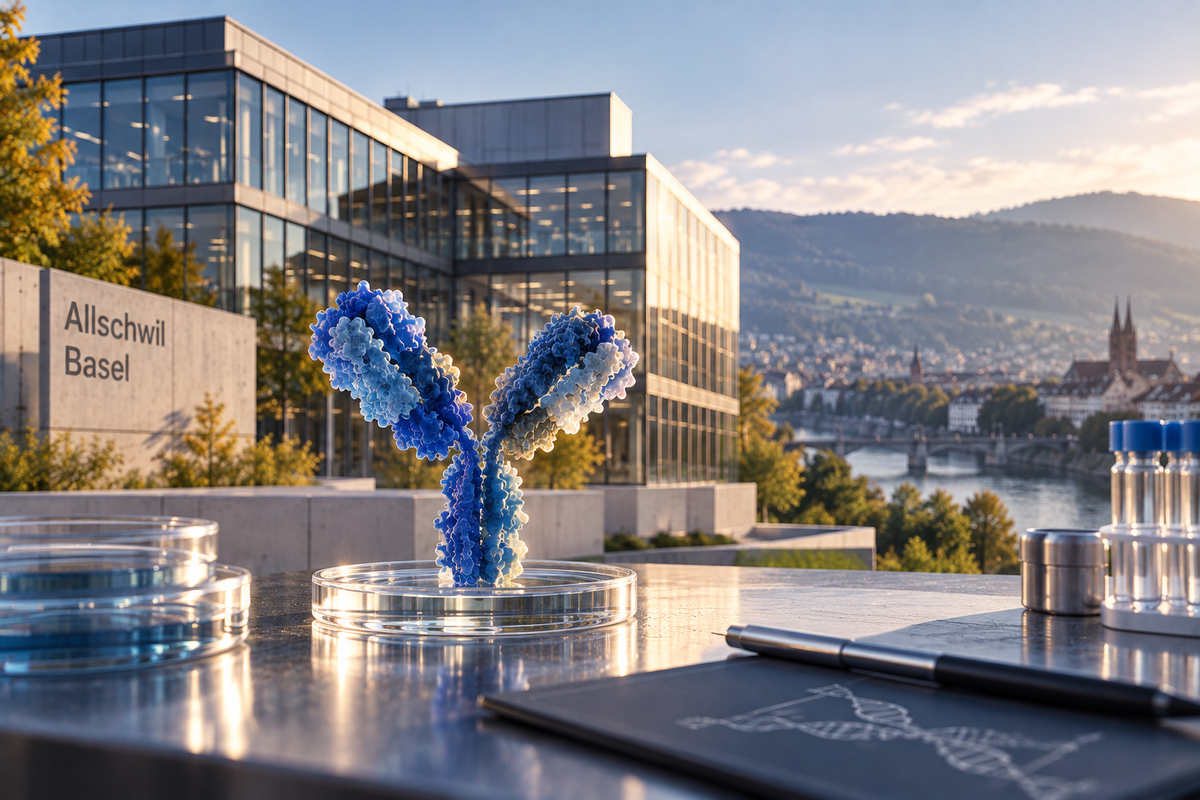
CSL is paying $355M for a share in a Swiss antibody for failing kidneys, nearly as much as venture investors put into its maker over seven years. Alentis keeps 45 percent of the profit and no royalty. The contract that defines that profit is unpublished, and so are the licences above it.
On 5 October 2026 CSL, an Australian drugmaker, agreed to pay Alentis Therapeutics $355M for a share in lixudebart, an antibody in mid-stage trials for a rare kidney disease. Up to $1.2B more is due if sales pass thresholds that neither company has published. CSL will pay for the trials. Once the drug is sold, CSL takes 55 percent of the profit and Alentis 45 percent.
Alentis is a private company in Allschwil, on the edge of Basel. Since 2019 it has raised $365.9M from venture investors in four rounds. The payment from CSL comes to 97 percent of that sum, and the release mentions no issue of shares.
Two months earlier CSL had lost a drug in the same disease. On 4 August the European Commission adopted a decision revoking the marketing authorisation of Tavneos, which CSL sells outside America for ANCA-associated vasculitis. CSL announced it two days later. Lixudebart's most advanced trial is in patients with that condition whose kidneys are failing fast.
The record shows a company that took a share of profit in place of a royalty. Alentis has no royalty on lixudebart to sell or pledge. Its 45 percent is defined by a contract that has not been filed anywhere. Above that share sit licences from French public research bodies, and their terms have never been published.
At a Glance
| Item | Detail |
|---|---|
| Company | Alentis Therapeutics AG, Allschwil, Switzerland. Private. Established in March 2019, with a research subsidiary in Strasbourg |
| Founder | Thomas Baumert, professor of medicine at the University of Strasbourg and head of an Inserm institute, who discovered the antibody |
| Staff | Over 50 employees |
| Chief executive | Mark Pruzanski, appointed 15 October 2025; founder of Intercept Pharmaceuticals |
| Chairman | Luca Santarelli, founder of VectivBio |
| Investors on the board | OrbiMed, Novo Holdings, Jeito Capital, Frazier Life Sciences and Longitude Capital |
| Equity raised | $365.9M: Series A of $12.5M (CHF 12.5M) in 2019, Series B of $67M in 2021, Series C of $105M in 2023 and Series D of $181.4M in 2024 |
| Target | Claudin-1, a protein that holds cells together and is exposed in fibrotic tissue and in many tumours |
| Lead drug | Lixudebart, formerly ALE.F02, an antibody in a Phase 2 trial in ANCA-associated vasculitis with rapidly progressive glomerulonephritis |
| The CSL agreement | 5 October 2026: $355M initial payment, up to $1.2B in commercial milestones, trial costs paid by CSL, global profit split 55 to 45 |
| Indications in the agreement | Kidney vasculitis, focal segmental glomerulosclerosis (FSGS) and primary sclerosing cholangitis (PSC). Idiopathic pulmonary fibrosis is not covered |
| Cancer drugs kept | ALE.P02 and ALE.P03, antibody-drug conjugates in Phase 1/2 trials; no partner announced |
| Regulatory designations | Orphan drug for lixudebart in idiopathic pulmonary fibrosis; Fast Track for ALE.P02 |
| Upstream licences | From the University of Strasbourg and Inserm through SATT Conectus, and from Mount Sinai in New York; terms undisclosed |
| Counsel on the CSL agreement | Goodwin, for Alentis |
| Royalty posture | Holds a profit share. No royalty owned, sold, pledged or bought in the public record |
A Note on Scope
Alentis is private and publishes no accounts. Its cash, spending and ownership are not on record, and this profile gives none of them. The sums raised are those the company announced.
The agreement with CSL has not been filed. CSL is listed in Australia, where companies announce material contracts without lodging them. Every term below comes from the joint release, which is dated 5 October in Melbourne and Basel and was distributed in America on the evening of 4 October.
Clinical results are as the company reported them. None of the lixudebart patient data cited here has appeared in a full journal paper that this profile could find.
The agreement was first recorded in The Weekly Term Sheet for week 41. The withdrawal of Tavneos is set among other European revocations in an earlier piece.
What Alentis Has Built
The company began with one antibody and one laboratory. Thomas Baumert, a liver specialist, had spent more than a decade at Strasbourg on claudin-1, first as the door through which hepatitis C enters a cell. In 2019 Swiss, French and German investors put $12.5M (CHF 12.5M) behind a plan to use his antibody against liver fibrosis and liver cancer. The technology was licensed in. SATT Conectus, the technology transfer office for Alsace, had assembled the patents.
Roberto Iacone, who became chief executive in July 2020, widened the plan twice. Claudin-1 also turns up in scarred kidneys and lungs, so the fibrosis programme moved beyond the liver. It is abundant in squamous tumours as well, so Alentis began a cancer programme.
The first cancer drug was ALE.C04, a plain antibody tested with Merck's Keytruda in head and neck cancer. The FDA gave it Fast Track status in August 2023. The trial was terminated in February 2025, and the registry gives the reason as reprioritisation.
By then the money had moved to antibody-drug conjugates, which use an antibody to carry a cell-killing payload into a tumour. The Series D of November 2024 was raised to take two of them into patients. ALE.P02 carries a tubulin inhibitor and ALE.P03 a topoisomerase I inhibitor. Both are now in Phase 1/2 trials.
Lixudebart kept going in fibrosis. In January 2025 Alentis reported interim results from 26 patients in the kidney trial, called RENAL, and from 41 patients with advanced liver fibrosis. It described improvement in kidney filtration and in protein loss at 24 weeks, and a fall in liver enzymes. The release gave no figures for either.
The Capital Record
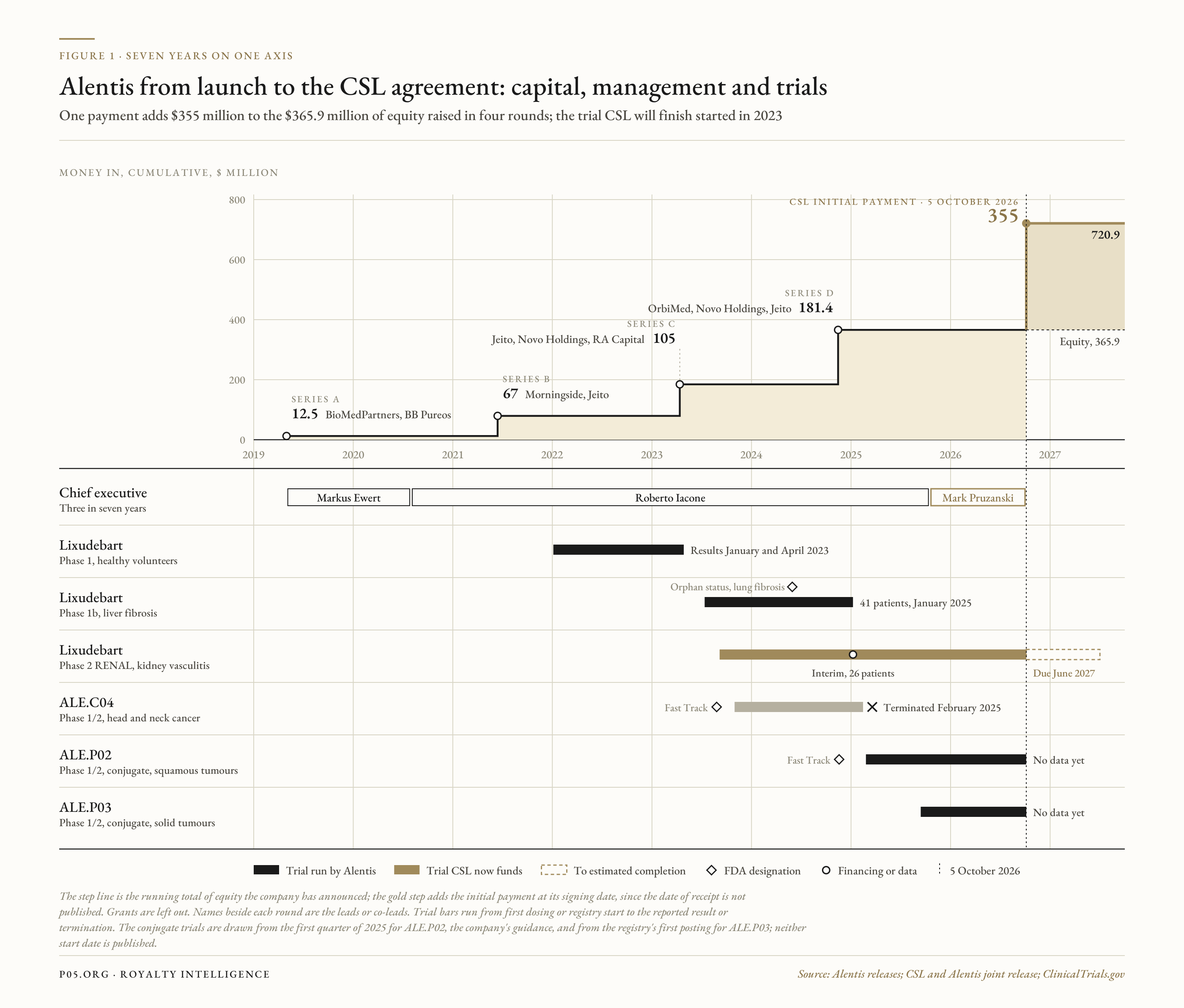
Cumulative money raised since 2019, with chief executives and every trial on the same time axis
Each round was larger than the last and brought new names. The Series B of June 2021 was led by Morningside and Jeito. Jeito led the Series C with Novo Holdings and RA Capital. OrbiMed led the Series D, with Novo Holdings and Jeito as co-leads and Frazier, Longitude, Catalio and Piper Heartland joining. The first investors, BioMedPartners, BB Pureos, Bpifrance and Schroders, date from 2019.
Five of the nine seats on the board are held by people from those funds. The two independent directors are William Pao, formerly chief development officer of Pfizer, and Sandip Kapadia, who was chief financial officer of Intercept Pharmaceuticals.
In October 2025 the board changed the chief executive. Mark Pruzanski had founded Intercept and taken its liver drug from discovery to market. He then ran Versanis Bio, which Eli Lilly agreed to buy for up to $1.925B in July 2023. A month after he arrived Alentis hired a general counsel and a chief business officer, both of whom had worked at Intercept.
The CSL agreement was announced in the twelfth month of his tenure. No earlier out-licence of an Alentis drug appears among the company's press releases.
The CSL Agreement
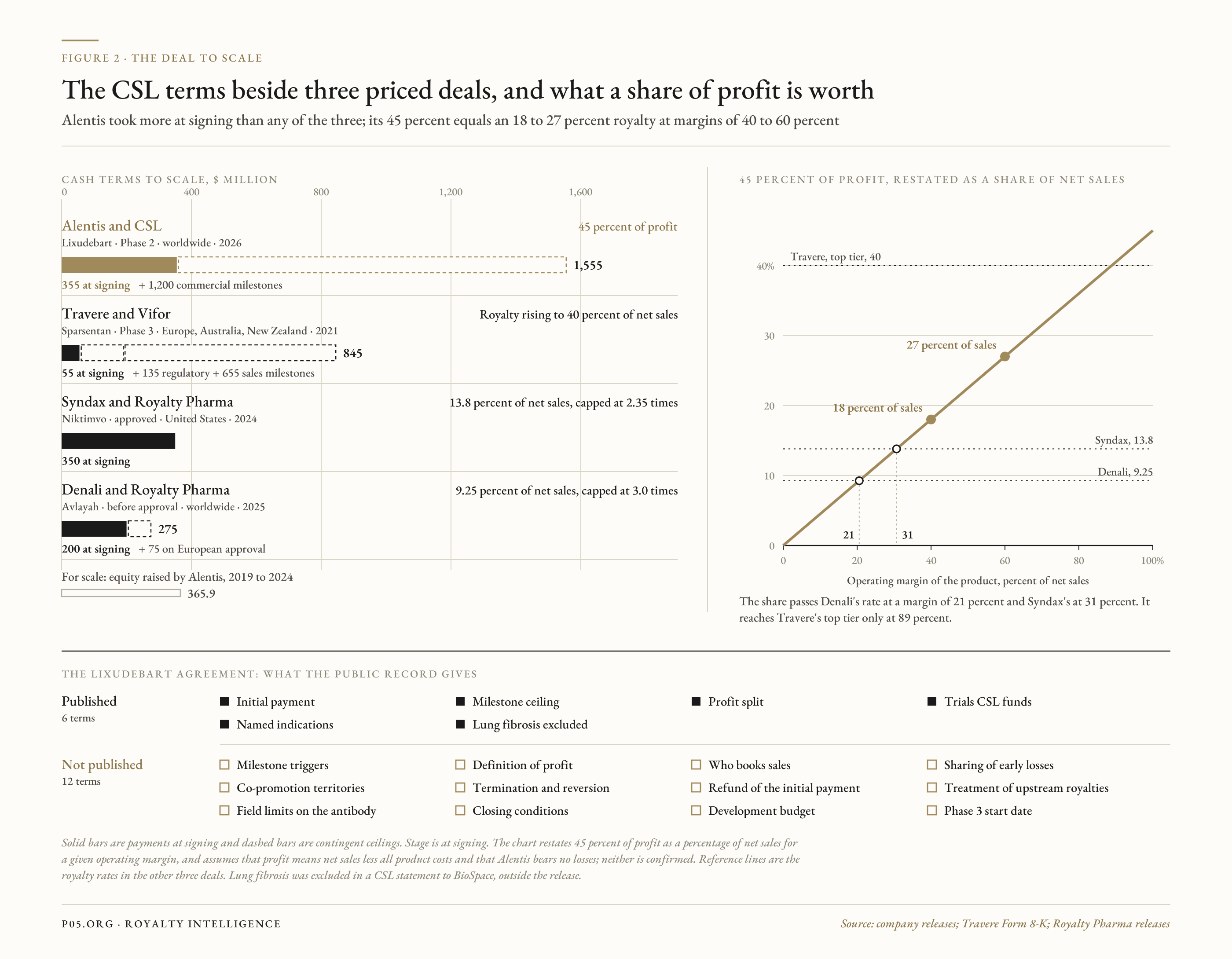
The CSL terms beside three priced deals, 45 percent of profit restated as a share of sales, and the terms that are and are not public
What Was Signed
The release calls the deal an exclusive global collaboration to co-develop and co-promote lixudebart.
CSL makes an initial payment of $355M. Alentis may receive up to $1.2B more, and the release describes all of it as commercial milestones. No payment tied to a trial result or an approval is mentioned.
CSL then pays for development in full. That covers the rest of the RENAL trial and a Phase 3 trial in the same disease. It also covers Phase 2 trials in FSGS, a scarring disease of the kidney's filters, and in PSC, a disease of the bile ducts. The budget is not given.
After launch the two companies share global profit, 55 percent to CSL and 45 percent to Alentis. The release gives one split for the whole world.
Lixudebart is some way from a launch. The registry lists RENAL as still recruiting, with primary completion estimated for 30 June 2027. A Phase 3 trial has to follow it. The interim analysis that the October release cites is the same 26-patient reading that Alentis reported in January 2025.
What CSL Brings
CSL makes most of its money from blood plasma. Its kidney business is CSL Vifor, and that business is shrinking. In August CSL reported impairments of $4,869M on CSL Vifor's goodwill and intangible assets for the year to June 2026 and forecast that the unit's revenue would fall by about a quarter.
Tavneos accounts for part of that. CSL holds the drug for Europe, Britain, Japan and some other markets under a licence from ChemoCentryx, now owned by Amgen. It sold $120M of it last year. European regulators reviewed how data were handled in the main Phase 3 trial, concluded that a positive balance of benefit and risk could no longer be established, and withdrew the authorisation. CSL wrote off $166M against the product.
Tavneos treats the vasculitis itself. Lixudebart is aimed at the kidney damage the disease causes, on top of standard treatment. CSL's head of research said the company wanted it first in kidney vasculitis and then in FSGS. CSL already sells a drug for rare kidney disease, Filspari, under licence from Travere Therapeutics.
What Is Not Published
A profit share depends on definitions, and none has been released. The announcement does not say which company books the sales, what costs are deducted before the split, or how the cost of a sales force is divided when both companies promote the drug.
It does not say what happens before profit. A new drug usually loses money in its first years on the market. Whether Alentis bears 45 percent of those losses, or is carried until the drug breaks even, is not stated.
Termination is also blank. The public documents do not show when CSL may leave or what would return to Alentis if it did. They are silent, too, on whether the $355M is refundable.
The release gives no closing condition, no antitrust clearance and no closing date. Goodwin acted for Alentis, and no financial adviser is named for either side.
One Antibody, Three Products
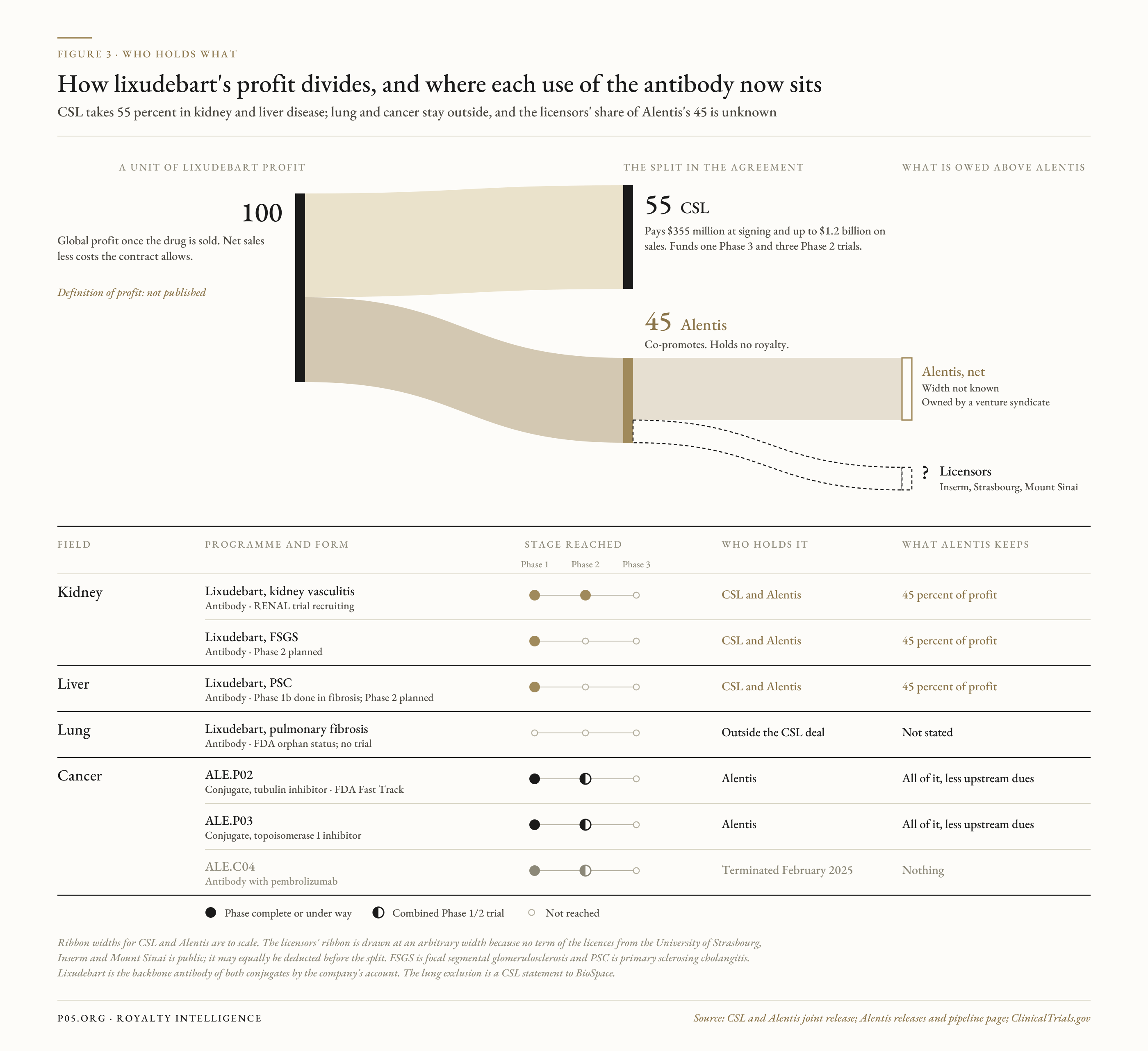
How a unit of lixudebart profit divides, and who holds each use of the antibody by field
The cancer drugs stay with Alentis. The release lists ALE.P02 and ALE.P03 as the company's own candidates, and Mr Pruzanski said the deal would help Alentis advance its other clinical assets.
They are close relatives of the drug that CSL now shares. In October 2024 the company's then chief executive described lixudebart as the backbone antibody for Alentis's conjugates. The same protein that CSL will develop for kidneys and livers is the carrier in both cancer products.
How the contract divides one antibody between two companies is not public. A field limit of some kind is likely, with CSL's rights confined to the unconjugated antibody or to named diseases. The release describes CSL's scope loosely, as kidney, liver and other diseases.
One boundary has been stated outside the release. Lixudebart has an orphan drug designation for idiopathic pulmonary fibrosis, and a CSL spokesperson told BioSpace that this indication is not covered, since pulmonary diseases are outside CSL's therapeutic areas. Whether Alentis is free to develop the antibody for lungs, alone or with another partner, has not been said.
The division matters for anything Alentis does next with the conjugates. A partner or buyer for ALE.P02 would want to know that CSL has no claim on the antibody inside it, and that Alentis can still make and supply that antibody for cancer.
Mr Pruzanski said on joining that data were expected in 2026 for each of the three candidates. The company's news page lists no release between 12 November 2025 and the CSL announcement. No patient data from either conjugate has been published there.
What Alentis Pays
Alentis does not own the foundation of its science outright. Its launch release says it had in-licensed platform technologies and a monoclonal antibody drug candidate from the University of Strasbourg and Inserm, and from Mount Sinai Hospital in New York. A second release, from a Strasbourg research institute that supported the technology, describes the same licence.
The patent record is consistent with that. United States patent 11,365,251, on humanised anti-claudin-1 antibodies, names Professor Baumert as inventor and is assigned to Inserm, the University of Strasbourg and the Strasbourg university hospitals. Its international application was filed on 21 March 2017. Counting 20 years from that date, and ignoring any extension, the family runs to March 2037.
No term of these licences is public. Academic licences of this kind usually carry milestones and a royalty on sales, and many take a share of what the licensee earns from a sublicence. Whether Alentis owes any of these is not known. If it does, a part of the $355M and of every later payment may be owed upstream.
The CSL announcement does not mention the licensors. It does not say whether a royalty owed to them is deducted before profit is split or paid by Alentis out of its 45 percent.
A Priced Comparable
No one has put a price on Alentis's profit share. Earlier transactions show how such positions have been valued.
The first involves CSL's own kidney unit. In September 2021 Vifor licensed sparsentan, now sold as Filspari, from Travere for Europe, Australia and New Zealand. The drug was then in Phase 3. Vifor paid $55M upfront, with up to $135M in regulatory and market access milestones and up to $655M in sales milestones. Travere also receives tiered royalties that reach 40 percent of net sales.
Set beside that, the Alentis terms are more than six times larger at signing for a drug one phase earlier, and they cover the world. The comparison is loose. Travere kept America, the largest market, for itself. Alentis has shared every market.
The Travere royalty also gives a way to read the 45 percent. A share of profit converts to a share of sales only with an assumption about margin. If lixudebart earned an operating margin of 60 percent on net sales, 45 percent of profit would equal 27 percent of sales. At a margin of 40 percent it would equal 18 percent. The share passes a royalty of 13.8 percent once the margin exceeds 31 percent, and it matches Travere's top tier of 40 percent only at a margin of 89 percent. These figures are illustrations, and the margin of a rare disease antibody sold by two companies is not known.
The second transaction shows a royalty fund financing the holder of a profit share. Syndax Pharmaceuticals developed Niktimvo with Incyte and sells it with Incyte in America. In November 2024 Royalty Pharma paid Syndax $350M for 13.8 percent of American net sales, with payments ending at 2.35 times the money advanced. Syndax said it would keep taking part in the drug's profits.
The instrument was a new royalty on sales, which Syndax pays out of whatever it earns. The profit share stayed with Syndax. At the cap, $350M returns $822.5M, which at 13.8 percent takes $5.96B of cumulative American sales. That sum assumes no other adjustment in the contract.
Royalty Pharma used the same instrument for Denali Therapeutics in December 2025, paying up to $275M for 9.25 percent of worldwide sales of Avlayah before the drug was approved. That deal was set out in last week's profile of JCR Pharmaceuticals.
Niktimvo had been approved three months before the Syndax deal. Lixudebart is in Phase 2. A similar financing for Alentis would be some years off, and it would need CSL's reports of sales to reach the buyer.
Financial Profile
| Item | Amount | Source and date |
|---|---|---|
| Series A | $12.5M (CHF 12.5M) | Launch release, 30 April 2019 |
| Series B | $67M | Series B release, 15 June 2021 |
| Series C | $105M | Series C release, 13 April 2023 |
| Series D | $181.4M | Series D release, 12 November 2024 |
| Equity announced, total | $365.9M | Sum of the four rounds |
| CSL initial payment | $355M | Joint release, 5 October 2026 |
| CSL commercial milestones, ceiling | $1.2B | same |
| Profit share | 45 percent to Alentis, 55 percent to CSL | same |
| Trial funding by CSL | Undisclosed | same |
| Cash, spending and debt at Alentis | Not published | Private company |
| CSL Vifor revenue | $2,379M | CSL results presentation, year to June 2026 |
| Tavneos sales at CSL | $120M | same |
| Tavneos impairment | $166M | same |
| CSL Vifor impairments, goodwill and intangibles | $4,869M | same |
| Vifor licence of sparsentan from Travere | $55M upfront, royalties up to 40 percent | Travere 8-K, 15 September 2021 |
| Royalty Pharma funding of Syndax | $350M for 13.8 percent, capped at 2.35 times | Royalty Pharma release, 4 November 2024 |
| Royalty Pharma funding of Denali | Up to $275M for 9.25 percent | Royalty Pharma release, 4 December 2025 |
Blue Team
- The cash is committed. The $355M initial payment does not wait on a trial, and it nearly equals all the equity the company has announced
- Development cost has moved to the partner. CSL pays in full for one Phase 3 trial and three Phase 2 trials, which leaves Alentis's own money for the cancer drugs
- Alentis keeps close to half of the economics in every market, America included, and will co-promote the drug
- The partner sells to the doctors who would prescribe the drug. CSL markets several kidney medicines and sold a vasculitis drug in Europe until this summer
- Lung fibrosis sits outside the deal. CSL has said that idiopathic pulmonary fibrosis is not covered, and lixudebart has an orphan designation there
- Two programmes remain unpartnered. ALE.P02 has Fast Track status and both conjugates are in patients
- The management has sold a company before. Mr Pruzanski ran Versanis up to its sale to Eli Lilly, and the chief business officer worked on that sale
- The target has drawn a second payer. Until October the case for claudin-1 rested on venture money alone
Red Team
- The clinical evidence is thin. The kidney data are an interim reading of 26 patients, reported without figures in January 2025 and not updated in the October release
- Launch is years away. RENAL's primary completion is estimated for June 2027, and a Phase 3 trial comes after it
- Every later payment depends on sales. The $1.2B is described as commercial milestones, with no trigger published
- Profit is undefined in public. Who books sales, which costs are deducted and whether Alentis funds early losses are all unstated
- The upstream licences are undisclosed. Alentis licensed its antibody from French public bodies and Mount Sinai, and what it owes them on the CSL payments is unknown
- One antibody serves a shared product and two that Alentis owns. Lixudebart is the backbone of both conjugates, and the field limits in the CSL contract are not published
- The partner's kidney unit is contracting. CSL forecasts a fall of about 25 percent in CSL Vifor's revenue this year and is run by an interim chief executive
- An earlier cancer programme was dropped. The ALE.C04 trial was terminated in February 2025, 15 months after it began
- The data promised for 2026 on the conjugates have not been published on the company's news page
- No accounts exist in public. A reader cannot check cash, spending or what the investors hold
Implications for the Pharmaceutical Royalty and Biotech Capital Markets
Alentis has financed itself for seven years with equity and now with a partner's cash. It has never sold a royalty, and after this agreement it has none on its lead drug to sell. What it holds is a claim on 45 percent of a profit that CSL will largely determine, since CSL funds the trials and has the larger sales organisation.
A profit share and a royalty behave differently in a buyer's model. A royalty is taken from net sales, a figure the partner reports and an auditor can test. Profit comes after manufacturing, promotion and whatever else the contract allows as a cost. Two companies that co-promote must also agree how many salespeople each may charge to the joint account. None of that drafting is visible here.
The share may also be negative for a time. If Alentis carries 45 percent of launch costs, its first years on the market consume cash. The $355M would then serve partly as a reserve against its own partner's spending plan.
The Syndax transaction shows that a royalty fund can still finance such a company. Royalty Pharma took a synthetic royalty on sales and left the profit share where it was. For Alentis that route would need three things that the public record does not yet show: an approved product, a right to pass CSL's sales reports to a financier, and consent from CSL if the contract requires it.
The upstream licences complicate any such sale. A buyer of a royalty granted by Alentis would rank behind whatever the company owes Strasbourg, Inserm and Mount Sinai. If those bodies are owed a share of sublicence income, the CSL payments may already have triggered it. A diligence team would ask for the Conectus licence before it asked for the CSL contract.
CSL's position is a reminder of how a licensed drug can fail for its licensee. Tavneos was approved and selling. It lost its European authorisation over the handling of data in its licensor's main trial. CSL has now taken a larger position in the same disease at an earlier stage, with the originator still involved in development.
The upfront is a data point on pricing for mid-stage rare disease assets in 2026. A Phase 2 antibody with one interim reading drew $355M at signing from a buyer whose kidney unit had been written down seven weeks earlier. The same buyer's unit paid $55M five years earlier for regional rights to a Phase 3 kidney drug.
For the venture funds on the board, the agreement puts a sum close to their total investment on the company's balance sheet. Lixudebart now has a fixed partner and a fixed split, and an acquirer of the whole company would inherit both. The conjugates stay unencumbered so far as the record shows, and they are the part of Alentis that an acquirer could own outright.
Recent Developments
- CSL and Alentis sign the lixudebart collaboration on 5 October 2026: $355M initial payment, up to $1.2B in commercial milestones and a 55 to 45 profit split
- CSL reports a statutory loss of $2.6B for the year to June 2026 on 18 August 2026, with $4,869M of impairments at CSL Vifor
- The European Commission revokes the authorisation of Tavneos by a decision of 4 August 2026, announced by CSL on 6 August
- Alentis appoints a general counsel and a chief business officer on 12 November 2025
- Mark Pruzanski becomes chief executive on 15 October 2025, succeeding Roberto Iacone
- The ALE.C04 trial is terminated on 12 February 2025
- Interim results for lixudebart in kidney vasculitis and liver fibrosis are reported on 9 January 2025
- The FDA grants Fast Track status to ALE.P02 on 18 November 2024
- Alentis raises a $181.4M Series D led by OrbiMed on 12 November 2024
- No sale, pledge or purchase of a royalty by Alentis has been identified
Financial History
| Date | Event |
|---|---|
| 21 Mar 2017 | International patent application on humanised anti-claudin-1 antibodies filed by Inserm, the University of Strasbourg and the Strasbourg university hospitals |
| Mar 2019 | Alentis Therapeutics established in Basel |
| 30 Apr 2019 | Series A of $12.5M (CHF 12.5M) announced; technology in-licensed from Strasbourg, Inserm and Mount Sinai |
| 29 Jul 2020 | Roberto Iacone named chief executive |
| 15 Jun 2021 | Series B of $67M, led by Morningside and Jeito |
| 13 Apr 2023 | Series C of $105M, led by Jeito with Novo Holdings and RA Capital |
| 29 Jun 2023 | Luca Santarelli appointed chairman |
| 24 Aug 2023 | FDA Fast Track status for ALE.C04 |
| 5 Dec 2023 | First patient dosed in the RENAL trial of lixudebart |
| 29 May 2024 | FDA orphan drug designation for lixudebart in idiopathic pulmonary fibrosis |
| 2 Oct 2024 | FDA clears the first trial of ALE.P02 |
| 12 Nov 2024 | Series D of $181.4M, led by OrbiMed |
| 18 Nov 2024 | FDA Fast Track status for ALE.P02 |
| 9 Jan 2025 | Interim lixudebart results in 26 kidney patients and 41 liver patients |
| 12 Feb 2025 | ALE.C04 trial terminated |
| 15 Oct 2025 | Mark Pruzanski appointed chief executive |
| 12 Nov 2025 | General counsel and chief business officer appointed |
| 4 Aug 2026 | European Commission adopts the decision revoking the authorisation of CSL's Tavneos; CSL announces it on 6 August |
| 18 Aug 2026 | CSL reports results for the year to June 2026 |
| 5 Oct 2026 | CSL and Alentis sign the lixudebart collaboration |
| 30 Jun 2027 | Estimated primary completion of the RENAL trial |
Conclusion
Alentis is a Swiss company built on one French antibody. It spent seven years and $365.9M of venture money taking that antibody into patients with scarred kidneys and livers, and into two cancer drugs. It has now shared the first of those uses with CSL for $355M and a promise of 45 percent of the profit.
That 45 percent is the company's whole interest in lixudebart. It is a larger percentage than a royalty would be, taken from a smaller base, and it comes after costs that the public cannot see and that CSL will mostly incur. The licences from Strasbourg, Inserm and Mount Sinai sit above it on terms that have not been published.
The trial that CSL has agreed to finish is due to reach its main reading in June 2027. Until a Phase 3 trial succeeds and the drug is approved, the $355M is the only part of the agreement of 5 October that Alentis can count.
All information in this report was accurate as of the research date and is derived from publicly available sources including court opinions, regulatory guidance, academic literature, SEC filings, and financial news reporting. Information may have changed since publication. This content is for informational purposes only and does not constitute investment, legal, or financial advice. The author is not a lawyer or financial adviser.