
No rate, no sum: what a trait licence and a trait settlement are worth to a royalty buyer

On 28 September 2026 two announcements about crop genetics went out within hours of each other. Cibus, a gene-editing company listed on Nasdaq, said that Crystal Crop Protection of New Delhi would develop gene-edited traits in Brassica juncea, India's mustard, and "evaluate and commercialize such traits under an exclusive license in India".
Corteva and Inari, a privately held seed developer, said they had reached "a confidential settlement agreement" in the Delaware suit Corteva filed in September 2023. The first release does not contain the word royalty, and the second names no sum.
A trait is a heritable characteristic, such as tolerance of a herbicide, that a developer licenses to seed companies for a fee on each bag sold or acre planted. Both announcements concern fees of that kind. Crystal will owe Cibus something if a mustard trait reaches the market. Inari will destroy the Corteva seed it took from public depositories, assign to Corteva the intellectual property in its edited versions, and the two have "agreed to negotiate certain licensing arrangements".
Our earlier article on seeds, traits and platform biotech found that crop traits are the largest royalty pool outside drugs and the one with the least outside finance, because the large owners borrow more cheaply than a royalty buyer can lend. This article starts from the two instruments of 28 September and asks what a buyer could pay for each.
The evidence is the handful of trait contracts whose terms have reached a court or a securities filing since 2022. It describes the position on 6 October 2026.
The licence
Cibus sets out its model in its annual report. "The trait provider is paid a royalty for every bag (unit) sold or each acre on which the traits are used", and the fee the grower pays is divided between the trait developer and the seed company.
The same report gives Cibus's own estimates of trait fees. Herbicide-tolerant rice is put at $30 to $50 an acre in the United States and Latin America and at about $2 an acre in India. It gives no figure for mustard.
The release puts India's mustard crop at roughly 21 million acres (8.5 million hectares). It also cites the environment ministry's decision of 30 March 2022, which exempts plants edited without foreign DNA from the rules for genetically modified organisms. The traits are still to be developed, and the release gives no date for a launch.
Rates in licences between large trait owners are almost never public. One reached the record through litigation. The cross-licence between Bayer and Corteva on agrobacterium transformation, a method of inserting genes, provided that Corteva "shall pay [Bayer] an Agrigenetics Royalty of Two U.S. Dollars ($2.00) for each Unit" of licensed product sold.
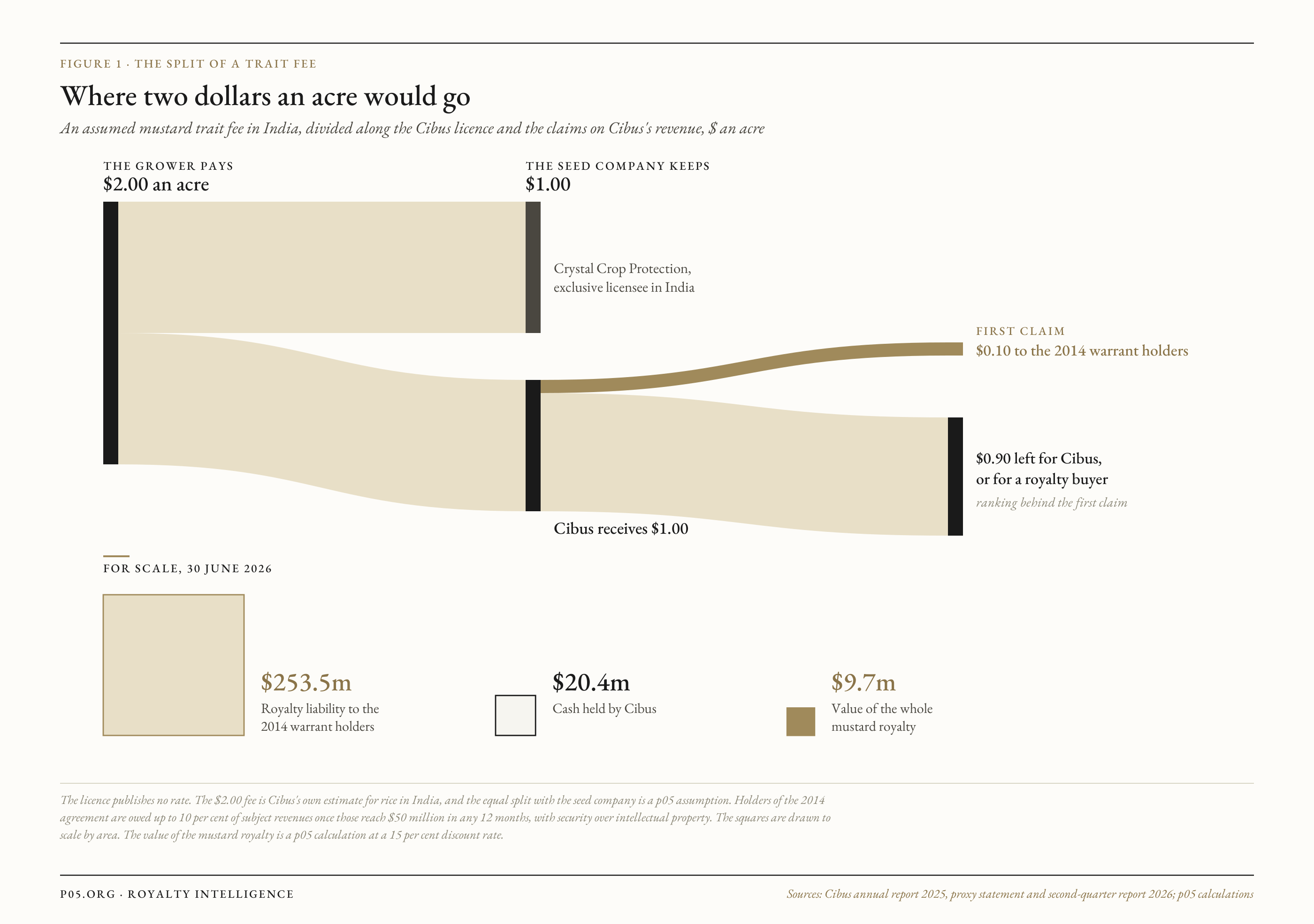
Figure 1. An assumed trait fee of $2.00 an acre, divided along the licence and the claims on Cibus's revenue. Holders of a 2014 agreement are owed up to 10 per cent first, and their claim is carried at 26 times the value p05 puts on the whole mustard royalty.
How long a rate lasts
That $2.00 rate is public because Bayer sued to collect it. Bayer claimed the royalty on Corteva's Enlist E3 soybeans from their launch in 2019 until 18 December 2029, and the court recorded that Corteva "never paid Bayer any royalties". The patent Bayer relied on had expired on 22 July 2008.
On 5 May 2025 Judge Sheldon Rennie of the Delaware Superior Court held that "Bayer's royalty claim is per se unlawful, because it relies on Corteva's post-expiration use of the '877 Patent".
The rule comes from the Supreme Court, which restated it in 2015: "a patentee cannot continue to receive royalties for sales made after his patent expires".
Eight months before Judge Rennie's ruling, another judge of the same court had applied the same rule to Roundup Ready corn and found for Bayer, holding that "royalties may run until the latest-running patent covered in the parties' agreement expires".
Read together, the two rulings make the term of a trait royalty a question of fact. It ends when the last patent the product uses expires, whatever end date the licence states. The Supreme Court left one route open, since a royalty may run longer if it is tied to a right other than a patent.
In seeds the nearest such right is a plant variety protection certificate, which lasts 20 years from issue. That reading is p05's, and no court has tested it on a trait licence.
The settlements
The two companies settled in January 2026. Corteva's filing records "a payment of $610 million of which approximately $546 million was paid through the first quarter of 2026 and the remainder due by September 15, 2026".
The cross-licence was terminated. So were "potential royalty obligations for Corteva's Enlist E3 soybeans, as well as future royalty payments due to Bayer under other licensing agreements in dispute".
Bayer's accounts describe the same event differently. Its statement for the first quarter of 2026 says it "received US$525 million (€448 million)" and booked it as licensing revenue in soybean seed and traits, and its results presentation attributes about €300 million of corn licensing in the last quarter of 2025 to "resolutions".
Neither company reconciles its figure with the other's. The earlier article covers what the payment did to Corteva's royalty balance. For a financier the relevant fact is that nine-tenths of the money moved within a quarter and the running royalties were cancelled, which leaves no receivable to buy.
The Inari settlement produced even less to finance. Trade reports put Corteva's damages claim at about $1.3 billion and say the case settled three trial days in. Inari, which investors valued at $2.17 billion in January 2025, gave up material and patents.
The release mentions no payment in either direction. A licence that is still to be negotiated has neither a rate nor a term.
In Brazil the money in dispute may flow back to the payers. Bayer collects a royalty on Intacta RR2 PRO soybeans from growers, at about $49 (BRL 280) a hectare according to CNN Brasil. Aprosoja-MT, the growers' association of Mato Grosso, says the first of three patents expired in March 2018 and the second in December 2020. On 13 February 2023 a justice of the supreme court ordered $252 million (BRL 1.3 billion) into escrow.
A first-instance court ordered refunds in December 2024, and in March 2025 Bayer won a suspension against guarantees of $785 million (BRL 4.5 billion). The state appeal court rejected Bayer's appeal on 25 June 2025, holding two-thirds of the royalty undue.
The case was undecided at the Superior Tribunal de Justiça on 4 August 2026, and Bayer says its protection runs to May 2028.
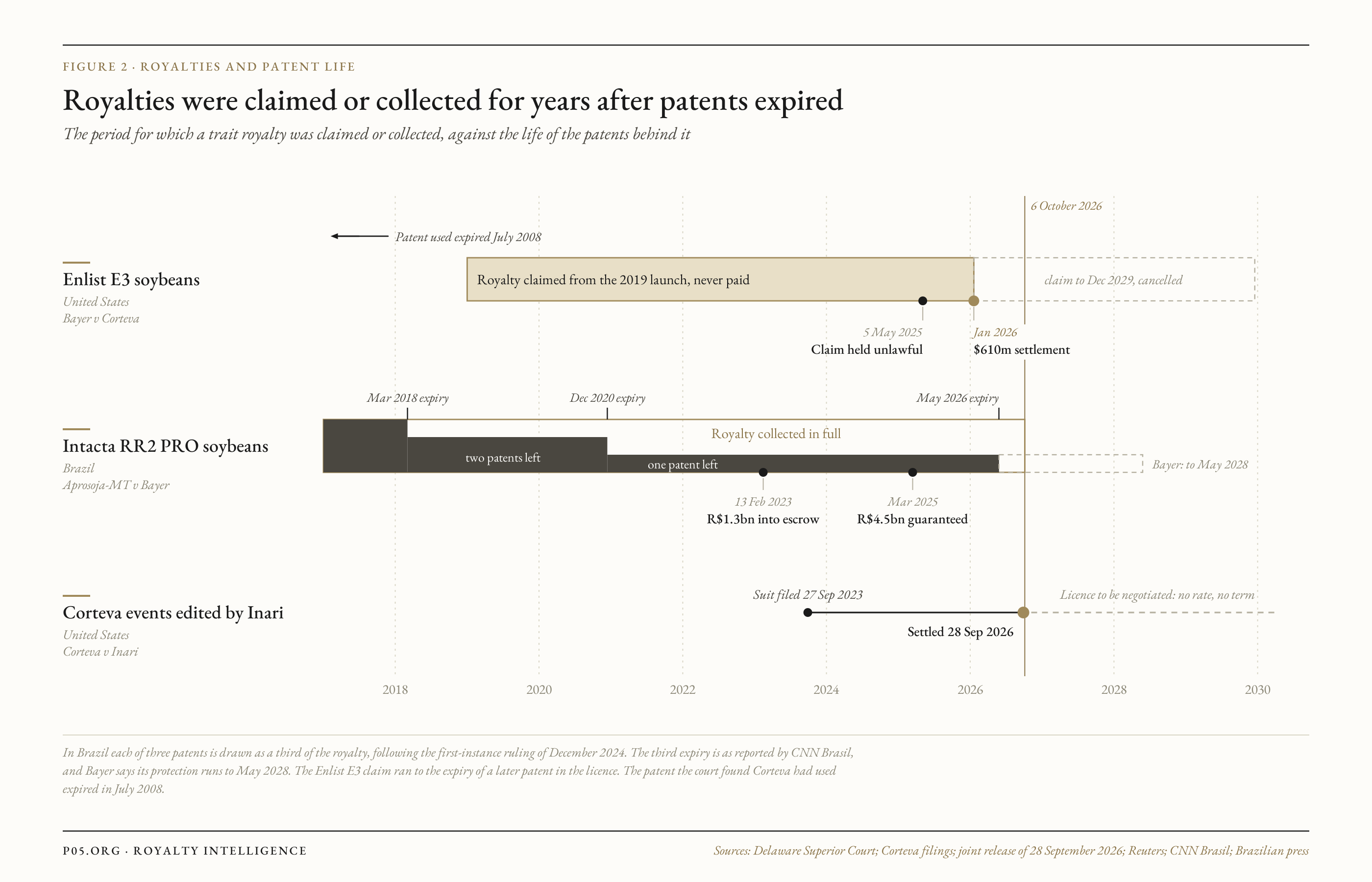
Figure 2. Royalties against patent life. Bayer claimed a royalty on Enlist E3 to 2029 on a patent that expired in 2008, and collected the Intacta royalty in full while growers say two of three patents had expired. The Inari settlement leaves a licence with no term.
A marketed trait, priced
Suppose a developer owns a trait in grain sorghum, planted on a tenth of American sorghum acres, and wants to sell the royalty. The table sets out the sum. Every input is an assumption except the acreage.
| Input | Value | Basis |
|---|---|---|
| Acres carrying the trait | 628,000 | A tenth of the 6.28 million acres planted in 2026 |
| Fee kept by the developer | $6 an acre | Middle of Cibus's estimate of $5 to $7 for a canola trait |
| Royalty a year | $3.8 million | Acres multiplied by fee |
| Remaining term | 10 years | Assumed life of the last patent used |
| Value at a discount rate of 15 per cent | $18.9 million | p05 calculation |
| Value at a discount rate of 20 per cent | $15.8 million | p05 calculation |
Sources: USDA National Agricultural Statistics Service; Cibus annual report for 2025; p05 calculations. The trait and the developer are hypothetical.
The discount rates are set above the drug market's. Royalty Pharma told investors in September 2025 that its returns on approved products "have trended to the low double-digit range". A trait royalty adds the uncertain term described above and a single crop's acreage.
The assumptions follow a real trait. S&W Seed's Double Team sorghum reached about 10 per cent of American sorghum acres in 2024, with product sales of $10.9 million in the year to June 2024. In March 2025 the Department of Agriculture cut its forecast of sorghum exports by just over 40 per cent, noting that China had taken 78 per cent of American sorghum exports over the previous decade.
On 17 June 2025 S&W's lender declared a default on about $20.9 million of obligations. The lender then sold everything used in the sorghum business under Article 9 of the Uniform Commercial Code for "a cash payment of approximately $7.0 million to Mountain Ridge plus certain deferred payments". The sale included the seed stock and the brand as well as the trait, and it raised less than half the lower value in the table.
The mustard licence, priced
The same sum can be done for the licence Cibus signed. p05 assumes a gross fee of $2 an acre, which is Cibus's estimate for rice in India, of which Cibus keeps half. Adoption starts at 2 per cent of the 21 million acres in 2031 and reaches a fifth from 2035, and the royalty runs to 2045. On those assumptions Cibus would collect $4.2 million a year at the peak and $52.9 million in all.
The stream is worth $9.7 million today at a discount rate of 15 per cent and $4.0 million at 25 per cent. The higher rate is nearer the drug market's price for unfinished products. Covington's study of synthetic royalties found a median cap of 4.25 times the amount advanced on products still in trials, against 2.00 times on approved ones.
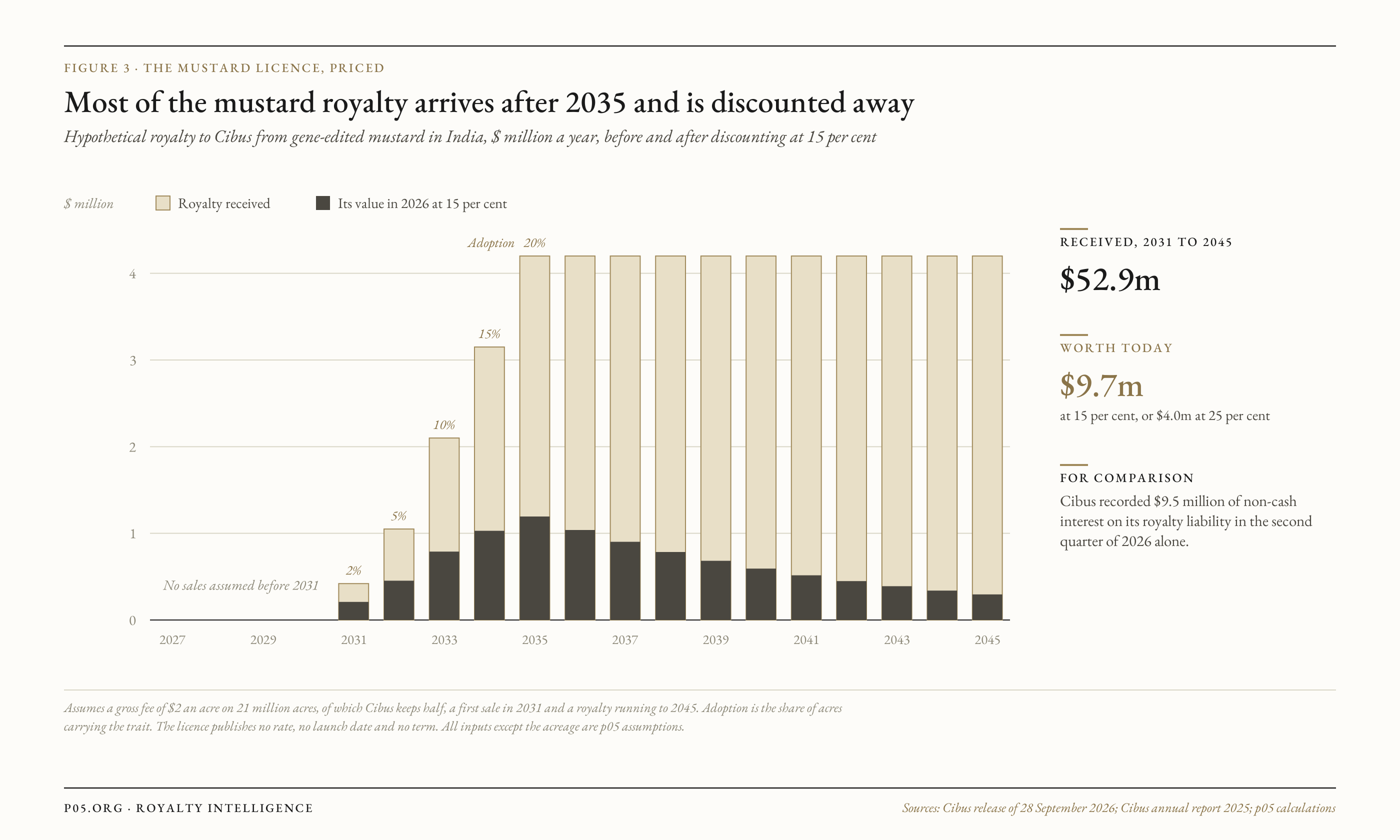
Figure 3. The hypothetical mustard royalty year by year. Cibus would receive $52.9 million between 2031 and 2045, worth $9.7 million today at a discount rate of 15 per cent.
A buyer of that stream would not be first in line. In December 2014 Cibus's operating company exchanged investors' warrants for a share of its revenue. Its proxy statement says "the aggregate portion payable to the investors each quarter is the product of the subject revenues and a percentage, which is capped at 10%", that subject revenues include licence fees and royalties, and that the obligation is "secured by a senior security interest in certain Cibus Global collateral".
Payments begin once subject revenues reach $50.0 million in any 12 consecutive months and run for 30 years from the first. The holders include Rory Riggs, a director, and Peter Beetham, the president.
Cibus carries this obligation as a royalty liability of $253.5 million at 30 June 2026, at an effective yield of 16.5 per cent. The non-cash interest on it was $9.5 million in the second quarter alone, about the value of the whole mustard stream at the lower discount rate.
Revenue in the first half of 2026 was $2.7 million, cash was $20.4 million, and the company reported "substantial doubt about the Company's ability to continue as a going concern".
India has also removed a trait fee by order. The government sets the maximum price of Bt cotton seed, including the part payable to the trait licensor. Press reports of the notifications put that part at $0.56 (INR 49) a packet in 2016, down from $1.85 (INR 163), then at $0.23 (INR 20) for 2019-20 and at zero from 2020-21. The order covers cotton seed only, and mustard seed prices are not controlled.
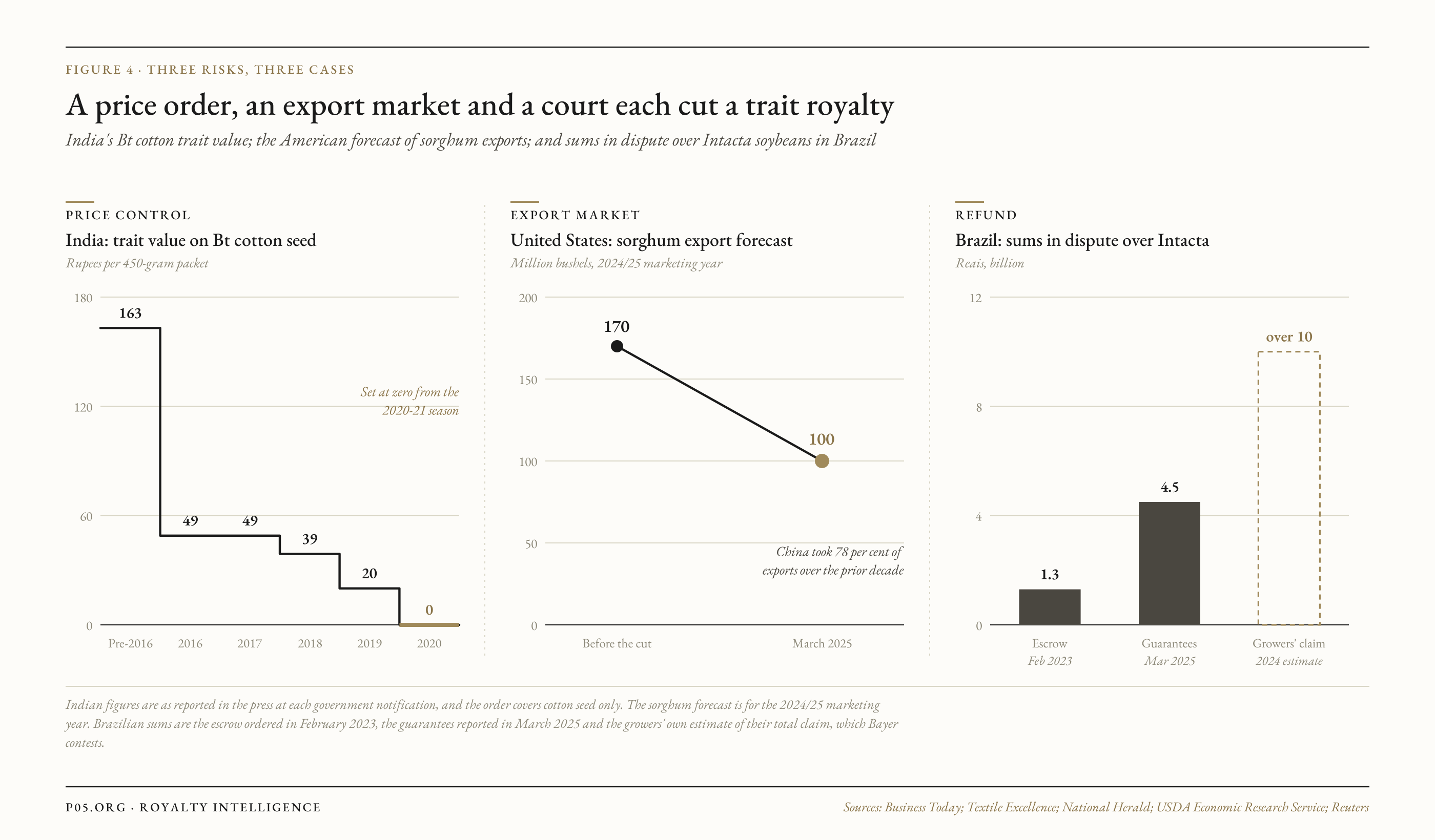
Figure 4. Three cases in which a trait royalty shrank: a price order in India, the loss of an export market for American sorghum, and refund claims in Brazil.
A settlement, priced
A settlement paid in instalments by a strong payer is the simplest of the three to value. Suppose a developer wins $40 million, payable at $10 million a year for four years by a company rated investment grade. The stream is worth $34.7 million at 6 per cent and $32.4 million at 9 per cent.
No trait settlement since 2022 has taken that form. Corteva paid nine-tenths of its $610 million within three months, and Inari's obligations are to destroy and assign. The drug market did produce one in the same week.
BioMarin filed its settlement licence with Ascendis on 30 September, at 20 per cent of American net sales and 18 per cent in the European Union, Brazil and South Korea until May 2030, as the Weekly Term Sheet for week 40 recorded.
What trait owners sold instead
The one trait royalty that has changed hands since 2022 was bought by the company that owed it. In November 2020 Arcadia Biosciences sold its share of the HB4 drought-tolerance trait to Bioceres for cash, shares and a royalty of "six percent (6%) for the net revenues" from HB4 soybeans, capped at $10 million. Arcadia's annual report shows $26,000 of such royalties in 2024.
On 28 March 2025 Bioceres paid $750,000, and Arcadia agreed to "cancel 100% of any future royalties arising from the sale or commercialization of soy products".
Other developers sold the patents themselves. Arcadia sold its resistant-starch wheat patents to Corteva for $4.0 million in May 2024. Yield10 Bioscience agreed to sell its camelina assets to Nufarm for $5.0 million less the loans Nufarm had made to it. Benson Hill's soybean germplasm and patents went in May 2025 to a company formed by its bankruptcy lenders, for a credit bid of their $11 million loan.
Bioceres itself is in dispute with its noteholders. On 20 January 2026 they bought collateral pledged by two American subsidiaries with a credit bid of $15 million, and Bioceres put the net assets lost at about $194 million.
Bioceres does not own HB4. Its annual report says the trait is licensed from its former parent and that after a change of control in June 2025 "either party now has the right to terminate such license agreement".
In each of these sales the buyer was a lender or a company in the trade. A lender that takes a trait licence as security faces a limit a patent buyer does not.
The Uniform Commercial Code lets a security interest attach to a licence despite a clause requiring consent, but says such an interest "is not enforceable against" the other party to the licence. On p05's reading, a lender could take the developer's rights under the licence but could not make the seed company pay it directly.
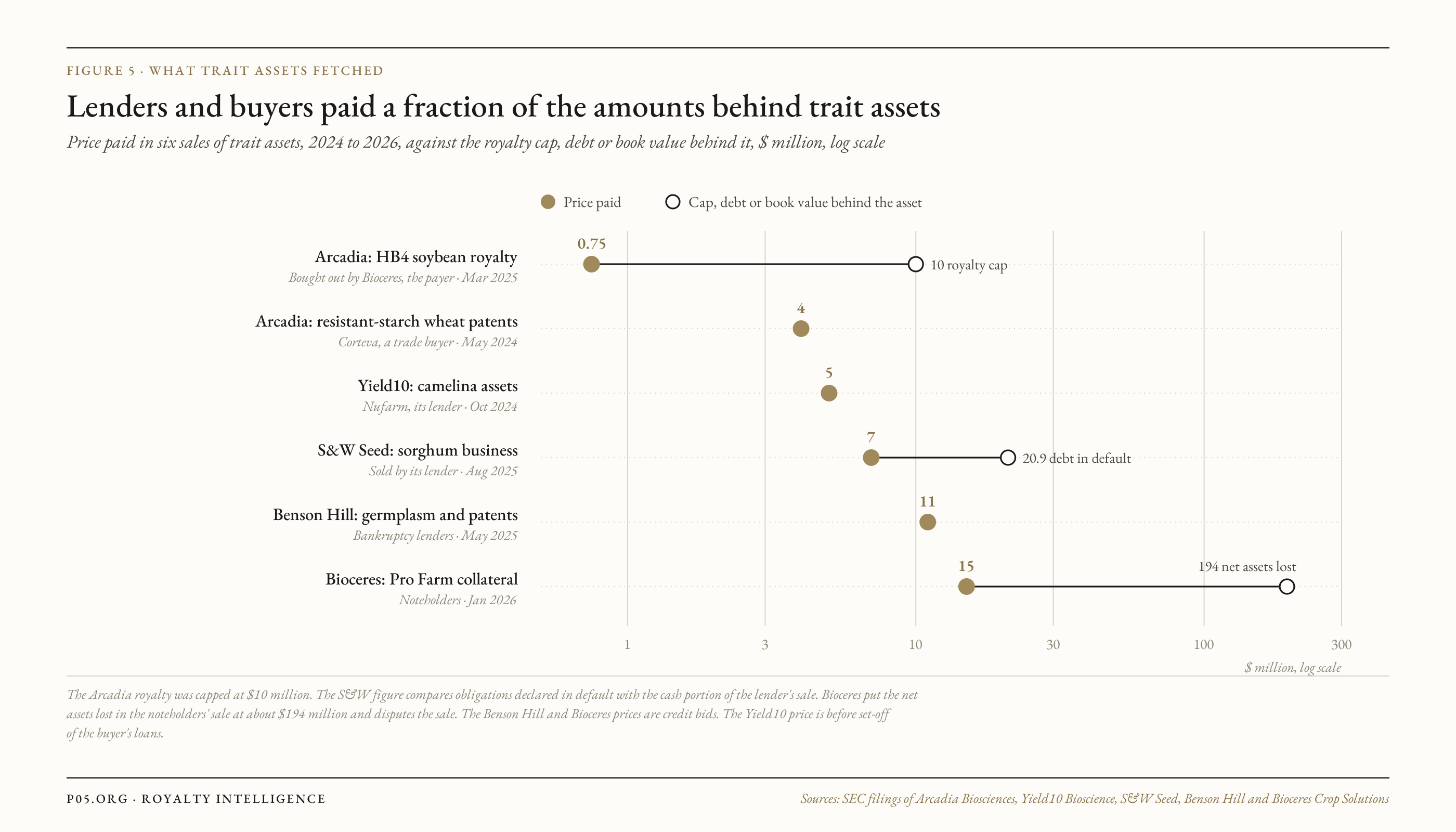
Figure 5. The price paid in six sales of trait assets, against the royalty cap, debt or book value behind three of them. The smallest, at $750,000, is the only sale of a royalty.
What each side should ask
For a buyer of a trait royalty
- Which patents does the product use, when does the last one expire, and does the licence tie any payment to a right that outlasts it?
- Who else has a claim on the developer's revenue or a lien on its patents, and will they release it?
- Can a regulator set the fee, or a court order it refunded, in the country where it is collected?
For a trait developer
- Is the licence assignable, and will the seed company agree to pay a buyer directly?
- Would a sale of the patents to a trade buyer raise more than a sale of the royalty, as it did for Arcadia?
For the payee of a settlement
- Is the money a fixed schedule owed by a rated payer, or a licence still to be negotiated?
- Does the settlement cancel royalties that someone else was counting on?
All information in this article was accurate as of the research date and is derived from publicly available sources including SEC filings, issuer press releases, court opinions, and legal and financial commentary. Information may have changed since publication. This content is for informational purposes only and does not constitute investment, legal, accounting, tax, or financial advice. The author is not a lawyer, accountant, tax adviser, or financial adviser.