
Nothing to trade: why nobody writes a derivative on a drug's sales

On 9 February 2023 Richard Gonzalez, AbbVie's chief executive, told analysts to expect "U.S. Humira sales down approximately 37%" that year. Humira had lost its American exclusivity at the end of January, the moment the industry calls a patent cliff, and cheaper copies known as biosimilars were arriving.
By December American sales had fallen by 34.7 per cent. A trader who had bet that sales would fall further than the company's own forecast would have lost money, even though the collapse had been announced in advance.
No such bet was on offer, because nobody sells exposure to the sales of a single drug. A royalty on a marketed drug can be bought or sold, and lenders will take it as security. Its owner can bet against the shares of the company that sells the drug, which is known as shorting them, though that is a bet on everything else the company sells too.
A bet on the drug's sales alone is not listed on any exchange or quoted by any dealer. It does not exist as a future, an option, an insurance policy or a swap, which is a contract in which two sides exchange one stream of payments for another. p05 searched exchange listings and public filings in America, the European Union, Switzerland and India and found none.
Plenty of investors hold the risk in concentrated form. Vertex's cystic fibrosis drugs accounted for 30 per cent of the current portion of Royalty Pharma's financial royalty assets at the end of June 2026. BioPharma Credit, a London-listed lender to drug companies, had 19.1 per cent of its net assets in a single loan to Insmed, against a limit for any borrower of 25 per cent of gross assets, a slightly different measure.
So p05 drafted the missing contract and priced it against three drugs since 2023. The contract is easy to write and probably legal in America for institutions, but it would have been of little use, because it pays on the gap between a company's forecast and its results, which is small beside the fall itself, and settles on a number that only the company can see in advance.
The investors who carry the risk already have cheaper ways of shedding it. This article describes the position on 5 October 2026.
What trades instead
The nearest thing on a trading screen is a share in a listed royalty company. Such a company holds a whole book of royalties, so an option on its shares says little about any one drug. Options that expire within days, which could be timed to a single earnings report, are out of reach.
A Cboe rule filing of January 2026 allows Monday and Wednesday expiries on a single stock only if the company is worth more than $700 billion and trades more than 10 million option contracts a month, and Royalty Pharma is worth about $26 billion.
Earlier articles here have covered the instruments that do trade: royalty bonds, the bond insurers' guarantees known as monoline wraps, development funding bonds, tokens and the contracts on drug approvals that Kalshi, a prediction market, launched on 16 July 2026. Each pays on a borrower's credit or a regulator's decision, or in the case of tokens has yet to pay at all. None pays on the sales of one product.
Royalty investors do profit from two gaps in price, neither of them in a single drug's sales. The first is in the cost of funding. In September 2025 Royalty Pharma sold 30-year notes at 128 basis points, or 1.28 percentage points, over Treasuries, while BioPharma Credit's loan to Insmed pays 9.60 per cent, a gap discussed in the article on the rate underneath the royalty.
The second is the takeover of a listed fund at a premium to its share price, which buys a whole portfolio. Concord agreed in September 2023 to pay a premium of 67.3 per cent for Round Hill Music Royalty Fund, Blackstone bid about $1.58 billion for Hipgnosis Songs Fund in June 2024, and in July 2026 Ligand bought XOMA Royalty.
European and Swiss law would admit the contract, though none has been written under either. MiFID II, the European Union's markets directive, covers derivatives "relating to assets, rights, obligations, indices and measures not otherwise mentioned", and Switzerland's Financial Market Infrastructure Act covers any financial contract "whose value depends on one or several underlying assets".
India's regulator admits a share to the derivatives segment only if it passes liquidity tests set in August 2024, which an unlisted royalty cannot do. Academic designs stop at approval. A working paper of 2017 by Andrew Lo and four co-authors designed hedges that pay when a drug fails a phase of approval, and said that they "do not aim to insure post-approval market risk".
The contract
The contract itself takes only a paragraph to describe. It names a drug whose American net sales the company reports every quarter. On the day of the trade the two sides fix a level of quarterly sales, called the strike. One side then pays a fixed sum each quarter, an agreed share of the strike, say 1 per cent. The other pays the same share of whatever the company goes on to report, so only the difference changes hands.
The side that receives the reported figure gains when sales beat the strike and is said to be long the drug, and the other side is short. With a strike of $2.9 billion and reported sales of $3.5 billion, the long collects $6 million. A cap, set here at a quarter of the fixed payment, limits what either side can owe in any quarter.
Because the contract refers only to a published number, nobody else has to agree to it. The drug's licensor is not a party and nor is any royalty holder, just as a company has no say over the credit default swaps, a form of insurance against default, that others write on its debt.
The paperwork would be the master agreement of the International Swaps and Derivatives Association, the standard form for privately negotiated derivatives, with each side posting collateral, the cash that secures a losing position.
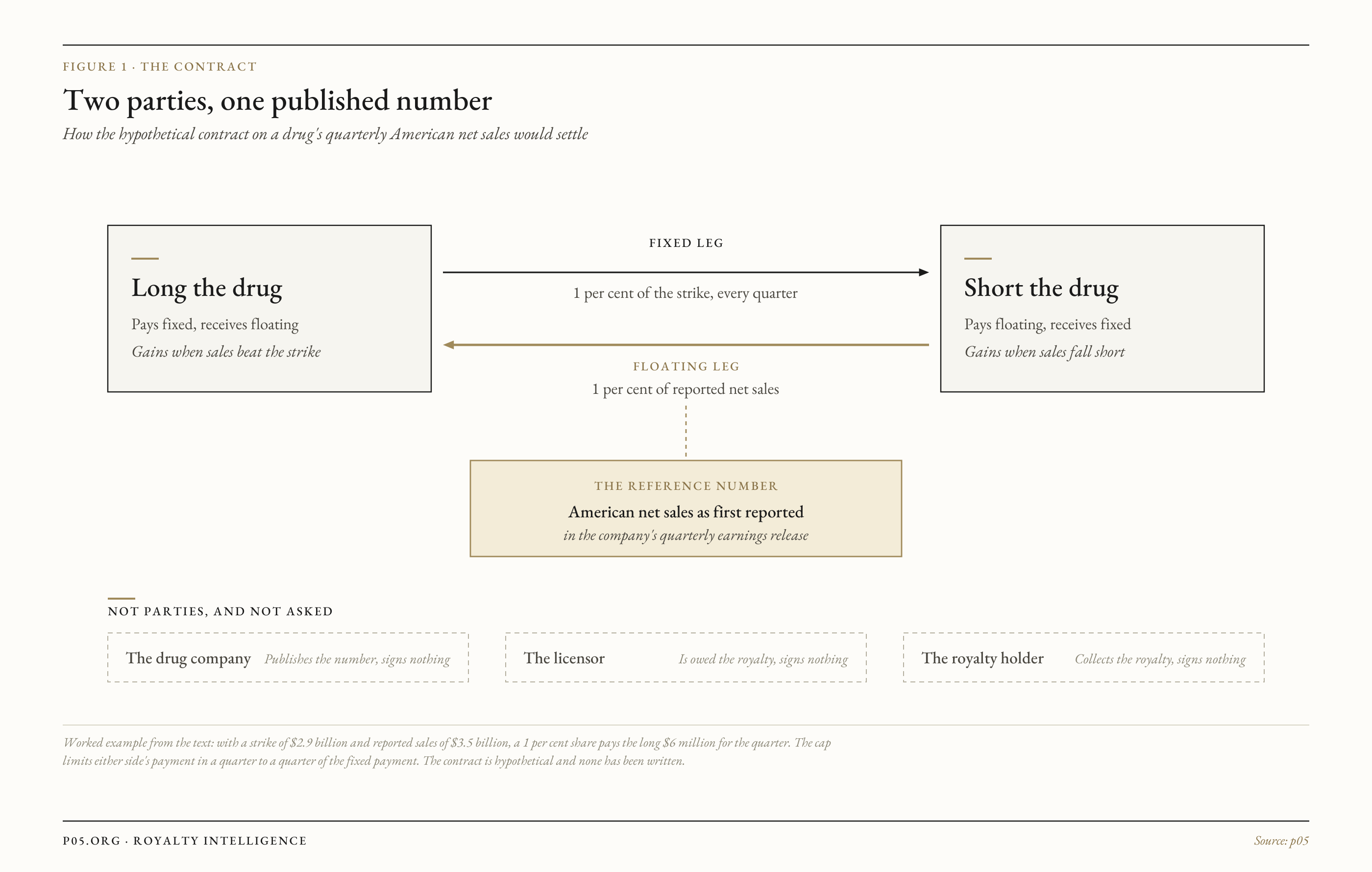
Figure 1. The hypothetical contract. Two parties exchange a fixed payment for a share of the sales the company reports, and neither the company, the licensor nor the royalty holder signs anything.
American law would probably treat the contract as a security-based swap. The Exchange Act gives that name to any swap based on "the occurrence, nonoccurrence, or extent of the occurrence of an event relating to a single issuer of a security". The event must be one that "directly affects the financial statements, financial condition, or financial obligations of the issuer", and a quarter's sales of a named product are a line in the issuer's revenue.
That is p05's reading, and no ruling exists to confirm it. If it is right, the contract falls to the Securities and Exchange Commission (SEC) and can be sold only to eligible contract participants, the statute's term for institutions and large investors, unless it is listed on a national securities exchange. Recasting the bet as an event contract of the kind Kalshi lists would not avoid the test, since a contract that pays when a drug's annual sales pass a threshold turns on the same line of the same company's accounts.
The same Act treats a security-based swap as a security, so Rule 10b-5, the anti-fraud rule, applies. The company knows each quarter's sales before it files them, and so would be trading as an insider if it took a side. A dealer must register once it writes more than $400 million of notional in a year, notional being the face amount on which payments are calculated.
The SEC has kept that level in place until 8 May 2028, after which it falls to $150 million. Banks also face a capital charge.
The Basel market-risk rules add 1 per cent of gross notional for instruments with an "exotic underlying", giving longevity, weather, natural disasters and future realised volatility as examples. Drug sales are not on that list, and p05 assumes a bank would apply the charge.
The nearest precedent, a contract on the takings of individual films, lasted five weeks. On 14 June 2010 the Commodity Futures Trading Commission approved contracts on box-office receipts proposed by Media Derivatives, and a fortnight later it approved a rival from Cantor Futures Exchange.
On 21 July, 37 days after the first approval, the Dodd-Frank Act became law and removed from the definition of a commodity "motion picture box office receipts (or any index, measure, value, or data related to such receipts)". Onions are the only other thing excluded by name, and drugs were left alone.
What it would have paid
p05 priced the contract against four episodes: Humira in 2023, Stelara in 2025 and again in the first half of 2026, and Eliquis in the first half of 2026. Each uses a share of 1 per cent and the cap. The strike is the previous year's average quarterly American sales, moved by whatever the company had told investors to expect, and payments are worked out on the figures as first reported, before rounding.
In every episode the patent cliff or the price cut was already in the strike on the first day. The money followed the gap between the company's forecast and its results, which was 2 percentage points for Humira and 13 for Eliquis, the two cases with a company forecast.
| Episode | Built into the strike | Strike per quarter | Reported American sales per quarter | Net to the short |
|---|---|---|---|---|
| Humira, 2023 | Fall of 37 per cent, AbbVie's forecast | $2.93 billion | $2.95 billion, $3.45 billion, $3.02 billion, $2.74 billion | Loss of $4.3 million |
| Stelara, 2025 | Fall of 35 per cent, taken from Humira | $1.09 billion | $981 million, $1.08 billion, $1.02 billion, $766 million | Gain of $4.7 million, after the cap withheld $500,000 |
| Stelara, first half of 2026 | Further fall of 50 per cent, p05's assumption | $481 million | $220 million, $336 million | Gain of $2.4 million, after the cap withheld $1.7 million |
| Eliquis, first half of 2026 | Rise of 12.5 per cent, midpoint of Bristol Myers Squibb's forecast | $2.88 billion | $3.08 billion, $3.36 billion | Loss of $6.7 million |
Sources: AbbVie, Johnson & Johnson and Bristol Myers Squibb earnings releases, linked in the table; p05 calculations on first-reported figures.
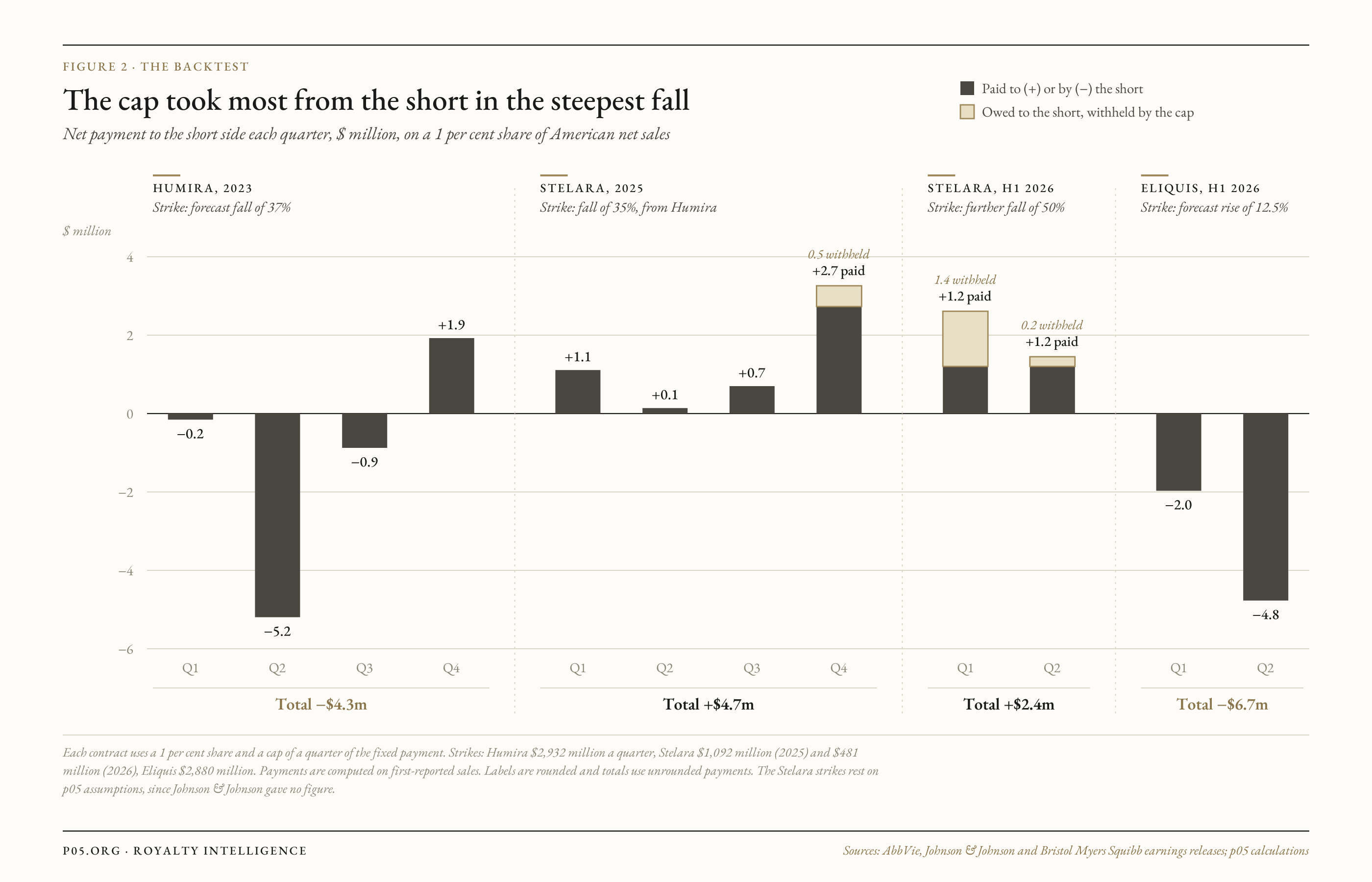
Figure 2. Net payment to the short side in each quarter of the four episodes, on a share of 1 per cent. The cap withheld $2.2 million across the two Stelara contracts.
AbbVie's forecast for Humira was too gloomy by 2.3 percentage points, on American sales of $18.6 billion the year before. That was enough to cost the short $4.3 million in a year when sales fell by a third. Most of the damage came in the second quarter, which alone cost $5.2 million, and the short paid out in three of the four quarters.
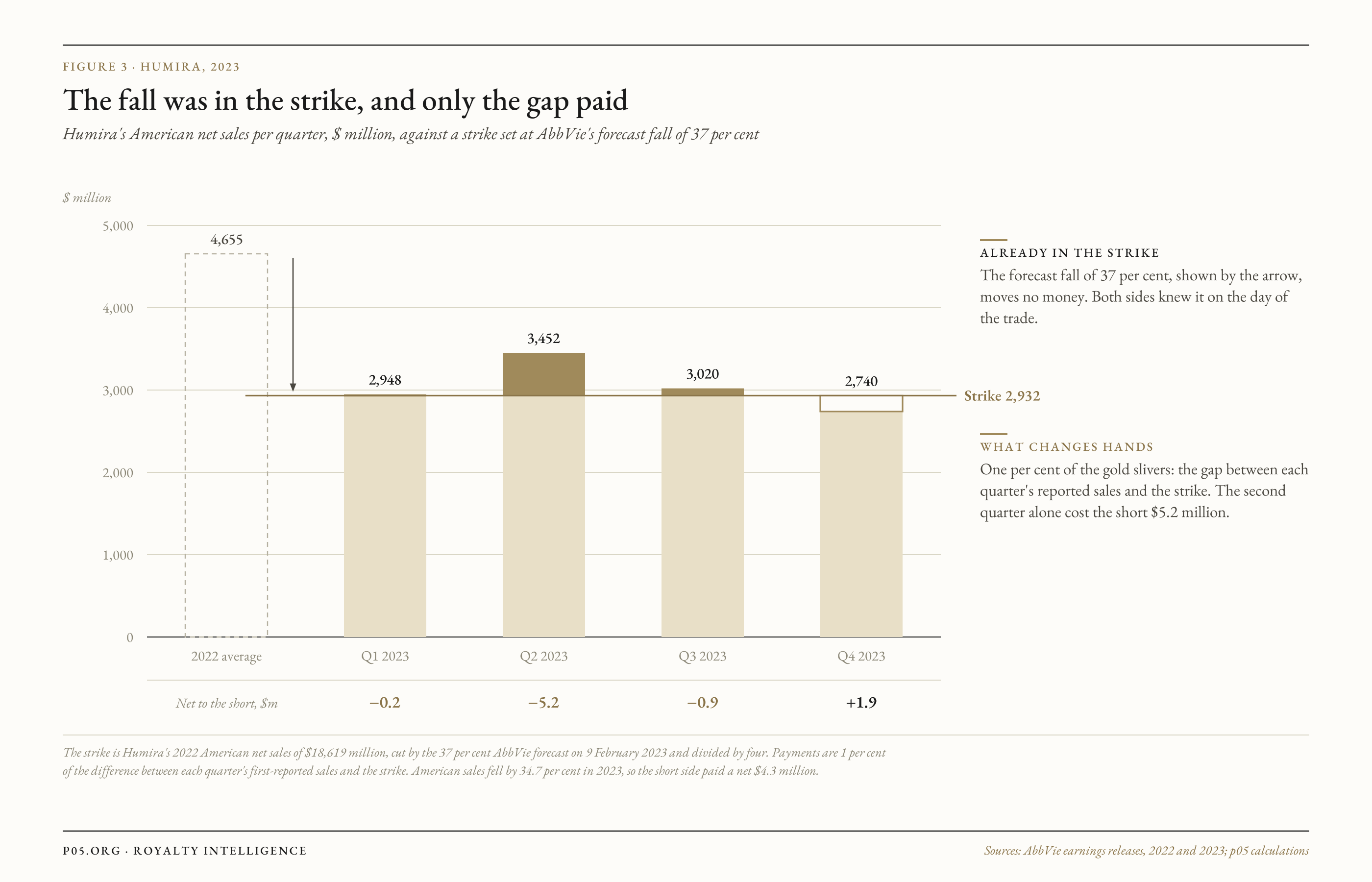
Figure 3. Humira in 2023. The forecast fall of 37 per cent sat in the strike from the first day, and payments followed only the gap between each quarter's reported sales and the strike.
Johnson & Johnson gave no figure for Stelara. Joseph Wolk, its chief financial officer, said on 22 January 2025 that "Humira's erosion curve, once faced with material biosimilar competition continues to be the best proxy for STELARA erosion with the additive impact of Part D redesign", so the test uses Humira's first-year fall, rounded to 35 per cent. Sales fell by 42.7 per cent and the short gained $4.7 million.
For the first half of 2026 there was nothing at all to strike against. p05 assumed a further fall of 50 per cent, and sales dropped by 71 per cent. The short was owed $4.1 million and received $2.4 million, because the cap, which is there to limit both sides' losses, removed two-fifths of the payout in the steepest fall of the four.
Eliquis sold more than forecast. On 1 January 2026 Medicare, America's public health scheme for the old, began paying a negotiated price of $231 for a 30-day supply, against a list price of $521 in 2023. Bristol Myers Squibb nonetheless forecast growth of 10 to 15 per cent in worldwide Eliquis revenue, which the test applies to American sales.
A short struck at the midpoint lost $6.7 million in six months, and in July the company raised its forecast to 20 to 25 per cent. Some companies give no forecast for a product at all, and Merck said of 2026 only that it faced "a headwind of approximately $2.5 billion from generic competition, IRA price setting and the restructured agreement for Koselugo", a figure that covers several products, among them the diabetes drug Januvia.
A contract that settles on a company's reported figure takes on that company's accounting adjustments. Generic copies of Entresto, a heart drug, arrived in America in the third quarter of 2025. For the first quarter of 2026 Novartis reported American sales of $72 million and for the second minus $2 million, against $1.22 billion in the second quarter of 2025.
Novartis had already attributed part of the fall in the last quarter of 2025 to "revenue deduction adjustments in the US, mainly related to Entresto and Promacta", which are corrections to the rebates and returns netted off sales. The contract therefore needs a floor at zero and a rule that later restatements are ignored.
Nor do reported sales always match the royalties paid on them. On 6 August 2025 Royalty Pharma said it "did not receive from Vertex the full amount of Royalty Receipts on Alyftrek net sales to which it is contractually entitled". Its managers told analysts the same day that they believed they were owed 8 per cent and had been paid 4 per cent, a shortfall that a contract on Alyftrek's reported sales would not have covered.
Who would take it
The short of American subprime mortgages before 2008, the trade recounted in "The Big Short", was built, like the contract tested here, from swaps negotiated one by one on named securities. It found takers because managers of collateralised debt obligations, which are pools of repackaged debt, needed those swaps as raw material. p05 could find no equivalent buyer for a contract on drug sales.
Health insurers and employers, known in America as payers, have the most obvious motive, since their bills rise when a drug sells well. Mercer's survey for 2026 found that 77 per cent of large employers rate managing the cost of GLP-1 drugs, the class that includes the new obesity treatments, as extremely or very important. So far they have responded by changing what they cover.
Blue Cross Blue Shield of Massachusetts told providers that from 1 January 2026 "GLP-1 medications will only be covered for type 2 diabetes". Excluding a drug from cover costs the payer no premium. The contract would also fit a payer badly, because it settles on a drug's national net sales, while a payer's bill depends on its own members and its own rebates.
The company that sells the drug cannot easily take the other side, because of the insider rule. When drug companies do sell sales risk they take cash up front, in a deal known as a synthetic royalty. In June 2025 Revolution Medicines agreed up to $1.25 billion of such funding from Royalty Pharma, and in November 2024 Geron took $125 million against a tiered share of Rytelo's American sales.
The buyer in these deals sees the company's books under a confidentiality agreement, which Regulation FD, the SEC's fair-disclosure rule, permits for "a person who expressly agrees to maintain the disclosed information in confidence". A swap negotiated on those terms would be hard to tell from a royalty financing.
Hedge funds might take a side for profit, since analysts' forecasts do miss. Humira's worldwide sales in the last quarter of 2024 were $1.68 billion and, as Zacks put it, "missed the Zacks Consensus Estimate of $1.94 billion". Entresto's worldwide sales a year later were $1.2 billion against a consensus of $1.5 billion, consensus being the average of analysts' estimates.
But a fund with a view on one drug can already trade the company's shares and listed options, without paying a dealer's spread and a bank's capital charge.
A lender such as BioPharma Credit would need a far larger contract than the one tested above. Covering a $300 million loan against a drug selling $12 billion a year in America would take a share of 10 per cent, because the cap limits the payout to a quarter of the fixed payments, which would then be $1.2 billion a year.
If that counts as the notional it is three times the dealer threshold, with a Basel charge of $12 million. Nor does the payoff match the risk, because a loan goes bad when a drug is withdrawn or its net price collapses, and the contract pays a little on every small miss.
Insmed had about $1.2 billion in cash and securities at the end of June 2026, against long-term debt of $544 million.
It had just raised its forecast for 2026 revenue from Brinsupri, its newer drug, to between $1.25 billion and $1.4 billion. With that much on the borrower's balance sheet, a shortfall of 30 per cent in sales would cost BioPharma Credit little. Its exposure is to a withdrawal of the drug, which a capped contract on sales would cover only in part.
Royalty funds protect themselves in the terms of each deal. DRI Healthcare, a Canadian royalty trust, held a put, the right to sell at a fixed price, on its royalty on Ekterly. It used the put on 10 July 2026 to hand the royalty back for about $178 million after Chiesi bought the drug's maker, a mechanism described in the article on puts in royalty financing.
Beyond such terms, a fund's return is its payment for carrying the sales risk of drugs, so a premium for outside protection comes straight out of it. The fund also knows more than any outsider, because it has the royalty reports and the audit rights. A counterparty asked to cover one asset out of 30 would assume the fund had picked its weakest and would price accordingly, the problem known as adverse selection.
A university, a hospital, an inventor or a small biotech company with one royalty is more exposed to a single drug than any fund. Such a holder sheds the risk by selling to a buyer that pays cash for an uncertain stream and spreads the risk across a portfolio, as an insurer would, charging for it through the discount rate.
Markets that last
Contracts on awkward numbers survive where the number is compiled by an outsider, or where the buyer is shedding a risk it is not paid to hold. Shipping's forward freight agreement, "a purely cash-settled contract with no physical delivery attached" in the Baltic Exchange's description, settles on indices compiled from shipbrokers "who do not invest in the markets they report".
In reinsurance, an industry loss warranty pays when the insured loss of a whole market passes a trigger. Howden Re, a broker, put the limit written on these in 2025 at about $6 billion, alongside a record $61.3 billion of catastrophe bonds, which pass disaster losses to investors.
The longevity swap is negotiated one deal at a time, as a contract on drug sales would be. A pension scheme pays a reinsurer a fixed stream and receives whatever its pensioners turn out to cost. Artemis, a trade publication, counted more than $41 billion (GBP 31 billion) of these in 2025 by early December, a record, including two of about $6.7 billion (GBP 5 billion) each for BT's pension scheme.
The number here comes from the buyer's own records, as it would with a drug company. But a pension scheme acquires longevity risk by employing people and has every reason to pass it on, while a royalty fund has chosen and paid for its exposure to a drug.
Written as insurance
Much of the securities law falls away if the contract is written as an insurance policy. The 2012 rule that defines swaps excludes a policy issued by a regulated insurer, provided the buyer has "an insurable interest", must prove a loss and cannot be paid more than "the value of the insurable interest". BioPharma Credit could therefore buy a policy that pays its proven loss once a drug's sales fall below a level set well under the forecast.
Royalty Pharma took a charge of $182 million on its royalty on Gavreto, a cancer drug, in the last quarter of 2022 "due to the uncertainty of Gavreto's commercial outlook", and DRI Healthcare wrote $13.7 million off its Vonjo royalty in 2025, blaming "negative competitive pressures in the U.S. myelofibrosis market and increased Part D discounts relating to the Inflation Reduction Act".
But the same Royalty Pharma release records charges of $274 million and $160 million on gantenerumab and otilimab, two drugs that never reached the market and so lay beyond any policy on sales. An earlier article covers how such charges are booked.
Insurers have offered something close only once, when in August 2013 Wells Fargo Insurance launched ANDAfend at Lloyd's to make good a shortfall in a drug's sales after a generic rival won a patent challenge. The trademark was cancelled in October 2020, and the products sold today cover neighbouring risks.
Starr became lead underwriter in November 2024 of a warranty that repays a payer when an expensive therapy fails a patient, and Swiss Re sells cover for business interruption without physical damage that responds to "pre-defined, loss-creating events" such as a cyber-attack. Each of these policies pays on an event that an outsider can certify. A fall in demand is not an event of that kind.
BioPharma Credit's loan to Insmed, valued at $218 million and paying 9.60 per cent, gives a sense of the price. Suppose a policy paid half the loan if sales fell below 70 per cent of the consensus forecast before the loan matures in three years. Investors in catastrophe bonds were earning 5.72 per cent in May 2026 for an expected loss of 2.39 per cent, or 2.4 times the expected loss, and the table applies the same multiple.
| Odds of a claim within three years | Expected loss a year, as a share of the loan | Premium at 2.4 times | Premium as a share of the 9.60 per cent coupon |
|---|---|---|---|
| 1 in 20 | 0.83 per cent | 2 per cent | 21 per cent |
| 3 in 20 | 2.5 per cent | 6 per cent | 62 per cent |
Sources: BioPharma Credit half-year report; Artemis; p05 calculations. The policy and the odds are assumptions.
The premium buys room to hold a bigger position. If a lender doubled a holding from 10 to 20 per cent of its book, and the money would otherwise earn 7 per cent, the added half would bring in an extra 2.6 percentage points, or 1.3 percentage points on the whole position.
That is less than even the cheaper premium. p05 also doubts that odds of 1 in 20 could be defended for a drug that faces generic competition or was launched recently, and those are the loans most likely to press against a concentration limit.
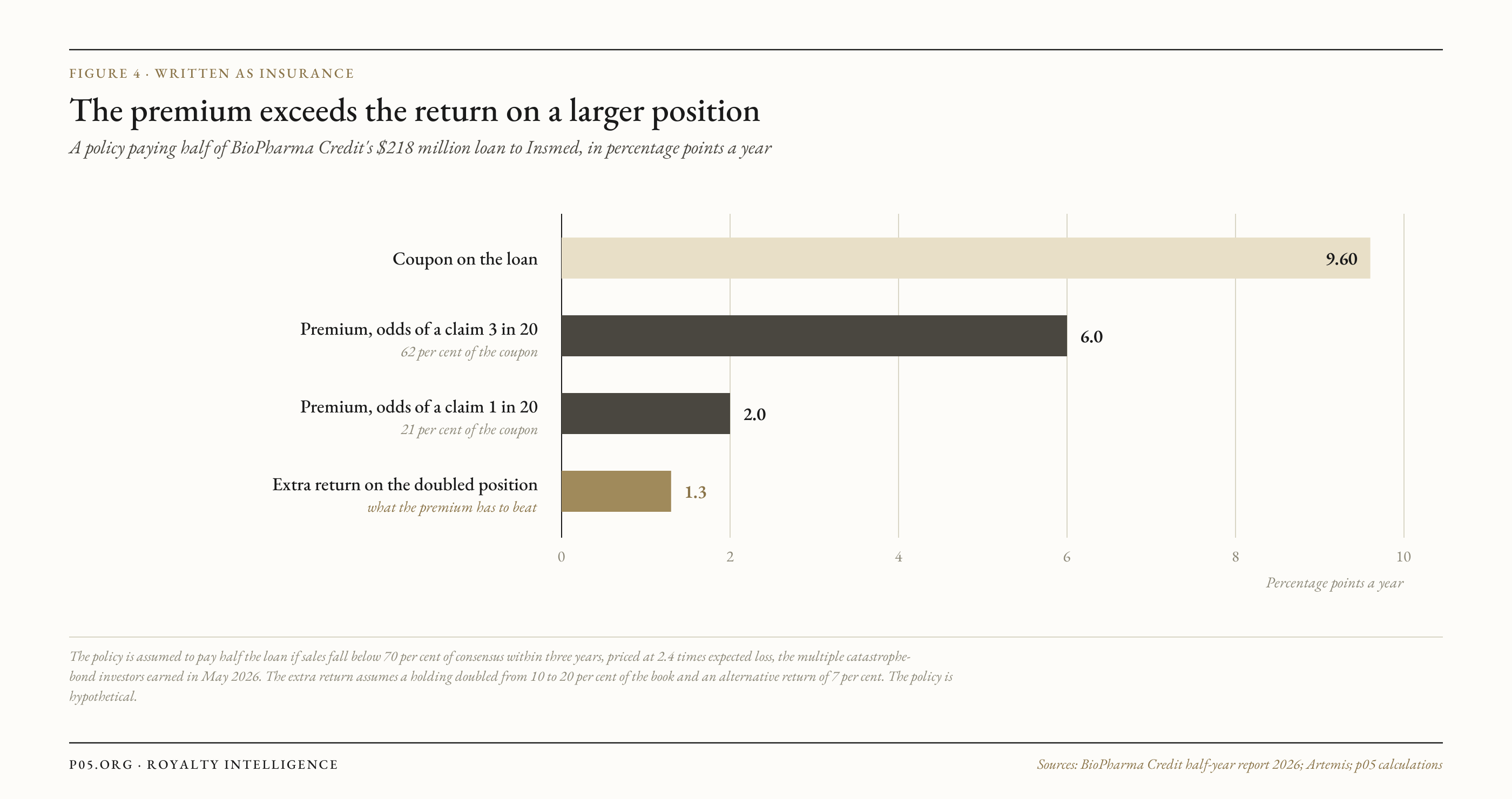
Figure 4. The annual premium on a policy covering half of the Insmed loan, at two sets of odds, against the extra return a lender would earn by doubling the position.
A European insurer that bought the policy would get no capital relief on an unrated loan. Solvency II is the European Union's capital regime for insurers. Its supervisor, the European Insurance and Occupational Pensions Authority, has said that under the standard formula "a guarantee by an insurance undertaking is not taken into account" in the spread-risk charge, the capital held against a loan's credit risk.
A bank may use the guarantor's risk weight, the factor that sets its capital, in place of the borrower's. As the article on Basel and the royalty warehouse found, however, a specialist insurer covering a single royalty stream usually fails the eligibility test.
What a market would need
The first requirement is a reference number that the drug company does not produce. Shipping gets its indices from a broker panel, and the equivalent for drugs would be an index of first-reported net sales by product, with deduction adjustments and restatements flagged.
An insurance version could instead use a trigger that an outsider can certify, such as a generic launch, a patent ruling, a withdrawal or a Medicare price, tied to proof of the buyer's own loss so that the policy stays on the insurance side of the 2012 rule. Even then somebody has to gain from buying.
The monoline wraps of the 2000s sold because they lifted a rating, and the closest candidate now is a bank funding a royalty book, in the cases where the insurer counts as an eligible guarantor.
Whether that demand exists can be measured. A manager would add up the positions cut back or turned down in the past two years because of a concentration limit, and work out what the full amounts would have earned. p05 has yet to find a manager who has published that sum, which is the amount a premium has to beat.
What each side should ask
For a royalty fund or lender
- How many positions in the past two years were cut back or declined because of a concentration limit, and what would the full amounts have earned?
- Does the risk on the largest position lie in a shortfall in sales, or in a withdrawal, a patent ruling or a Medicare price that an outsider can certify?
- Could a term in the deal itself, such as the put DRI Healthcare held on Ekterly, do the same work without a premium?
For the holder of a single royalty
- What would a sale of part of the stream raise, and at what discount rate?
- Do the royalty reports match the sales the marketer publishes, given the shortfall Royalty Pharma reported on Alyftrek?
For a dealer or insurer
- Who compiles the reference number, and how are deduction adjustments, negative quarters and restatements treated?
- Is each counterparty an eligible contract participant, and does either side hold sales information that the company has yet to publish?
- Does the buyer have an insurable interest and a loss it can prove, as the 2012 rule requires?
All information in this article was accurate as of the research date and is derived from publicly available sources including SEC filings, issuer press releases, court opinions, and legal and financial commentary. Information may have changed since publication. This content is for informational purposes only and does not constitute investment, legal, accounting, tax, or financial advice. The author is not a lawyer, accountant, tax adviser, or financial adviser.