
Nobody Holds It Long Enough: What Animal Health Royalties Need to Become an Asset Class
A royalty market can fail in three ways. There can be no cash flow, in which case there is nothing to discuss. There can be cash flow and no price, which is the biosimilar case: a stream exists, both sides can see it, and no number satisfies buyer and seller at once. Or there can be cash flow, a workable price, and no inventory.
Animal health is the third case, and it is the least discussed because it looks from the outside like the second. It is not. The economics here are better than most people assume. A veterinary royalty is cash-pay, unreimbursed, slow to erode, and paid by an obligor with an investment-grade-adjacent balance sheet. Rates run comparable to human deals. Nothing about the underlying asset makes it unfinanceable.
Three facts organise everything that follows.
A complete veterinary development programme, candidate to approval, costs about as much as one small revenue interest financing. The sector has been searched for royalties large enough to buy, when the correct trade was to create them.
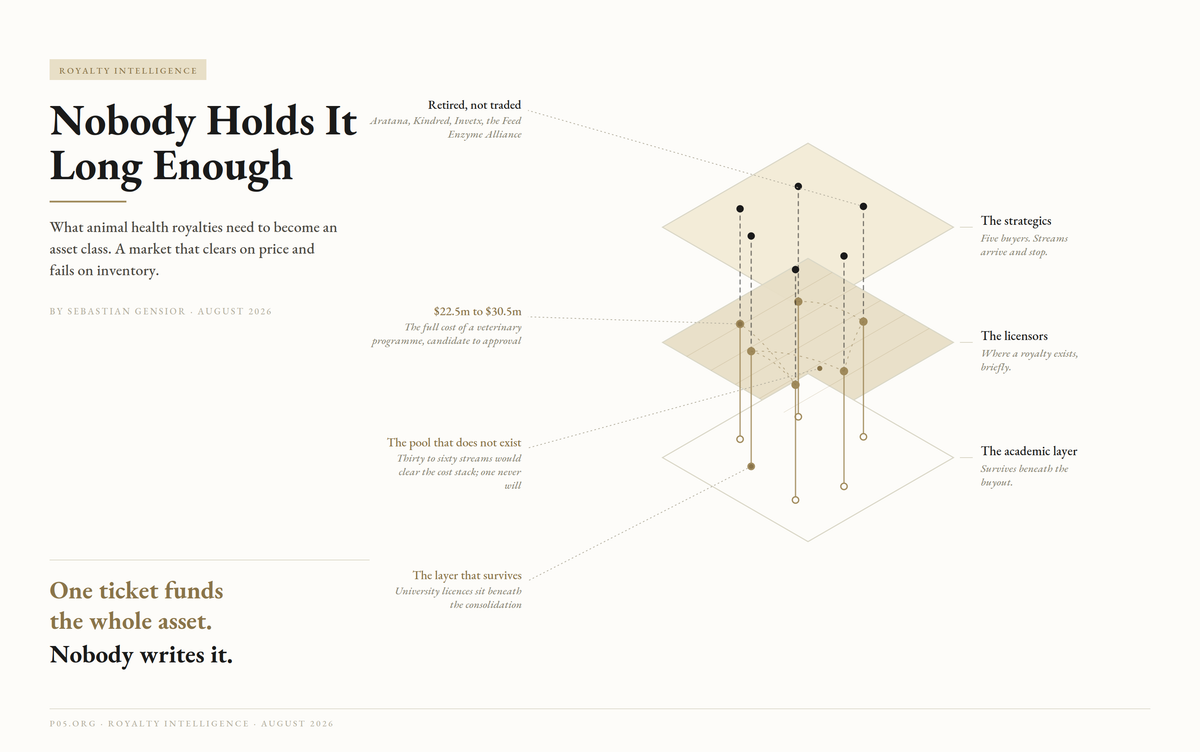
The sector is capital-starved rather than capital-rich, and the only substitute on offer takes the product. Founders who cannot raise sell to one of five strategics, which is why streams are retired rather than traded.
And the trade has already been done once, in 2021, by a credible product finance house. Nobody has replicated it.
This piece asks what would have to change, current to August 2026, and what 2027 specifically brings. It follows How Veterinary Royalty Deals Are Built, which set out the contract mechanics, and Global Royalty-Related Deals in Veterinary Pharmaceuticals, which counted what printed. Neither asked the structural question. It also extends the frame to the part of the sector that is larger than veterinary pharmaceuticals and gets no royalty attention at all, which is feed.
The frame: this is a supply failure, not a price failure
The biosimilar analysis organised itself around the bid condition, the requirement that a price exist which both sides prefer to their alternatives. That test disposes of biosimilars in ten minutes, because the observed cost of debt across the sector runs below any return a structured buyer requires.
Run the same test on animal health and it passes.
The evidence comes from the strategics themselves, in two transactions that price production-animal cash flow directly. In April 2024 Zoetis agreed to sell its medicated feed additive portfolio to Phibro for $350 million against approximately $400 million of 2023 revenue, more than 37 product lines across roughly 80 countries. Under 0.9 times sales, for a portfolio with decades of trading history.
In February 2026 dsm-firmenich agreed to sell its Animal Nutrition and Health business to CVC for an enterprise value of about $2.6 billion (EUR 2.2 billion), including an earnout of up to $590 million (EUR 0.5 billion), retaining a 20 percent stake.
The company's annual report records that the total ANH business represented roughly $4.1 billion (EUR 3.5 billion) of net sales and around $590 million (EUR 0.5 billion) of adjusted EBITDA in 2025, and that the divestment carried a non-cash impairment of roughly $2.2 billion (EUR 1.9 billion).
Read those as discount rates rather than as strategy. A seller accepting high single digits of EBITDA for animal nutrition assets is implicitly clearing at a low-to-mid-teens cash yield. That is the range a royalty buyer underwrites at. The band is not inverted here. It is empty, which is a different failure with a different fix.
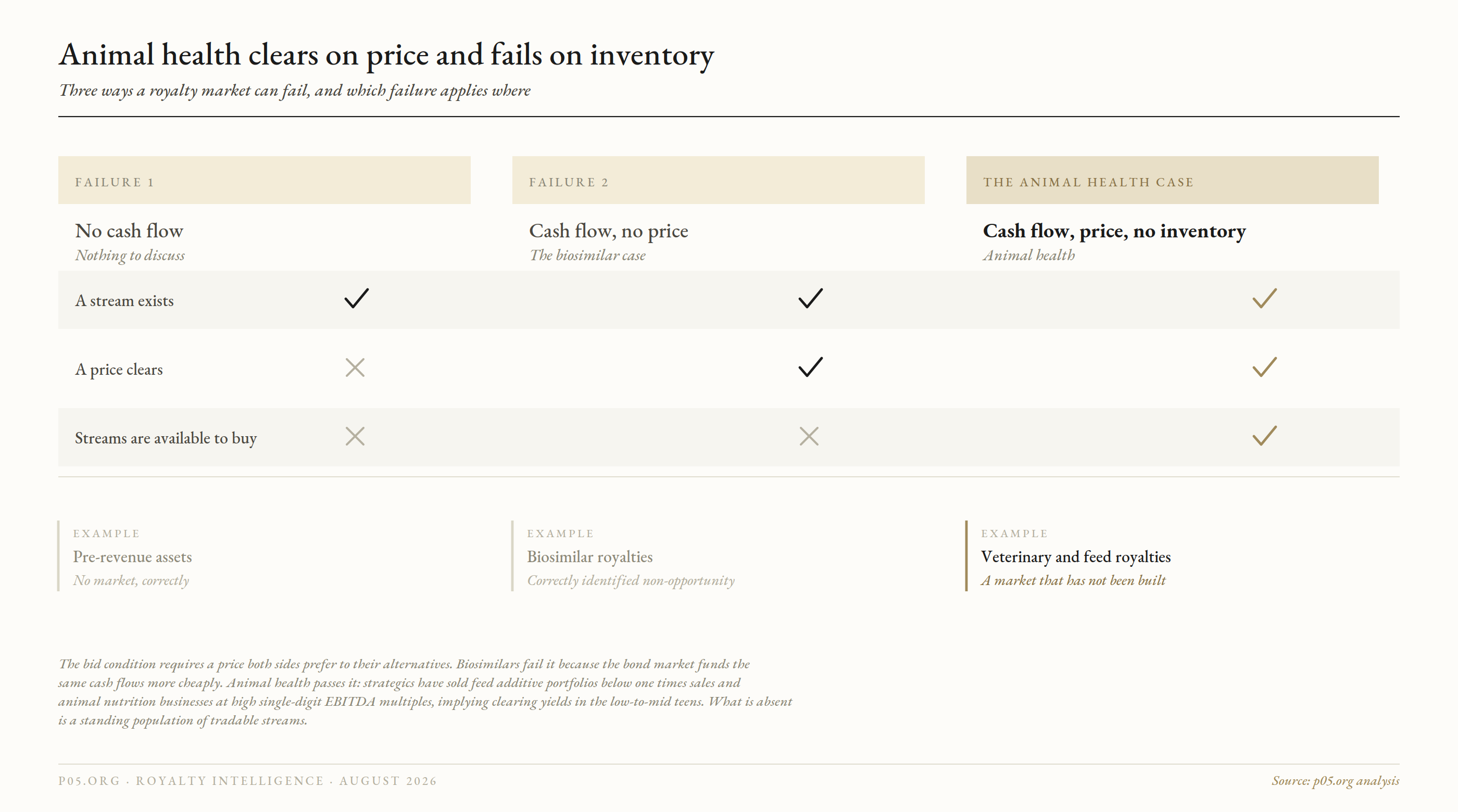
Figure 1. Three ways a royalty market fails. Animal health clears on price and fails on inventory.
Part one: the size of the thing nobody finances
Global animal health ran to roughly $67 billion in 2025, with production animals still the larger share of revenue and companion animals the faster grower. The market-sizing houses diverge widely on scope, from the low forties to the low seventies, so treat that as an anchor with a range attached.
Sitting alongside it, and almost entirely absent from royalty conversations, is feed. Animal feed additives were approximately $44.4 billion in 2025, moving to about $46.0 billion in 2026. The feed itself is an order of magnitude larger: $656.1 billion in 2025 rising to $685.9 billion in 2026, against world compound feed production of roughly 1.4 billion tonnes and commercial feed manufacturing turnover above $500 billion.
So the addressable revenue base across animal health and feed additives is on the order of $110 billion, before touching feed itself. Set against that:
- No dedicated animal health royalty fund exists.
- No rated veterinary or feed royalty pool has ever been issued.
- No pharmaceutical royalty buyer has disclosed a transaction whose underlying is a veterinary product.
The closest thing to an exception proves the rule. In May 2025 Elanco sold royalty and milestone rights on lotilaner in human health to Blackstone for $295 million, applying the proceeds to debt paydown. Blackstone's side has performed: Tarsus reported XDEMVY net product sales of $451.4 million for full-year 2025, up more than 150 percent, with stated peak potential above $2 billion.
Note what happened there. An animal health company originated the molecule, out-licensed it into human health, and monetised the resulting royalty. The transaction is a vet-sector transaction in every respect except the one that matters: the underlying product is a human eye drop. Nobody has bought a royalty on a product a veterinarian prescribes.
Nor is it that the long-tail aggregation model is unavailable. XOMA Royalty spent years building exactly that machinery and was absorbed into Ligand on 14 July 2026 at $39.00 per share, roughly $739 million of equity value plus a contingent value right, taking the combined platform past 200 royalty assets. Not one is veterinary, and the sector's most plausible natural buyer has now consolidated into a larger one with a larger minimum cheque.
Sizing the stock
Take the roughly $67 billion animal health market plus the roughly $46 billion feed additive market. From the deal census in the prior piece, the fraction of product revenue carrying an external royalty obligation is small: most large veterinary products are internally originated or were acquired outright.
Five to ten percent is a defensible band, giving $5.5 billion to $11 billion of royalty-bearing sales. At blended rates of 8 to 12 percent, that is roughly $450 million to $1.3 billion of annual royalty flows, consistent with the $650 million to $975 million the earlier census produced for the veterinary side alone.
Capitalise the midpoint at the 8 to 12 times current royalties that duration-favourable streams command, and the outstanding stock of animal health and feed royalty interests is worth something like $7 billion to $11 billion.
That is a real asset class by size and invisible in transaction terms. For scale, the human biopharmaceutical royalty transaction market reached a record $10.0 billion in 2025 alone. One year of trading there exceeds the entire estimated stock of animal health royalty value. That is the whole reason the incumbents cannot be the buyers here.
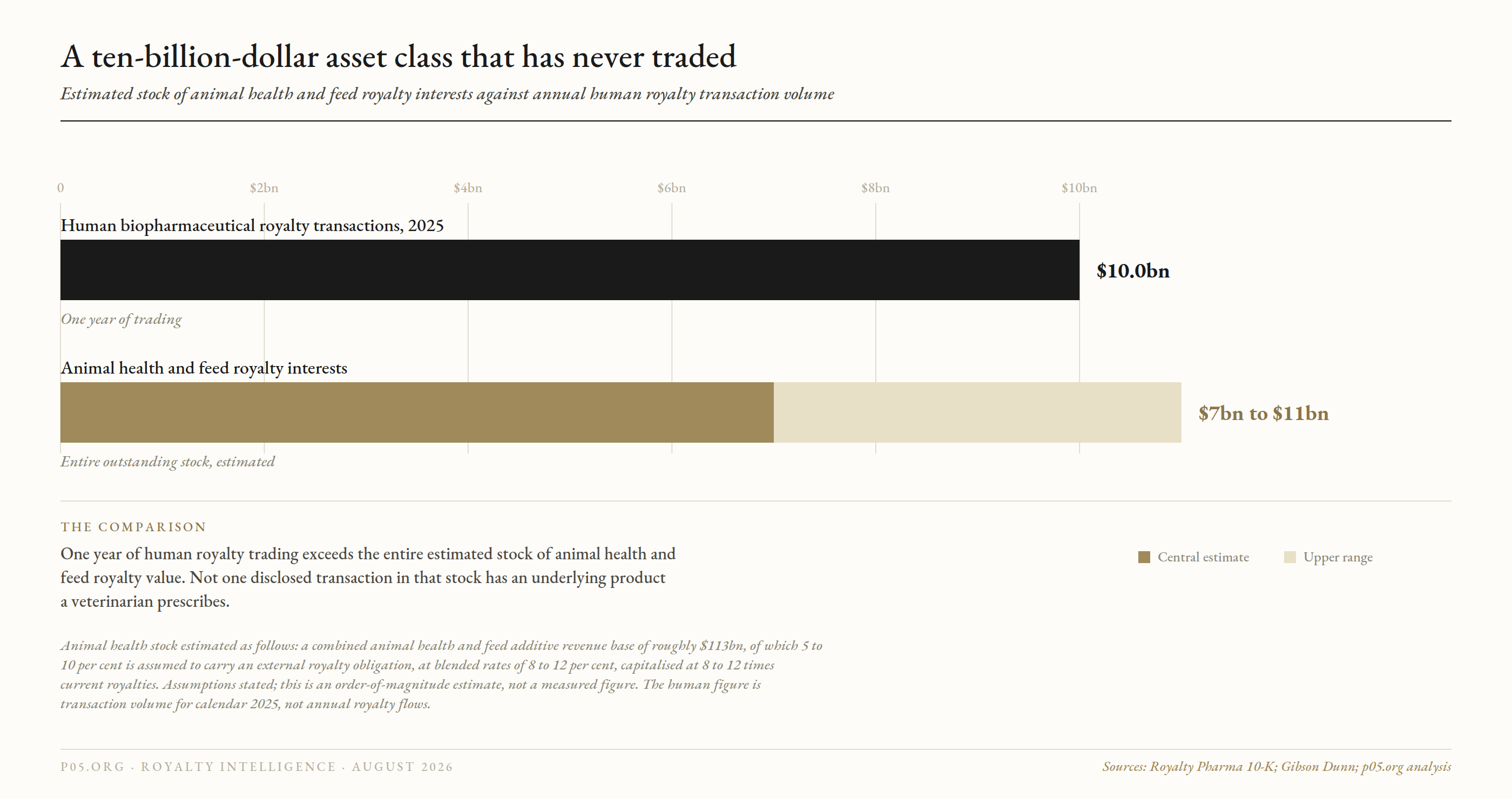
Figure 2. A ten-billion-dollar asset class that has never traded. Estimated stock of animal health and feed royalty interests against annual human biopharmaceutical royalty transaction volume.
Part two: the arithmetic nobody has run
Here is the number that reframes the sector, and it comes from the industry's own trade body rather than from a fund.
A HealthforAnimals study of the US market, cited by the Animal Health Institute, found that developing a drug with a new active ingredient takes on average 6.5 years and $22.5 million for a new companion animal pharmaceutical, and 8.5 years and $30.5 million for livestock, with costs as high as $62 million and overall development costs up more than 50 percent since 2011.
Figures cited at animal drug user fee reauthorisation hearings run higher, on the order of $50 million to $100 million, depending on scope and species. Call the honest range $25 million to $75 million and five to nine years.
Now put that beside the ticket sizes in the structured finance market that supposedly cannot serve this sector. Sagard's revenue interest financing with Marinus was $32.5 million.
XOMA's financing with Daré Bioscience was $22 million, combining a traditional royalty purchase with a synthetic royalty on two additional assets. SWK Holdings writes $5.0 million to $25.0 million per transaction.
A single small revenue interest financing funds an entire veterinary product from candidate to approval.
In human pharma, $30 million buys a fraction of one Phase III. The instrument is necessarily a slice of something larger, which is why the human market gravitates to nine-figure tickets and why sub-scale origination fails there. In animal health, $30 million is the whole asset.
That inverts the standard objection. The complaint that veterinary royalties are too small to finance holds only where the exercise is confined to buying seasoned streams. Applied to created royalties it says the opposite: the sector's development budgets are precisely the size the revenue interest market already writes, and nothing about the diligence cost stack changes.
The time dimension compounds it. A companion animal programme reaching revenue in six and a half years, against a human asset reaching revenue in ten to fifteen, means the created royalty starts paying inside a normal fund's hold period, not beyond it. Conditional approval compresses it further. In December 2025 the FDA granted full approval to an expanded Vetmedin indication that began under expanded conditional approval, the first time an animal drug indication made that transition. The pathway has been run end to end.
It has been done, once
One immediate objection: if the trade were available, someone would have taken it. Someone did.
In May 2021 Argenta, the animal health specialist contract research and development organisation, entered a $30 million product financing agreement with NovaQuest Capital Management for the development of several innovative veterinary pharmaceuticals. NovaQuest called it its first expansion of that structure into animal health.
The firm had pioneered at-risk, non-dilutive product finance in human biopharma, was then managing more than $2.2 billion, and was investing from a $1.2 billion fund at financing needs of $30 million to $100 million.
NovaQuest maintains a standing animal health strategy making product-specific structured finance investments alongside equity, and in November 2021 acquired TechAccel's stake in Covenant Animal Health Partners, a development vehicle formed with Reliance Animal Health Partners dedicated to registering revenue-ready animal health products and advancing them into industry partner portfolios.
So the structure is proven, the ticket size is exactly the $30 million Part Two predicts, and the counterparty was a development organisation, not a product company, which is itself instructive: NovaQuest funded the capability rather than a single asset.
Five years on, no comparable animal health book has been disclosed by any other buyer, no rated pool exists, and the transactions that do happen are individual and quiet. Whether that reflects an unexploited opening or an unfavourable experience nobody has published is not determinable from the outside, and the ambiguity is addressed below.
The precedent cuts two ways. A credible house executed the trade half a decade ago and the market did not follow, which is consistent with a constraint of origination and attention, not economics. It is also consistent with an outcome that was not worth repeating, and NovaQuest has published nothing either way. NovaQuest is the only comparable set available, and it is a set of one with an unobservable result.
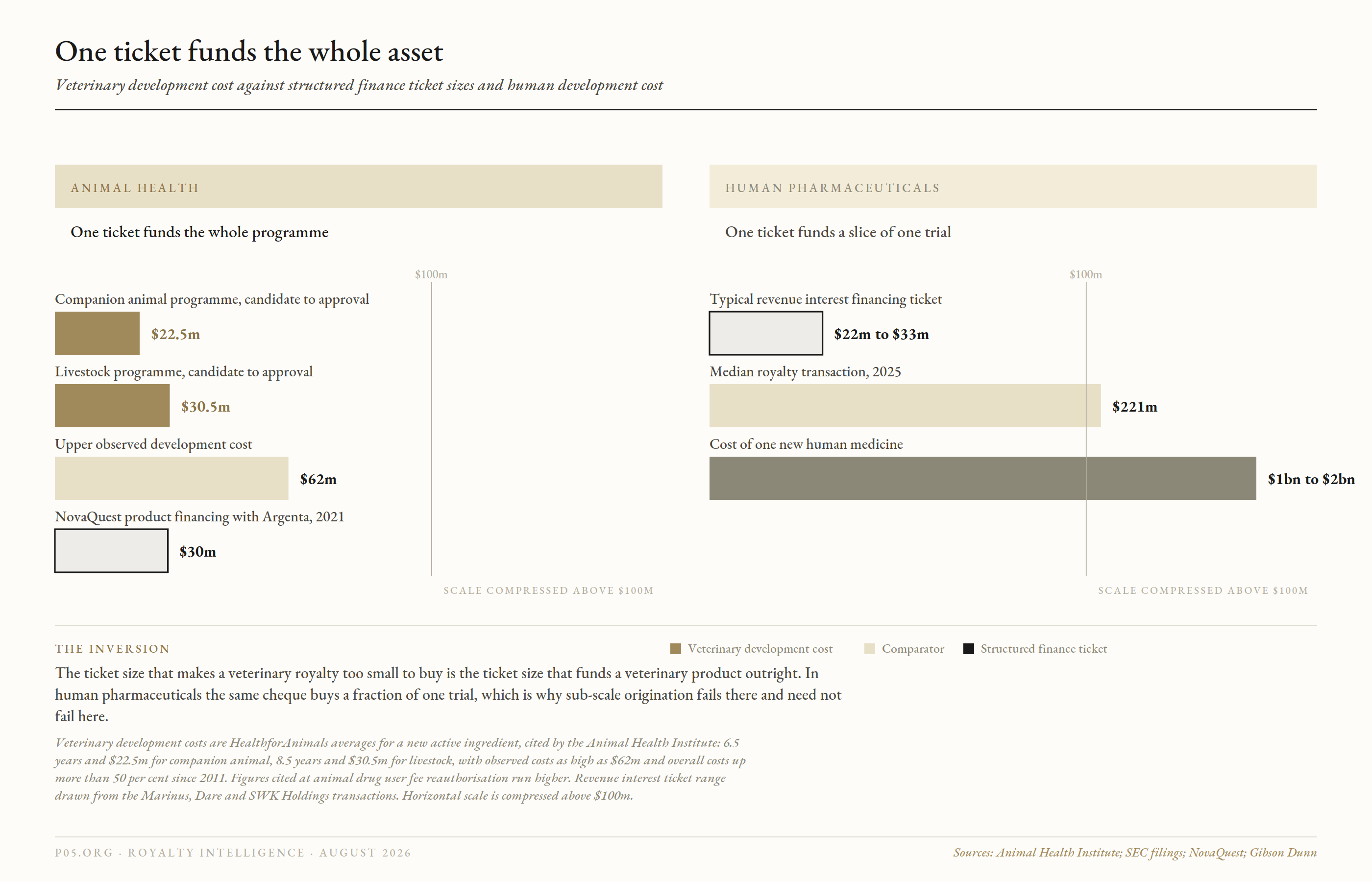
Figure 3. One ticket funds the whole asset. Veterinary development cost against typical revenue interest financing size and human pharmaceutical development cost.
Part three: why the inventory never accumulates
Four constraints get cited whenever this comes up. Three are real and surmountable. The fourth is binding and rarely named. A fifth explains why nobody is even looking.
I. Deal size, which is real for purchases and not for creations
The largest veterinary franchises top out where human blockbusters begin. Zoetis reported full-year 2025 revenue of $9.5 billion, with the Simparica franchise at $1.5 billion, dermatology at $1.7 billion and the osteoarthritis pain monoclonal franchise at $568 million.
Merck's animal health segment did $6.4 billion for 2025, with Bravecto at $1.1 billion. Boehringer Ingelheim's NexGard is around $1.5 billion (EUR 1.4 billion).
Those figures are already dated. In the first quarter of 2026 Zoetis reported US segment revenue down 8 percent with companion animal sales down 11 percent, the Simparica franchise down 1 percent globally to $385 million, the osteoarthritis pain monoclonals down 8 percent to $140 million, and full-year guidance revised down to $9.680 billion to $9.960 billion on organic growth of 2 to 5 percent.
Second-quarter results were scheduled for 6 August 2026. The direction matters more than the level for anyone underwriting a stream against these franchises.
Below those names the distribution falls away fast into the $100 million to $300 million band. That is a reason nothing prints one at a time as a purchase. Part Two is why it is not a reason nothing prints at all.
II. Data opacity, which is real and fixable
Veterinary majors disclose franchises, not products. Elanco reports Pet Health and Farm Animal with selected brands: $718 million and $633 million respectively in the second quarter of 2026, with the Advantage family at $154 million and Seresto at $117 million. Below that line there is nothing public at the granularity an underwriter needs.
The data exists in paid panels. Animalytix runs a census of the US and Canadian market, reporting on more than $13 billion of annual product movement sourced from the major distributors, and Kynetec's PetTrak builds from practice management system data. Neither is packaged as a diligence-grade dataset. That is a product gap, not an information gap, and the most tractable item on this list.
III. Contract architecture, which turns out not to be a problem
The RaQualia to Aratana grapiprant licence, filed as an exhibit to Aratana's registration statement, contains the full apparatus: a running royalty on net sales where a valid claim subsists; quarterly payment with quantity statements; an audit right with the standard cost-shift; assignment permitted on notice in connection with a merger or change of control; and a sublicence pass-through subject to a net sales floor, which became live when Aratana sublicensed Galliprant to Elanco.
The Advaxis to Aratana canine osteosarcoma licence, filed with Advaxis's 10-Q, grants an exclusive worldwide royalty-bearing licence with multi-tier sublicensing and audit rights flowing through to sublicensees. Pacira's disclosure of the Nocita arrangement records a tiered double-digit royalty on US net sales, up to $40 million of commercial milestones, effective until July 2033 with a five-year extension option.
The plumbing works. What is missing is the building.
IV. The acquisition reflex, which is the binding constraint
In veterinary pharmaceuticals, the terminal event for a successful royalty is not monetisation. It is the acquisition of the licensor by the licensee.
Elanco acquired Aratana in 2019 in a stock-for-stock transaction representing aggregate value of up to approximately $245 million including a contingent value right, and closed its acquisition of Kindred Biosciences in August 2021 at $9.25 per share, approximately $444 million, a transaction that built on the parties' existing licence of the global commercial rights to KIND-030.
Both collapsed royalty obligations into the acquirer's own P&L. Dechra acquired Invetx in 2024 for up to $520 million on a cash-free, debt-free basis, taking the half-life extension platform outright rather than licensing it.
The same reflex operates in feed, at ten times the size. In February 2025 Novonesis agreed to dissolve the 25-year Feed Enzyme Alliance and take over its sales and distribution activities for a total cash consideration of $1.56 billion (EUR 1.5 billion), completing that June, with dsm-firmenich receiving approximately $1.45 billion (EUR 1.4 billion) net of costs on activities representing roughly $324 million (EUR 300 million) of annual net sales.
A quarter-century of shared economics on a durable, growing product line, extinguished by a single cash payment at roughly five times sales. The stream did not trade. It became a line in someone's purchase price allocation.
Four knock-on effects follow. No seasoning, because the moment a stream demonstrates a financeable profile is the moment the licensee can justify buying the licensor. No comparables, because retirement produces no price discovery, which widens spreads without preventing a bilateral trade, as section VI sets out. Adverse selection, because what remains available to a financial buyer skews toward what the strategic declined.
And survivorship at the academic layer: when Ceva acquired Scout Bio in January 2024, the University of Pennsylvania's intellectual property licence went with the asset, now licensed post-acquisition to Ceva, and Penn disclosed it may result in future financial returns rather than being extinguished at closing. University royalties sit beneath corporate consolidation and persist. They are also small, individually unfinanceable, and numerous, which describes a securitisation pool.
V. The sector is capital-starved, and the only substitute takes the product
This is the part most often got backwards, including in an earlier draft of this piece. The intuitive story is that animal health founders have easy access to equity and therefore no need for structured capital. The evidence says the opposite.
Start with the incumbents. Zoetis spent $698 million on research and development in 2025 against revenue of $9,467 million, an intensity of 7.4 percent. Large-cap human pharmaceutical companies typically run two to three times that. The industry that would have to fund innovation internally spends proportionally half of what its human counterpart does.
Now the startups. Joseph Harvey, head of animal health at S&P Global, has tracked this sector since 2012 and puts the current population at between 500 and 600 animal health startups, up from two or three when he started, with 90 percent of the startups he speaks to saying there is not enough funding available.
The aggregate has not kept pace with the population: more deals, mostly small, with a handful of large rounds distorting the totals. The companies that did raise heavily, Loyal in pet longevity, Halter and Targan in livestock technology, all raised from outside the animal health investor base.
The structural reason is a mandate problem. In Harvey's account, very few human health investors have a remit covering animal health; they take a deal occasionally as an alternative opportunity, and if it does not work out they do not come back. The investor pool is small enough that a single failure removes participants: PetDx, a pet cancer diagnostics company, raised significant capital and failed, and the category was set back for years because outside investors read it as a signal about the space, not the company. Human biotech absorbs failures of that kind weekly. Animal health cannot.
Corporate venture is filling part of the gap and cannot fill much of it. Mars runs Companion Fund II at $300 million through Digitalis. Elanco announced Elanco Ventures on a $25 million multi-year commitment focused on pre-seed, seed and Series A, launching late 2026. That is one development programme, spread across years and a portfolio.
So the competing source of capital is not venture equity. It is the strategic. Harvey is explicit that success for an animal health startup at the later stage means being acquired by one of the big four or securing a commercial partnership with one, and that no animal health startup has yet built independent global commercial scale. Capital arrives with ownership attached because it is the only capital reliably on offer.
That is the same mechanism as the acquisition reflex, one stage earlier, and it sharpens the gap. A developer with a $30 million programme and a market where most rounds are far smaller has two options: dilute heavily into a thin investor base, or hand the product to one of five buyers on terms set without competitive tension. A revenue interest is the third option, and outside NovaQuest almost nobody offers it.
The demand-side conclusion is that the unmet need in this sector is not capital in general. It is capital that does not take the asset. That is a narrower and more defensible product than "financing for animal health", it is priced against a genuinely bad alternative, not a competitive one, and it is the reason a structured buyer here has pricing power rather than the reverse.
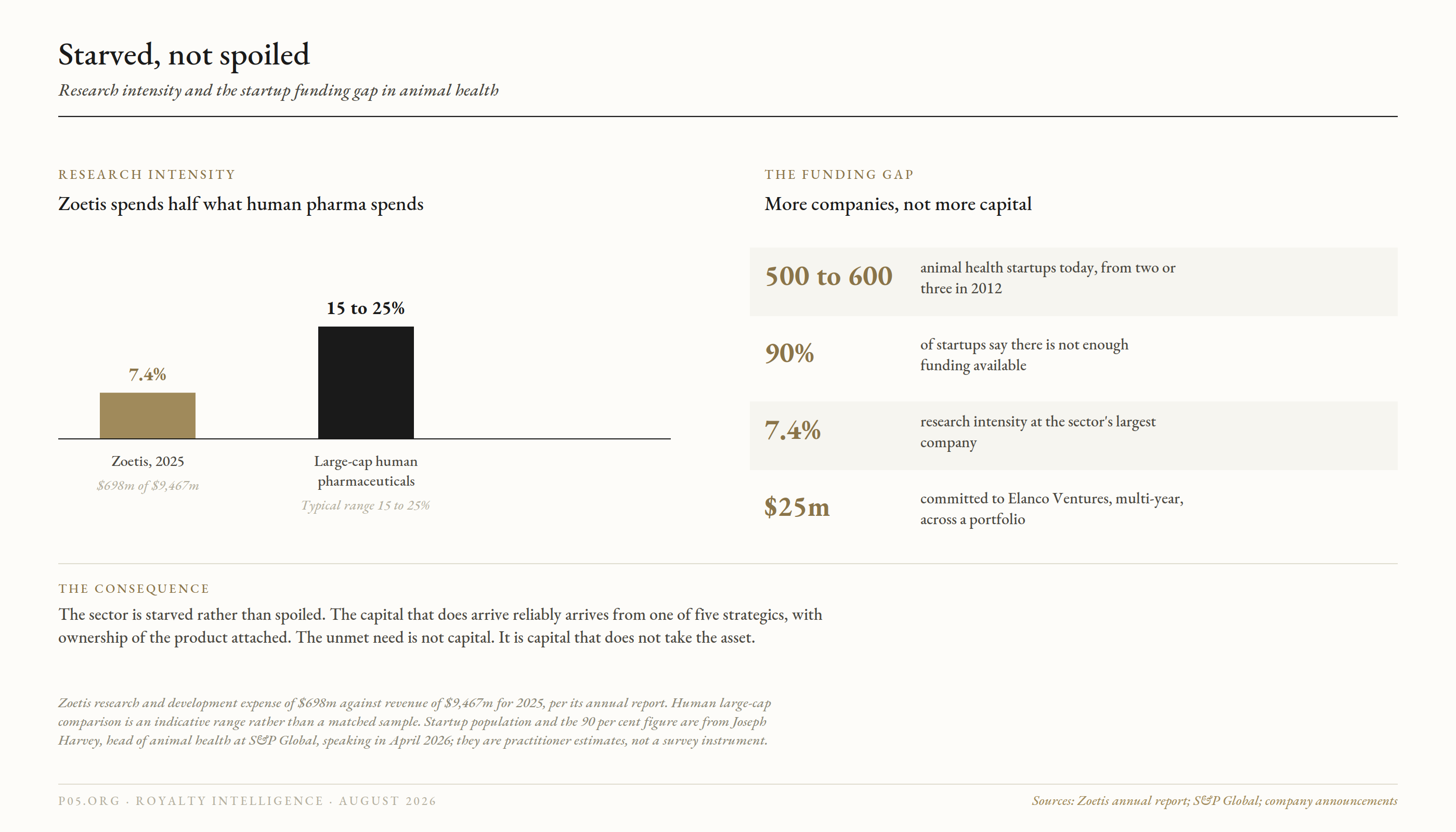
Figure 4. Starved, not spoiled. Research and development intensity at Zoetis against large-cap human pharmaceutical norms, and startup population against aggregate funding.
VI. Below the threshold is not the same as impossible
One objection has to be disposed of before it does any damage, because it is the reason the sector goes unexamined.
The objection is that veterinary royalties cannot be underwritten because the terms are invisible: developers are private, rates are redacted, there is no comparables set. Each part of that is either untrue or true of the whole royalty market rather than of animal health.
Rates are redacted everywhere. Since April 2019, Item 601(b)(10)(iv) has let any issuer redact terms that are immaterial and would likely cause competitive harm, without filing a confidential treatment request, and life sciences licence agreements were the category that drove the change. A human royalty buyer opening a licence exhibit finds the same black boxes. Nobody in this market prices off a published rate table; they price off the asset.
Nor are the deals invisible. One commercial tracker follows more than 280 animal health partnerships since 2017 with headline values, upfronts, milestones and royalties, and the underlying contracts where available. That is thin against human licensing, and it is not nothing.
What is actually true is narrower and duller. A $25 million to $40 million veterinary ticket sits below the threshold of most royalty funds and inside the mandate of a few. Nothing about that size is exotic even in human royalties: Covington's annual study of the monetisation market covers commitments from $15 million upward, and SWK Holdings runs an entire book at $5.0 million to $25.0 million per transaction. Deals of this size are ordinary. They are simply not worth a week of diligence to a team whose cost base assumes nine-figure cheques.
That is a statement about funds, not about assets. A mandate threshold is not a finding about whether veterinary cash flows can be financed, though it is sometimes presented as one. The animal health evidence points the other way: NovaQuest wrote $30 million against Argenta's veterinary development programmes in 2021 and built a standing vehicle in Covenant to originate more. The structure works at this size. It is under-supplied, not unproven.
Thin coverage does carry three genuine costs, and they are worth stating precisely because none of them is a reason not to transact.
Origination is relationship work rather than database work. Pipeline has to come from strategics' business development teams, university and tech transfer offices, the specialist venture funds already on these cap tables, contract development organisations, and the conditional approval docket at the Center for Veterinary Medicine. That is a cost, and it is also a moat, because it cannot be bought as a subscription.
Positions are held to maturity. No comparables means no mark, no syndication, no refinancing. That is a requirement on the capital, not the asset: permanent, evergreen or balance-sheet money works, and a ten-year fund reporting quarterly net asset value to an unfamiliar limited partner base does not.
Pooling and rating are deferred. A rated vehicle needs a data layer and a loss history. That constrains when this scales, not whether it starts.
Set against those costs is what the same conditions buy, which is the absence of competitive tension. The counterparty's realistic alternative is not a rival royalty offer. It is dilution into a thin equity market, or a partnership that takes the product. A bilateral negotiation with the only provider of non-dilutive capital in the room prices nothing like an auction.
The reading to take is that below-threshold and uncontested are the same condition described from two sides. The incumbents' absence is a mandate artefact, not a verdict on the assets, and it is what leaves the terms uncontested for whoever is willing to do the origination.
The real ceiling is size: a market whose outstanding stock is $7bn to $11bn and whose realistic decade-long deployment is a few hundred million dollars is a good business for a $200m to $500m vehicle and a poor one for anything larger.
Part four: feed, the larger and stranger half
The case for
The template is disclosed. In April 2022 DSM granted Elanco exclusive US rights to develop, manufacture and commercialise Bovaer, the 3-NOP methane-reducing feed ingredient, in exchange for a single-digit millions upfront payment, royalty income on Elanco's US sales and a portion of product supply, against a stated US opportunity above $200 million within an estimated $1 billion to $2 billion global methane-reduction market. The FDA completed its review in May 2024 and Elanco expanded the arrangement to Canada and Mexico.
A named originator, a large-cap licensee obligor, a defined territory, a disclosed royalty obligation, regulatory clearance in hand, and a policy tailwind.
Feed additive economics also flatter a royalty in three ways. No cliff in the pharmaceutical sense, because protection rests on formulation, process, strain ownership and trade secret, not composition of matter. No reimbursement, because the customer is a producer running a feed conversion calculation.
And a regulatory pathway that is being shortened: the Innovative FEED Act would create a statutory category of zootechnical animal food substance and route it through the food additive petition process rather than the new animal drug application, and Covington's practice note records that many stakeholders including FDA support it, with the agency intending to develop facilitating policies even if the bill does not pass.
The case against
Commodity transmission. Demand rides protein cycles, herd sizes and producer margin, and that volatility is a common factor across the sector rather than a diversifiable one.
No exclusivity floor. The regulatory lightness that shortens the pathway also shortens the moat.
Worse data than veterinary. Product-level feed additive revenue is disclosed nowhere and the customer base is fragmented across mills and integrators.
What the sector just told us about its own valuation
The dsm-firmenich exit is a pricing signal. The enzyme stake at $1.56 billion (EUR 1.5 billion), then the remaining ANH business at about $2.6 billion (EUR 2.2 billion) enterprise value on roughly $4.1 billion (EUR 3.5 billion) of net sales and around $590 million (EUR 0.5 billion) of adjusted EBITDA, with a $2.2 billion (EUR 1.9 billion) impairment along the way.
Two readings. Animal nutrition equity is cheap, which is why a private markets manager, not a strategic, ended up with it. And the implied cash yield at the point of sale sits in the low-to-mid teens, which is not a market where a 13 to 15 percent royalty underwrite is uncompetitive.
Note what dsm-firmenich kept. Bovaer moved out of ANH into Taste, Texture and Health rather than going with the rest. The company divested the volume business and retained the royalty-shaped one.
Part five: 2027
Most of what would change this market is already scheduled.
A large, levered, sponsor-owned animal nutrition platform comes into existence. The CVC transaction is expected to complete at the end of 2026, splitting ANH into a standalone Essential Products Company and a standalone Solutions Company, with dsm-firmenich retaining 20 percent of each and providing a loan facility of up to roughly $530 million (EUR 450 million). Leveraged, sponsor-owned, carve-out, defined exit horizon, portfolio of licensed products. That is the standard profile of a first-time non-dilutive seller.
The distribution layer consolidates, and with it the data. In February 2026 Cencora and Covetrus agreed to merge MWI Animal Health with Covetrus at an enterprise value of $3.5 billion, with Cencora taking $1.25 billion of cash, $800 million of preferred equity and a non-controlling 34.3 percent common stake, not expected to close before 30 September 2026.
The product-level census data this sector lacks derives from distributor sell-through. Combining the two largest US companion animal distributors concentrates it, alongside practice management software. Anyone building the underwriting dataset will from 2027 be negotiating with fewer, larger counterparties.
The livestock data layer consolidates too. Zoetis agreed on 2 March 2026 to acquire Neogen's animal genomics business for $160 million, a unit generating roughly $90 million of sales in Neogen's 2025 fiscal year, with completion expected in the second half of 2026. The Australian competition regulator moved the transaction to a Phase 2 review in 2026, with submissions invited to 31 July, so timing is not settled.
The pattern is the same as in distribution: the parties who hold the underlying data are consolidating, and the counterparty set for anyone assembling an underwriting dataset gets smaller each year.
Elanco finishes deleveraging and keeps proving the trade. Net leverage reached 3.1 times at the second quarter of 2026, with full-year revenue, EBITDA, EPS and leverage targets all raised, against a December 2025 commitment to double revenue from six potential blockbusters between 2025 and 2028.
Elanco now excludes royalty revenue sold to a third party from its organic growth reconciliation, which is to say the Blackstone transaction created a permanent reporting line. Befrena, its anti-IL-31 monoclonal, is supply-constrained with unconstrained supply not expected until early 2027.
Conditional approval assets reach market. Loyal's LOY-002 has FDA acceptance of two of three technical sections, with chemistry, manufacturing and controls outstanding. Okava and Vivani Medical dosed the first cat in the MEOW-1 study of OKV-119 in December 2025, under an arrangement in which Vivani retains milestones and royalties.
Loyal is also the sector's bellwether in a stronger sense: a large exit would bring human health investors into animal health for the first time, and a visible failure would set the whole companion animal therapeutics category back, on the PetDx precedent.
Veterinary biologics stops being a monopoly. Elanco has launched Zenrelia and Befrena, Dechra is building on the Invetx platform, and a tier including Akston, MabGenesis and Vetigenics is advancing. Competitive entry means more in-licensed assets and more platform licences, because no single company owns all the relevant antibody technology.
Read together, these make a two-window market. The first window is now through 2027, in pre-commercial and conditional approval assets, where royalties can be created rather than bought and where the strategics are not yet competing for the paper. The second opens only once a data layer and a comparables set exist, which is a 2028 question. A fund that waits for the second will find the first has closed, because these developers will by then have been bought.
Part six: the structural options, and what each would require
Five structures are available to anyone approaching this sector. None is novel finance. Each has a precedent, and each has a specific requirement that has so far gone unmet.
Creation rather than purchase. A full veterinary development programme costs one revenue interest ticket, so the instrument that funds a slice of a human trial funds an animal health asset outright. The templates are filed and the precedent exists in NovaQuest's arrangement with Argenta. What it needs is a pipeline of private developers, built through relationships instead of screening.
Obligor substitution. In a typical veterinary licence the credit-strongest party is the licensee, not the licensor holding the royalty. A royalty restructured as a direct payment obligation of Zoetis, Elanco, Merck Animal Health, Boehringer Ingelheim or Ceva, with the receivable assigned and the assignment acknowledged, converts small-cap developer credit into large-cap trade receivable risk with a volume kicker.
On this reading counterparty concentration turns from a weakness into a strength, and the filed agreements already permit assignment on notice. It would also blunt the acquisition reflex, since buying the licensor does not extinguish an acknowledged direct obligation as cleanly. All it needs is one licensee willing to sign an acknowledgement. No disclosed transaction has been structured this way.
Drafting that survives the buyout. Three provisions carry the weight: change-of-control language keeping the royalty alive and assignable; an explicit buyout formula at a defined multiple of trailing royalties instead of left to negotiation; and survival on divestment or sublicence, which is what carried the Penn licence through the Scout Bio sale.
The buyout formula is the interesting one, because it caps the licensor's downside in a takeout and, incidentally, generates the disclosed price points the sector has never produced. It only works if negotiated before a stream becomes valuable, not after.
A data layer. Product-level veterinary revenue exists in the Animalytix and Kynetec panels but has never been reconciled to reported franchise revenue and packaged for underwriting. It needs a two-year build with a documented methodology, and the MWI and Covetrus combination makes the counterparty set smaller after 2027.
Pooling. Individually these streams are too small and too idiosyncratic to finance; collectively they have the shape rating agencies already underwrite. KBRA's whole business securitisation methodology covers transactions collateralised by substantially all of a company's revenue-generating assets, and Jersey Mike's issued $760 million of BBB-rated notes in its 2026-1 transaction, with net franchise royalties accounting for 52.9 percent of securitised revenues, off a master trust established in 2019.
On the intangible side KBRA has rated more than $12.9 billion of music royalty bonds across 18 issuers since 2020. The transferable features are diversification counts, coverage tests, master trusts, servicers, and a methodology that treats predictable decay as amortisation, not hazard, which suits a shallow veterinary erosion curve better than it suits a human blockbuster.
A first pool of 30 to 60 streams mixed across companion and production animal, to break the commodity correlation, would support $150 million to $300 million of paper. It needs a seasoned inventory, which is exactly what the acquisition reflex removes.
Two risks sit underneath all five and are priced by none of them.
The first is generic erosion, which the shallow-cliff reading has probably underweighted. There is still no large global veterinary generics company, and erosion has historically been slow. But Zoetis disclosed in the first quarter of 2026 that Convenia and Cerenia, two blockbusters, had lost meaningful share to price-driven generic competition. Slow is not the same as absent, and a stream underwritten on a twenty-year tail is exposed to a change in that pattern.
The second is a safety or perception event in a cash-pay category with no reimbursement buffer. Librela is the worked example: the FDA issued a Dear Veterinarian Letter flagging neurological and other adverse signs, with the adverse event database holding thousands of reports; Zoetis updated the US label in February 2025; and US Librela revenue fell 16 percent in 2025 within an OA pain franchise that declined to $568 million. A model carrying a smooth erosion curve and a single patent expiry event captures neither of these.
What would make this reading wrong
The argument above has a shape that should make a reader suspicious: every constraint examined turns out to be surmountable, and the conclusion is that an unexploited opening exists. Six things would falsify it. Three of them cannot be observed from outside.
The silence may be informative. NovaQuest wrote $30 million against Argenta's veterinary programmes in 2021 and has published nothing about how those programmes performed. Private product finance returns are not disclosed. An absence of imitators after five years is consistent with an overlooked opening and equally consistent with a disappointing one, and there is no way to distinguish the two from the public record. Anyone treating the NovaQuest precedent as validation should hold that reading loosely.
The buyout can be triggered against the holder. A created royalty on a successful asset invites the licensee to buy the licensor, and if a buyout formula is in the document the holder receives a defined multiple instead of the stream. That caps the upside precisely where the underwriting assumed it. The structure that protects against a value-destroying takeout also removes the tail that justified the position.
The erosion assumption may be softening. Much of the case for veterinary royalties rests on a shallow decay curve. Convenia and Cerenia losing meaningful share to price-driven generics in early 2026 is the first visible crack in that assumption at blockbuster scale. If generic entry in animal health starts to behave more like the human pattern, the duration argument that makes these streams attractive weakens at the same time as the ticket sizes stay small.
Sentiment risk is fast and large. Librela lost 16 percent of US revenue in a year on adverse event reporting and a label change, without generic entry. A pool of 30 to 60 streams diversifies idiosyncratic product risk but not the category risk that pet owners and veterinarians respond to safety reporting more sharply than payers do.
A single visible failure can close the window. PetDx raised significant capital, failed, and set back pet cancer diagnostics for years because the investor pool is too small to absorb it. Loyal occupies a similar position now. A failure there would reduce the supply of financeable developers at the same moment it raised the cost of capital for the survivors.
The pricing advantage may be temporary by design. Elanco Ventures, Mars Companion Fund II and the strategics' own business development teams are all expanding into the same early-stage gap. If a strategic decides that offering non-dilutive capital is cheaper than acquiring, the absence of competitive tension that makes these terms attractive disappears without the market ever becoming large enough to compensate.
The honest position is that this is an under-examined sector with sound underlying cash flows, a demonstrated structure, and no disclosed track record. Those are not the same thing as a validated opportunity.
Comparative summary
| Constraint | Mechanism | Severity | Addressed by creation, pooling or obligor substitution? |
|---|---|---|---|
| Deal size | $20m to $40m tickets carry a full legal and diligence stack | Real for purchases only | Yes, a full vet programme is one normal ticket |
| Time to revenue | 6.5 to 8.5 years, faster under conditional approval | Advantage, not constraint | Not applicable |
| Data opacity | Franchise-level disclosure; product data in paid panels | Real, tractable | Partly, needs a data build before 2027 |
| Contract architecture | Audit, reporting, assignment terms already standard | Not a constraint | Not applicable |
| Acquisition reflex | Streams retired by licensee acquisition of licensor | Binding | Partly, direct obligor structures survive it |
| Capital scarcity | 90 percent of startups report insufficient funding; no investor mandates | Source of demand rather than obstacle | Yes, this is the demand side |
| Strategic as substitute | Capital available only with ownership attached | Binding on the seller | Yes, this is the product being sold against |
| Thin rate disclosure | Redaction is universal in life sciences, not sector-specific | Not a constraint | Not applicable |
| Below fund thresholds | $25m to $40m sits under most mandates, inside a few | Mandate artefact, not a verdict on the asset | Yes, with fewer competing bids as the corollary |
| Fund-scale ceiling | Deployable capital is a few hundred million over a decade | Binding on who can participate | No, this defines the vehicle rather than the trade |
| No comparables | No trades means no price discovery | Costs exit and marking, not pricing | Partly; it also suppresses competing bids |
| Commodity transmission (feed) | Protein cycle is a common factor | Real, sector-specific | Yes, by mixing companion and production animal |
| Sentiment-driven impairment | Cash-pay category, no reimbursement buffer | Underpriced | No, a modelling change |
The shape of the answer
The animal health royalty market does not exist, and none of the reasons is that the cash flows are bad or that the transaction cannot be priced.
The streams get bought before they can be sold. The natural buyer of a proven veterinary royalty is the company paying it, so every asset reaches the point of being underwritable and the point of being acquirable at the same moment.
The tickets sit below the threshold of nearly everyone who could write them. A $25 million to $40 million veterinary deal carries the same legal and diligence stack as one ten times the size, which prices it out of a fund built for nine-figure cheques and prices it comfortably into a specialist one. That is a fact about mandates, not about assets, and it leaves the terms uncontested for whoever is willing to do the origination.
And the sector is starved rather than spoiled. Zoetis spends 7.4 percent of revenue on research and development. Nine in ten startups say they cannot raise enough. Human health investors have no mandate here and leave after one bad outcome. The capital that does arrive reliably arrives from a strategic, with the product attached.
That last fact reframes the constraint rather than confirming it. The scarce thing is not capital but capital that does not take the asset, and the counterparty for it is a developer whose alternative is to hand a product to one of five buyers without competitive tension.
The arithmetic is consistent with that. A full veterinary product costs one revenue interest ticket and reaches revenue in six and a half years, on a shallower erosion curve than anything a human royalty fund underwrites. NovaQuest executed at exactly the $30 million the arithmetic predicts, in 2021, and no comparable book has been disclosed since. Whether that silence is an opening or a verdict is the question the public record cannot answer.
The structural responses are unexceptional: the licensee as direct obligor, so the exposure becomes large-cap receivable risk and survives consolidation; buyout formulas in the licences, so the sector generates price points it has never produced; and pooling, because at 30 to 60 streams the diversification arithmetic works and at one it does not. Each has a precedent. None has been applied here.
The scheduled events do the rest. A sponsor-owned animal nutrition platform arrives with leverage and an exit clock at the end of 2026. The distribution and data layer consolidates in 2027. The first conditional-approval longevity asset reaches market. Veterinary biologics stops being one company's monopoly.
The theoretical market is on the order of $7 billion to $11 billion of outstanding royalty value across a $110 billion revenue base, spread across animal health and a feed additive sector royalty investors have not examined. It is large enough to matter to a specialist and too small to matter to anyone else, which is both the reason it has stayed empty and the reason it may not remain so. The window in which these streams can be created rather than bought narrows as the current cohort of private developers is acquired.
Standard disclaimer
All information in this report was accurate as of the research date and is derived from publicly available sources including SEC filings, regulatory guidance, company press releases, exchange announcements, trade association publications, analyst commentary, and financial news reporting. Currency conversions are approximate and taken at spot around the relevant announcement date. Market sizing and development cost figures vary materially between sources depending on scope definitions and are presented with that range noted. Modelling references are illustrative and based on stated assumptions; they are not forecasts. Information may have changed since publication. This content is for informational purposes only and does not constitute investment, legal, or financial advice. The author is not a lawyer or financial adviser.