Tariffs in the net sales definition: whether an import duty comes off the royalty base
Since 29 September 2026 most imported patented drugs carry a United States duty. Whether the licensor bears part of it depends on a few words in the net sales definition, and in most licences those words point the other way.

At 12:01 am Eastern time on 29 September 2026 the last phase of the Section 232 pharmaceutical tariffs took effect. Proclamation 11020, signed on 2 April, imposes a duty of 100 per cent ad valorem on imported patented pharmaceuticals and their ingredients.
Seventeen large companies named in an annex had been subject to it since 31 July, most of them at zero under agreements with the administration. From 29 September it reached everyone else.
The rate depends on where the product comes from and who imports it. Products of the European Union, Japan, Korea, Switzerland and Liechtenstein pay 15 per cent. British products pay nothing under the US-UK pharmaceutical agreement.
Companies with an approved onshoring plan pay 20 per cent, rising to 100 per cent on 2 April 2030, and companies that have also signed pricing agreements with the Department of Health and Human Services pay zero until 20 January 2029.
Generics and biosimilars are excluded for now, as are products of American origin. Orphan drugs, cell and gene therapies, antibody-drug conjugates and several other specialty classes can enter at zero, but only from jurisdictions with a trade framework or where an urgent health need is shown.
A royalty is paid on net sales, and the duty is paid on the import. The question for a licensor is whether the licensee may subtract the duty before applying the rate. p05's gross-to-net piece of January 2026 covered rebates, channel fees and statutory discounts, and was written before the tariff existed.
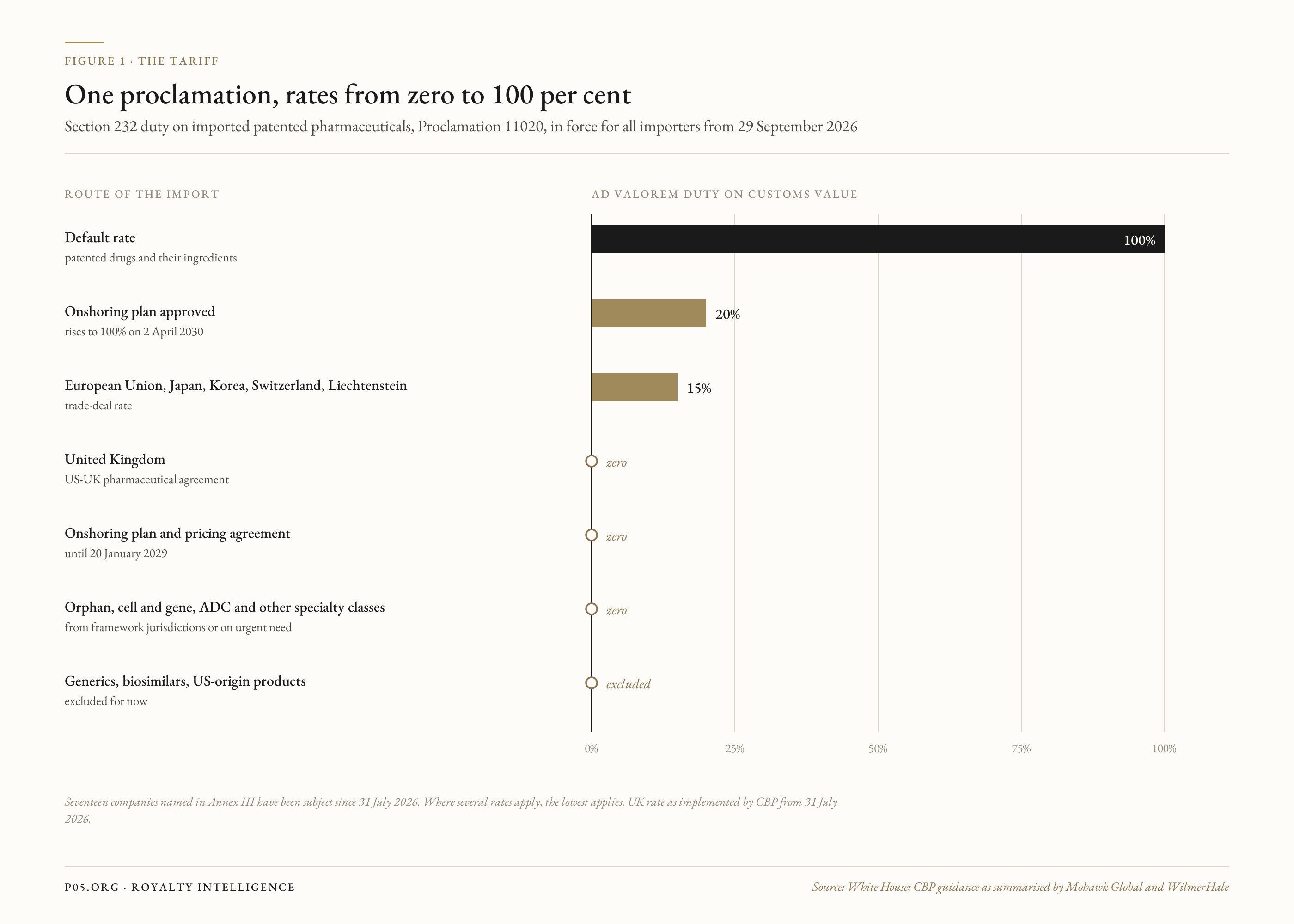
Section 232 duty rates on imported patented pharmaceuticals under Proclamation 11020, as in effect from 29 September 2026.
Where the duty sits in the accounts
The duty is levied on the customs value of the import. For most imports that is the transaction value, the price actually paid or payable when the goods are sold for export to the United States. Where a licensee's American affiliate buys finished product from its own plant abroad, it is the transfer price between the two.
The duty is therefore a cost of acquiring the product, incurred before any sale. International accounting standards say so directly: the cost of purchasing inventory comprises the purchase price, import duties and other non-recoverable taxes. A licensee that follows that standard records the duty in cost of goods sold, not as a reduction of revenue.
That matters because most licences tie net sales to the licensee's accounts. A Gibson Dunn note of April 2025 concluded that tariffs on a marketer's purchases are generally part of cost of goods sold and not deductible unless the licence says otherwise.
A note published after the September go-live took the opposite starting point, that many licences let the licensee deduct customs duties. Both are right about some licences. The words decide.
What the licences say
p05 read the net sales definitions in the 50 licences used for the audit piece and the pieces since. In 23 the list of deductions is redacted, which is itself a finding: a royalty holder looking at the public record often cannot tell.
Of the 27 that can be read, five allow no deduction for duties at all. One of them, a university licence, caps total deductions at 4 per cent of gross sales without the licensor's approval.
Thirteen name duties or tariffs but limit them to charges on the sale or on the invoice. Janssen's form is typical. Its 2021 licence with Cidara allows "excise taxes, use taxes, tariffs, sales taxes and customs duties" to be deducted, but only those "imposed on the sale of such Product".
A Section 232 duty is imposed on the import, not the sale. Other licences require the duty to be "separately itemized on the invoice", "included in the gross amount invoiced", or "paid by the purchaser". A licensee that pays the duty itself and does not pass it to its customers as a line on the invoice fails each test.
Pfizer's licence with Sangamo allows "customs or excise duties" and other duties "relating to sales of such Product". The phrase is wider than "imposed on the sale", and a licensee could argue that a duty on goods imported for sale relates to the sale. The same agreement lists "customs duty and charges levied by Governmental Authorities" among manufacturing costs, which points the other way.
Four licences use broad wording without naming duties, such as "governmental charges levied on the production, sale, transportation, delivery or use" of the product. Several of these also require the charge to be stated on the documents of sale.
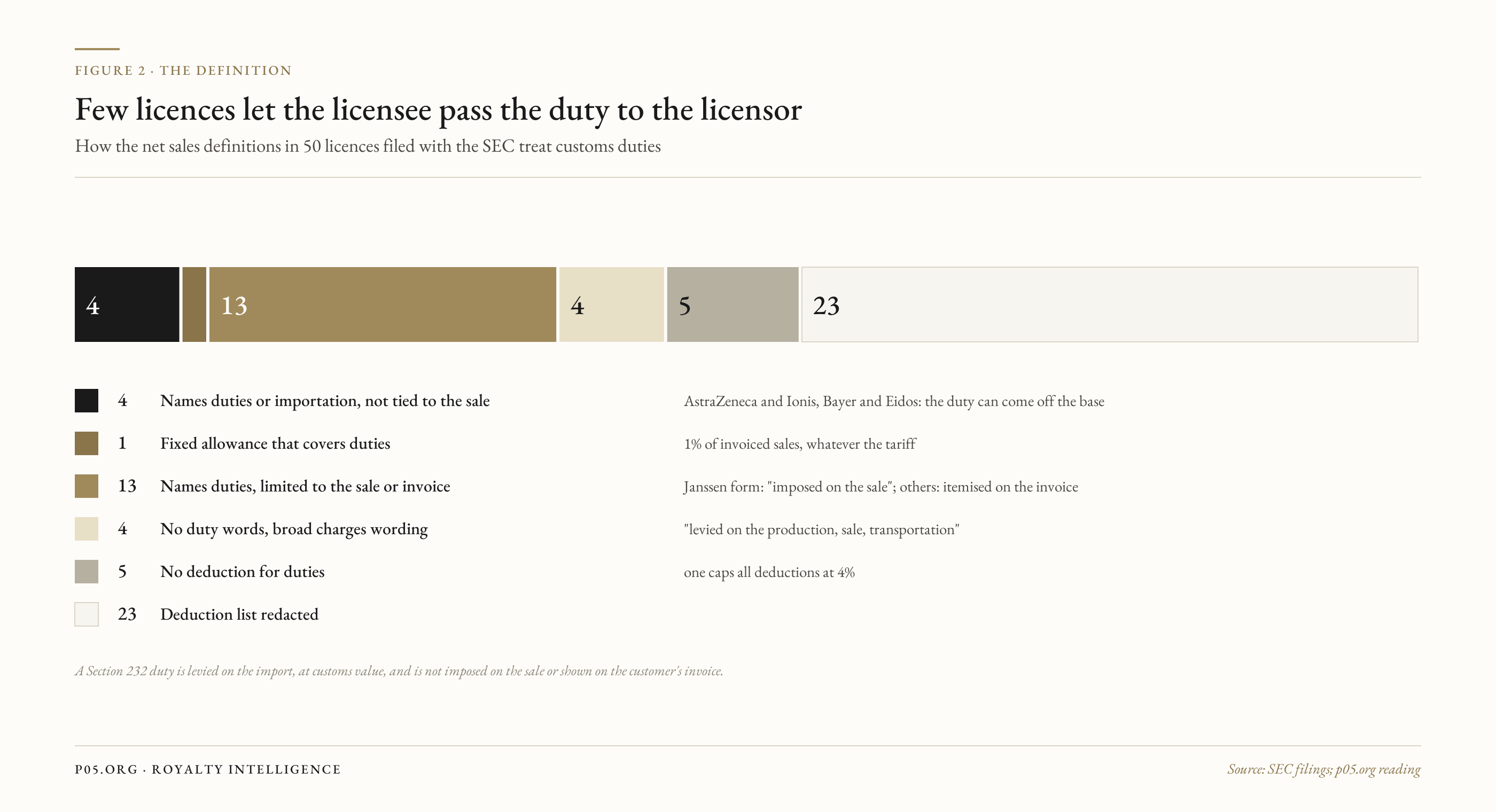
How 50 licences filed with the SEC treat customs duties in the net sales definition. p05.org reading of the filed agreements.
The licences that reach importation
Four of the readable licences name duties without tying them to the sale or the invoice. AstraZeneca's 2021 licence with Ionis deducts "customs duties, customs levies and import fees imposed on the sale, importation, use or distribution" of the product. Bayer's licence with Eidos deducts tariffs and duties "imposed upon and paid with respect to the sale, transportation, delivery, use, exportation, or importation".
Edesa Biotech's licence for an in-licensed product deducts "custom, import and export duties actually paid". Under these definitions a Section 232 duty paid by the licensee comes off the royalty base.
Bayer adds a floor. Most reductions cannot take net sales below the revenue the licensee reports, and a duty recorded in cost of goods sold does not reduce reported revenue. A licensor can read that proviso as limiting the duty deduction.
One other licence covers duties with a fixed allowance of 1 per cent of invoiced sales, together with bad debt, discounts, transport and insurance. Under that wording the licensee's deduction stays at 1 per cent whatever the tariff.
Royalty purchase and synthetic royalty agreements follow the same pattern. KalVista's agreement with DRI deducts customs duties "incurred in connection with the exportation or importation of a Product to the extent included in the gross amount invoiced".
The first half reaches the import, and the second half limits it to duties passed to the customer. Savara's agreement with 4010 Royalty Investments defines taxes to include customs duties, but deducts only taxes "imposed in connection with the sales of the Product to any Third Party".
What the deduction would cost
Where the duty is deductible, the licensor bears a share of it equal to its royalty rate. Take $1B of American net sales on a 10 per cent royalty, with product imported at a transfer price of 40 per cent of net sales. At the 15 per cent rate for European products the duty is $60M, 6 per cent of net sales, and the royalty falls from $100M to $94M. At the onshoring rate of 20 per cent it falls to $92M.
At the default rate of 100 per cent the duty is $400M and the royalty falls to $60M. A 4 per cent cap on total deductions would hold it at $96M. These figures are p05.org calculations.
The transfer price drives the result as much as the tariff rate. A licensee that imports at 20 per cent of net sales pays half the duty of one that imports at 40 per cent. A licensee that moves fill-and-finish to the United States while importing active ingredient pays duty only on the ingredient, if the ingredient is covered. American-origin active ingredient packaged abroad can be excluded with supporting documents.
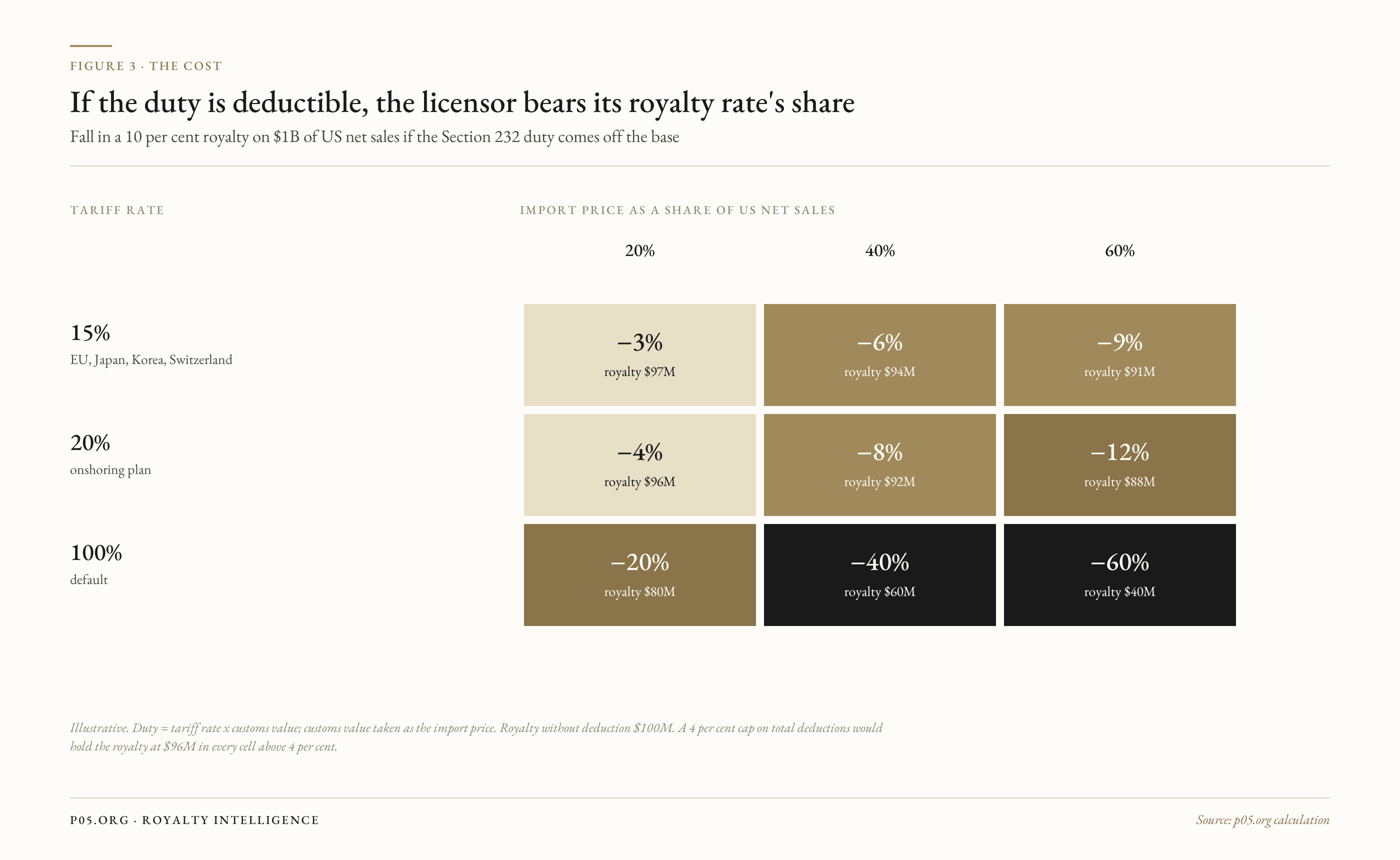
Reduction in the royalty if a Section 232 duty is deductible from net sales, by tariff rate and import price as a share of net sales. p05.org calculation.
Customs value and the royalty
The two calculations can also meet at the border. The customs valuation statute adds to transaction value any royalty or licence fee related to the imported goods that the buyer must pay as a condition of the sale for export.
A royalty an American licensee pays to an unrelated licensor is usually not a condition of buying the product from its own plant, and so is usually not dutiable. Where the licensor also supplies the product, or the importer pays the royalty to the foreign seller, the question needs customs advice.
Implications for the Pharmaceutical Royalty Market
The licences that expose a licensor are those that name importation or duties without tying them to the sale. Licences on the Janssen form, and those requiring the duty to appear on the invoice, keep the duty in the licensee's cost of goods.
Where the definition follows the licensee's accounts, the accounting standards point the same way, because a duty is an inventory cost and not a revenue deduction.
The first royalty reports covering sales after 29 September are due early in 2027. A holder can check whether a deduction for duties appears and compare it with the definition.
Buyers should add the tariff to diligence on streams with imported product. The questions are whether the product is patented and imported, its origin and the licensee's tariff route, the transfer price, and the deduction language.
A licensee with a pricing agreement imports at zero until January 2029, and the risk to the holder starts then. For a redacted definition, the seller can be asked for the unredacted text.
The tariff can also reach the royalty without any deduction. A licensee that pays 100 per cent on a product made abroad may raise its price, cut volume or move production, and each changes net sales. That effect falls on every holder, whatever the definition says.
Conclusion
The duty that took effect on 29 September is levied on the price at which the product crosses the border. Most licences with a readable definition leave it there, in the licensee's cost of goods. A handful, including AstraZeneca's licence with Ionis and Bayer's with Eidos, name importation and let the licensee pass part of it to the licensor. The fourth-quarter royalty reports will show which licensees try.
All information in this report was accurate as of the research date and is derived from publicly available sources including court opinions, regulatory guidance, academic literature, SEC filings, and financial news reporting. Information may have changed since publication. This content is for informational purposes only and does not constitute investment, legal, or financial advice. The author is not a lawyer or financial adviser.