
Note or sale: the recourse ladder in royalty finance, and who wants which rung

On 3 June 2026 Mineralys Therapeutics borrowed money at SOFR plus 5.50 percent in order to stop paying a royalty.
The chief executive framed it as eliminating all future royalty payments and positioning the company to capture incremental value from future sales.
Read as a swap rather than as two announcements, Mineralys exchanged an uncapped percentage of lorundrostat's lifetime sales for a dated, capped, amortising obligation at a floating rate under 9 percent, and paid the difference in cash and shares. A company judged its own royalty obligation more expensive than senior secured debt and acted on it.
That judgment sits at the centre of a question this site has approached from several sides without asking directly: when money is raised against a drug, what decides whether the instrument is a royalty sale, a royalty-backed note, or an ordinary secured loan? The answer, on the 2026 evidence, is not the product and not the accounting. It is how much of the borrower stands behind the money, and the market prices that in a visible ladder.
The second half of the piece asks who wants each rung, and that question has three answers rather than one, because the issuer, the fund writing the paper, and the fund borrowing against its own portfolio are all using royalty-backed debt for different reasons.
What the corpus already settles
Four prior articles are assumed rather than restated.
Accounting. Royalty financing on the balance sheet works the ASC 470-10-25-2 factors, the IFRS 9 derecognition route, the Ionis SPINRAZA roll-forward at a 13.5 percent effective interest rate, the income-statement gross-up and the EBITDA wedge, and the rating-agency look-through. Its conclusion governs everything below: for an operating company the default outcome is a liability, and the features a seller negotiates hardest for are the features that defeat sale treatment.
Tax. Debt for deferral sets out the sale-or-loan test for the seller's own income tax, why a royalty sale generally produces ordinary income rather than capital gain, the contingent payment debt instrument regime, section 163(j) after the July 2025 legislation, and why the portfolio interest exemption reaches only the non-contingent part of a return.
Insolvency. Vector V of When the money stops early works true sale against recharacterisation and the defensive stack. Insolvency liens and reject, assume, assign cover security and section 365.
The holder's mirror. The impairment is not the loss covers how the same underperformance lands on the buyer, as a provision on a financial royalty asset, an impairment on an intangible, or nothing at all on a guaranteed bond.
What none of them asks is the structuring question. Given that the accounting will usually produce a liability whichever document is signed, and that the tax and insolvency answers are decided on their own tests, what is actually being chosen, and by whom?
1. The 2026 cohort
Enough has printed this year to compare formats at close dates rather than across cycles.
| Date | Recipient | Provider | Format | Size | Stated economics |
|---|---|---|---|---|---|
| 11 Jan | Teva | Royalty Pharma | Development funding, anti-IL-15 TEV-'408 | Up to $500m | Undisclosed |
| 2 Mar | Zymeworks | Royalty Pharma | Non-recourse royalty-backed note, 30% of Ziihera royalty | $250m | 1.65x by 31 Dec 2033, 1.925x thereafter |
| 30 Mar | Johnson & Johnson | Royalty Pharma | R&D co-funding, JNJ-4804 | $500m across 2026-27 | Undisclosed |
| 22 May | Royalty Pharma | Bank syndicate, BofA agent | Unsecured revolving credit facility | $1.8bn | Matures 2031; leverage, portfolio cash flow and coverage covenants |
| 3 Jun | Mineralys | Pharmakon | Senior secured term loan, four tranches | Up to $500m | SOFR + 5.50%, 3.25% floor, matures Jun 2031 |
| 30 Jun | MeiraGTx | Oberland Capital | Royalty Note Purchase Agreement plus equity | Up to $400m | Low single-digit capped royalties on three products, buy-back option |
| 22 Jul | Neurimmune | Royalty Pharma | Purchase of part of a royalty on AstraZeneca's cliramitug | Up to $425m, $125m upfront | Sale |
| 12 Aug | Zealand Pharma | Royalty Pharma | Purchase of remaining rusfertide economics | $100m | Sale; seller keeps 0.25% above $1.5bn |
| 13 Aug | OPKO Health | HealthCare Royalty (KKR) | Senior secured notes on mazdutide and EirGen profit share | $125m additional | SOFR + 7.50%, 4.00% floor, 2044, 1.5x cap |
Sources are the Royalty Pharma transactions page, the Mineralys release above, the MeiraGTx release, the OPKO release, the Royalty Pharma revolver terms and, for the rusfertide terms, Weekly Term Sheet 2026-W33.
Two sales, three notes, one corporate loan to an issuer, one corporate revolver to a fund, two development fundings. The same buyer, Royalty Pharma, appears on both sides of the note-versus-sale line within four months, and once as a borrower.
The MeiraGTx transaction is the most instructive of the notes because the format is named in the document. On 30 June 2026 MeiraGTx and certain subsidiaries entered a Royalty Note Purchase Agreement with MeiraGTx, LLC as issuer, the parent and subsidiaries as obligors, and Maverick SA LLC as purchaser agent, an affiliate of funds managed by Oberland Capital.
A note, at a subsidiary issuer, with obligor guarantees, optional tranches, a cap, a rate that steps on a date, and a buy-back. Every one of those features is a lender's feature, and none of them is available in a clean sale.
For scale, Gibson Dunn's 2026 market update counts 133 transactions from 2020 through 2025, with annual value rising from $5.2 billion to $7.1 billion, deal count stable at 25 to 27 a year and median deal size reaching $221 million in 2025.
Royalty Pharma puts the 2025 market at $10 billion, a record, and its own announced transactions at $4.7 billion. The gap between $7.1 billion and $10 billion is a scope difference rather than a dispute, and anyone quoting a market size should say which one they mean.
2. The recourse ladder
Order the disclosed transactions by how much stands behind the money, and the pricing falls into line.
| Rung | Deal | What the funder can reach | Stated pricing | Cap |
|---|---|---|---|---|
| Corporate secured | Mineralys / Pharmakon, Jun 2026 | Substantially all assets, corporate recourse | SOFR + 5.50%, 3.25% floor | None |
| Product-secured term loan | Revolution Medicines / RPRX, 2025 | Product assets, alongside a synthetic royalty | SOFR + 5.75% | Term loan amortises |
| Product-secured term loan | Nuvation Bio / Sagard, 2025 | Product assets, alongside a synthetic royalty | SOFR + 6.00%, 4.00% floor | 1.6x to 2.0x on the royalty leg |
| Royalty-secured note | OPKO / HCRx, Aug 2026 | One royalty plus a profit share, limited recourse | SOFR + 7.50%, 4.00% floor | 1.5x funded |
| Royalty note, subsidiary issuer | MeiraGTx / Oberland, Jun 2026 | Three product royalties, obligor guarantees | No stated coupon; low single-digit royalties | Capped, buy-back option |
| Non-recourse note | Zymeworks / RPRX, Mar 2026 | 30% of one royalty, at a subsidiary, nothing else | No stated coupon | 1.65x, then 1.925x |
| Outright sale | Market, 2019-2025 | Nothing; the buyer holds product risk | No coupon | Median 2.13x where capped |
The ordering is consistent and it is not about the drug. Price falls as the funder's claim broadens. A borrower pledging the company gets SOFR plus 550. A borrower pledging product assets alongside a royalty gets SOFR plus 575 to 600. A borrower pledging one royalty stream and nothing else gets SOFR plus 750. A borrower pledging 30 percent of one royalty at a subsidiary pays no coupon at all and a multiple instead. A seller transferring product risk entirely pays a capped multiple that implies more again on any reasonable time-to-cap.
The monetisation figures come from Covington's third annual royalty monetisation study, covering 54 transactions from 2019 through 2025 at a $15 million threshold, with 16 unique investors, a median upfront of $131 million, a median commitment of $200 million, and a median capped multiple of 2.13 times against a range of 1.3 to 3.4 times. The Revolution Medicines and Nuvation term loan pricing is as recorded in the royalty bonds piece and the bridge and take-out piece.
Mineralys ran the ladder in reverse. It climbed to the cheapest rung and used the proceeds to retire an obligation sitting near the most expensive one.
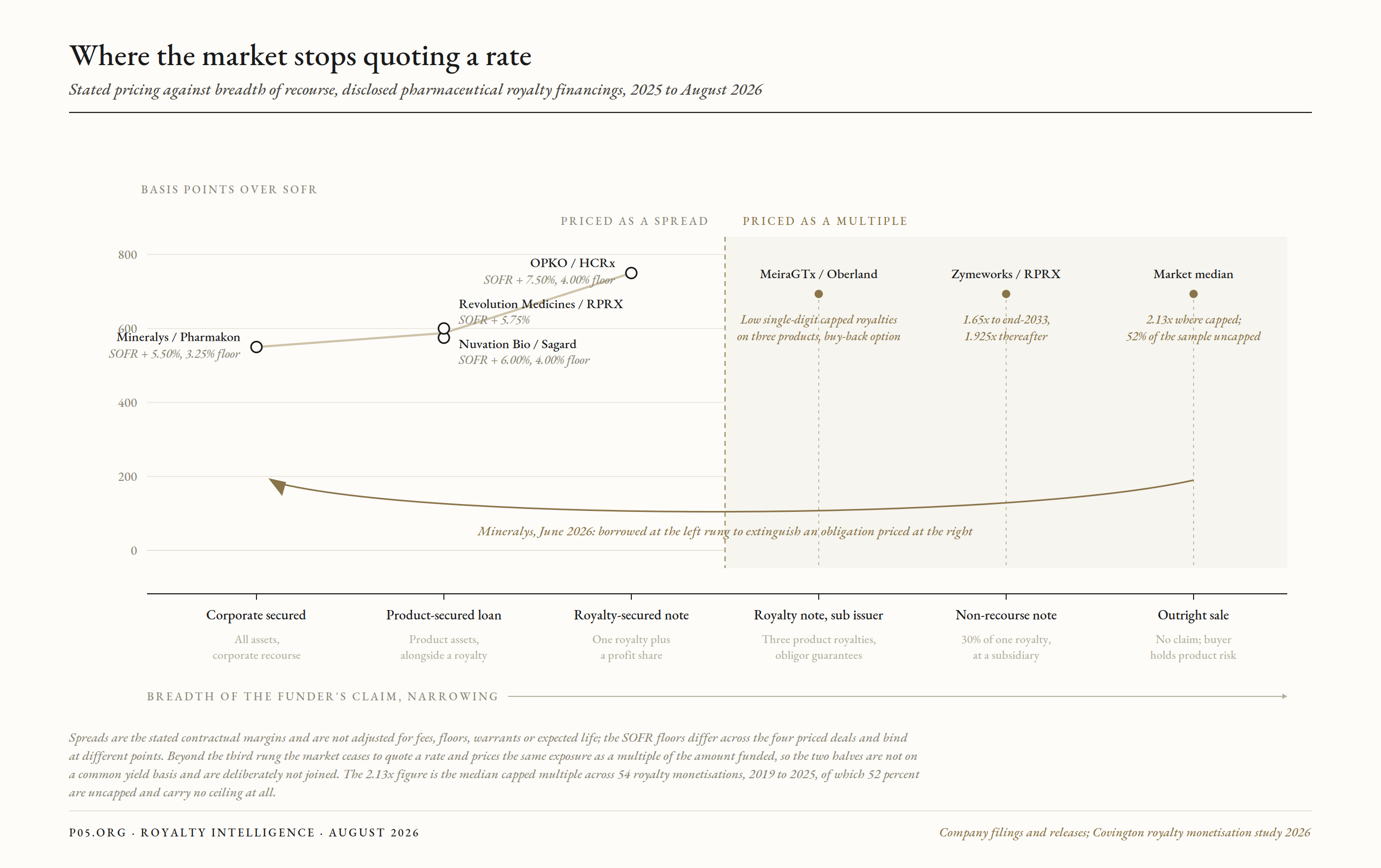
Figure 1. Where the market stops quoting a rate. The break at the third rung is the finding: past the point where a funder holds a claim on more than one royalty, pricing stops being expressed as a spread and starts being expressed as a multiple. The two halves are not on a common yield basis and are deliberately not joined.
3. Motivation one: the issuer
Why an operating company reaches for royalty-backed debt rather than the two obvious alternatives.
Against an ordinary term loan
Covington's growth and venture lending study covers 138 transactions from 2021 to 2024 at a $25 million threshold, with 29 unique lenders, a median initial loan of $30 million and a median commitment of $75 million. Against the two 2026 royalty studies it gives the comparison directly.
| Term | Growth or venture loan | Synthetic royalty | Royalty monetisation |
|---|---|---|---|
| Obligation to repay principal | Absolute | 44% for approved assets, 9% for clinical-stage | 4% |
| Amortisation | Required in 81%; median 5-year term | None; payments track sales | None; payments track sales |
| Other financial covenants | Liquidity in 83% of 2024 loans, revenue covenant in 45% | 0%, with liquidity or going-concern in 19% | 0% |
| Limitations on debt | Standard | 66% | 7% |
| Liens on all assets | Standard; IP in 86% of 2023-24 loans | 26% | 11% |
| Liens on product assets | Included | 91% | 55% |
| Material adverse effect default | 84% | Put right in 13% | Put right in 0% |
| Cross-default to other debt | Standard | Put right in 34% | Put right in 6% |
| Going-concern qualification prohibited | 68% | Within the 19% liquidity group | Not used |
| Unrestricted subsidiaries permitted | 2% | Not applicable | Not applicable |
| Who pays the investor's expenses | Borrower | Borrower | Payor reimburses buyer in only 24% |
| Median return cap | Not applicable | 2.00x approved, 4.25x clinical | 2.13x where capped |
The loan column reflects a market that has tightened. Liquidity covenants rose from 58 percent in 2021 to 83 percent in 2024, and IP security from 52 percent to 86 percent.
Three reasons follow.
No date on which the money is due. In 91 percent of clinical-stage synthetic royalty financings and 96 percent of monetisations there is no fixed obligation to repay any of the advanced funds regardless of the amount of royalties received. A term loan asks the company to be solvent on a schedule set at signing. A royalty asks it to sell the drug.
No EBITDA figure required to underwrite. BioMarin's 2026 credit agreement requires a maximum total net leverage ratio of 3.50 to 1.00 and a minimum interest coverage ratio of 3.00 to 1.00. Ordinary terms for a profitable specialty pharmaceutical company, unsignable for a company with one approved product and negative operating cash flow. Mineralys reached Pharmakon's paper because it had an NDA under review and an equity market open to a $150 million offering on the same day.
MeiraGTx, with three unapproved gene therapies, could not have signed a leverage covenant on any measure, and took a royalty note instead.
The covenant package does not reach the rest of the company. Royalty monetisations have no financial covenants and limit debt in 7 percent of cases. A growth loan restricts additional debt, out-licences, in-licences, acquisitions and distributions, prohibits unrestricted subsidiary designation in 98 percent of cases, and treats a material adverse effect as an event of default in 84 percent. The venture debt trap piece works what happens once both are outstanding.
Against a straight royalty sale
Six reasons the note format wins, of which the last is the strongest and depends on the June balance-sheet article.
The cap is native to the note and optional in the sale. Covington finds 44 percent of royalty monetisations capped, 52 percent uncapped and 4 percent capped with a tail. A sale of an uncapped stream hands over every dollar the product ever pays. A note terminates by construction.
Royalty Pharma ceases receiving Ziihera royalties on cumulative payments of either 1.65 times the note amount by 31 December 2033 or 1.925 times at any time thereafter, at which point no further repayments are owed, and Zymeworks retains 70 percent of the royalty throughout with full rights reverting afterwards. OPKO caps at 1.5 times. MeiraGTx holds a buy-back option on the funded note.
You can pledge what you cannot sell. Covington finds that 70 percent of underlying licence agreements require consent for assignment of rights to payment and 37 percent require consent for information sharing such as royalty reports, while consents were specified as obtained in only 40 percent of cases overall. Buyers rely on the UCC section 9-406 override, which makes contractual restrictions on assignment of payment rights ineffective. That override does not reach confidentiality provisions, so a sale can leave the buyer with the money and no contractual route to the reporting that makes it auditable. A note leaves the seller as counterparty of record.
The recharacterisation question disappears by not being asked. A true sale needs an opinion, a risk-transfer analysis and the defensive stack in When the money stops early, and can still fail years later. A note asks nothing. It also removes the drafting drag the minimum guarantee piece traces through floors, puts and make-wholes.
Non-recourse at a subsidiary gives isolation without a sale. Zymeworks moved a 30 percent interest in the Ziihera royalty into a newly formed subsidiary that borrowed on terms non-recourse to the parent. MeiraGTx issued through MeiraGTx, LLC with the parent and subsidiaries as obligors.
Covington finds SPV structures required in only 3 percent of synthetic royalty deals and 15 percent of monetisations, so the subsidiary-issuer route is doing work the classic bankruptcy-remote SPV mostly is not. The segregation mechanics are the subject of the sleeves piece.
The tranching is optional, which a sale cannot be. MeiraGTx's three $50 million tranches sit at the company's option against 2027 and 2028 milestones. A company that does not need the money does not draw it and does not pay for it. A sale delivers the cash and takes the stream on day one.
The accounting is going to be a liability regardless. This closes the loop with the June article. If continuing involvement and a cap mean ASC 470-10-25-2 produces a liability whether the paper says sale or note, the seller receives the balance sheet consequence either way. The sale's principal advantage is therefore unavailable to the issuer most likely to be offered one, and the note's advantages all remain. An operating company choosing a sale over a note is paying for derecognition it will not get.
When the sale still wins
Price per dollar raised. An uncapped stream is worth more, and the buyer pays for it. Gibson Dunn observes the market moving this way: in 2020 and 2021 half of synthetics were structured as true sales, and by 2024 and 2025 that reached 71 percent of deals and 91 percent of value.
Finality. Royalty Pharma's August 2026 purchase of Zealand Pharma's remaining rusfertide economics for $100 million, leaving the seller 0.25 percent of net sales above $1.5 billion, is an exit rather than a financing. So is the July 2026 purchase of part of Neurimmune's cliramitug royalty. A seller that no longer wants exposure does not want a note against it.
Derecognition, where genuinely available. The June article identifies who achieves it: non-operating holders with nothing to do with generating the sales, and operating companies selling a legacy tail outright with no cap and no reversion.
Tax, in one direction. Debt for deferral sets out why a loss company with expiring net operating losses may prefer the sale and a profitable holder the loan. The choice runs opposite for the two profiles.
4. Motivation two: the fund writing the paper
The issuer side is the half the market talks about. The fund side is the half that decides which deals exist, and a royalty fund choosing to lend rather than buy is making five distinct judgments.
Capital comes back on a schedule. An uncapped royalty is a permanent hold with a duration set by patent life. A capped note returns capital when the multiple is reached, which is a date the fund can model. For a finite-life vehicle that is the difference between a position that can be recycled inside the fund term and one that has to be sold or continued. The early-royalty aggregation piece works the same trade-off at the other end of the risk curve, where recycling is the whole strategy.
It fits a credit mandate. Capped, secured, dated instruments are underwritable by credit teams and financeable at the fund level. Pharmakon, investment manager of the BioPharma Credit funds, has committed up to $12 billion across 76 investments since 2009. HealthCare Royalty now sits inside KKR's asset-based finance platform, and the OPKO notes are exactly what an asset-based finance book is built to hold: a stated spread, a stated maturity, defined collateral and a cap. An uncapped perpetual royalty fits neither book cleanly. Who buys a royalty maps which of the five businesses writes which format.
Enforcement rights. The gap here is stark. Covington finds put rights in royalty monetisations at 6 percent for bankruptcy, 6 percent for covenant breach, 2 percent for representation breach and 0 percent for material adverse effect. A buyer of a royalty has almost no contractual remedy against the seller, by design, because it is relying on the stream. A lender has security, covenants, an intercreditor agreement and an acceleration right. When the counterparty is a clinical-stage company with three unapproved products, that difference is the deal.
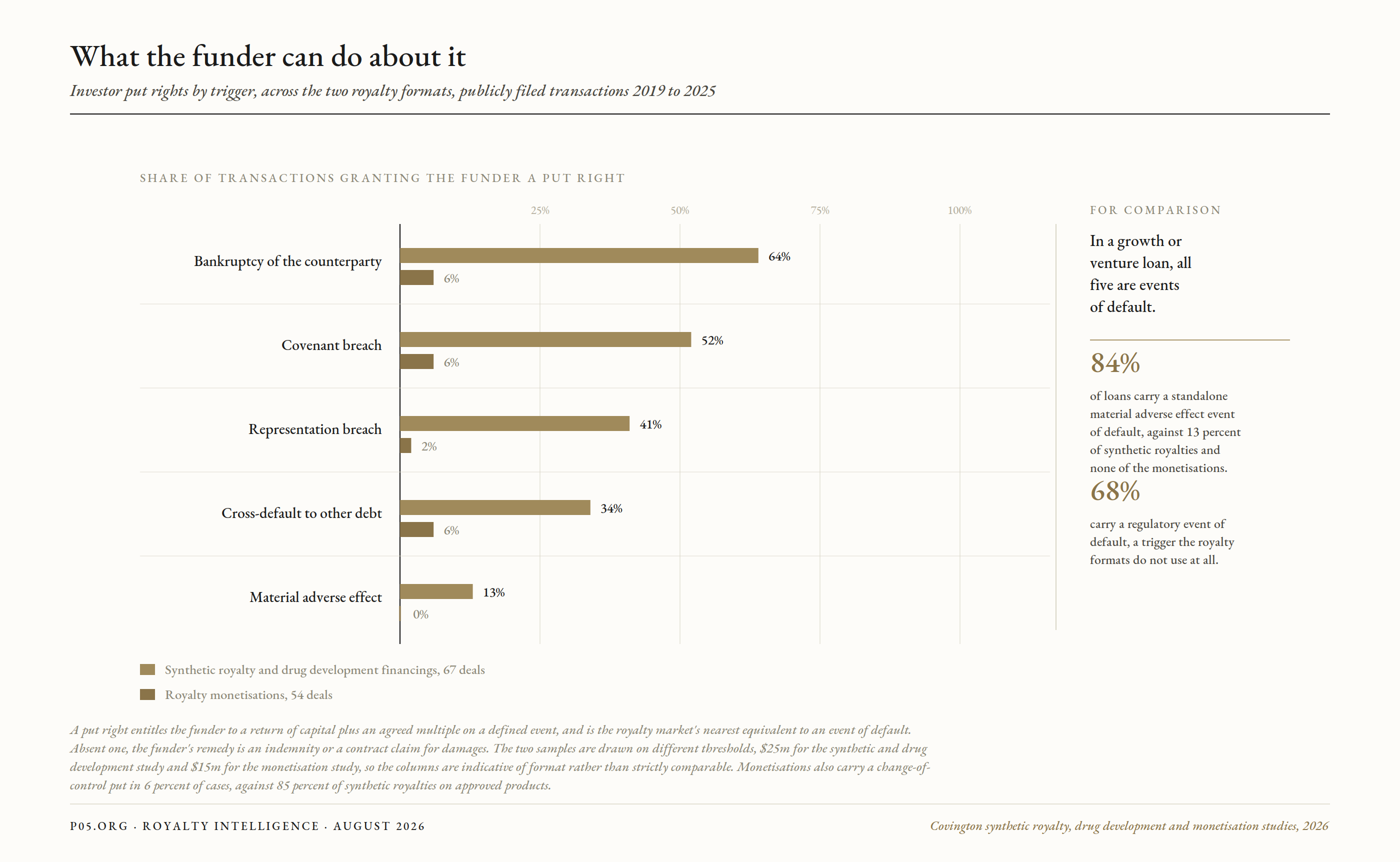
Figure 3. What the funder can do about it. Put rights are the royalty market's nearest equivalent to an event of default, and the monetisation format grants almost none of them. A lender to the same counterparty, on the same product, holds all five.
Downside protection in a seller's market. Gibson Dunn's finding that sellers are capturing more value as competition increases cuts against buyers on price. A note recovers some of it in structure rather than in price: the same capital gets a stated coupon or a floor, a security package, and a claim that does not evaporate if the drug underperforms in the way a royalty does.
The impairment is not the loss sets out the endpoint of that distinction, where a guaranteed instrument absorbs nothing from a commercial disappointment that writes down an equity holder and reduces a royalty holder's cheque.
Access to issuers who will not sell. Consent-constrained streams, companies that want the tail back, and companies whose existing lender will not permit an outright disposition are all reachable with a note and unreachable with a purchase. The note is not only a different risk position; it is a different pipeline.
Set against those, the reason a fund still prefers to buy is the one the note gives away: the uncapped tail. Royalty Pharma's returns have historically come from assets that outran their underwriting, and a 1.65 times cap forecloses that outcome by contract. A buyer confident in a product's upside sells the cap dearly or refuses it.
5. Motivation three: the fund borrowing against its own portfolio
The third use of royalty-backed debt is the one furthest from the drug, and it is where the largest balances sit.
The covenant package is the interesting part, because it shows what a bank syndicate requires of a royalty portfolio: a consolidated leverage ratio at or below 4.00 to 1.00 of funded debt to adjusted EBITDA, rising to 4.50 following a qualifying material acquisition; a consolidated portfolio cash flow ratio at or below 5.00 to 1.00, rising to 5.50; and a consolidated coverage ratio at or above 2.50 to 1.00 of adjusted EBITDA to consolidated interest expense.
Three ratios, one of them specific to this asset class. The portfolio cash flow ratio exists because a royalty book's EBITDA and its collections diverge, and a lender to a royalty fund wants a test that tracks what actually arrives.
The reason a fund borrows at all is the spread. A diversified investment grade royalty holder raises unsecured debt in the range the royalty bonds piece documents and deploys it into acquisitions underwritten several hundred basis points wider. That gap, levered, is the business. It is also why the format at fund level has migrated: Royalty Pharma's own registration statement records that it created the first securitisation debt facility backed by pharmaceutical royalties in 2004, converted it to a syndicated term loan in 2007, and states that each change led to a lower blended cost of capital and greater scale.
Securitisation, then a syndicated loan, then an IPO, then investment grade bonds, then a revolver. Each instrument was the take-out of the one before it, which is the sequence the bridge and take-out piece treats at length, and the cross-sector piece compares to the music warehouse-to-ABS ladder.
The observation worth carrying is that the same words describe three different trades. An issuer's royalty-backed debt is a claim on one product. A fund's royalty-backed lending is a credit position in a portfolio of such claims. A fund's own borrowing is corporate paper against a diversified book, priced tighter than either. The instrument at the bottom of that stack is a royalty on a drug, and by the time it reaches the top it is investment grade.
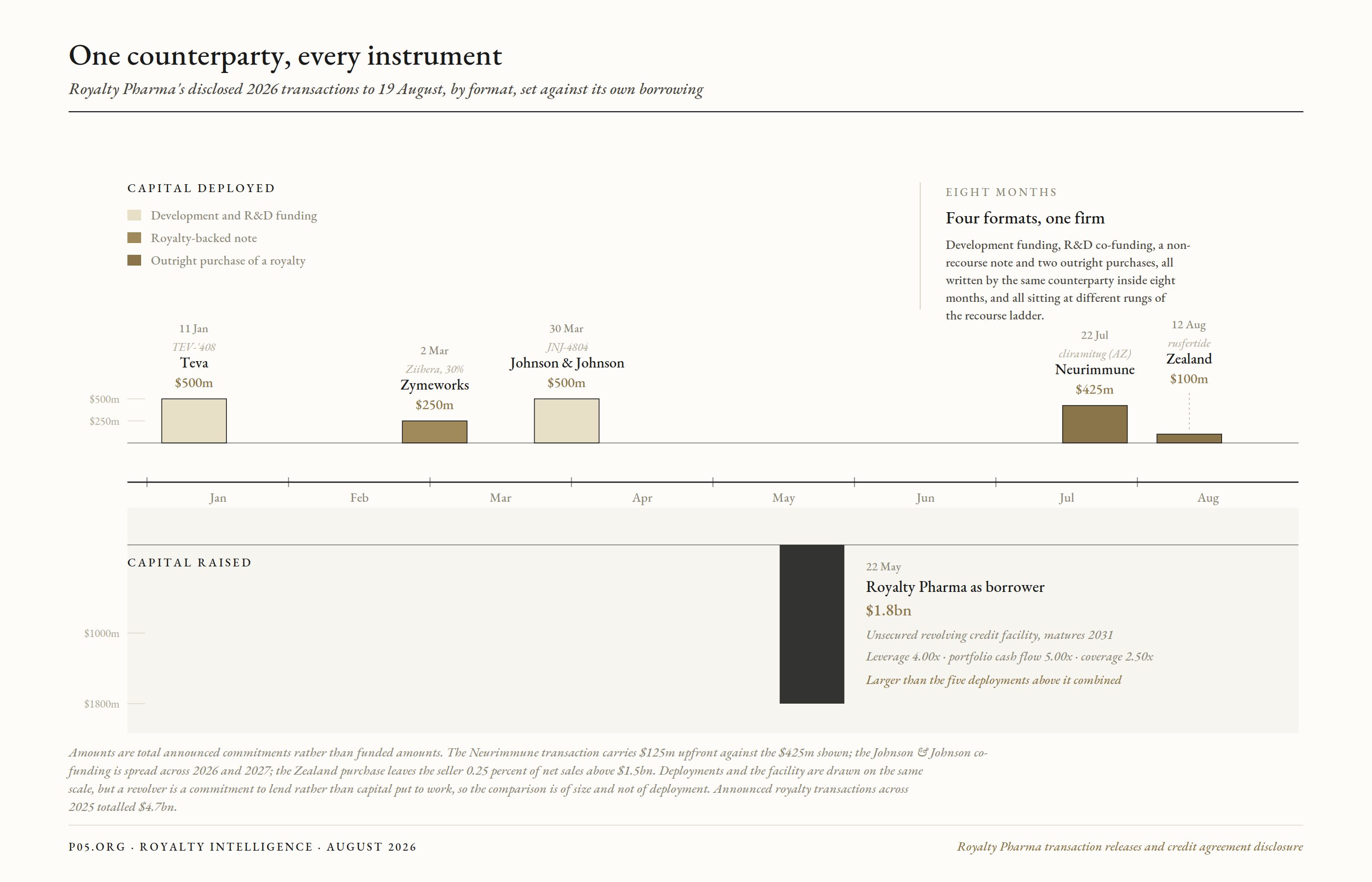
Figure 2. One counterparty, every instrument. Royalty Pharma wrote development funding, R&D co-funding, a non-recourse note and two outright purchases inside eight months, at four different rungs of the ladder, and raised more for itself in a single facility than it committed to any of them.
6. The covenant that sets the size
One practical point that lives in the loan documents rather than the royalty documents. If the issuer already has a term loan, the minimum size of the royalty deal is set by the credit agreement, not by the funding need.
Dyne Therapeutics' 2026 loan agreement defines a Permitted Royalty Transaction as either a true royalty or synthetic royalty financing whereby the borrower receives unencumbered and unrestricted net cash proceeds of no less than a specified amount, in exchange for rights to receive future payments based on net sales of named products, subject to an intercreditor agreement satisfactory to the agent, with any security limited solely to those products and subordinated to the agent's first priority lien, and with no guaranteed minimum return or true-up payment earlier than 180 days after the term loan maturity date.
The conditions are a list of the ways a royalty financing can hurt an existing lender, negated one at a time. MoonLake Immunotherapeutics runs the same architecture, and its amendment shows the negotiation: the minimum net cash proceeds threshold was reduced from $300 million to $200 million, with permitted liens extended to the purchased royalty interests and milestone payments and the deposit accounts holding their proceeds.
Spero Therapeutics uses Permitted Royalty Monetization and requires that terms on collateral and subordination be no less favourable than those in the existing transaction documents, with any monetisation counterparty capped at 35 percent of the pledged capital stock and ranking pari passu on the remaining back-up collateral.
UroGen is the negative case, stating that no direct or indirect synthetic royalty or similar financing involving the sale of revenues or royalties entered into after the Tranche A closing date shall in any instance be permitted without the prior written consent of the collateral agent or required lenders.
A company needing $120 million with a $200 million floor in its own carve-out either raises $200 million, renegotiates, or does not transact. That threshold is a better predictor of deal size than the funding requirement, and it is the first number to find in diligence on a levered issuer's next royalty deal.
7. Three accounting behaviours the June article did not have
The balance-sheet piece worked the Ionis roll-forward, where a paying royalty on an approved product still accreted in year one because imputed interest exceeded cash forwarded. The 2026 filings add three variants.
A liability that grows with no cash at all. Where the product is not approved, nothing reduces the balance while imputed interest accretes. Arrowhead's olpasiran liability ran $268.3 million at 30 September 2023, $341.4 million at 30 September 2024 including a $50 million milestone receipt, $367.4 million at 30 September 2025, and $383.8 million at 31 March 2026, with the effective rate moving from 6.3 percent at December 2024 to 8.3 percent by September 2025. The same note records that the company accounted for the transaction as debt and is not obligated to repay these funds.
Effective rates that go negative. Arcus Biosciences disclosed that after discontinuing the BVF programme in the first quarter of 2025 it began amortising the net carrying amount back to the initial $15 million using an imputed effective interest rate of negative 6.1 percent, against 10.1 percent for periods before that quarter.
Cytokinetics avoids the outcome by policy, stating that the imputed rate on the omecamtiv mecarbil liability is reassessed periodically and is not reduced below 0 percent.
Earnings that move on a forecast revision. Cytokinetics disclosed that in 2025 it updated its assumptions on the aficamten royalty purchase agreement and that the change in estimate decreased non-cash interest expense by $3.6 million and net loss per share by $0.03. Xencor names the source of those forecasts: estimates of future royalty payments are primarily based on externally available analyst consensus forecasts, rather than internally developed sales projections.
That last disclosure is the seller-side twin of a finding in the impairment piece, which records that Royalty Pharma names movements in sell-side consensus as the trigger for its own provisions. Both sides of a royalty financing mark the same position to the same public forecasts, in opposite directions, and neither uses private information to do it.
8. A decision frame
| Condition | Note | Sale | Term loan |
|---|---|---|---|
| Underlying licence conditions assignment on consent | Yes | Consent needed, or 9-406 relied on | Neutral |
| Issuer expects the product to outperform | Yes; cap and reversion retain the tail | No; upside transferred | Yes |
| Issuer has significant continuing involvement | Neutral; liability either way | Sale gains nothing on the balance sheet | Neutral |
| Issuer is a non-operating holder | No | Yes; derecognition available | No |
| Issuer is profitable and seeking deferral | Yes | No | Yes |
| Issuer has expiring net operating losses | No | Yes | No |
| Issuer wants optional, milestone-gated tranches | Yes | No | Sometimes |
| Issuer can sign a leverage and coverage covenant | Neutral | Neutral | Yes |
| Funder is a credit fund | Yes | Harder to fit | Yes |
| Funder needs capital back inside a fund term | Yes | Only if capped | Yes |
| Funder wants uncapped upside | No | Yes | No |
| Existing lender has a minimum-proceeds floor | Either, subject to the floor | Either, subject to the floor | Not applicable |
9. What would make this reading wrong
The ladder may be a sample, not a structure. Seven disclosed points across eighteen months, each with its own product, credit and negotiation, is thin evidence for a pricing curve. The ordering is consistent and the mechanism is plausible, and neither of those is a large sample.
The convergence on true sales may finish the job. Gibson Dunn's 71 percent of deals and 91 percent of value in 2024 and 2025 points one way; the persistence of the note format at Royalty Pharma, HealthCare Royalty and Oberland in 2026 points another. If the sale format keeps taking share, sections 3 and 4 describe a shrinking corner.
The Mineralys trade may not generalise. That company retired a licensor royalty owed under an in-licence, not a monetisation sold to a fund. Buying out a licensor is a different negotiation, and the boomerang licence piece covers why reacquisitions price the way they do.
The fund-level cost of capital assumes the rating holds. The whole third motivation rests on a spread between what a royalty fund borrows at and what it deploys at. A downgrade, a covenant reset, or a repricing of asset-based finance closes it, and the covenant grid in the May 2026 revolver is where that would first show.
The equity market sets the whole comparison. Zymeworks was explicit that the funding enhances flexibility to continue repurchasing shares at current prices, which the company believes represents a compelling discount to its estimate of intrinsic value. A sustained biotech recovery removes the premise for that judgment and for much of this piece.
10. Comparative summary
| Question | Term loan | Royalty-backed note | Royalty sale |
|---|---|---|---|
| Recourse | Corporate, all assets | Limited or non-recourse to defined streams | None |
| Repayment promise | Absolute | Yes, from the pledged stream | No, in 96% of cases |
| Upside retained by issuer | All | Above the cap | Only if capped |
| Optional tranches | Sometimes | Yes | No |
| Licensee assignment consent needed | No | Usually no | Often yes |
| True sale opinion needed | No | No | Yes |
| Financial covenants | Liquidity and often revenue | Negotiated | None |
| Funder's enforcement rights | Full | Security, covenants, acceleration | Put rights in under 6% |
| Balance sheet under GAAP | Long-term debt | Debt | Usually a liability anyway |
| Capital returns to the funder | On schedule | At the cap | Over patent life |
| 2026 example | Mineralys / Pharmakon | Zymeworks / RPRX; MeiraGTx / Oberland; OPKO / HCRx | Zealand / RPRX; Neurimmune / RPRX |
11. The shape of the answer
The choice between a royalty sale, a royalty-backed note and a secured loan looks like a choice between three products. On the 2026 evidence it is one choice made three ways: how much of the borrower stands behind the money.
Pledge the company and pay SOFR plus 550. Pledge product assets alongside a royalty and pay SOFR plus 575 to 600. Pledge one royalty and a profit share and pay SOFR plus 750. Pledge a subsidiary holding part of one royalty and pay no coupon at all, only a multiple. Pledge nothing, transfer the product risk, and pay a median 2.13 times cap where the deal is capped and everything above it where it is not.
Within that, three parties are using the same instrument for different reasons. The issuer takes a note because it will get a liability on the balance sheet whichever document it signs, and the note is the version that keeps the cap, the reversion, the optional tranches and the licensee relationship.
The fund writes a note rather than buying a royalty because capital comes back on a date, the position fits a credit mandate and can be levered, and it carries enforcement rights that a purchase deliberately lacks. And the fund borrows against its own book because the spread between what a diversified royalty portfolio can raise and what it can deploy at is the business, which is why the format at fund level walked from securitisation to syndicated loan to public equity to investment grade bonds to a $1.8 billion revolver.
The same royalty sits under all three. It is a single-product claim at the bottom and investment grade paper at the top, and each layer of aggregation takes a slice of the spread for doing the aggregating.
Mineralys is the case that shows what the ladder is worth in cash. A company with an NDA under review, an open equity window and a lender willing to take the whole balance sheet borrowed at the cheapest rung and retired an obligation from near the most expensive one. That trade is available to any issuer with an outstanding royalty and access to the loan market, and it is the trade the royalty funds are selling against.
Standard disclaimer
All information in this report was accurate as of the research date and is derived from publicly available sources including SEC filings, issuer press releases, accounting standards and interpretive literature, law firm studies, and financial news reporting. Study percentages are drawn from samples of publicly filed agreements with differing inclusion thresholds and are not directly comparable across studies. Market size figures differ between sources depending on scope and are presented with that difference noted. The recourse ladder is drawn from a small number of disclosed transactions and is presented as an observed ordering rather than a measured curve. Implied yields and price comparisons are illustrative and derived from disclosed terms. Information may have changed since publication. This content is for informational purposes only and does not constitute investment, legal, accounting, tax, or financial advice. The author is not a lawyer, accountant, tax adviser, or financial adviser.