
The Boomerang Licence: When Regional Rights Are Bought Back, Not Handed Back
A regional out-licence usually ends by running off or by reverting on termination. A third ending is the boomerang: the licensor, often after being acquired itself, buys the territory back for fresh cash and extinguishes the royalty.
A regional out-licence normally ends in one of two ways. It runs to the end of its royalty term, or it terminates and the rights revert to the licensor for little or no money.
A third ending is less discussed, and more interesting for anyone underwriting the stream. The licensor, or more often the company that acquired the licensor, pays the regional partner fresh cash to hand the territory back. The royalty that sat on top of that licence disappears.
Call it the boomerang. Rights go out, the counterparty above the licensee changes hands, and the rights come home by acquisition rather than by reversion. The royalty is not written off because the drug failed. It is bought out because a global owner decided unified control was worth more than the payments coming up the chain.
This piece sets out the anatomy of the structure, works through three cases, ivosidenib, Trodelvy, and Ohtuvayre, and then turns to the intelligence question: how to read a boomerang before it happens.
The Ohtuvayre case matters most, because the return route there was not negotiated after the fact. It was written into the licence as a buy-back option. Stated as of July 2026. The mechanics sit one layer above the deal terms catalogued in the anatomy of biopharma royalty deals, and they interact with the change-of-control language that most royalty holders under-model.
Two ordinary endings, and a third
Start with the two familiar exits, because the boomerang is defined against them.
Run-off. The licensee keeps the territory, sells the drug, and pays the agreed royalty to the licensor until loss of exclusivity. Nothing reverts. This is the base case a royalty buyer prices.
Termination and reversion. The licensee gives up, or breaches, or discontinues, and the rights revert to the licensor. Consideration is usually small or nil. The royalty ends because the underlying licence ended.
The boomerang is neither. The licence is performing, or at least alive, when it ends.
The licensor, or its successor, pays a negotiated sum to take the territory back, releases the licensee from its remaining obligations, and folds the region into wholly owned economics. What terminates is not a failed licence but a working one. The trigger is a strategic decision by a global owner, not distress at the regional partner.
The distinction matters, because the three endings carry different risk for a royalty on that licence. Run-off is duration risk. Reversion is failure risk. The boomerang is optionality risk: the party above the licensee holds, in effect, a call on the territory, and can exercise it at a time and price of its choosing.
Anatomy of a boomerang
The structure has three moves.
1. The out-licence. An originator grants regional rights to a partner in exchange for an upfront, milestones, and a royalty. The royalty flows up the chain, from licensee to licensor. At this point the stream looks like any other regional royalty, and could in principle be monetised by the recipient.
2. The licensor changes hands. The originator is acquired, and the acquirer inherits the regional licence as the new licensor. The royalty it now receives is frequently booked as an intangible asset in the purchase accounting. That is the acquirer putting a number on the stream it has just inherited.
3. The reacquisition. The global owner buys the regional rights back from the licensee for cash, terminates the licence, and releases the licensee from remaining milestones. The inherited royalty is extinguished. The territory is now wholly owned, and every future dollar of regional sales accrues to the acquirer rather than being split with a partner.
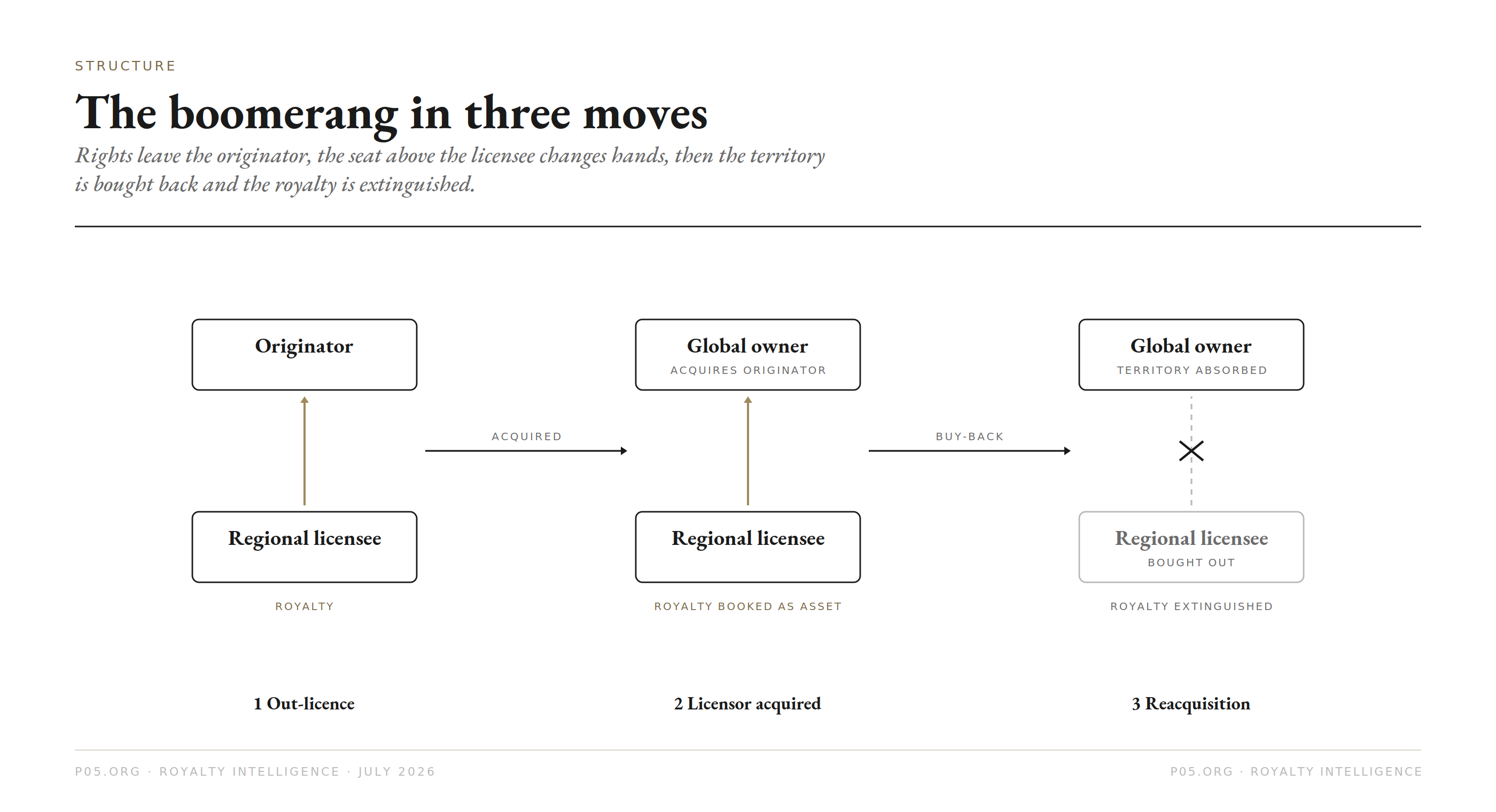
Figure 1. The tell is in move three. The global owner is not writing off a bad asset. It is paying to retire a royalty it was receiving, because owning the whole territory outright is worth more than the net-of-royalty economics of leaving the partner in place.
That only makes sense when the acquirer has global ambitions for the molecule, and the regional partner has become a fragment of a strategy the acquirer would rather run itself.
Ivosidenib: the textbook case
Ivosidenib (TIBSOVO), the first-in-class IDH1 inhibitor, traces the pattern exactly.
In June 2018, Agios granted CStone Pharmaceuticals exclusive rights to develop and commercialise ivosidenib across Mainland China, Hong Kong, Macau, and Taiwan.
Agios took a $12 million upfront, became eligible for up to $412 million in milestones (about $147 million development and regulatory, $265 million sales), and was owed tiered royalties described publicly as mid to high teens. Its own SEC disclosure fixes the band at 15 to 19 percent of net sales in the territory. CStone carried all costs. A clean regional out-licence, with the royalty running up to Agios.
Then the seat above CStone changed. In a transaction that closed on 31 March 2021, Agios sold its entire oncology business to Servier for $1.8 billion upfront, up to $200 million in a vorasidenib milestone, and retained royalties of 5 percent on US net sales of TIBSOVO and 15 percent on US net sales of vorasidenib.
Servier inherited the CStone licence and became CStone's licensor. Ivosidenib now had a global owner, and CStone's Greater China licence had become one regional node inside Servier's oncology strategy.
The boomerang closed in December 2023. Servier bought the Greater China and Singapore rights back from CStone for $44 million upfront and up to a further $6 million on completion, up to $50 million in total.
The licence was terminated, and CStone was released from its remaining milestones. CStone framed it as recouping its historical investment while it refocused on assets it holds globally. Servier framed it as consolidating a molecule it already owned worldwide. The 15 to 19 percent Greater China royalty that had run up the chain since 2018 simply ceased to exist.
| Step | When | Terms |
|---|---|---|
| Out-licence to CStone | Jun 2018 | $12m upfront, up to $412m milestones, 15 to 19% royalty to Agios |
| Agios oncology sold to Servier | Mar 2021 | $1.8bn upfront, up to $200m; Agios keeps 5% and 15% US royalties |
| Servier buys the region back | Dec 2023 | up to $50m; milestones released; royalty extinguished |
There is a second layer worth noting, because it shows how a boomerang can extinguish one royalty while others in the same molecule live on.
The royalties Agios kept in 2021 were not regional pass-throughs but a slice of Servier's own US sales. Agios later monetised them: it sold the 15 percent US vorasidenib royalty to Royalty Pharma for $905 million and sold the 5 percent TIBSOVO royalty for a one-time payment.
The regional royalty above CStone was retired by reacquisition. The top-of-house royalties Agios retained became someone else's asset. Same molecule, two very different fates for two very different royalties.
Trodelvy: the same shape at antibody-drug-conjugate scale
The Trodelvy (sacituzumab govitecan) story is the same structure, larger, and with the purchase-accounting detail visible in the filings.
In April 2019, Immunomedics granted Everest Medicines an exclusive licence to Trodelvy across Greater China, South Korea, and several South-East Asian markets. The deal was worth up to $835 million with a $65 million upfront, plus tiered royalties and sales milestones flowing up to Immunomedics.
In October 2020, Gilead acquired Immunomedics for roughly $21 billion and inherited the Everest licence.
Gilead's 2022 annual report is explicit about what that inheritance was worth on paper. The assumed Everest licence and supply agreement, which provided for milestones and royalties to Gilead, was recorded as a $175 million finite-lived asset in the purchase accounting. The regional royalty had a book value on Gilead's balance sheet.
In the fourth quarter of 2022, right as Everest was launching Trodelvy in China, Gilead reacquired all the Asia rights from Everest for up to $455 million, $280 million upfront plus up to $175 million in milestones, and terminated the agreement. Everest was released from roughly $710 million in remaining milestone obligations.
Gilead's own accounts describe it plainly: it reacquired all rights and terminated the previous agreement. The $175 million royalty asset it had inherited was extinguished by paying to own the territory outright.
| Step | When | Terms |
|---|---|---|
| Out-licence to Everest | Apr 2019 | up to $835m ($65m upfront), royalties and milestones to Immunomedics |
| Immunomedics bought by Gilead | Oct 2020 | ~$21bn; Everest licence booked as a $175m asset |
| Gilead reacquires the region | Q4 2022 | up to $455m; ~$710m milestones released |
Two molecules, two acquirers, the same three moves. In both cases the reacquisition landed within about two to three years of the licensor changing hands, and right around regional approval or launch. That timing is not a coincidence, and it is the part the intelligence angle turns on.
Ohtuvayre: the buy-back option, written into the licence
The third case is the most instructive, because the return route was not improvised. It was a term of the original licence.
In 2021 Verona Pharma sublicensed Greater China rights, Mainland China, Hong Kong, Macau, and Taiwan, to Nuance Pharma for ensifentrine, later branded Ohtuvayre, for up to $179 million in milestones plus royalties.
Unlike the two cases above, Verona did not have to negotiate its way back into the territory. It held a contractual buy-back option it could exercise at its own discretion.
The trigger was value, not distress. The FDA approved Ohtuvayre in June 2024 as the first novel inhaled mechanism for COPD maintenance in more than two decades. Nuance then delivered in the territory: Macau approval in February 2025, the first anywhere outside the US, and completion of the China Phase 3 in March 2025, which paid Verona a $5 million milestone.
With the asset de-risked regionally, on 24 June 2025 Verona exercised its option to buy the licence back, including Nuance's sublicences and all related assets. Nuance disputed the notice and asked for it to be withdrawn, and the matter was still unresolved on the most recent filings. Verona kept the right to withdraw the notice before paying the consideration.
Two features make this the sharpest illustration of the structure.
First, the option shows the boomerang can be pre-committed. The originator holds a call on the territory from day one, exercisable exactly when consolidation becomes worth more than the royalty.
Second, the dispute shows the option is not self-executing. A buy-back written into the licence still has to be enforced, priced, and closed, and a licensee sitting on a freshly de-risked asset has every reason to resist.
The licensor then changed hands over the top of all of it. In July 2025 Merck agreed to acquire Verona for about $10 billion, $107 per ADS, and the deal closed in October 2025.
Merck inherited Ohtuvayre worldwide and, with it, the unresolved China buy-back. The move that took years to arrive in the ivosidenib and Trodelvy cases, a global owner sitting above the regional licensee, was here compressed into the same handful of months as the buy-back itself.
And as with ivosidenib, a top-of-house royalty sits above the whole structure and is untouched by the regional buy-back. Ligand holds a 3 percent royalty on global Ohtuvayre net sales, assembled through its 2018 acquisition of Vernalis and further inventor rights bought during 2024 and into January 2025. The China licence can boomerang; the global 3 percent does not.
Three cases, one shape
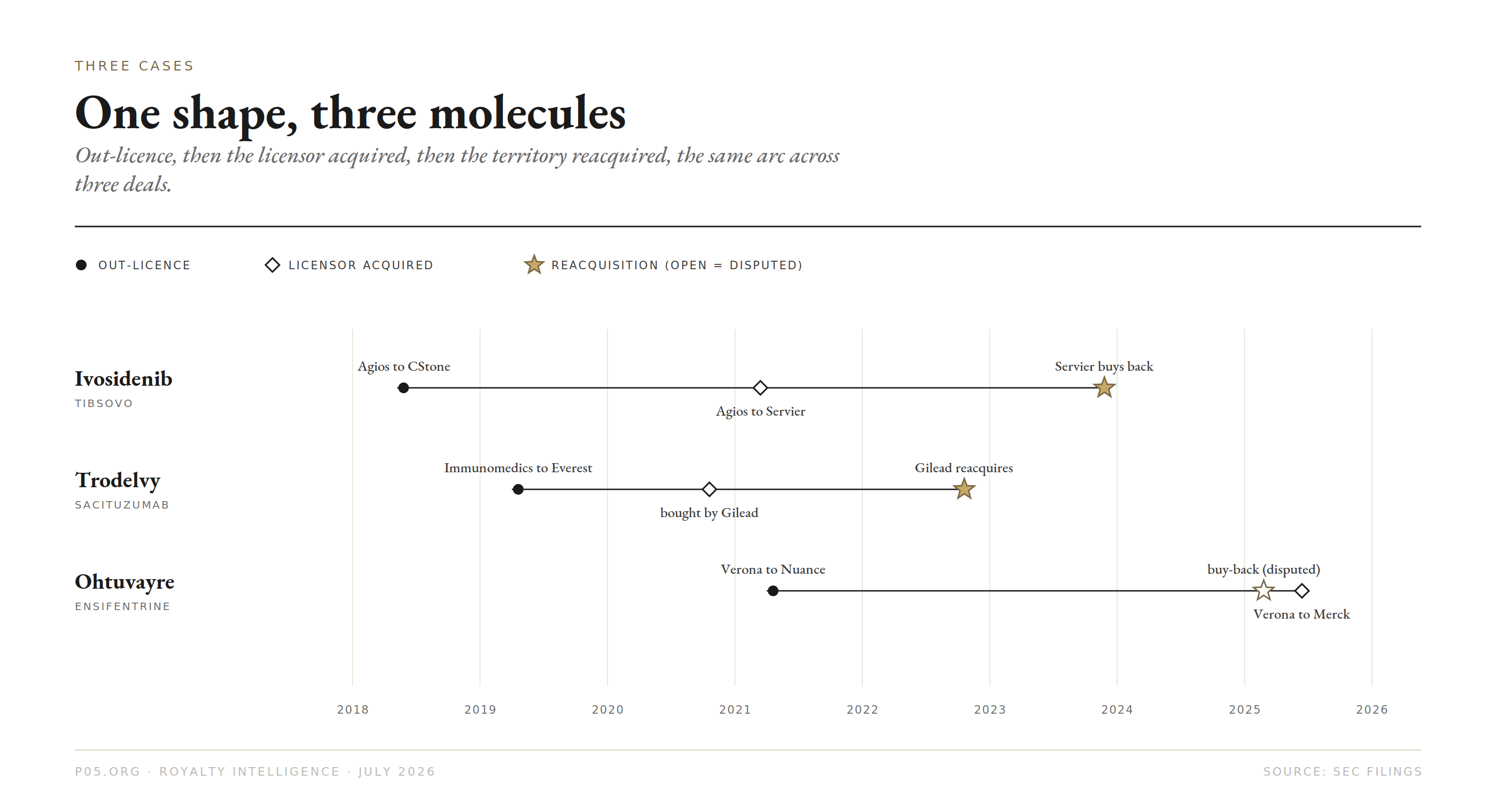
Figure 2. The same arc, three molecules. Out-licence, licensor acquired, then the territory reacquired. In Ohtuvayre the last two events collapse into the same few months, and the buy-back is still disputed.
| Ivosidenib | Trodelvy | Ohtuvayre | |
|---|---|---|---|
| Originator | Agios | Immunomedics | Verona |
| Licensee | CStone | Everest | Nuance |
| Territory | Greater China | China + Asia | Greater China |
| Out-licence | 2018 | 2019 | 2021 |
| Licensor sold | to Servier, 2021 | to Gilead, 2020 | to Merck, 2025 |
| Return | buyback, 2023 | reacquired, 2022 | option, 2025 |
| Price | up to $50m | up to $455m | disputed |
| Top royalty | Agios 5%, sold | none | Ligand 3% |
The shape is constant. An originator out-licenses a territory, the seat above the licensee passes to a global owner through M&A, and the territory is then pulled back in, retiring the regional royalty.
What varies is the mechanism, negotiated after the fact or written in as an option, and whether the return closes cleanly or lands in dispute.
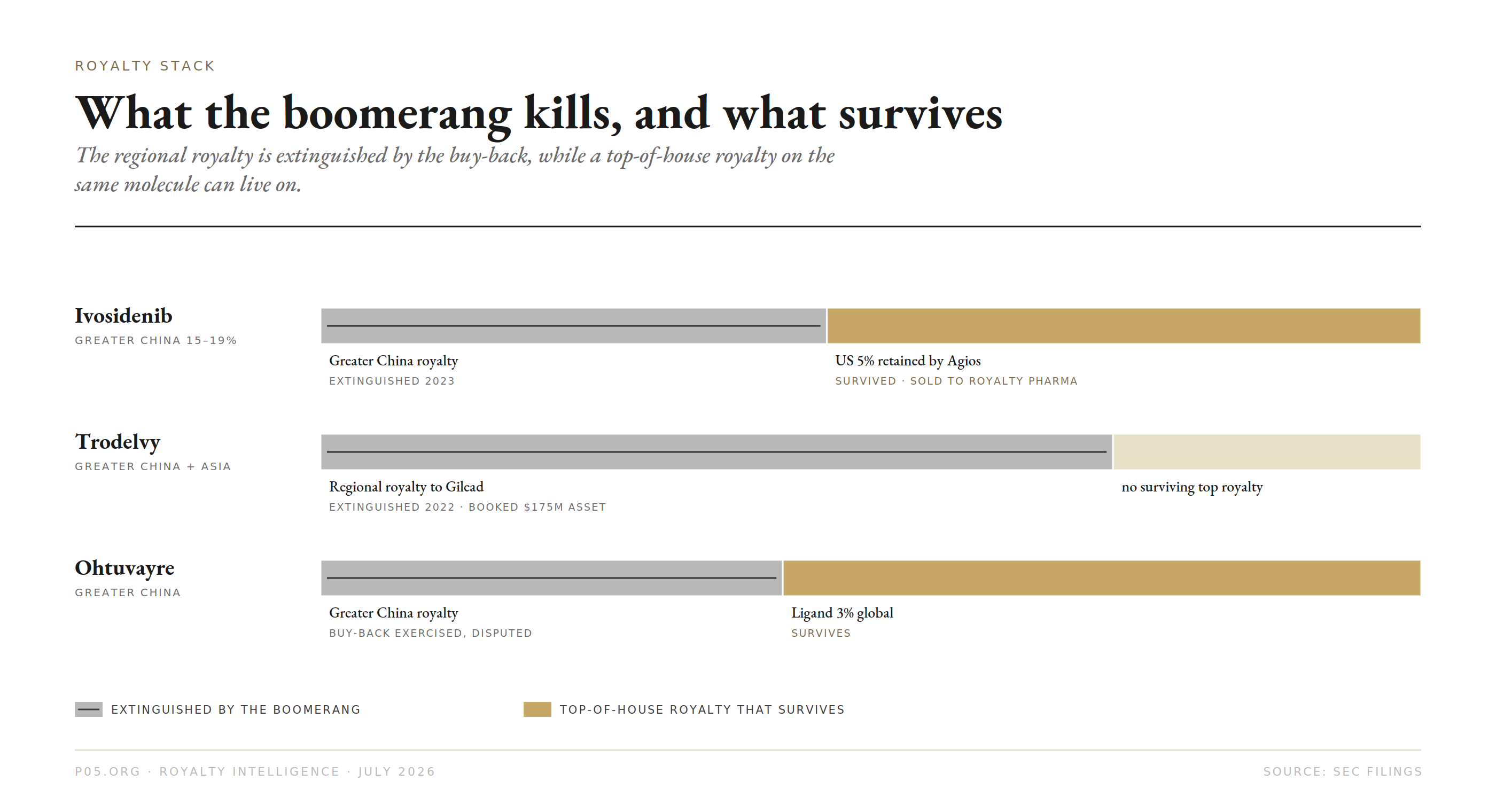
Figure 3. A boomerang extinguishes the regional royalty, but a top-of-house royalty on the same molecule can survive it. Agios kept a US royalty on ivosidenib and later sold it; Ligand's 3 percent global royalty on Ohtuvayre sits above the disputed China buy-back.
Why the pattern is becoming more common
The population of licences that can boomerang is growing quickly, for structural reasons.
Chinese cross-border out-licensing reached a record in 2025, with about $137.7 billion in announced value and roughly $60 billion of new deals in the first quarter of 2026 alone. Every regional in-licence and out-licence in that wave is a potential boomerang node.
At the same time, a patent-cliff-driven M&A cycle is putting more originators inside larger global owners, which is exactly the event that creates the loose end. When a global acquirer swallows an originator, it inherits every regional sub-licence that originator had signed, and each one is a fragment of a territory the acquirer may prefer to run itself.
Regional economics push the same way. In China specifically, national reimbursement negotiation and price pressure can compress the value a local partner extracts from a narrow, biomarker-defined population.
That is precisely the ivosidenib profile: an IDH1-mutant indication is a thin slice of the addressable market, and a thin slice under reimbursement pressure is a weak base for a standalone regional business. It makes the partner a willing seller and the global owner a motivated buyer at the same moment.
The result is a structural bias toward reacquisition wherever a recently acquired molecule has a live regional licence, a global owner with the territory in its own plans, and a partner for whom the region is no longer core.
Variants and edge cases
The core boomerang has a licensee handing a territory back to the party above it for cash. Three adjacent structures are worth separating, because they change either the mechanism or the cleanliness of the ending.
The affiliate reabsorption. Instead of licensing to a third party, an originator can license to a separately listed affiliate and later reabsorb it.
Ionis did exactly this with Akcea Therapeutics, its majority-owned commercial affiliate, which held licences to Ionis-discovered drugs including Tegsedi and Waylivra and shared milestones and royalties with the parent. In 2020 Ionis acquired the roughly 24 percent of Akcea it did not already own in an all-stock deal, folding the affiliate and those intercompany splits back into the parent. The boomerang here is corporate rather than territorial, but the effect is the same: an internal royalty is retired by buying back the entity that owed it.
Reversion with a trailing royalty. A reversion is not always clean or free.
When FibroGen and AstraZeneca terminated their US and rest-of-world roxadustat agreement in 2024, AstraZeneca returned the non-China rights to FibroGen but kept tiered mid-single-digit royalties on FibroGen's sales in the returned territories, or 35 percent of any proceeds if FibroGen relicensed or sold them. The rights went home, but a royalty followed them back the other way. A model that treats reversion as the end of all economics on a licence would miss it.
Consolidation by buying the regional business. The territory can also be consolidated by acquiring the regional entity rather than repurchasing the licence.
In August 2025 AstraZeneca closed the acquisition of FibroGen's China operations outright through a share purchase, taking China roxadustat in-house by buying the company that held it. The endpoint is the same unified control, reached through M&A of the business rather than a licence buyback.
What it is not: the sideways reshuffle
Not every rights transfer is a boomerang, and the distinction is worth drawing because it changes the risk.
In June 2026, Everest Medicines acquired the Greater China rights to the presbyopia therapy VIZZ (LNZ100, aceclidine) from Corxel Pharmaceuticals, which had itself picked up those rights from originator LENZ Therapeutics in 2022.
The rights moved from one regional licensee to another and stayed in China. LENZ did not get them back. That is a sideways transfer, a secondary trade in a regional licence, not a boomerang. The royalty up to the originator survives; only the identity of the payer changes.
The boomerang requires the rights to return to the party above the licensee, and it requires that party to be paying to extinguish a royalty it was receiving. A reshuffle keeps the stream alive and simply hands it a new counterparty. Telling the two apart is the difference between a royalty that continues under new management and one that ends.
Reading the boomerang from the outside
For anyone tracking or underwriting these streams, the useful work is spotting the setup before the buyback prints. A recognisable signature precedes most of them.
A recently acquired originator. The licensor has changed hands through M&A within the last few years, and the acquirer is a global with its own commercial presence in the territory. This is the single strongest predictor. No global owner above the licensee, no boomerang.
An explicit buy-back option. Some licences hand the originator a contractual call on the territory from the outset, as Verona's did. Where that option exists, the boomerang is not a question of whether the parties negotiate but of when the holder exercises, and the licence text sets out the price mechanism in advance.
A royalty booked as an intangible. The acquirer's purchase accounting carries the assumed regional licence as a finite-lived asset, as Gilead's did at $175 million. That line is the acquirer telling you it has priced the stream it inherited.
Regional underperformance or a thin population. Narrow biomarker-defined indications, reimbursement gaps, and slow national listing all weaken the standalone case for the local partner and turn it into a willing seller.
A modest buyback ceiling. Reacquisitions tend to price well below the original headline value of the licence.
When several of these line up on the same licence, the reacquisition is a question of timing, not of whether.
What it means for a royalty holder
If you own, or are pricing, a royalty that sits on a regional out-licence, the boomerang is a specific and often mispriced form of early-termination risk.
The stream can be bought out at the global owner's option, at a negotiated price or a pre-agreed one, at a moment the owner chooses, and none of that depends on the drug failing. It is the mirror image of a monetisation: instead of the royalty holder selling the stream to a fund, the party underneath buys back the asset the stream sits on, and the stream disappears.
That risk lives in the change-of-control and buyout language, which is exactly the part of a regional licence that a duration-and-failure model tends to ignore. The questions to ask are concrete.
Does the licence give the licensor, or its successor, a right to reacquire the territory, and on what terms? Is that a discretionary call option, as in the Ohtuvayre licence, and can it be exercised without the licensee's consent? Is there a make-whole or a floor that protects the royalty on a buyback, or does the royalty simply end when the licence does? Who inherits the licensor's position on a change of control, and does that party have the territory in its own strategy?
A royalty that reads as clean duration risk on the base case can carry an embedded short call that the payer, or the payer's acquirer, is holding.
The same features that make the payer want to boomerang, a thin regional population and a global owner with unified ambitions, are visible from the outside well before the buyback. Pricing the stream without pricing that optionality is pricing only two of the three endings.
Diligence checklist
Royalty holder or underwriter
- Does the licence contain a buy-back or call option over the territory, on what price mechanism, and can it be exercised without the licensee's consent?
- Does the royalty survive a buyback through a make-whole or a floor, or end with the licence?
- Has the licensor been acquired, and does the acquirer have the territory in its own commercial plans?
- Is the regional population thin or reimbursement-constrained enough to make the local partner a willing seller?
- Have you modelled the buyback as an embedded call, not just duration and failure?
Regional licensee
- If the region is no longer core, is a negotiated buyback a cleaner exit than a slow run-off, and does it release remaining milestones?
- If the licence carries a buy-back option against you, on what terms, and what leverage do you hold if it is exercised at an inconvenient moment?
- What is the reacquisition worth against the sunk investment and the realistic standalone forecast under national pricing?
Acquiring global owner
- Is the inherited regional royalty carried as an intangible, and is retiring it worth more than leaving the partner in place?
- Is it cheaper to exercise a buy-back option, negotiate a repurchase, or acquire the regional business outright?
- Does reacquisition close near regional approval or launch, where unified control compounds fastest?
A regional out-licence has three endings, not two, and the third is the one a base-case model tends to leave out. Run-off is duration, reversion is failure, and the boomerang is a global owner paying to retire a royalty it was receiving so it can own the territory outright.
Ivosidenib, Trodelvy, and Ohtuvayre show the shape cleanly: rights out, licensor acquired, rights bought home, royalty extinguished. Ohtuvayre goes furthest, because the buy-back was a term of the licence from the start and the licensee is contesting it, which is the clearest demonstration that this risk is written into the paper rather than invented at the exit.
With record cross-border licensing feeding a patent-cliff M&A cycle, the population of licences that can travel that arc is larger now than it has ever been. For a royalty holder, the discipline is to price all three endings, and to find the reacquisition option before the party underneath exercises it.
The development funding bond is the reminder that a royalty is only ever as durable as the contract underneath it. The boomerang is the reminder that the contract can be bought back out from under the stream.
All information in this article was accurate as of July 2026 and is derived from publicly available sources including SEC filings, company press releases, and financial news reporting. Information may have changed since publication. This content is for informational purposes only and does not constitute investment, legal, or financial advice. The author is not a lawyer or financial adviser.