
The royalty deal written into the loan: how a senior lender sets the terms before any buyer arrives

On 6 October Rocket Pharmaceuticals announced that Hercules Capital had lent it $35.0M, the first draw on a senior secured facility of up to $150.0M signed on 30 September. The press release said the money, with the cash already in hand, would fund the company into the third quarter of 2028. The loan agreement filed with it describes a royalty financing that Rocket has yet to sign.
It sits in the definitions, under "Permitted Royalty Transaction". The term names the one royalty deal Rocket may strike on RP-A501, its gene therapy for Danon disease, while the loan is outstanding. Credit lawyers call such a carve-out from a covenant a basket. This one fixes the smallest cheque a buyer may write, the largest share of sales it may take, the ceiling on its payments, the rank of its security, and the earliest date on which it may be owed a guaranteed return. Any buyer of an RP-A501 royalty before 2031 will be pricing a structure that Hercules drafted in September.
The consent gate described the standard Hercules basket through Savara's facility. The Rocket text sets a floor price for each point of royalty and gives the agent a veto over the buyer's fees. It also stops Rocket promising anyone else not to grant liens, and it ties the release of Hercules's lien to the agent's own view of what counts as a true sale.
The clause
The definition admits "either a true royalty or synthetic royalty financing". Rocket must receive net cash proceeds of at least $200M, free of any redemption, clawback, or escrow, in exchange for payments based on RP-A501's sales or milestones. Those payments have one of two limits. The buyer may take up to 10 per cent of worldwide net sales across all such deals. Alternatively it may take fixed and variable success fees worth up to two times the proceeds, on terms that Hercules approves "in its sole discretion".
The figures scale downwards. The agreement gives the example of $100M for no more than 5 per cent of RP-A501's net product revenue, and it makes 5 per cent the smallest slice that any one deal may carry. Rocket may have only one such deal on RP-A501 at a time, and none while it is in default.
Divided out, the two numbers set a price. A buyer must pay at least $20M for each percentage point of worldwide sales, which puts a floor of $2.0B on the value of all of RP-A501's future sales. Rocket cannot sell 2 per cent to a buyer that wants a small position. Nor can it accept $150M for 10 per cent, however much it needs the cash.
Hercules has written the same scaffolding at other prices. MoonLake Immunotherapeutics' loan of up to $500M, signed on 31 March 2025, allowed royalty deals on sonelokimab, one at a time, for at least $300M against no more than 10 per cent of worldwide sales, or $30M a point. The facility of up to $200M that Hercules signed with 4D Molecular Therapeutics on 24 June 2026 keeps the frame for 4D-150, redacts both the minimum price and the rate, and sets its timing limit 150 days after the loan matures. Of the three, only the Rocket text offers a second limb measured as a multiple of the money paid.
What the lender keeps
Most of the conditions that follow protect Hercules's first lien. A synthetic royalty, which the definition separates from "royalty purchases or buyouts", must sit under an intercreditor agreement "in form and substance satisfactory to Agent in its sole discretion". Any security the buyer takes may cover no more than 10 per cent of RP-A501's net product revenue and must rank behind Hercules.
The list of permitted liens adds a back-up lien on a royalty bought outright, and on a segregated account into which only that royalty is paid.
The timing condition reaches furthest. No permitted deal may carry a guaranteed minimum return or "true-up" payment earlier than 180 days after the loan matures, and a deal written as debt may not mature before that date either.
The loan matures on 1 October 2030, or on 1 October 2031 if Rocket reaches the Danon data milestone that unlocks its fourth tranche. The earliest permitted true-up therefore falls on 30 March 2031, or on 29 March 2032 after an extension.
The agreement also limits what a buyer may ask of Rocket. Under section 7.5 Rocket may not agree with anyone except Hercules and the lenders not to encumber its property, other than in connection with permitted liens. Royalty buyers usually take a negative pledge over the product's assets. At Rocket such a covenant would need Hercules's agreement.
The agreement casts the lien release as an obligation, with a test that Hercules applies. If Rocket asks, the agent "shall" release its lien on purchased revenue in a "true sale" of "an existing revenue stream", provided the deal is permitted and is not a synthetic royalty "as determined by the Agent in its reasonable business judgment". RP-A501 has no sales yet. The agreement is silent on whether a royalty sold before approval is an existing revenue stream.
The covenants give Rocket a reason to sell. Proceeds of a permitted royalty deal count as qualified equity proceeds, the measure that postpones the first test of the cash covenant. Without such proceeds the test begins on 1 July 2027. With $150M to $350M raised it begins between 1 July 2028 and 1 July 2029.
Once the test applies, Rocket must hold cash equal to 55 per cent of the loan before the Danon data milestone, 45 per cent after it, 35 per cent after approval, and 75 per cent if the programme stops or misses its primary endpoint. The covenant falls away on any day that Rocket's market value exceeds $600M.
The arithmetic
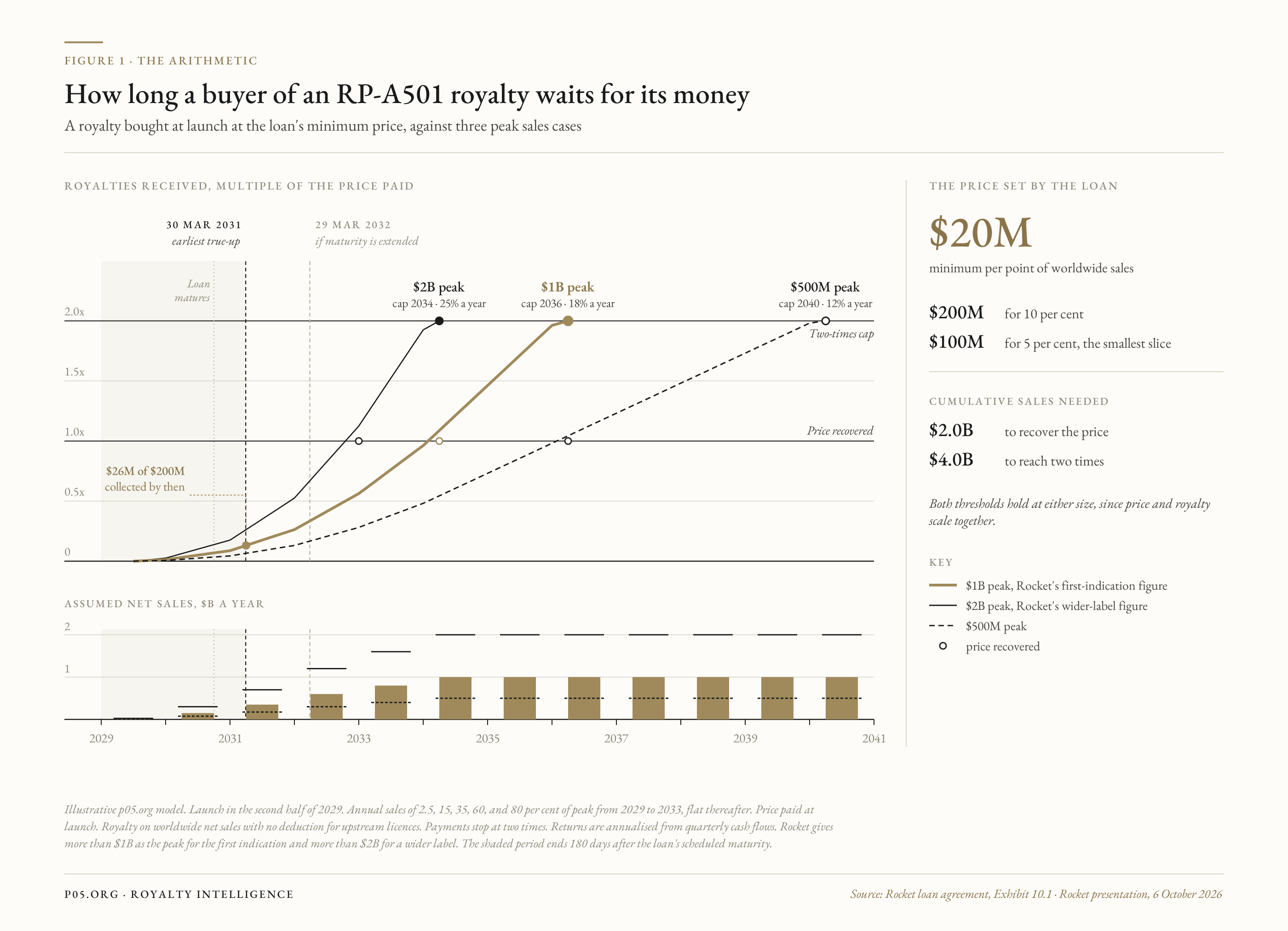
Because the price and the royalty scale together, the sales a buyer needs to be repaid are the same at any deal size. At $20M a point, a royalty earns back its price once cumulative worldwide net sales reach $2.0B. Two times the price comes back at $4.0B. Both figures hold for $200M against 10 per cent and for $100M against 5 per cent.
How long that takes depends on the launch. Rocket's presentation of 6 October targets the last patient dosed in the registrational cohort by mid-2027, topline data in mid-2028, and a filing for accelerated approval late that year. It puts the peak for the first indication at more than $1B a year worldwide, and above $2B for a wider label.
The curve below assumes approval and launch in the second half of 2029. Sales reach 2.5, 15, 35, 60, and 80 per cent of peak in the five calendar years from 2029, then hold flat. The buyer pays at launch, receives its percentage of net sales, and stops at two times its money, with nothing deducted for the licences described below. These assumptions are p05.org's own. Rocket has given no sales guidance.
At a $1B peak the buyer recovers its price in the first quarter of 2034 and reaches two times in the first quarter of 2036, an annual return of about 18 per cent. If peak sales reach only $500M, recovery slips to 2036 and the cap to 2040, and the return falls to about 12 per cent. Rocket's $2B figure brings the cap forward to 2034 and lifts the return to about 25 per cent.
Under every curve the timing condition bites early. By 30 March 2031, the first date on which a true-up may fall due, a buyer of 10 per cent for $200M would have collected about $26M at a $1B peak. That is 13 per cent of its money. At a $500M peak it would have collected about $13M. A make-whole payment dated any earlier falls outside the basket.
The loan itself
The loan comes in five tranches. Rocket drew the first, $35.0M, at signing. It may draw $20.0M more at its option until 30 June 2027 and a further $15.0M until 30 September 2027. A fourth tranche of $30.0M depends on the Danon milestone. Exhibit K defines it as positive data from the registrational study, or positive interim data that Hercules, after reviewing the results and the FDA correspondence, judges sufficient to support a filing. The last $50.0M is available only if Hercules's investment committee approves it "in its sole and unfettered discretion".
Interest floats at the greater of the prime rate and 6.75 per cent, plus 2.40 per cent, so the coupon cannot fall below 9.15 per cent. Rocket pays interest only until 1 April 2029. That date moves to 1 April 2030 on the data milestone and to 1 October 2030 on approval. Early repayment costs 3 per cent of principal in the first year, 2 per cent in the second, and 1 per cent after that. An end-of-term charge applies on top. Rocket redacted its percentages, as it did the facility fees.
The lenders also hold warrants over 1,755,853 shares at $2.99, which vest in proportion to the amount drawn. Warrants over 409,699 shares became exercisable with the first draw. A separate clause lets the lenders put up to $5.0M in total into Rocket's broadly marketed equity offerings of $30M or more.
The security is a first-priority lien on substantially all of Rocket's assets, including its intellectual property. The agreement's definition of company IP reaches the American patents, know-how, and regulatory filings behind Rocket's products, together with the income and royalties earned on them.
Rocket's other assets carry terms of their own. The permitted transfers let it sell Kresladi and two other lentiviral programmes, RP-L102 and RP-L301, outright at fair value, provided the cash lands in an account under Hercules's control. It may grant exclusive licences of its IP only for territories outside America, and any other licence of company IP needs the consent of lenders holding more than half the loans, which they may not withhold unreasonably.
It may also issue convertible notes worth up to the lesser of $200M and 20 per cent of its market value, with no principal due until 180 days after the loan matures. A change of control obliges Rocket to repay the loan in full, with the prepayment charge.
The agreement also shields Rocket from one kind of default. Its definition of a material adverse effect excludes a missed milestone, a poor trial result, a refusal or delay by the FDA, and a change to a licence or partnership that leaves Rocket able to pay, so a setback in the Danon study does not by itself let Hercules accelerate the loan. The cash floor rises to 75 per cent instead.
Hercules is lending against a programme that the FDA halted for three months last year. In May 2025 two patients in the study developed a capillary leak syndrome, and one of them died. The FDA placed the trial on clinical hold on 23 May 2025 and lifted it that August. Dosing resumed at a lower dose with a revised immune-suppression regimen, and Rocket reported no recurrence in the three patients treated since, as of 3 August 2026. Its October presentation says the FDA has agreed that a further cohort can support a filing for accelerated approval.
Rocket also has other money. On 10 June 2026 it sold the priority review voucher it received with the approval of Kresladi for $180.0M, and it held cash and investments of $283.7M at 30 June.
The licences above it
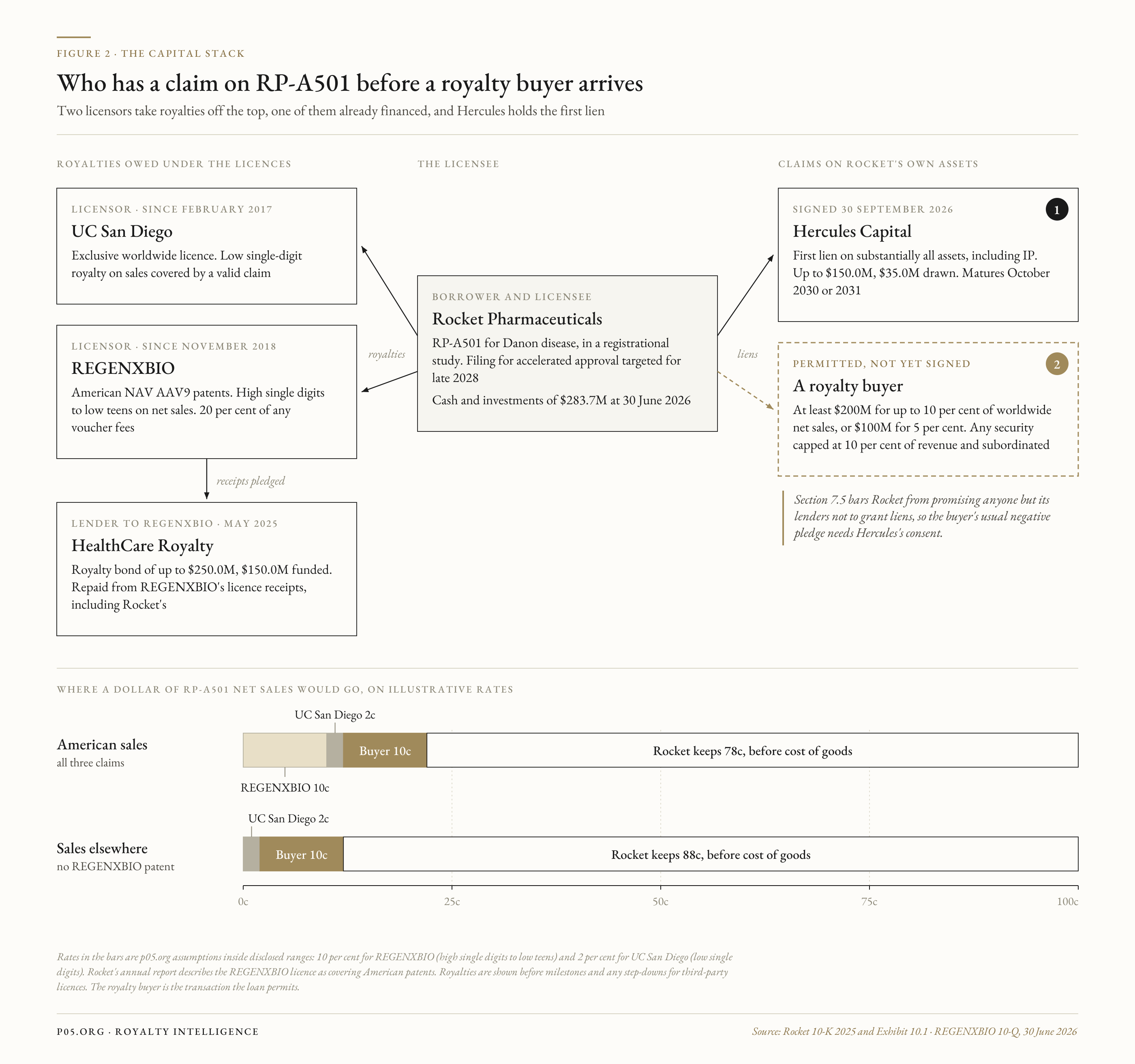
A buyer of an RP-A501 royalty would rank behind Hercules and beside two licensors. The University of California, San Diego granted Rocket an exclusive worldwide licence in February 2017 for lysosomal storage diseases, including Danon disease, for a low single-digit royalty on sales covered by a valid claim.
REGENXBIO granted an exclusive licence in November 2018 to its American patents on the NAV AAV9 vector for Danon disease. It earns royalties from the high single digits to the low teens on net sales, up to $13.0M in milestones for each product and 20 per cent of any fees Rocket receives for a priority review voucher tied to the product. Its royalty runs, country by country, until the later of the last valid claim and ten years after first sale.
Part of the REGENXBIO stream is already financed. In May 2025 REGENXBIO agreed a limited-recourse loan of up to $250.0M with HealthCare Royalty, and HealthCare Royalty funded $150.0M at closing. It bears interest at 9.75 per cent over SOFR, the secured overnight financing rate, with a floor of 14.0 per cent.
REGENXBIO repays it only from specified royalties and licence payments, net of what it owes its own licensors, and these include its NAV technology licences with Rocket and Ultragenyx. HealthCare Royalty therefore already holds a claim on RP-A501's American sales, two steps removed and secured on REGENXBIO's receipts.
On American sales the claims stack up. Suppose the REGENXBIO rate were 10 per cent and the university's 2 per cent, both assumptions inside the disclosed ranges. A buyer of 10 per cent would then bring the royalties on each dollar of American net sales to 22 cents before Rocket paid for manufacturing. Rocket's annual report describes the REGENXBIO licence as covering American patents, so on that reading the stack outside America would be 12 cents.
The other ways round
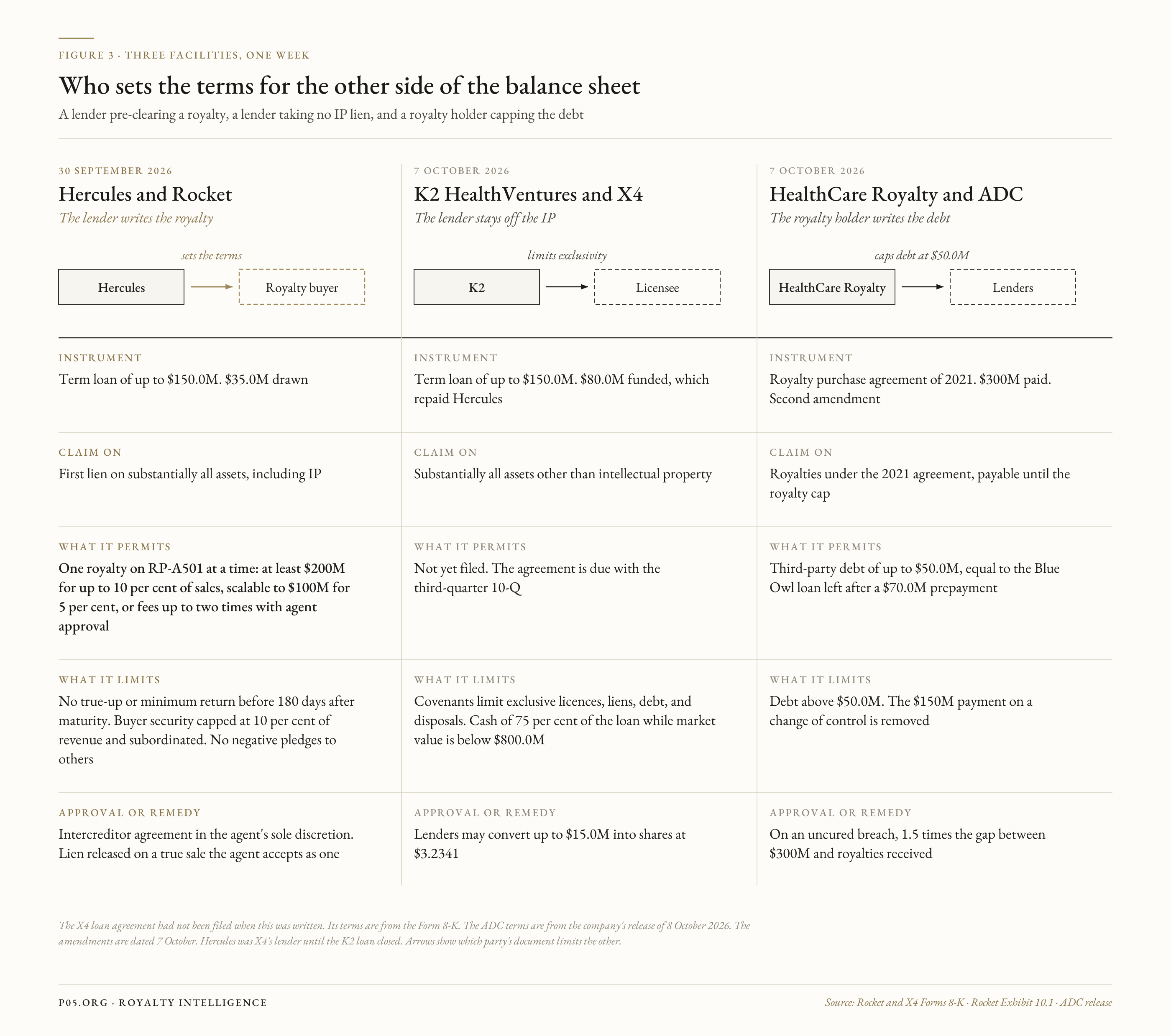
The week the Rocket agreement became public, two other companies divided the same ground differently. On 7 October X4 Pharmaceuticals replaced its Hercules facility with a loan of up to $150.0M from K2 HealthVentures, paying Hercules about $78.7M to retire $75.0M of principal. K2 takes security over substantially all of X4's assets other than its intellectual property.
Its covenants limit, among other things, X4's ability to grant exclusive licences. A royalty buyer at X4 would meet no lender lien on the patents, and a covenant that reaches any structure built on an exclusive licence.
The same day ADC Therapeutics signed a second amendment to its 2021 royalty purchase agreement with HealthCare Royalty, which has paid ADC $300M. The amendment removes a $150M payment due to HealthCare Royalty on a change of control. The same amendment caps the debt ADC and its subsidiaries may incur at $50.0M. If ADC breaches the cap and fails to cure it, HealthCare Royalty may demand 1.5 times the gap between the $300M it paid and the royalties it has received.
At the same time ADC prepaid $70.0M of its Blue Owl term loan, leaving $50.0M outstanding, the same figure as the new cap, and arranged a private placement of about $86.6M. HealthCare Royalty's 9,834,776 warrants, issued in February 2026, now carry an exercise price of $0.10 a share, down from $3.8130.
Kodiak Sciences shows an older form of the same reversal. Under a funding agreement of December 2019, Baker Bros. Advisors bought a 4.5 per cent royalty on tarcocimab, capped at 4.5 times the money paid. It paid $100M of a promised $225M, and the parties cancelled the remaining $125M at Kodiak's request in July 2021.
Kodiak may buy the royalty back at any time for 4.5 times the money paid, less what Baker has already received. Section 5.11 bars Kodiak from granting any lien on the product's assets beyond permitted liens. Those allow an asset-based revolving facility of up to $200.0M and other secured debt of up to $100.0M. Kodiak may add secured debt up to the payments Baker has received, provided secured leverage stays at or below 1.5 times and Baker is secured equally with the new lender. On 28 September tarcocimab met its primary endpoint in the DAYBREAK trial, and Kodiak plans to file for approval in the fourth quarter of 2026.
Where a buyer's diligence starts
For a buyer of an RP-A501 royalty the purchase agreement is the second document. The first is the definition of a permitted royalty transaction, which sets the minimum price, the share of sales, the choice between a percentage and a multiple, and the one-deal limit. A bid outside it needs Hercules's consent. Hercules has kept sole discretion over both the fees limb and the intercreditor agreement, and Rocket has filed no form of that intercreditor agreement.
Section 7.5 decides whether the buyer can hold a negative pledge. Other lenders draft it differently. At Scholar Rock, Oxford Finance and its co-lenders agreed in September 2025 that the agent may accept a negative lien covenant in a synthetic royalty, so long as the covenant expressly permits the agent's own liens.
The maturity-linked dates decide when a minimum return can bite, which at Rocket is 30 March 2031 at the earliest. The loan Mineralys Therapeutics took from BioPharma Credit on 2 June 2026 is stricter. It permits only a true sale of lorundrostat revenue and bars any true-up or advance payment outright. Nor may the buyer receive any payment on a change of control other than a call option exercised once the loan has been repaid.
The release mechanics decide what the buyer owns if Rocket fails. A true sale frees the purchased stream from Hercules's lien when Rocket asks, provided the stream already exists and Hercules judges the deal not to be synthetic. A synthetic royalty keeps its security behind Hercules, capped at 10 per cent of RP-A501's revenue, under an intercreditor agreement that Hercules approves. The buyer's rank therefore depends on decisions Hercules takes after the bid is made.
The facility Hercules signed on 30 September has so far advanced $35.0M. Until at least 30 March 2031, Rocket can sell a royalty on RP-A501 only for $20M a point or more, in slices of no less than 5 per cent, one deal at a time, with any security ranking behind Hercules.
All information in this report was accurate as of the research date and is derived from publicly available sources including court opinions, regulatory guidance, academic literature, SEC filings, and financial news reporting. Information may have changed since publication. This content is for informational purposes only and does not constitute investment, legal, or financial advice. The author is not a lawyer or financial adviser.