
Reject, assume, assign: section 365 and the pharmaceutical royalty

Section 365 of the Bankruptcy Code is the estate's power to reject, assume, or assign the executory contracts a royalty depends on. This is a practitioner's account of how each power reaches a pharmaceutical stream, worked through the filings, at the deal level and the fund level.
A financed royalty is a derivative interest in agreements to which the holder is usually a stranger: the in-licence supplying the patent, the collaboration marketing the product, the servicing arrangement remitting the cash, and the purchase agreement that conveyed the stream. Section 365 operates on those agreements, not on the royalty instrument, and the holder's fate turns on whether its interest was conveyed and completed or still rides on performance the estate can refuse.
The encumbrances piece fixed the royalty's rank in a payment order set before the holder arrived. Section 365 is the counterparty-insolvency overlay on that order: the powers that can reopen it, sever the licence beneath it, or discharge it to a claim. Everything below is those powers, applied.
1. The statutory architecture
Section 365 reaches only executory contracts. The prevailing definition is Countryman's: a contract on which both sides owe performance so far unperformed that either's failure to complete would be a material breach excusing the other. A funded loan is not executory, because only repayment remains and the holder is a claimant rather than a counterparty. That threshold controls whether a royalty purchase agreement is within section 365 at all, and section 4 turns on it.
Within the section, the estate has three powers, each with its own conditions.
- Rejection under section 365(a) is a business-judgment decision requiring court approval. Under section 365(g)(1) it is a breach deemed to occur immediately before the petition, relegating the counterparty to a prepetition general unsecured claim. Rejection of a contract already assumed is instead an administrative-priority breach under section 365(g)(2).
- Assumption under section 365(b)(1) requires the estate to cure defaults, compensate actual pecuniary loss, and give adequate assurance of future performance, taken cum onere: the whole contract, burdens included. Section 365(k) relieves the estate of liability for breaches occurring after a later assignment.
- Assignment under section 365(f) overrides contractual and applicable-law restrictions on transfer, subject to prior assumption and adequate assurance, and subject to the exception in section 365(c) that section 6 develops.
Two provisions set the perimeter.
Section 365(e)(1) voids ipso facto clauses that terminate or modify a contract on the counterparty's bankruptcy. But section 365(e)(2)(A) restores them for contracts that section 365(c)(1) makes non-assignable, so the shield is thinnest exactly where a non-exclusive patent licence sits.
Section 365(d)(2) sets no outside deadline in Chapter 11 short of plan confirmation, though the counterparty may move to compel an earlier election. Until it does, the licence and its royalty sit in suspense.
2. Keeping the licence out of the estate: Sorrento and Scilex
In re Sorrento Therapeutics, Inc., No. 23-90085 (DRJ) (Bankr. S.D. Tex.)
Sorrento Therapeutics and Scintilla Pharmaceuticals filed Chapter 11 on 13 February 2023. The group's commercial engine, Scilex Holding Company, a majority-owned subsidiary, was not a debtor and kept operating.
The structural consequence is the point. Because Scilex was not a debtor, its licences never became property of a debtor's estate under section 541, and no court acquired section 365 power over them.
That is entity architecture doing work seniority language cannot: a royalty on a Scilex product sat outside the parent's bankruptcy entirely. The protection is only as strong as the separateness, because a creditor can seek substantive consolidation of a non-debtor affiliate on alter-ego or asset-commingling grounds, which is why bankruptcy-remote structures pair separateness covenants with a non-consolidation opinion.
The product licences are the archetype of what a royalty rides on. Under a 2022 agreement disclosed in Sorrento's filings, Romeg Therapeutics licensed GLOPERBA to Scilex, a liquid colchicine formulation for gout prophylaxis, in a single instrument granting three distinct rights:
- a transferable licence under the specified patents;
- a licence to the related know-how, exclusive for defined purposes; and
- an exclusive, transferable licence to the GLOPERBA trademark.
Consideration was two million dollars upfront, up to thirteen million dollars in milestones, and running royalties in the mid-single-digit to low-double-digit percentages of net sales.
The three grants are not fungible under section 365. On the licensor's rejection they take three different paths, which the next case fixes.
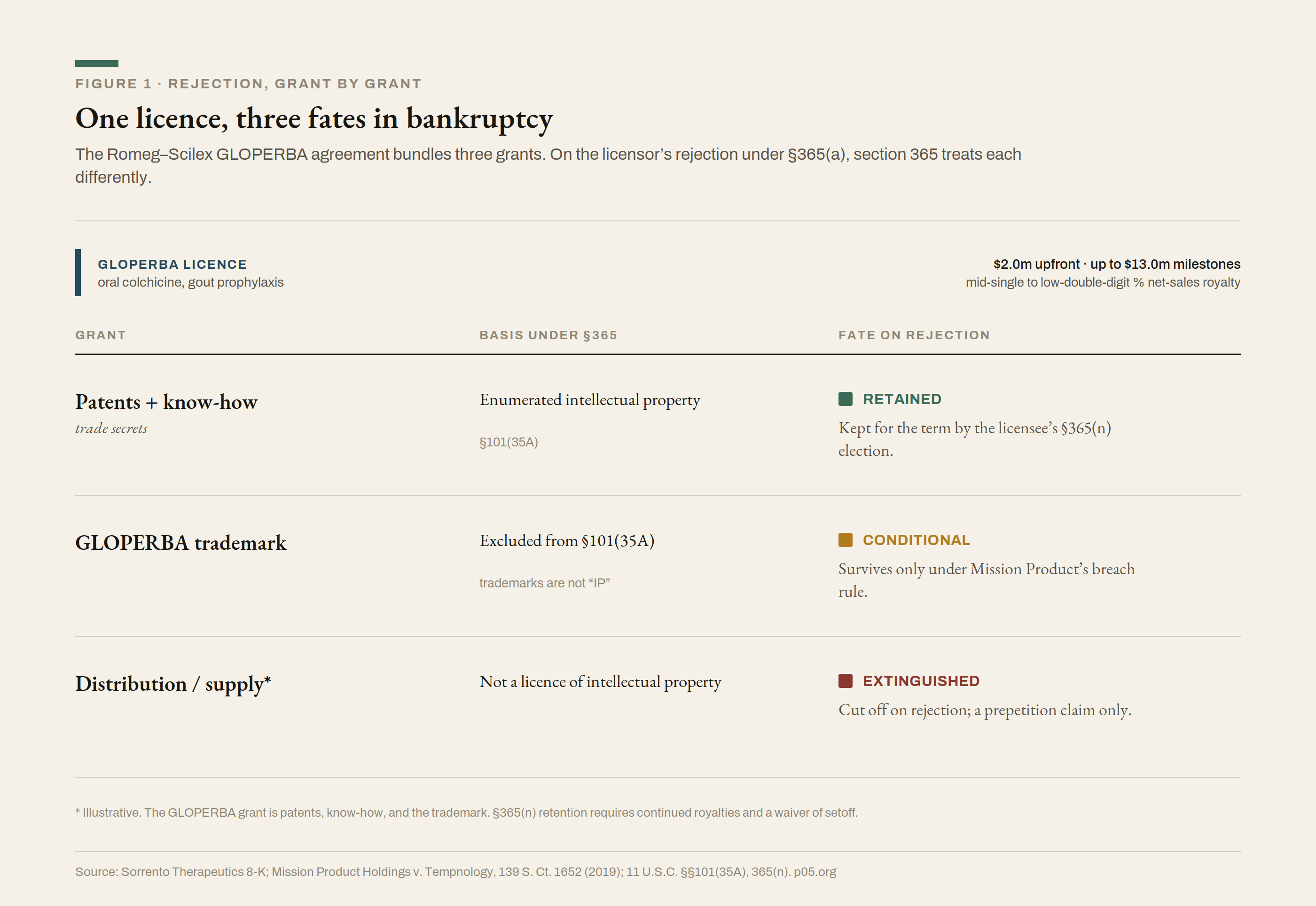
Figure 1. A single pharmaceutical licence bundles patent, know-how, and trademark grants. On the licensor's rejection under section 365(a), the enumerated IP is retained by a section 365(n) election, the trademark survives only under Mission Product, and a bare distribution right is extinguished.
3. Rejection grant by grant: Tempnology
Mission Product Holdings, Inc. v. Tempnology, LLC, 139 S. Ct. 1652 (2019), rev'g In re Tempnology, LLC, 879 F.3d 389 (1st Cir. 2018)
Section 365(n) is the licensee-protective response to Lubrizol Enters., Inc. v. Richmond Metal Finishers, Inc., 756 F.2d 1043 (4th Cir. 1985), which let a debtor-licensor's rejection strip a licensee's going-forward rights. The Intellectual Property Bankruptcy Protection Act of 1988, Pub. L. No. 100-506, added section 365(n) and the section 101(35A) definition.
Tempnology filed Chapter 11 in New Hampshire on 1 September 2015 and moved the next day to reject a co-marketing and distribution agreement with Mission Product Holdings under section 365(a). Like the GLOPERBA licence, it bundled a non-exclusive perpetual licence to patents, trade secrets, and copyrights; exclusive US distribution rights; and a Coolcore trademark licence.
Mission made the retention election. Section 365(n)(1) gives the licensee a choice: treat the licence as terminated and take a damages claim, or retain its rights, including exclusivity, for the term and any extensions. Section 365(n)(2) conditions retention on continued royalty payments and a waiver of setoff and of any section 503(b) administrative claim; courts have allowed recoupment, not setoff, in narrow cases.
The bundle then split three ways.
- The patent, trade-secret, and copyright licence survived: those are enumerated in section 101(35A) and retained by the election.
- The exclusive distribution rights did not survive: a distribution right is not a licence of intellectual property.
- The trademark licence fell outside section 365(n), because section 101(35A) omits trademarks. The Bankruptcy Court and the First Circuit read a negative inference from that omission and held the mark terminated.
The Supreme Court reversed on the trademark, eight to one, adopting Sunbeam Prods., Inc. v. Chicago Am. Mfg., LLC, 686 F.3d 372 (7th Cir. 2012), whose reasoning tracked Judge Ambro's concurrence in In re Exide Techs., 607 F.3d 957 (3d Cir. 2010). It held that rejection under section 365(g) is a breach, not a rescission: the debtor may stop performing, but the rights it already conveyed survive under non-bankruptcy law.
Justice Sotomayor's concurrence added the qualifier that matters to underwriting: post-rejection survival is a case-by-case function of the applicable non-bankruptcy law and the licence terms, not an automatic entitlement. A trademark holder relying on Mission Product holds a weaker and slower position than a patent holder relying on the statutory election, as Mission's four-year path to Washington shows.
Two further points fix the analysis.
What counts as a "royalty" under section 365(n) is decided by substance, per In re Prize Frize, Inc., 32 F.3d 426 (9th Cir. 1994), not by the label on the payment.
And the section 365(n) election belongs to the licensee. In the ordinary monetisation the licensee is the operating company, and a royalty buyer sitting behind it holds no election of its own. The buyer's protection on an upstream licensor's rejection is entirely derivative: it survives only if the operating company elects retention and funds the continuing upstream royalties. This is the gap that the Mallinckrodt structuring lesson in section 8 addresses directly.
4. Whether the purchase agreement is executory
The threshold question for a financed royalty is whether the conveying instrument is even within section 365.
A true sale is a completed conveyance. It is not executory, cannot be rejected, and has already moved the stream out of the seller as section 541 property. That is the first reason true-sale substance matters, before any priority contest, and it rests on the same recharacterisation factors the encumbrances piece sets out.
Royalty purchase agreements rarely leave the seller with nothing to do. Where the seller retains reporting, audit-cooperation, licence-enforcement, or non-compete obligations, and a court finds them material under Countryman, the agreement is executory and rejectable, converting the stream into a prepetition unsecured claim. Courts divide on whether a discrete executory covenant can be severed from an otherwise completed sale.
Recharacterisation runs the other way to a similar place. Recast as a secured loan, the purchase is not executory either, but the buyer is then exposed on perfection: under section 544(a) the trustee's strong-arm power primes an unperfected interest, which is why a true-sale opinion is filed alongside a precautionary UCC-1.
Mission Product supplies the floor: even if the agreement is executory, rejection breaches it without rescinding rights already conveyed. The payor-side application appears in section 8, where the Third Circuit held the Sanofi agreement non-executory, so section 365 never engaged and the royalty was simply a dischargeable claim.
5. Section 363 sales and the assignment gate: Achaogen
In re Achaogen, Inc. (Bankr. D. Del. 2019)
Achaogen developed ZEMDRI (plazomicin) and filed Chapter 11 in Delaware on 15 April 2019 with a section 363 sale motion and a twenty-five million dollar Silicon Valley Bank DIP.
At the 3 June 2019 auction the estate split the asset. Cipla USA took the ex-Greater China rights plus related assets and liabilities; QiLu Antibiotics took an exclusive, royalty-free, perpetual Greater China licence; a third buyer took lab equipment. Aggregate cash was about sixteen million dollars plus contingent royalties and assumed liabilities, per the Form 8-K, with the sale approved in July 2019.
The section 365 mechanics under a 363 sale:
- A buyer takes the product's contracts only as the estate can assume and assign them under section 365. The sale order's cure schedule and the section 365(b)(1) adequate-assurance showing govern which in-licences travel and at what cost, and an unpaid upstream royalty becomes a cure obligation payable in full as the price of assumption.
- Whether a royalty is stripped off the asset turns on section 363(f), which permits a free-and-clear sale only where one of five conditions is met: applicable law permits it; the holder consents; the interest is a lien and the price exceeds all liens; the interest is in bona fide dispute; or the holder could be compelled to accept a money satisfaction. Courts read "interest" broadly.
- A royalty drafted to run with the IP has the better claim to survive the sale, along the covenant-running analysis the encumbrances piece drew from the oil-and-gas cases; a bare contract right is vulnerable to being cut off and relegated to the proceeds, with section 363(e) adequate protection the fallback.
- Section 363(m) then insulates a good-faith sale from reversal on appeal, so a royalty holder must object and obtain a stay before closing or lose the point.
6. The assumption and assignment bar: section 365(c), as of August 2026
Section 365(c)(1) is the exception that survives the section 365(f) override, and it is the sharpest section 365 risk a royalty faces. The estate may not assume or assign an executory contract where applicable non-bankruptcy law would excuse the counterparty from accepting performance from, or rendering it to, an entity other than the debtor, and the counterparty does not consent.
The "applicable law" here is the federal common law of patents. A non-exclusive patent licence is presumptively non-assignable without the licensor's consent, per Everex Sys., Inc. v. Cadtrak Corp. (In re CFLC, Inc.), 89 F.3d 673 (9th Cir. 1996). Exclusive licences are generally assignable; the bar bites on the non-exclusive in-licence at the core of most pharmaceutical royalties, and copyright licences are treated the same way.
The circuits split on the disjunctive "or," and the split is unresolved as of August 2026.
- Hypothetical test (Third, Fourth, Ninth, Eleventh Circuits): Perlman v. Catapult Entm't, Inc. (In re Catapult Entm't, Inc.), 165 F.3d 747 (9th Cir. 1999). If the debtor could not hypothetically assign to a stranger, it may not even assume for its own use. In re Sunterra Corp., 361 F.3d 257 (4th Cir. 2004), extends the bar to assumption standing alone.
- Actual test (First Circuit and most bankruptcy courts): Institut Pasteur v. Cambridge Biotech Corp., 104 F.3d 489 (1st Cir. 1997), applying the "actual performance" inquiry of Summit Inv. & Dev. Corp. v. Leroux (In re Leroux), 69 F.3d 608 (1st Cir. 1995). The bar applies only where the nondebtor is in fact forced to accept performance from a stranger.
- Footstar middle path: In re Footstar, Inc., 323 B.R. 566 (Bankr. S.D.N.Y. 2005). Because the debtor in possession is the same "entity" as the debtor, section 365(c) bars assignment but not the DIP's own assumption. Widely followed by bankruptcy courts inside hypothetical-test circuits, and it can preserve a reorganizing debtor's licence even without consent.
The Supreme Court denied certiorari in N.C.P. Marketing Group, Inc. v. BG Star Prods., Inc., 556 U.S. 1145 (2009); Justice Kennedy, joined by Justice Breyer, filed a statement flagging the split as important and unresolved.
The most recent application is Crivella Holdings Ltd. v. MeSearch Media Techs. Ltd., 2025 WL 2443400 (W.D. Pa. Aug. 25, 2025), affirming the bankruptcy court (Bankr. W.D. Pa. Feb. 28, 2025). The court applied the Third Circuit's hypothetical test, yet the licence was assignable, because the agreement permitted assignment to a successor in interest without the licensor's further consent, which supplied the consent the patent-law default otherwise withholds. A January 2026 survey reads the case law the same way: the licence's assignment and successor-in-interest language governs, and patent law fills the gap only where the contract is silent.
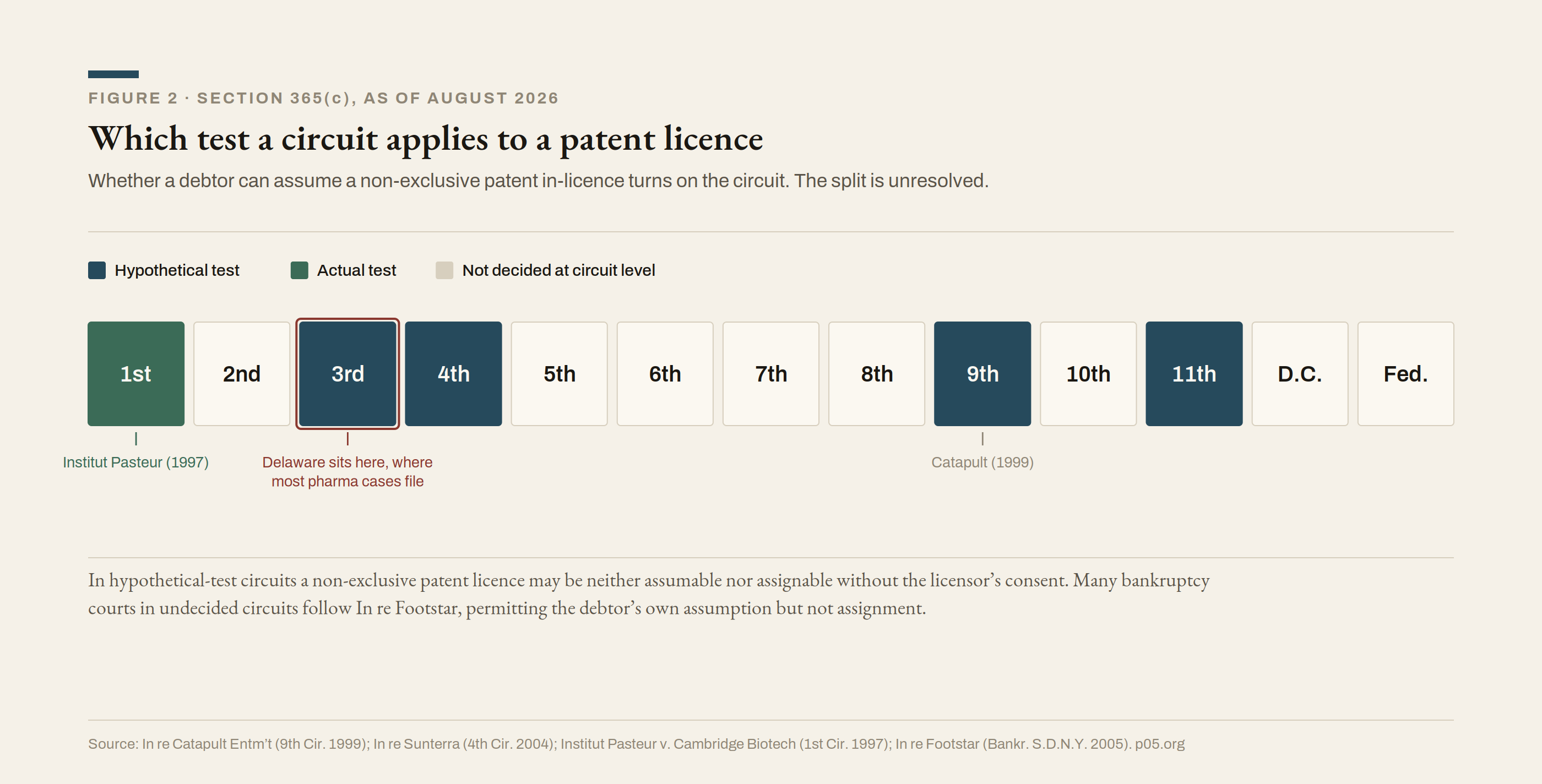
Figure 2. Whether a debtor can assume a non-exclusive patent in-licence turns on the circuit, and the split is unresolved as of August 2026. The Third Circuit, which includes Delaware, applies the hypothetical test.
For the royalty rider the exposure is doubled, and most large pharmaceutical cases file in Delaware, inside the Third Circuit. A non-exclusive in-licence there may be neither assumable, so the product cannot continue in the debtor's hands, nor assignable in a 363 sale, so a buyer cannot take it, absent licensor consent. Footstar may preserve the debtor's own assumption depending on the court, but the reliable cure sits upstream, in the in-licence: a consent to assignment, an express successor-in-interest clause, or a licensor estoppel taken at closing.
Section 365(c)(2) is the adjacent trap. It bars assumption or assignment of a contract to make a loan or extend other financial accommodations, whatever the counterparty says, and in In re Svenhard's Swedish Bakery, 154 F.4th 1100 (9th Cir. 2025), the Ninth Circuit read "financial accommodation" well past conventional lending. A synthetic royalty documented as a staged funding commitment with undrawn tranches risks being caught, which argues for funding upfront rather than in arrears.
7. Foreign IP and the section 101(35A) gap
Section 101(35A) defines intellectual property by reference to Titles 17 and 35 of the US Code, which leaves foreign patents arguably outside its scope and therefore outside section 365(n).
In In re Qimonda AG, 462 B.R. 165 (Bankr. E.D. Va. 2011), aff'd sub nom. Jaffé v. Samsung Elecs. Co., 737 F.3d 14 (4th Cir. 2013), a German insolvency administrator sought to use Chapter 15 to cancel US patent licences under German law. The court applied the section 1506 public-policy exception and the section 1521 limits on discretionary relief to require section 365(n)-equivalent protection, with roughly forty-seven million dollars of re-licensing fees at stake.
That protection came from the Chapter 15 overlay, not section 365(n) itself, and only for the US patents. The American Bankruptcy Institute's reform commission recommended adding foreign IP to section 101(35A); as of August 2026 it is unenacted. A royalty on a product sold across Europe, riding on foreign patents licensed from a foreign licensor, cannot assume the statutory net travels with it.
8. Discharge at the payor: Royalty Pharma's book and Mallinckrodt
Diversification, and its limit. Royalty Pharma's Form 10-K reports royalties paid by a broad marketer base, including Vertex, GSK, Roche, Johnson & Johnson, Biogen, AbbVie, Astellas, Pfizer, Novartis, and Gilead, and describes its concentration of credit risk as limited. The same filing states that a counterparty bankruptcy may cause significant delays in recovery.
Diversification absorbs an idiosyncratic single-payor default. It does nothing against a structural defect repeated across every deal in the book, which is what the next case exposed.
In re Mallinckrodt PLC, 99 F.4th 617 (3d Cir. 2024), aff'g 646 F. Supp. 3d 565 (D. Del. 2022).
In 2001 Sanofi sold the rights to Acthar Gel for a hundred thousand dollar upfront payment plus a perpetual royalty of one percent of annual net sales above ten million dollars. Sanofi retained no licence and took no security interest. Acthar reached nearly one billion dollars in annual sales; Mallinckrodt filed Chapter 11 in October 2020 on unrelated opioid liabilities.
The Third Circuit's holdings:
- The sale agreement was not executory, because Sanofi owed no material continuing performance, so section 365 rejection or assumption never applied.
- Sanofi's right to future royalties was a "claim" under section 101(5), a right to payment even though contingent and unliquidated, that arose when the parties signed in 2001, not annually at each sales trigger. The court declined to import the Grossman's "exposure" accrual test (In re Grossman's Inc., 607 F.3d 114 (3d Cir. 2010)) into a contract claim.
- As a prepetition unsecured claim it was discharged under section 1141(d) on confirmation, subject to due-process notice, which the court remanded. Reorganized Mallinckrodt kept selling Acthar and paid nothing further.
Sanofi's three omissions are three structuring instructions: no retained licence (no section 365(n)), no security interest (no collateral, no priority), and no continuing performance (not executory, hence a dischargeable section 101(5) claim).
Market effect. Covington's tracking records that no unsecured synthetic royalty financings by public biotechs reached the market after the December 2022 district court ruling. Portfolio diversification would not have changed Sanofi's outcome, because the defect was in the single deal's structure.
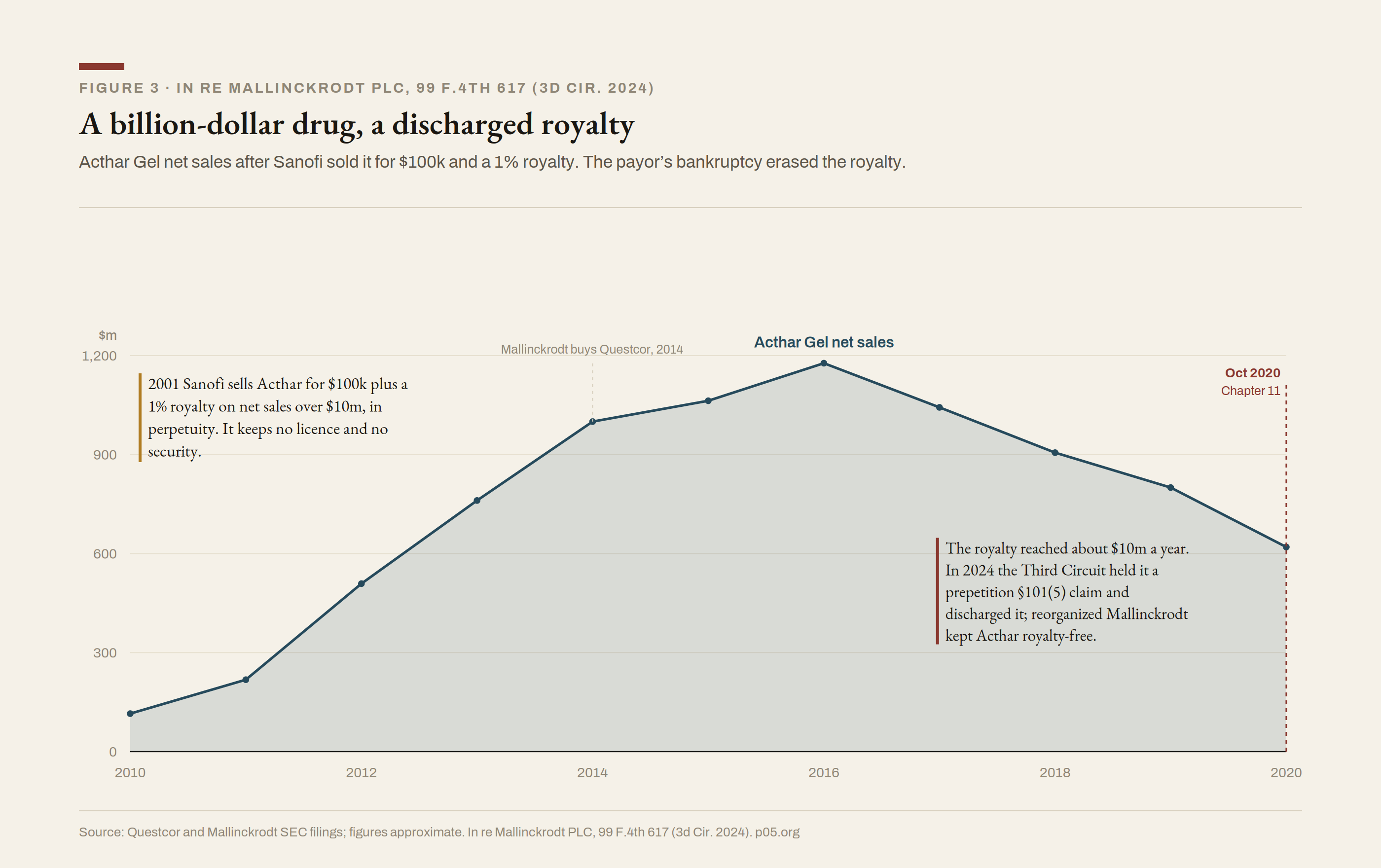
Figure 3. Acthar Gel grew into a billion-dollar drug after Sanofi sold it for $100k and a 1% royalty. In re Mallinckrodt PLC, 99 F.4th 617 (3d Cir. 2024) discharged that royalty as a prepetition section 101(5) claim; reorganized Mallinckrodt kept the drug royalty-free.
9. Structuring around section 365 at scale
The large funds apply a stack of protections to every deal so that no position ends in Sanofi's seat.
- True sale plus backup lien. A true-sale conveyance with a filed precautionary UCC-1 and often a backup security interest in the royalties and sometimes the IP, so a recharacterisation or a section 544(a) attack leaves a perfected secured claim rather than an unsecured one.
- Section 365(n) backstop. Structuring the acquisition so the holder is, or holds, an IP licence rather than a bare payment right brings section 365(n) into play on the licensor's rejection. This is the direct answer to Sanofi's position: a licensor with a retained licence has the statutory election Sanofi lacked.
- Non-incurrence covenants and intercreditor terms. Covenants that bar the payor from new debt or liens ahead of the stream, and the intercreditor architecture fixing enforcement order where a senior lender shares the collateral. Product-asset security appears in the large majority of synthetic deals.
- Cash dominion. A lockbox or direction-to-pay that routes collections to the holder before they become section 541 property of the payor's estate.
- Bankruptcy-remote vehicle. An SPE holding the rights apart from the payor's and the fund's estates, with separateness covenants, an independent director, a non-petition covenant, and a non-consolidation opinion.
The furthest move abandons the product royalty for a claim on the parent. In Royalty Pharma's 2021 MorphoSys partnership, a 2.025 billion dollar package funding the Constellation acquisition, the Janssen Tremfya royalty was paired with up to 350 million dollars of Development Funding Bonds that Royalty Pharma booked as bonds, not royalties.
A parent bond is a section 101(5) credit claim on the whole company, not a licence the estate can reject. When investment-grade Novartis acquired MorphoSys in 2024, the bonds became money-good and Royalty Pharma sold them in January 2025. This is the instrument the development funding bond piece treats as a royalty deal that was never a royalty, swapping product-level section 365 exposure for parent-level credit.
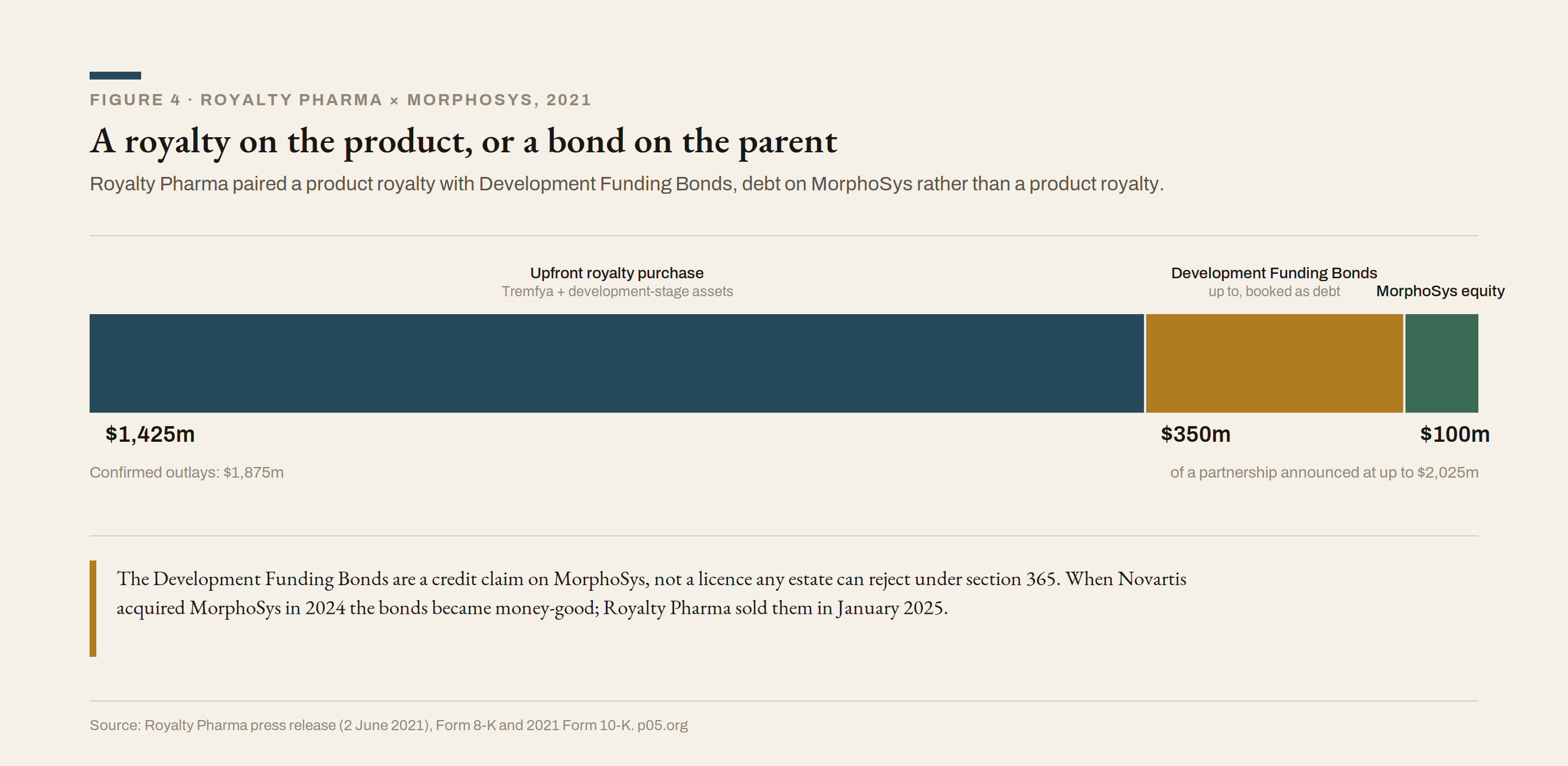
Figure 4. Royalty Pharma's 2021 MorphoSys deal paired a product royalty with Development Funding Bonds, a credit claim on the parent that sits outside section 365. When Novartis acquired MorphoSys, the bonds were repaid and Royalty Pharma sold them.
For rated pharmaceutical royalty ABS, section 365 is the subject of the legal opinions, not a footnote. The true-sale, non-consolidation, and bankruptcy-remote SPE opinions the rating depends on all answer one question: when the originator or the payor files, can section 365 reach the securitised cash flow.
What changes a holder's position under section 365, and what only appears to
Terms that move the position:
- A revenue entity held outside the failing group's estate, as Scilex was, so its licences are never property of a debtor's estate under section 541.
- A completed true sale with minimal surviving seller obligations, so the purchase agreement is non-executory and unrejectable, backed by a precautionary UCC-1 against a section 544(a) recharacterisation.
- A retained IP licence or secured interest, so the holder has the section 365(n) election or the collateral Sanofi lacked in Mallinckrodt.
- Consent to assignment or a successor-in-interest clause in the in-licence, of the kind that carried assumability in Crivella despite the hypothetical test.
- Cash dominion through a lockbox or direction-to-pay, keeping collections out of the estate.
- At portfolio scale, marketer diversification for idiosyncratic default, and parent-credit instruments where a single product's section 365 exposure is unacceptable.
Terms that only appear to:
- A "sale" label over an agreement thick with material surviving obligations, which a court can hold executory or a disguised loan.
- Reliance on section 365(n) by a party that is not the licensee and holds no election.
- An ipso facto clause struck in the abstract, where section 365(e)(2)(A) revives it for the non-assignable patent licence.
- A payor covenant to maintain the in-licence, which yields to the estate's section 365 powers on filing.
- A staged funding structure that reads as a section 365(c)(2) financial accommodation, stranding the undrawn tranches.
What each side should ask
For the company raising royalty capital
- Is the interest conveyed as a completed sale, or does retained seller performance make the agreement executory and rejectable, or a disguised loan?
- Does the in-licence permit assumption and assignment through consent or successor-in-interest language, so a 363 buyer can take the product in a hypothetical-test circuit?
- Can the revenue asset sit in an entity separate from the group that might fail, as Scilex did, with a non-consolidation opinion behind it?
For the royalty investor
- Which contracts does the stream ride on, and whose bankruptcy puts each in front of section 365?
- On an upstream licensor's rejection, who holds the section 365(n) election, and am I the licensee or a step behind one whose election and cash I am depending on?
- Which grants underneath the royalty are enumerated IP retained by election, which are trademarks left to Mission Product, and which are bare rights that rejection extinguishes?
- Do I hold a retained licence or a lien, or am I, like Sanofi, an unsecured holder of a bare payment right exposed to discharge under section 1141(d)?
- Is the interest a staged funding commitment that section 365(c)(2) could bar the debtor from assuming?
For the fund or portfolio holder
- Do the positions share one structural weakness, an unsecured bare payment right with no retained licence and no backup lien, that diversification cannot cure because every deal carries it?
- If a stream must be money-good through a payor bankruptcy, is it secured, a true-sale interest in a bankruptcy-remote asset, or a section 365(n) licence, and if none, why expect a different result than Mallinckrodt gave Sanofi?
- Do the true-sale, non-consolidation, and bankruptcy-remote opinions actually resolve whether section 365 reaches the cash flow, or only assert that it does not?
Section 365 is the estate's authority over the contracts a royalty rides on: to reject them into prepetition unsecured claims, to assume them at the price of cure, or to assign them subject to the licensor consent rights the Code sometimes preserves and sometimes overrides.
Sorrento kept the licence out of the estate. Tempnology split a bundled licence three ways on rejection. Achaogen ran the 363 and 365 sale gates. Crivella turned assumability on one clause. Mallinckrodt discharged an unsecured royalty to nothing. Royalty Pharma diversified what it could and, where it could not, took parent credit instead.
Drug performance is decided in the clinic. Whether the stream survives the counterparty's bankruptcy is decided in the licence, the purchase agreement, and the docket, and section 365 is where that is tested.
All information in this article was accurate as of the research date and is derived from publicly available sources including the United States Code, court decisions and dockets, SEC filings and issuer press releases, and legal and financial commentary. Information may have changed since publication. This content is for informational purposes only and does not constitute investment, legal, accounting, tax, or financial advice. The author is not a lawyer, accountant, tax adviser, or financial adviser.