The price of consent: what a royalty holder charges after the deal has closed

On 13 October Liquidia settled six lawsuits with United Therapeutics over YUTREPIA, its inhaled treprostinil. The settlement agreement has Liquidia pay a net $175.0M within 30 business days and $145.4M in two instalments by the end of April 2027. Section 2.4 requires it to deliver, within ten business days, an irrevocable letter of credit from "a reputable, international bank acceptable to UTC" covering both payments. If the letter is late, United Therapeutics may terminate the settlement.
Liquidia could not open that letter of credit on its own authority. Its revenue interest financing with HealthCare Royalty forbids new debt beyond a list of permitted baskets, and a bank's claim for reimbursement under a letter of credit is debt. The same day, Liquidia signed a Seventh Amendment to that agreement.
The company's current report states the terms in one sentence: "As consideration for such consent, the Company has agreed to increase the minimum cash covenant under the Financing Agreement from $15.0 million to $45.0 million."
Six days earlier the same manager had priced a consent for ADC Therapeutics, and took repriced warrants and a cap on debt backed by a penalty. The filings since 2020 show royalty holders and their lenders charging for consent in many currencies, among them covenants, warrants, mandatory draws, paydowns and time. Cash fees are the smallest of these. The size of the price follows the holder's alternative to saying yes, which the original agreement fixed years earlier.
Why the settlement needed a signature
The revenue interest financing agreement of 9 January 2023 is a secured contract with the negative covenants of a term loan. Section 7.2 forbids any indebtedness "without the prior written consent of the Investor Representative, except Permitted Debt".
The definition of Permitted Debt allows letters of credit for ordinary-course obligations up to an amount the filed copy redacts. It does not stretch to a guarantee of $320.4M of settlement payments.
A letter of credit is a bank's promise to pay a named beneficiary on presentation of documents. The company that asks for it owes the bank whatever the bank pays out, and that reimbursement claim is the debt the covenant catches. Without consent, issuing the letter would have been a breach. Under the agreement, an event of default lets HealthCare Royalty accelerate payments "up to the Hard Cap, plus the IRR True-Up Payment".
The Hard Cap is 175 per cent of the $175.0M funded. The true-up tops up any shortfall to internal rates of return of 18 per cent on the first $67.5M funded, 16 per cent on the next $57.5M and 13 per cent on the $50.0M after that.
Liquidia had one alternative to asking. The agreement lets it make voluntary prepayments "at any time", credited against the Hard Cap. At 30 June the remaining fixed payments came to $250.6M through 2033, against a carrying value of $176.1M. Retiring HealthCare Royalty would have cost a sum of that order in cash. Liquidia was about to commit $380.7M to the settlement, and it held $396.1M of cash at 30 September.
What Liquidia gave
The Seventh Amendment does two things. Section 1 declares the standby letters of credit listed in its Exhibit A to be Permitted Debt, on conditions. Their stated amount "may not be increased", a drawing may not be reinstated, and once they expire they "may not be renewed, replaced or reissued" without a further consent.
Section 2 restates the minimum cash covenant in section 7.8. The filed exhibit redacts the new figure, and the current report gives it as $45.0M.
The covenant counts only cash held in accounts for which HealthCare Royalty "shall have received an effective Deposit Account Control Agreement or Securities Account Control Agreement". A control agreement is a three-way contract with the bank that lets the secured party take over the account on default. So the $45.0M has to sit where HealthCare Royalty can seize it, for the rest of a payment term that the quarterly report expects to end in 2033. A dip below the line on any day is a default.
The amendment adds no fee and leaves the rate and the payment schedule unchanged.
The price can be measured. The company keeps ownership of the extra $30.0M. What it gives up is the use of that cash for about six and a half years. Valuing the cash at what the company would otherwise earn on it, net of what it earns in a money market fund at about 4.08 per cent, gives a cost between about $8M and $12.5M in present value.
The low end assumes a 10 per cent cost of capital. The high end uses the 14.4 per cent effective rate that Liquidia's own accounts apply to the HealthCare Royalty liability. Either figure is under 4 per cent of the face of the letters of credit.
The cash the settlement uses
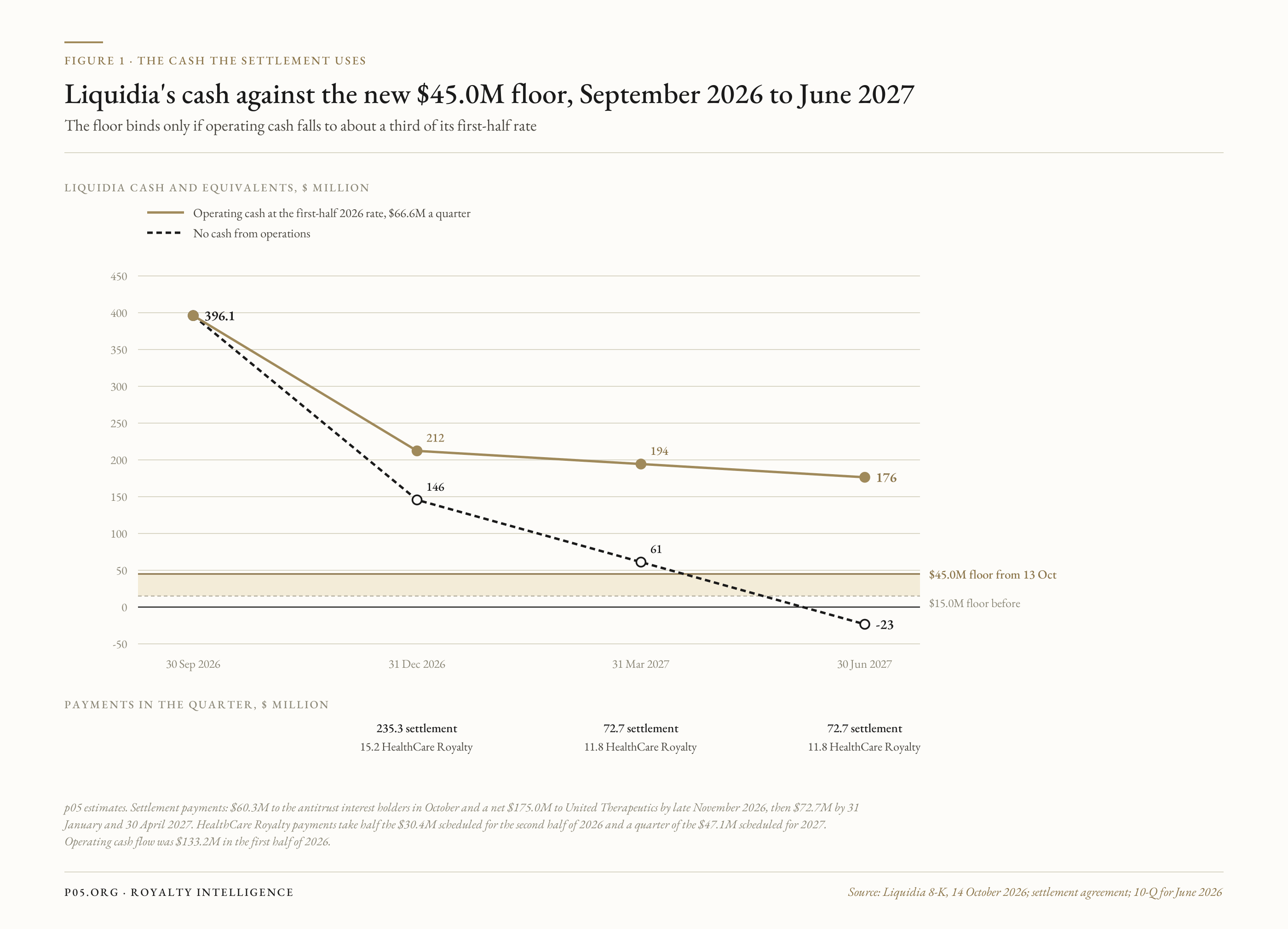
The covenant level matters because of the timing of the settlement payments. From $396.1M at 30 September, Liquidia owes $60.3M this month to the holders of interests in the antitrust case, $175.0M to United Therapeutics by late November and $72.7M at each of the end of January and the end of April 2027.
HealthCare Royalty's fixed schedule takes about $15M in the fourth quarter of 2026 and about $12M a quarter in 2027. Those outflows add up to about $419M over three quarters.
Without any cash from operations, the balance would fall to about $146M at the end of 2026, $61M at the end of March 2027 and below zero by the end of June. The business does generate cash. Operating activities produced $133.2M in the first half of 2026, and YUTREPIA's preliminary net sales for the third quarter were $222.7M. At the first-half rate the balance stays above $175M throughout.
The $45.0M line becomes a constraint only if operating cash falls to about a third of that rate while the instalments fall due.
Seven amendments, one counterparty
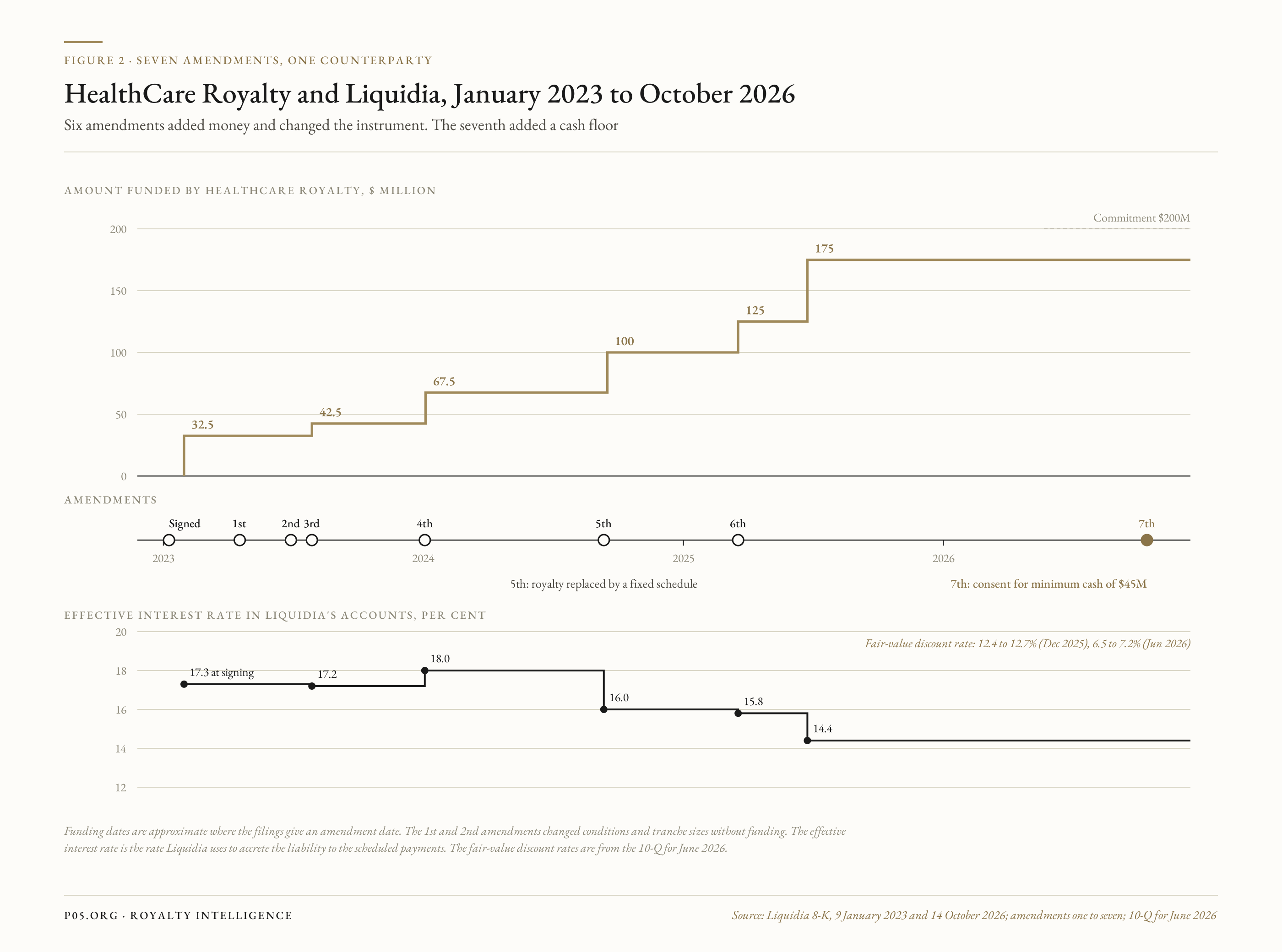
HealthCare Royalty's agreement with Liquidia has been rewritten seven times. The first six added money and changed the instrument. The original deal of up to $100.0M paid HealthCare Royalty a tiered royalty of 3.60 to 10.00 per cent on the first $250M of annual net revenue, with fixed quarterly payments on top.
The Fifth Amendment of September 2024 set the third and fourth investment amounts to zero, "with the effects that ... no payments shall be required from the Company in respect of the Included Product Payment Amount". The royalty became a fixed schedule. The Sixth Amendment of March 2025 raised the commitment to $200.0M, of which $175.0M has been funded.
Each round moved the cost of the money. Liquidia's quarterly report traces the effective interest rate from 17.3 per cent at signing to 18.0 per cent after the Fourth Amendment, 16.0 per cent after the Fifth, 15.8 per cent after the Sixth and 14.4 per cent after the funding of June 2025. The same report values the liability at $211.5M against its carrying value, using discount rates of 6.5 to 7.2 per cent. Six months earlier the rates had been 12.4 to 12.7 per cent.
HealthCare Royalty therefore holds a fixed claim on a company whose product now sells more than $200M a quarter. Its payments do not rise with YUTREPIA. What it needs from Liquidia is solvency through 2033, and the price it asked for its consent protects that. It took a larger cash floor under its own control, and it barred the letters of credit from growing, revolving or being renewed.
The same week at ADC Therapeutics
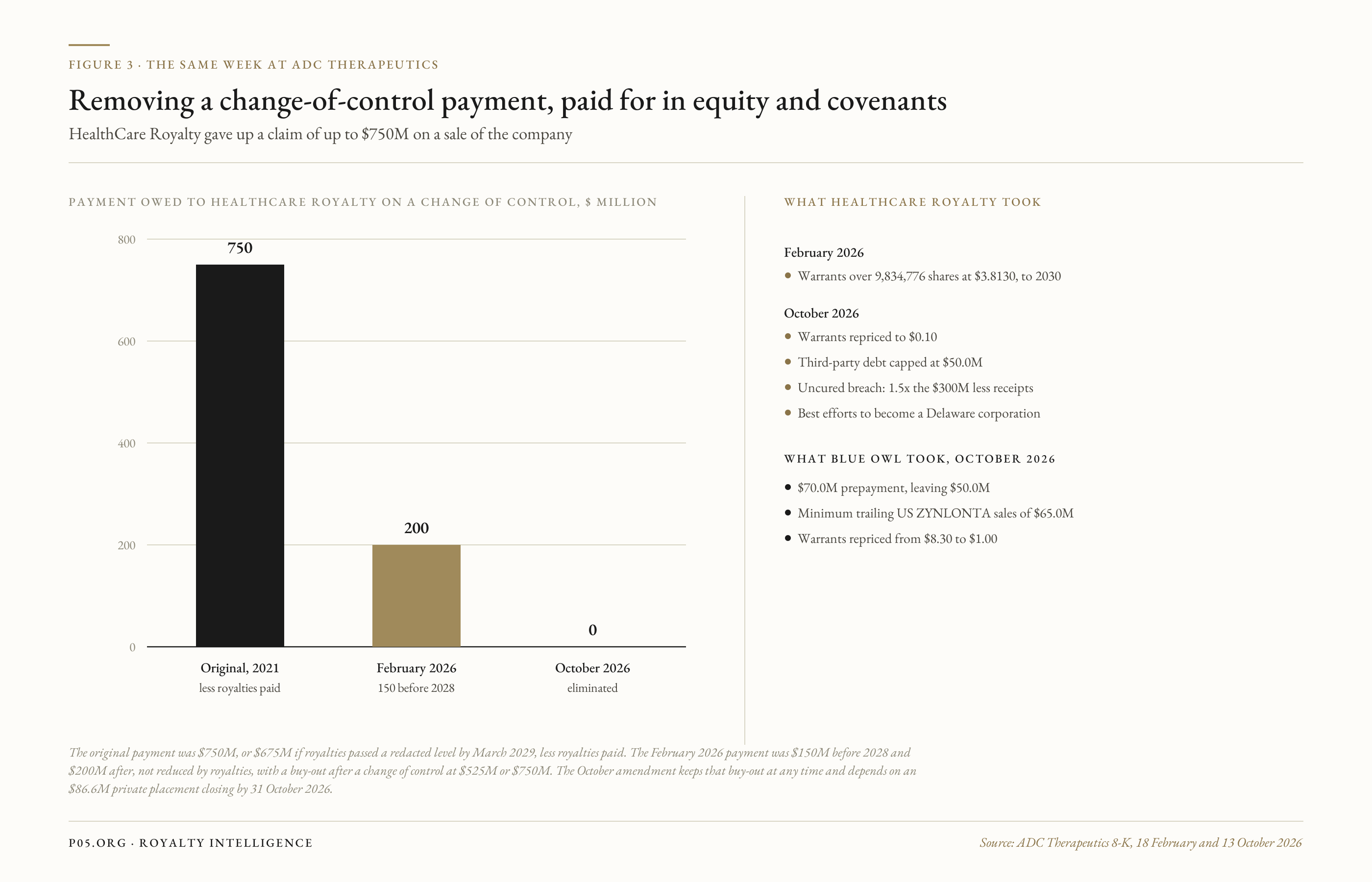
ADC Therapeutics sold HealthCare Royalty a royalty on ZYNLONTA in 2021 for $300M. On a change of control the company owed HealthCare Royalty $750M, or $675M in one case, less royalties already paid.
In February 2026 the two sides cut that payment to $150M before 2028 and $200M after, no longer reduced by royalties paid, and added a buy-out after a change of control at $525M or $750M. HealthCare Royalty received warrants over 9,834,776 shares at $3.8130.
On 7 October ADC signed Amendment No. 2, which removes the change-of-control payment altogether and leaves the buy-out available at any time. HealthCare Royalty's warrants were repriced from $3.8130 to $0.10.
Third-party debt was capped at $50.0M, and an uncured breach of that cap lets HealthCare Royalty elect "the non-performance payment equaling 1.5 times" the $300M less what it has received. ADC also agreed to use its best efforts to become a Delaware corporation.
The term lender in the same structure charged differently. Blue Owl agreed to drop scheduled amortisation and the minimum liquidity covenant on a condition: a prepayment of $70.0M, which leaves $50.0M outstanding.
It added a covenant that trailing four-quarter American sales of ZYNLONTA stay above $65.0M, and it repriced its own warrants from $8.30 to $1.00. Both amendments depend on an $86.6M private placement at $1.42 a share closing by 31 October.
The two HealthCare Royalty consents of October 2026 differ in what they bought. At Liquidia the company was performing and asked for a bank guarantee, and the price was a cash floor. At ADC the company was raising equity at a low price and asked for the removal of a large contingent claim. There the price was equity at a nominal strike and a debt cap backed by a penalty.
Paydowns, draws and fees elsewhere
Other holders have consented to convertible notes in return for a smaller or larger share of the company's debt. Nuvation Bio's revenue interest with Sagard required Sagard's consent to $250M of 0.75 per cent convertible notes in June 2026.
The amended agreement made the closing conditional on Sagard's separate $50M term loan being "paid in full in cash", added a controlled "RIFA Account" for American receipts, and carried an amendment fee. Nuvation's quarterly report records $58.7M paid "to repay in full ... the Loan Agreement and pay an amendment fee", with a loss of $9.5M on extinguishment. Royalty Pharma went the other way at Cytokinetics in 2022.
Its loan defined permitted convertible debt by maturity, and Cytokinetics' proposed notes fell short. The Consent and Amendment of 30 June 2022 approved them and raised the mandatory draw, once triggered, to "at least $50,000,000". Royalty Pharma took its price as more money lent at its own rate.
Pharmakon charged in time when Geron asked for more of it. Geron's January 2026 amendment extended the deadline for requesting two undrawn tranches, of $75M and $50M, from 31 December 2025 to 30 July 2026. In return, the date before which any prepayment of the drawn $125M carries a make-whole moved from 1 November 2026 to 1 May 2027.
A make-whole is a payment of the interest the lender would have earned up to a set date. Moving the date added six months of coupon to the cost of any refinancing. Neither tranche was drawn.
Paydown from proceeds is the largest currency in the record. Oberland's waiver for Esperion in November 2022 covered "certain claimed defaults, breaches and Put Option Events" arising from a new bank account. Esperion paid for it with a $50M partial call, and the cap on payments fell to $177.8M.
Aquestive's noteholders consented in November 2020 to the sale of its KYNMOBI royalties and were repaid $22.5M at par from the proceeds, with $4.0M of new notes in lieu of a prepayment premium. A year later they charged a consent fee of $52.43 per $1,000 of notes, about 5.2 per cent, to defer amortisation.
Where a cash fee is stated, it is small. Oaktree charged BioXcel a waiver fee of 0.25 per cent of the loans outstanding, $180,044.68, plus 0.25 per cent of every later prepayment. Lenders more often took warrants.
Marathon received 5,000,000 warrants from Theratechnologies in 2023 for removing a draw condition, and SWK took a warrant over 289,736 shares from Eton in October 2024 when it consented to the Increlex acquisition and enlarged its loan.
Some consents carry no stated price. Eton's April 2026 amendment, which lowered its rate, records that "There were no fees paid to SWK." Madrigal's second and third amendments with Blue Owl raised its permitted acquisition limit for nothing beyond expenses. Elsewhere the consenting party took part in the transaction.
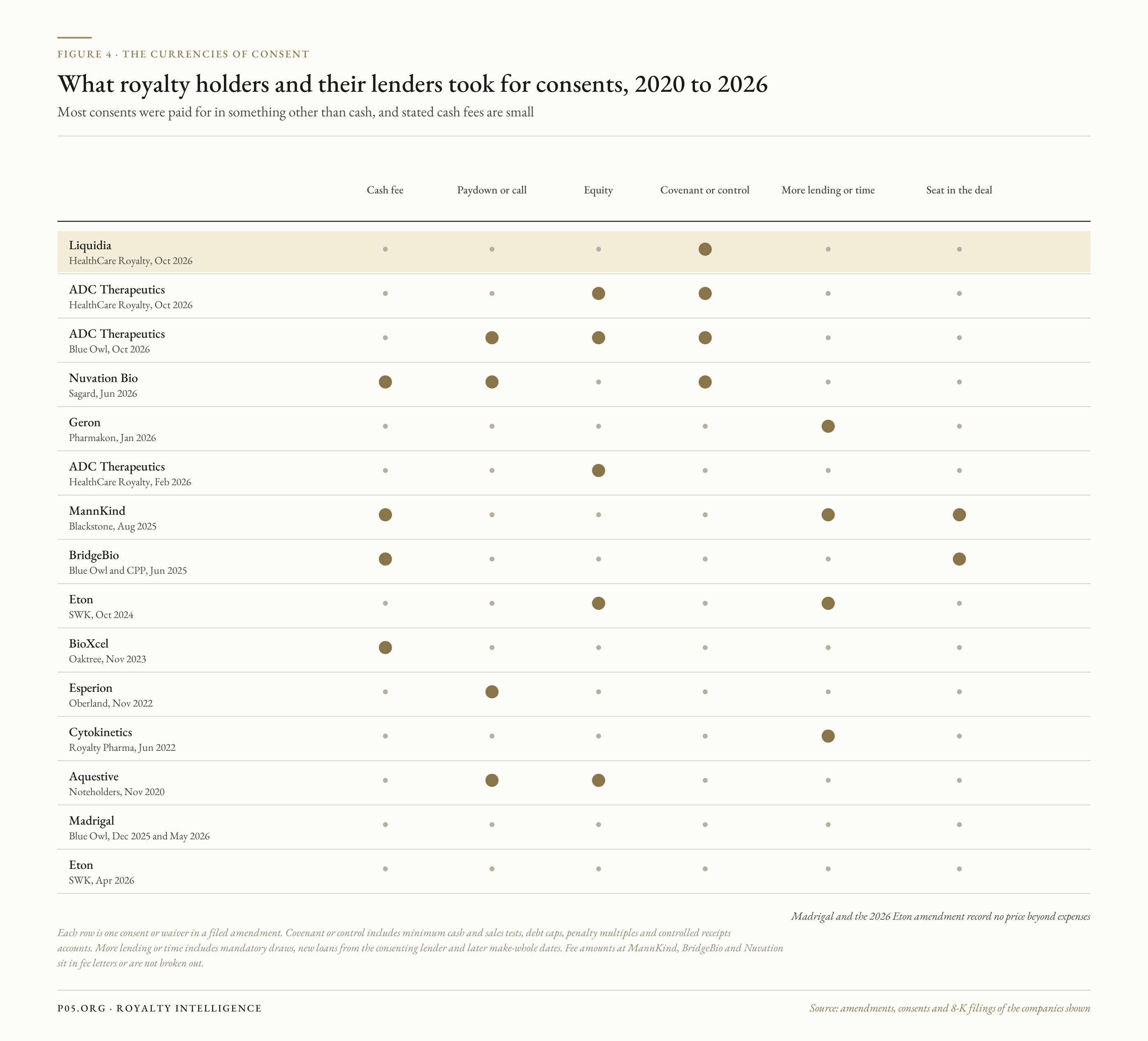
Blue Owl's LSI vehicle consented to BridgeBio's sale of its European royalty in June 2025 under an undisclosed fee letter and was one of the buyers. Hercules consented to Phathom's 2022 revenue interest financing and was one of its investors. Blackstone consented to MannKind's acquisition of scPharmaceuticals and lent a further $175M to pay for it.
| Company and holder | Date | What the company wanted | What it gave | Source |
|---|---|---|---|---|
| Liquidia / HealthCare Royalty | Oct 2026 | Letters of credit for a $320.4M settlement | Minimum cash from $15.0M to $45.0M in controlled accounts; no growth, reinstatement or renewal of the letters | Seventh Amendment |
| ADC Therapeutics / HealthCare Royalty | Oct 2026 | Remove the change-of-control payment | Warrants repriced to $0.10; debt capped at $50.0M with a 1.5x penalty | 8-K |
| ADC Therapeutics / Blue Owl | Oct 2026 | Drop amortisation and the liquidity covenant | $70.0M prepayment; $65.0M sales covenant; warrants repriced to $1.00 | 8-K |
| Nuvation Bio / Sagard | Jun 2026 | $250M of convertible notes | Term loan repaid with make-whole; amendment fee; controlled receipts account | Amendment |
| Geron / Pharmakon | Jan 2026 | Seven more months to draw $125M | Make-whole date moved six months later | 8-K |
| ADC Therapeutics / HealthCare Royalty | Feb 2026 | Smaller change-of-control payment | Warrants over 9,834,776 shares at $3.8130 | 8-K |
| MannKind / Blackstone | Aug 2025 | Acquire scPharmaceuticals | Fee letter; new $175M loan from the consenting lender | 8-K |
| BridgeBio / Blue Owl and CPP Investments | Jun 2025 | Sell the European royalty | Fee letter; consenting holder joins the purchase | Amendment |
| Eton / SWK | Oct 2024 | Acquire Increlex | Warrant over 289,736 shares | 8-K |
| BioXcel / Oaktree | Nov 2023 | Waive a covenant default | 0.25 per cent fee, and 0.25 per cent on later prepayments | Amendment |
| Esperion / Oberland | Nov 2022 | Waive claimed defaults | $50M partial call; cap cut to $177.8M | 8-K |
| Cytokinetics / Royalty Pharma | Jun 2022 | Convertible notes outside the permitted definition | Mandatory draw of at least $50M once triggered | Consent and Amendment |
| Aquestive / noteholders | Nov 2020 | Sell the KYNMOBI royalties | $22.5M repaid at par; $4.0M of new notes | 8-K |
Reading the price
Each currency costs the company something different, and the cost can be put in the same units. A cash fee costs its face value. A paydown costs the make-whole and premium on the debt retired, which at Nuvation came to a loss of $9.5M on a $50M loan.
A mandatory draw costs the gap between the lender's coupon and what the cash earns, for as long as the company is locked in. A warrant costs the value of an option on the company's shares, which at a strike of $0.10 against a share price above $1.00 is close to the share price itself. A tighter covenant costs the return the company forgoes on the cash it must hold, plus the chance that the new line is crossed.
The holders choose the currency that protects the claim they hold. HealthCare Royalty's claim at Liquidia is a fixed schedule, so it took cash it can seize. Its claim at ADC is a royalty with a buy-out and a capped multiple, and it took equity and a limit on the debt that would rank around it.
Sagard holds a revenue interest on Nuvation's American sales, and it took a lockbox over those receipts and the removal of a loan that would have ranked with it. Royalty Pharma and Pharmakon lend at fixed spreads, and they took more lending or a longer make-whole.
The size of the price follows the holder's position if it refuses. A refusal would have ended a settlement that mattered more to Liquidia than its whole HealthCare Royalty debt, and the company could not prepay in the same quarter.
ADC's change-of-control payment of up to $750M stood between the company and any buyer. Esperion faced claimed defaults and put rights. Where the company has an easy way round the holder, as Madrigal and Eton had, the filings record no price at all.
That position is set when the deal is signed. Liquidia's 2023 agreement already permitted convertible notes, ordinary-course letters of credit and other named debts. A settlement letter of credit was not on the list, and the basket was small.
The Permitted Debt definition and the voluntary prepayment clause decided in January 2023 what consent would cost in October 2026. The earlier consent gate piece covered the same mechanism for consents needed before a royalty can be sold.
Implications for the Pharmaceutical Royalty Market
For a buyer of royalties, consent rights carry value that appears in no model of the stream. HealthCare Royalty collected a $30M increase in protected cash at Liquidia and equity at a $0.10 strike at ADC within a week, without new money. The value comes from negative covenants written to term-loan standards into a contract documented as a purchase.
The forbearance piece set out what such accommodations can do to the characterisation of a revenue interest as a sale. A minimum cash test in controlled accounts and a debt cap with a 1.5x penalty move the instrument further toward a secured loan.
For a company, the drafting points are specific. The baskets for letters of credit, convertible notes, permitted acquisitions and settlements decide which future decisions need a signature. A voluntary prepayment right at a known price sets a ceiling on what a holder can charge.
Liquidia's prepayment right was credited against the Hard Cap, so exercising it would have cost close to the full remaining schedule. Agreements with a buy-out grid, such as ADC's $525M option, give the company a known way out.
For a secondary buyer of a revenue interest, the amendment record is part of the asset. Seven amendments at Liquidia moved the instrument from a royalty to a fixed schedule, and its effective rate between 14.4 and 18.0 per cent.
A buyer of HealthCare Royalty's position today would own a fixed claim with a $45.0M cash floor in controlled accounts. A buyer of the 2023 contract would have owned a share of YUTREPIA's sales.
Conclusion
Liquidia's first settlement payments fall due this month and next. The net $175.0M to United Therapeutics is due by late November, and the two instalments of $72.7M follow on 31 January and 30 April 2027, backed by letters of credit that cannot be increased or renewed. HealthCare Royalty's fixed schedule runs alongside, at about $47M in 2027 and $55M in 2028.
The price of the signature that made the settlement possible will last longer than the settlement. Until 2033 Liquidia must keep $45.0M of cash in accounts its royalty holder controls, three times the floor it agreed in 2023, against a payment schedule that does not depend on how YUTREPIA sells.
All information in this report was accurate as of the research date and is derived from publicly available sources including court opinions, regulatory guidance, academic literature, SEC filings, and financial news reporting. Information may have changed since publication. This content is for informational purposes only and does not constitute investment, legal, or financial advice. The author is not a lawyer or financial adviser.