
The claims ahead of the royalty: encumbrances in pharmaceutical royalty finance
A royalty buyer acquires a place in a payment order that was fixed before it arrived. This is a guide to what ranks ahead of it, where each senior claim is documented, and what a diligence process has to test.
A pharmaceutical royalty is a right to a share of a product's revenue. It is not ownership of the drug, the patents, or the pricing decisions.
It is also rarely the first claim on the cash it tracks. Between the sale of a unit and the arrival of a royalty payment sit other claimants: the licensors whose IP underlies the product, the lenders who took security over its assets, the bankruptcy estate of whichever entity collects and remits, and the government that funded the early science. Each is an encumbrance. Each is fixed in the contracts or the statute book before any clinical or commercial data arrives.
Drug performance is the risk that royalty underwriting exists to measure. Priority is a separate risk, answered in the documents rather than in the clinic, and a royalty can be sound on the first and impaired on the second.
The XACIATO example
A small, recent, fully disclosed deal shows the point. In April 2024, XOMA paid Daré Bioscience 22.0 million dollars for royalty and milestone rights on XACIATO, a clindamycin phosphate vaginal gel that Daré had licensed to Organon.
The consideration clause defines the asset by subtraction. XOMA bought the XACIATO royalties and milestones payable to Daré under the Organon licence, after deducting:
- all amounts due on those royalties and milestones to third-party licensors, and
- all payments owed by Daré under its existing royalty interest financing with United in Endeavour, LLC.
XOMA's 2025 Form 10-K restates the same structure: the acquired stream is what remains "net of payments owed by Daré to upstream licensors," equal to a low-to-high single-digit percentage of net sales.
Two encumbrances, both named, stand between the sales line and the buyer's receipts. The upstream licensors rank first, the prior financier second, XOMA third. The buyer priced the third claim in a three-deep queue on one product.
That structure is the norm. "A royalty on net sales" almost always means a royalty on what is left after everyone senior is paid, and the size of those senior claims is much of what the buyer is pricing.
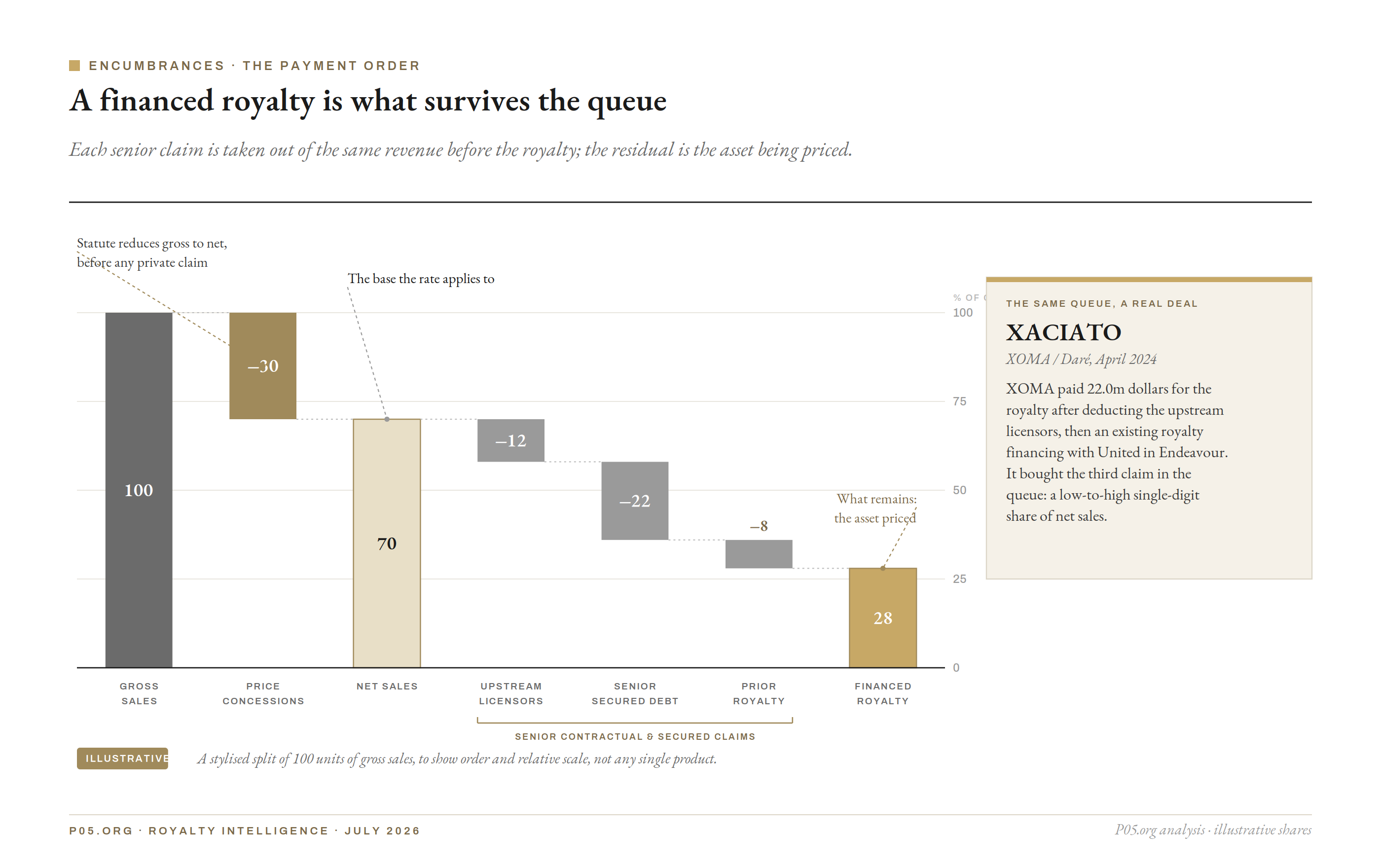
Figure 1. An illustrative cascade of 100 units of gross sales. Statutory concessions reduce gross to net, then net sales are drawn down by upstream licensors, the senior secured lender, and any prior royalty purchaser before the financed royalty. The XACIATO panel shows the same queue in a real deal. Shares are stylised, to show order and relative scale.
Four surfaces a senior claim attaches to
Encumbrance is broader than a lien. In royalty finance a prior claim can attach to any of four surfaces, and each is perfected, ranked, and defended under a different body of law.
- The revenue. A licensor, prior royalty buyer, or profit-share partner holds a senior contractual right to the same net-sales line. No lien is required; the later royalty is simply the residual.
- The collateral. The patents, approvals, and receivables can be pledged to secure debt. A lender with a perfected first-priority interest can enforce against the assets that generate the royalty.
- The counterparty. A royalty depends on one entity continuing to collect and remit. That entity's bankruptcy brings the automatic stay, priming finance, contract rejection, and recharacterisation into play.
- The invention and its price. Federal funding leaves the government with retained patent rights under Bayh-Dole. Separately, mandatory rebates and negotiated prices shrink the net-sales base itself.
Only the first surface is visible in the headline royalty rate. The other three live in the security package, the bankruptcy docket, and the statute book, and the rest of this piece works through them.
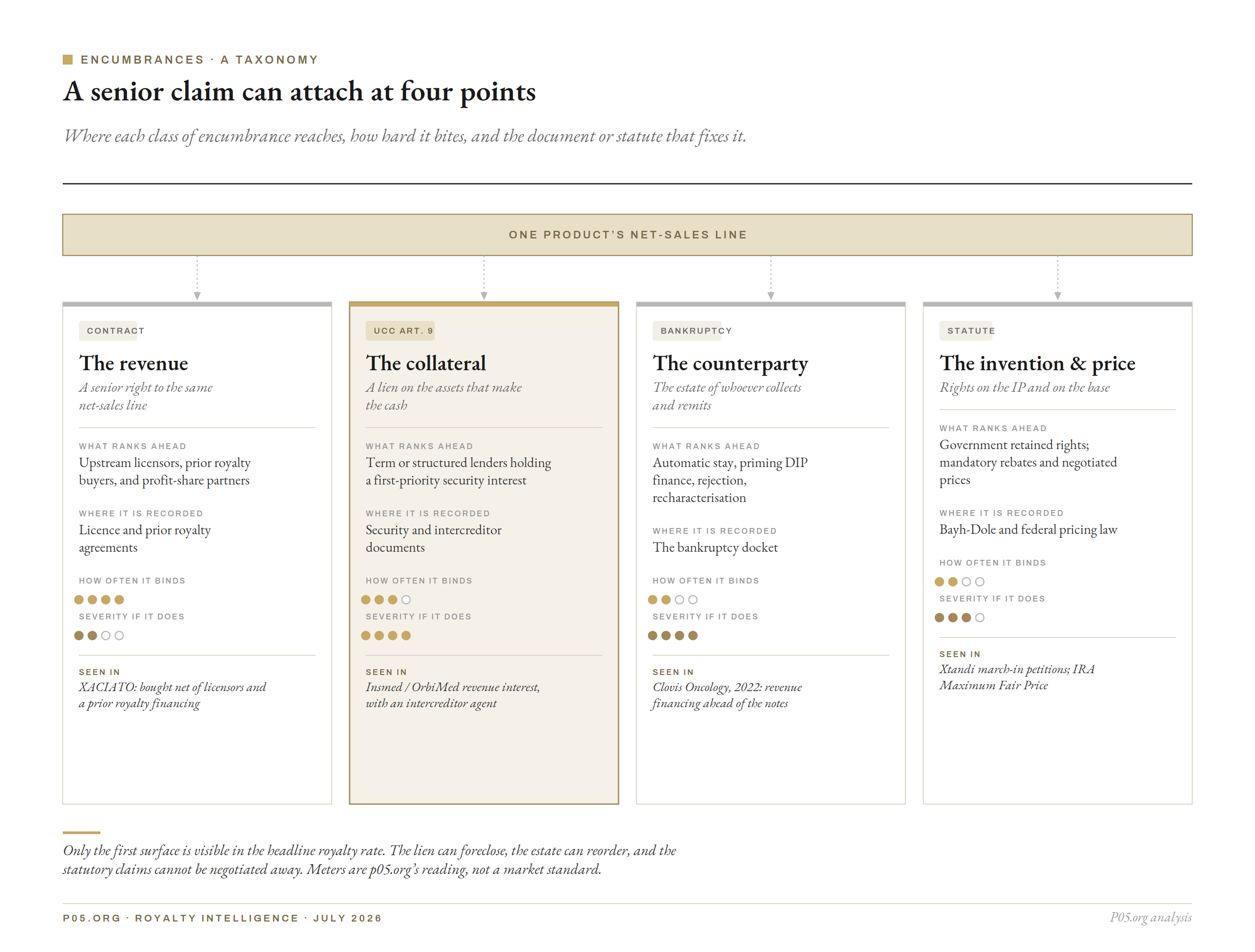
Figure 2. The four surfaces to which an encumbrance can attach, what each reaches, and the document or statute that fixes it. Only seniority on the revenue is visible in the royalty rate.
1. The royalty stack
The most common encumbrance is neither a lien nor a bankruptcy. It is the set of royalties the product already owes to the parties whose IP it uses.
Few drugs rest on one patent held by one owner. A compound may come from a university, its target from a second institution, an enabling method or delivery technology from a third, a formulation from a company that licensed it in.
Each grant usually carries a running royalty on net sales. Stacked together, these are paid from the same revenue before the commercial owner keeps anything, and therefore before a financier who bought a slice of what the owner keeps. XOMA's XACIATO stream sits below two identified layers of exactly this kind.
How stacking clauses reallocate the hit
Licences manage a heavy stack through anti-stacking provisions, and the mechanics decide which layer absorbs a reduction. A representative clause, of the kind filed with the SEC in university licence agreements, works in three moves:
- a stacking threshold, set as a percentage of net sales;
- a reduction formula that lowers each licensor's rate once total third-party royalties breach the threshold; and
- a floor below which a given licensor's rate cannot be cut.
For a financier holding a royalty exposed to such a clause, the direction of the adjustment governs everything. A stream that compresses as the stack grows will shrink at the moment the company in-licenses further technology to strengthen the product's patent position. Reading the threshold, the formula, and the floor is diligence on a licence that predates the purchase.
The stack allocates a share of net sales. How large net sales are in the first place is a statutory question, taken up in section 4.
2. The lien
A stack is seniority on the cash. A lien is seniority on the asset that produces the cash, and it can be enforced against that asset even after the counterparty fails.
Development-stage synthetic royalties are heavily secured, because a royalty on an unapproved product is a loan against a projection, and a lender against a projection takes collateral. Survey data in the anatomy analysis put product-asset liens in roughly 86 percent of synthetic deals against about 11 percent of traditional monetisations. The collateral is generally the product IP, the regulatory filings, and often the revenue accounts.
Put two financiers on one asset and priority becomes a contest. A biotech with a marketed product often carries a senior secured term loan beneath a royalty or revenue-interest financing.
If the term lender holds a first-priority interest in the same IP and receivables the royalty depends on, the royalty holder is economically junior even where its own paper says "sale." On a loan default, the secured lender can accelerate and enforce against the collateral that produces the royalty.
The intercreditor agreement, not the royalty purchase agreement, then governs recovery. The Insmed and OrbiMed revenue-interest structure imported the intercreditor-agent and gratuitous-bailee mechanics from leveraged finance for that reason. Where those mechanics appear, the parties knew at signing that the royalty ranked behind a lien and wrote down the order of enforcement.
Which UCC category the royalty falls in
Whether a purchased royalty ranks as a sale or as loan collateral is governed by Article 9 of the Uniform Commercial Code, which under § 9-109 reaches both security interests and sales of accounts, chattel paper, and payment intangibles.
A pharmaceutical royalty is typically a payment intangible: a general intangible whose account debtor owes a monetary obligation, a category the drafting comments list royalties within. That classification carries a consequence most buyers rely on and few state out loud. Under UCC § 9-309(3), the sale of a payment intangible is perfected automatically on attachment, with no financing statement required.
Automatic perfection is convenient and, on recharacterisation, dangerous, for reasons taken up next.
3. Recharacterisation
Courts test a "true sale" against economic substance, not the labels in the documents. The consequences are felt in bankruptcy.
The factors
Practitioner summaries of the leading cases identify the factors courts weigh:
- the language and conduct of the parties;
- the extent of any recourse to the seller;
- who bears the risk of loss on the asset;
- who takes any surplus and who absorbs any deficiency;
- the seller's right to excess collections; and
- who administers and services the stream.
No factor controls. In In re Shoot the Moon a transfer was recast as a disguised financing; in R&J Pizza comparable facts supported a sale. Both courts looked past stated intent to recourse, risk, and the seller's right to excess collections.
Why the payment-intangible point bites here
Automatic perfection under § 9-309(3) covers the sale of a payment intangible. It does not cover a security interest in a payment intangible that secures a loan; that requires a filed financing statement under §§ 9-310 and 9-312.
So a buyer that relied on automatic perfection and filed nothing is exposed on recharacterisation. Recast as a secured lender, it is unperfected. Under Bankruptcy Code § 544(a), the trustee or debtor in possession takes the status of a hypothetical lien creditor and primes an unperfected security interest, dropping the former "buyer" to unsecured.
This is the concrete reason sophisticated royalty buyers file a precautionary UCC-1 even while opining that the deal is a true sale with automatic perfection: the filing is the hedge against the day the opinion fails. Recharacterisation is distinct from equitable subordination under § 510(c) and from fraudulent-transfer avoidance under § 548, and a stressed deal can face more than one.
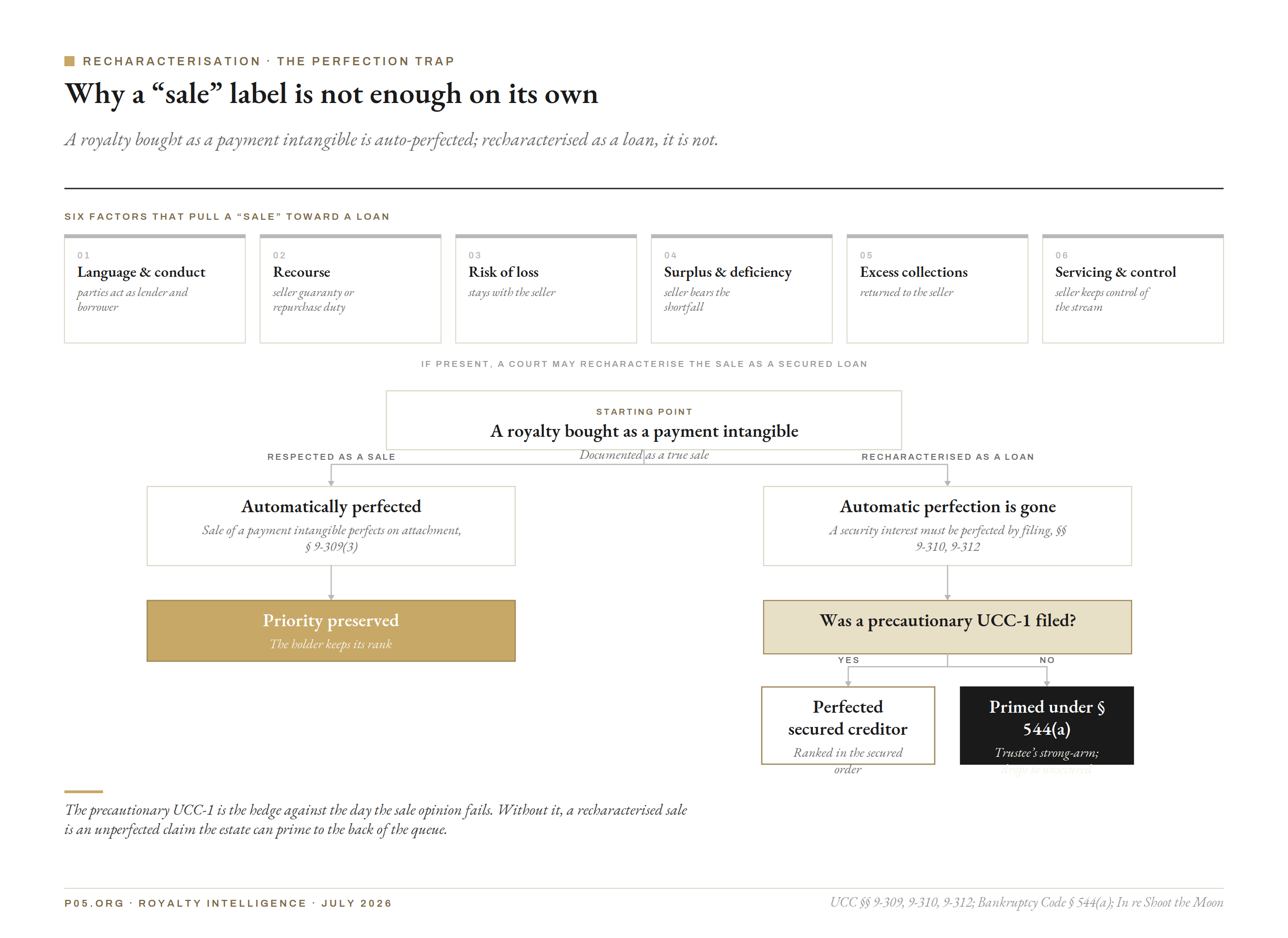
Figure 3. A royalty bought as a payment intangible is perfected automatically under UCC § 9-309(3). Recharacterised as a loan, it is not, and absent a filed precautionary UCC-1 the trustee's strong-arm power under § 544(a) primes it to unsecured.
4. The estate
Every claim above worsens in the counterparty's bankruptcy, which also introduces claims that exist nowhere else. Two lines of authority matter, depending on which party fails.
When the debtor is the payor: Clovis Oncology
Clovis financed the ATHENA trial for its ovarian-cancer drug Rubraca through affiliates of Sixth Street Partners on 1 May 2019. The cash mechanics resembled a synthetic royalty: repayment ran as a percentage of Rubraca revenues, with quarterly caps and a cap of two times the amount advanced.
The documentation was not a sale. Clovis recorded that it had borrowed 175.0 million dollars under a Financing Agreement, secured by a first-priority interest in all Rubraca assets including the IP, with equity pledges and guarantees from its UK and Irish subsidiaries. The financier took security rather than buying the stream, and that choice set its rank.
It filed for Chapter 11 in Delaware in December 2022. The sequence that followed is a clean illustration of how the estate reorders a royalty-like claim:
- DIP priming. Clovis obtained a debtor-in-possession facility of up to 75 million dollars. Under § 364(d)(1), such financing can prime existing liens where the court finds the primed creditor adequately protected.
- A § 363 sale of the collateral. Rubraca was auctioned to Pharma& for 70 million dollars up front and up to 65 million dollars in milestones, against a structure that included more than 400 million dollars of unsecured convertible notes. The secured Rubraca financing ranked ahead of those notes on the very assets sold.
- A challenge to the senior claim. The unsecured creditors' committee brought an adversary proceeding against the Sixth Street entity, TOP IV Talents, LLC, the standard route by which junior stakeholders test a senior lender's position. The cases closed by final decree in October 2024.
The lesson is narrow and general at once: a revenue-linked financing that behaved like a royalty recovered ahead of unsecured creditors because it was documented as secured debt, and the label chosen at signing decided the rank.
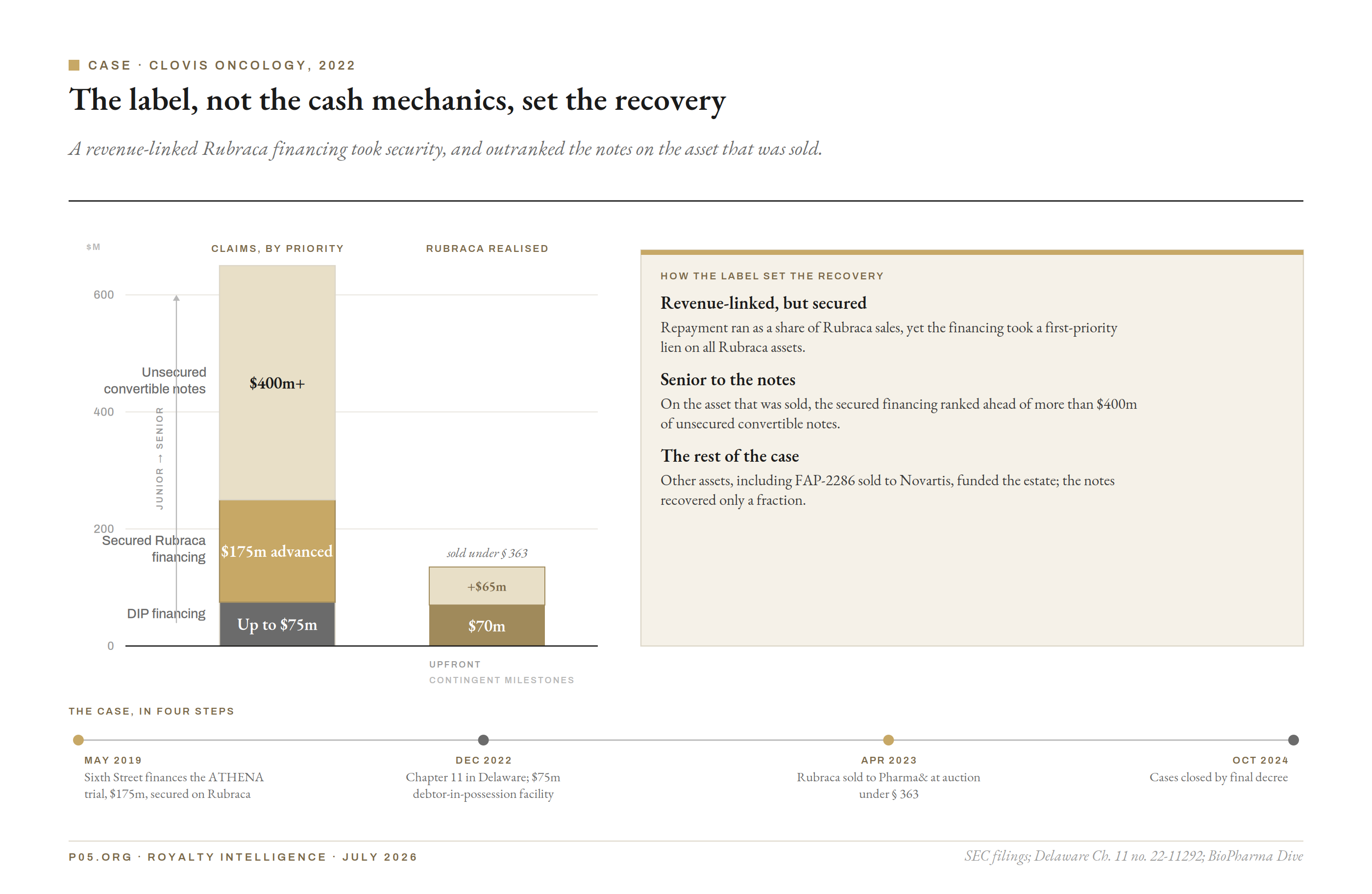
Figure 4. Clovis Oncology (Delaware, 2022). A revenue-linked Rubraca financing took a first-priority lien and ranked ahead of more than 400 million dollars of unsecured notes on the asset that was later sold under § 363 for a fraction of that amount.
The § 363(f) risk to a surviving royalty
Clovis also frames a question every royalty holder should ask about the collateral. When the product IP is sold under § 363, is the royalty stripped and pushed onto the sale proceeds, or does it travel with the asset?
Section 363(f) permits a sale "free and clear" of an interest only where one of five conditions is met: nonbankruptcy law permits it; the holder consents; the interest is a lien and the price exceeds all liens; the interest is in bona fide dispute; or the holder could be compelled to accept money satisfaction. Courts read "interest" broadly, and a royalty framed as a bare contract right is vulnerable to being cut off and relegated to the proceeds.
A royalty drafted as a real covenant that runs with the IP has a better claim to survive the sale. In the oil-and-gas context, the Fifth Circuit in In re Energytec treated a throughput fee tied to a pipeline as a covenant running with the property that could survive a § 363 transfer.
Whether a pharmaceutical royalty runs with the IP or merely binds the debtor is a drafting question decided long before any sale, and § 363(e) adequate protection is the fallback the holder is left arguing if it comes out on the wrong side.
When the debtor is the licensor: § 365(n)
A different provision governs the failure of the licensor whose IP the royalty depends on. A debtor may reject executory contracts under § 365(a), and an IP licence is frequently executory.
Congress added § 365(n) in 1988 after the Fourth Circuit's Lubrizol decision (1985) let a debtor-licensor strip a licensee on rejection. Under § 365(n)(1)(B) the licensee may elect to retain its licensed rights for the term. The election is constrained:
- it must continue to make all royalty payments for the duration and waives setoff against them, though courts have allowed recoupment in narrow cases;
- "intellectual property" is defined in § 101(35A) to cover patents, copyrights, and trade secrets, and to exclude trademarks (the separate treatment the Supreme Court addressed in Mission Product Holdings v. Tempnology, 2019); and
- what counts as a "royalty" turns on substance, not label. In In re Prize Frize (9th Cir. 1994) a fixed licence fee was treated as a royalty, with payments for a licensor's affirmative obligations analysed differently.
Two adjacent traps deserve a line each. In a cross-border case, the Fourth Circuit's Jaffé v. Samsung (In re Qimonda, 2013) held that a foreign representative could not use Chapter 15 to strip US patent licences without affording § 365(n)-equivalent protection, with roughly 47 million dollars in re-licensing fees at issue.
And where a royalty rides on an inbound licence, § 365(c)(1) and the "hypothetical test" applied in cases such as Catapult Entertainment can block the debtor from assuming or assigning that licence over the licensor's objection, which can sever the stream regardless of how the royalty itself was papered.
The structural answers
Counterparty insolvency is contained by structure rather than by drug quality. A bankruptcy-remote vehicle holds the acquired rights in an entity separated from the operating company's estate. The development funding bond reaches the same end from the other direction, replacing exposure to one product's revenue with a claim on parent credit. Each works only to the extent the documents make it work.
5. Statutory encumbrances
The claims so far are private and, in principle, could have been drafted otherwise. The last set arises by law, and the parties cannot contract around it.
Bayh-Dole: a latent claim on the IP
Where federal funding supported the underlying research, the government keeps two rights in the resulting patents.
- A royalty-free licence under 35 U.S.C. § 202(c)(4), a standing right to practise the invention for government purposes that no royalty holder can extinguish. The Federal Circuit confirmed such a licence in University of South Florida Board of Trustees v. United States (2024).
- March-in under 35 U.S.C. § 203, the power to require additional licences on reasonable terms where the invention is not available to the public on reasonable terms or where health, safety, or federal-use needs are unmet.
The practical status of march-in matters more than the text. No agency has exercised it in the 45 years since 1980, and every petition has been declined. On Xtandi (enzalutamide), whose patents trace to University of California research funded by the NIH and the US Army, the NIH declined a march-in petition in March 2023 on the ground that the drug was widely available, and HHS affirmed in February 2024.
A NIST draft framework from December 2023 would have made price a march-in factor; it was not finalised, and price-based march-in is contested rather than settled. The reach is also narrow: one analysis found that only about 2 percent of new molecular entities approved from 1985 to 2022 had all unexpired patents subject to Bayh-Dole, the condition for march-in to enable generic entry.
For a royalty holder, Bayh-Dole is a permanent, unpriced, so-far-untriggered claim on a large body of underlying science, revived from time to time as a policy instrument. No contract removes it, because it belongs to the government.
Price compression: a claim on the base
A second statutory encumbrance works on net sales rather than on the payment order. A royalty is a percentage of net sales, and net sales are gross sales after concessions the manufacturer must give.
- Medicaid rebates. Under 42 U.S.C. § 1396r-8, a manufacturer that wants Medicaid and Part B coverage must sign a rebate agreement. The basic rebate on an innovator drug is the greater of 23.1 percent of Average Manufacturer Price or AMP minus best price, plus a CPI-U inflation penalty. Since 1 January 2024 the old cap at 100 percent of AMP is gone, so rebates on some products can exceed AMP.
- 340B. For covered entities, the ceiling price is AMP minus the Medicaid unit rebate amount, under section 340B(a)(1) of the Public Health Service Act.
- IRA Maximum Fair Prices. The first ten Part D drugs reached negotiated prices effective 1 January 2026, at reductions CMS placed at 38 to 79 percent, with a second cohort of fifteen for 2027 and a third, reaching Part B, for 2028. A manufacturer that neither agrees a price nor withdraws faces an escalating excise tax under 26 U.S.C. § 5000D.
The program's footing is now firm. After a three-year industry campaign in which the government won on the merits at every level, including the Third Circuit's AstraZeneca decision (May 2025), the Supreme Court denied all six manufacturer cert petitions on 18 May 2026.
A royalty holder is not a party to any of this, holds no seniority language that reaches it, and gains no protection from a perfected lien or a clean true-sale opinion against a reduction in the base.
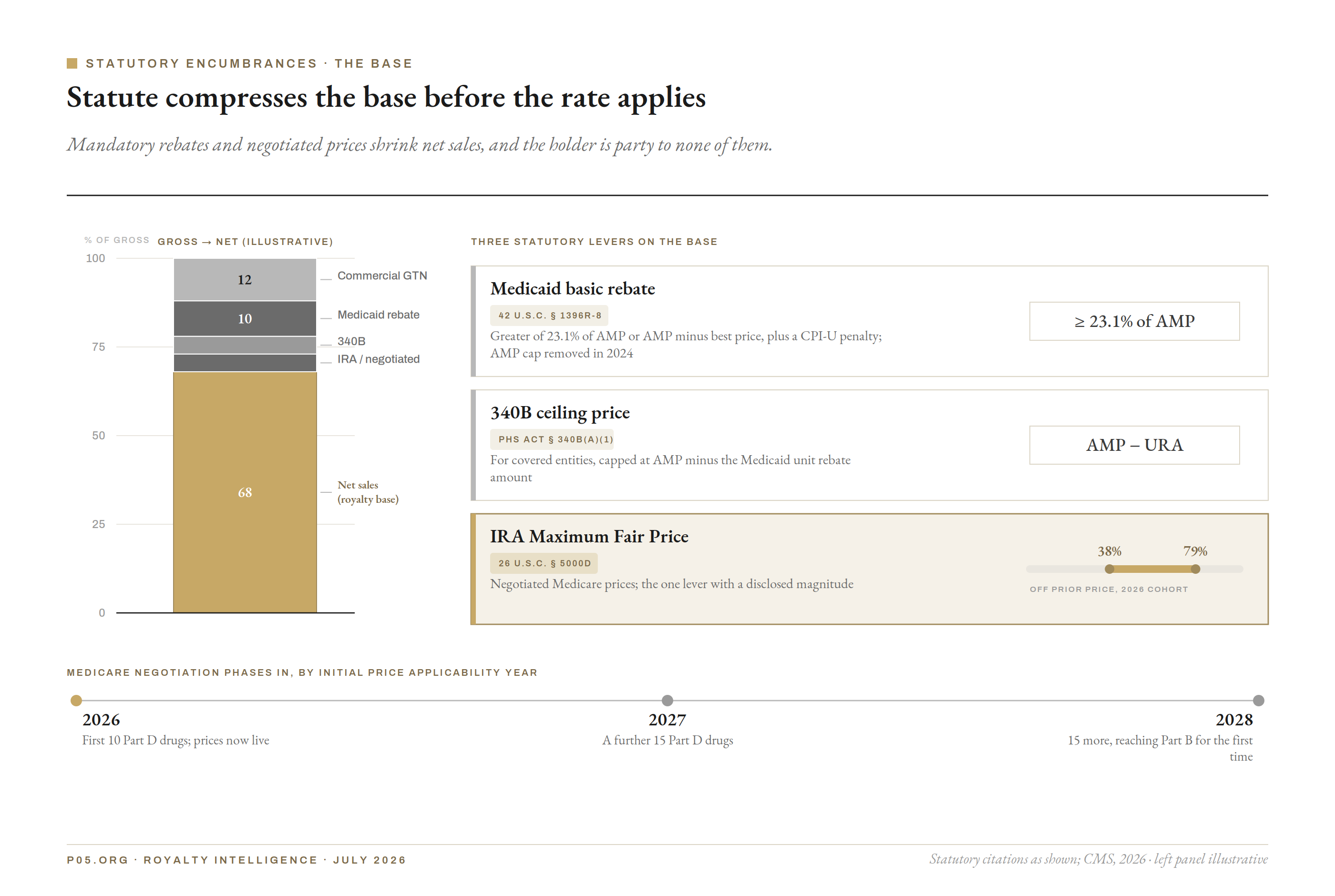
Figure 5. Mandatory rebates and negotiated prices shrink net sales before the royalty rate applies. The IRA Maximum Fair Price is the one quantified lever: reductions of 38 to 79 percent below prior prices for the 2026 cohort. The holder is party to none of them.
What changes rank, and what only records it
Diligence on encumbrances comes down to separating terms that move a holder's rank from terms that merely describe it.
Terms that change rank
- a first-priority security interest that is actually perfected and prior in time;
- a true-sale characterisation with real economic substance under the recharacterisation factors, backed by a filed precautionary UCC-1;
- a direction-to-pay or lockbox that routes cash to the holder before it enters the counterparty's accounts;
- consents, estoppels, or subordination agreements from the upstream licensors and senior lender, taken at closing;
- royalty language drafted to run with the IP rather than to bind only the debtor; and
- a bankruptcy-remote vehicle that genuinely holds the asset apart from the estate.
Terms that only record rank
- covenants against new liens, which bind a solvent counterparty and lapse when they are needed;
- "net of" language, which prices an encumbrance without removing or reordering it;
- a security interest granted but left unperfected, close to worthless in a priority contest; and
- a true-sale label without the substance a court requires to respect it.
The recurring mistake is to read the rate and the "sale" label and stop. Neither establishes rank.
The relationship to impairment
The companion piece on impairment covered the size of the stream when a drug underperforms. Encumbrance risk covers the holder's share of the stream and its place in the order, and it can bind even when the drug performs.
The two are read in different documents. Impairment risk sits in the epidemiology, the label, the competitive set, and the pricing outlook. Encumbrance risk sits in the licence, the security agreement, the intercreditor deed, the bankruptcy docket, and the statute book. A royalty can be reduced by either alone or by both, and diligence that addresses one leaves the other open.
What each side should ask
For the company raising royalty capital
- What already ranks ahead of the interest being sold, and has all of it been disclosed? An undisclosed upstream royalty or prior lien turns the buyer into a litigant, and a vague "net of" clause is what the dispute turns on.
- If a lien to a senior lender and a royalty sale sit on the same asset, are the intercreditor terms set so both remain viable, or is the royalty effectively uninvestable beneath the loan?
For the royalty investor
- Rank before rate: who reaches this cash flow ahead of me, in what order, and under which documents?
- Will the sale characterisation survive challenge, and is the backup UCC-1 filed and perfected against the day it does not?
- Does the cash reach me before it reaches the estate, through a direction-to-pay, lockbox, or remote vehicle?
- If the IP is sold under § 363, does my royalty run with it or fall onto the proceeds?
- If the drug performs to forecast, how much reaches me after every senior claim is paid? Where that figure sits well below the sales line, the encumbrances are the deal, and the drug was never the main risk.
A royalty is a claim on a distribution whose order was set before the holder arrived. Upstream licensors rank first because their science underlies the product. A secured lender ranks ahead because it took collateral. The estate can reorder the distribution if the counterparty fails. The government retains an unpriced interest in federally funded science and, through pricing law, a growing hand on the size of the base.
What the holder owns is the residual after those claims. The documents and the applicable law, not the clinical data, decide how large it is.
All information in this article was accurate as of the research date and is derived from publicly available sources including SEC filings, issuer press releases and annual reports, statutory and regulatory materials, court decisions and dockets, and legal and financial commentary. Information may have changed since publication. This content is for informational purposes only and does not constitute investment, legal, accounting, tax, or financial advice. The author is not a lawyer, accountant, tax adviser, or financial adviser.