Royalties past the patent: Kimble in the United States and the new technology transfer rules in Europe
A royalty that outlives its patent is enforceable in Europe if the licensee can still walk away and rivals can compete. In the United States it is enforceable only if it pays for something other than the patent. Most licences do not say which.

On 16 July 2026 a Delaware judge denied ANI Pharmaceuticals' post-trial motions in its dispute with CG Oncology, and ANI said it would appeal. In November 2010 ANI's predecessor had assigned to CG the patents, biomaterials and other intellectual property behind CG0070, now cretostimogene, an oncolytic virus for bladder cancer.
In return it took a small cash payment, a 30 per cent share of sublicensing revenue, equity and a 5 per cent running royalty on net sales. The royalty had no end date.
In July 2025 the court held that the royalty was an impermissible perpetual royalty under Brulotte v Thys and could not be enforced. A jury then found that losing the clause was not materially adverse to ANI, so the rest of the agreement survived without it, and ANI's unjust enrichment claim was never reached.
CG plans to complete its biologics licence application in the fourth quarter of 2026. If the ruling stands, the drug will reach the market carrying no royalty to ANI at all.
Ten weeks before the ruling, Europe changed its rules on the same question. A new technology transfer block exemption and new guidelines took effect on 1 May 2026, and the United Kingdom replaced its version on the same day.
This piece sets out what each regime lets a royalty tail be priced on, and what 50 licences filed with the SEC actually say.
p05 has covered parts of this before. Reach-through royalties and the contractual tail (April 2026) set out Kimble, Brulotte and the Third Circuit's Ares v Dyax decision, and the 2014 European guidelines. When Does the Money Stop? and Patent Life and Loss of Exclusivity modelled the step-down.
Royalty Tail Structures (February 2026) described the structures without the legal limits. What follows adds the 2026 European texts, the case law since 2024 and the clause data.
The United States: what survives the patent
The rule is federal patent law and has not moved since 1964. In Kimble v Marvel the Supreme Court declined to overrule Brulotte in 2015, six to three, and left any change to Congress. A royalty for using an invention after its patent expires is unenforceable. A choice of New York or Delaware law does not avoid it.
The Court also listed what a tail can lawfully be priced on. A licensee may defer payment for use before expiry into the years after it. Royalties tied to a non-patent right, such as a trade secret, may continue. A licence of a patent and a trade secret can charge 5 per cent while the patent lasts and 4 per cent afterwards, the lower rate paying for the secret alone.
The cases since 2024 show how courts apply that list. In C.R. Bard v Atrium the district court found misuse by looking at what the parties had intended. The Ninth Circuit reversed in 2024, holding that whether a royalty pays for post-expiry use is a question of law decided on the terms, and that motive is irrelevant. The Supreme Court declined to hear the case.
Delaware has since decided two hybrid licences with opposite results. In Corteva v Monsanto (September 2024) the Superior Court enforced a worldwide licence of patents, know-how and biological materials that ran until the last patent anywhere expired, because the royalty was measured on sales and the package included non-patent rights.
In Bayer v Corteva (2025) the same court barred a royalty claim based on use of the Hinchee patents after they expired, and rejected the argument that it was deferred payment. The judge wrote that he "cannot remain intellectually honest and find that Brulotte does not bar" the claim.
ANI's agreement also transferred biomaterials, but its royalty had no step-down and no end, and it fell.
The American test is therefore what the tail pays for, read from the contract. A rate that falls when the patent expires shows that the remainder pays for something else. A rate that does not fall invites a court to treat the whole tail as patent royalty.
Europe: whether others can compete
European law asks a different question. Article 101 of the Treaty prohibits agreements that restrict competition, and the block exemption shelters most technology licences between parties below set market shares. Regulation 2026/877, adopted on 16 April and in force from 1 May 2026 to 30 April 2038, keeps the old limit on duration.
The exemption lasts only while the licensed rights have not expired, lapsed or been declared invalid, or, for know-how, while it remains secret. Agreements that met the 2014 rules but not the new ones have until 30 April 2027.
After expiry, a licence is assessed on its own. The 2014 guidelines said the parties could normally agree to extend royalties beyond the validity of the licensed rights. The 2026 guidelines say such royalties "do not necessarily restrict competition" and may let the licensee spread payment over a longer period.
They add that where third parties can lawfully use the technology after expiry and create sufficient competitive pressure, post-expiry royalties are unlikely to restrict competition. The Commission's explanatory note does not list the passage among the changes. The wording is softer than "normally", and it ties lawfulness to the market after expiry.
The Court of Justice has set the other condition. In Ottung (1989) a royalty after patent expiry did not breach the Treaty where the licensee could terminate on reasonable notice.
In Genentech v Hoechst and Sanofi-Aventis (2016) the Court held that Genentech owed the royalty for the whole term of its licence, although the patents had been revoked, because it had been free to terminate. Neither judgment asks what the tail paid for.
The United Kingdom reached the same place by its own route. The Technology Transfer Agreements Block Exemption Order 2026 replaced the retained European regulation from 1 May 2026.
In Rocep-Lusol v Lindal the Inner House of the Court of Session in 2025 enforced, under English law, reduced royalties for January 2021 to December 2023 on patents that had expired in December 2020. The licensee dropped its competition argument on appeal.
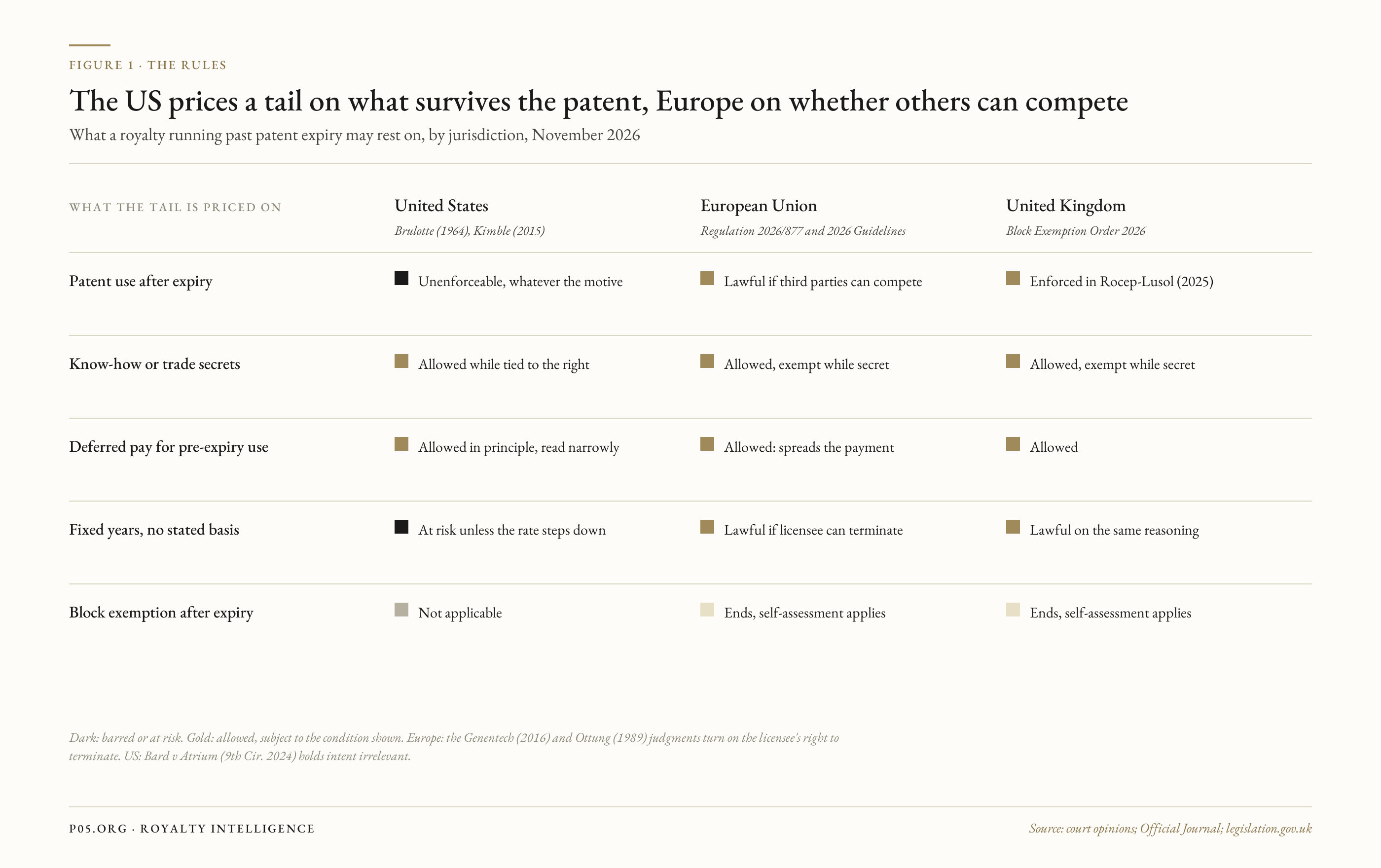
What a royalty running past patent expiry may rest on, by jurisdiction, November 2026.
What the licences say
p05 read the royalty-term clauses in the 50 licences used for the audit piece and the pieces since. In 36 the royalty runs past the last patent on the face of the clause. In four more the term is redacted but the rate falls when no patent covers the product, which only makes sense if royalties are paid without one.
One, Baylor's licence to Kuur, runs past the patent only in countries where none ever issued. Four end with the patent: MIT's licence to Cyclerion, the University of Zurich's to Viventia, the University of Arizona's to Sunshine Biopharma and a Supernus patent settlement. Five are redacted or unclear.
Most tails are priced on time. The typical company licence ends on the latest of the last valid claim, the end of regulatory exclusivity and a fixed period after first sale, ten to fifteen years where the number is shown. Of the 40 licences that run past the patent, 33 rest on prongs of that kind, or have a redacted term, and give no basis for the tail.
The other seven name know-how or trade secrets: six university licences and SomaLogic's licence to Illumina, where royalties continue while the product uses trade secrets protected under US law.
The universities are the most explicit. Columbia's licence to Tonix states that its technical information was separately available and paid for on its own commercial value. The University of Texas at Austin halves the rate, from 2 per cent to 1 per cent, for ten years of know-how royalties after the patents.
The University of Louisville charges 2.5 per cent on sales not covered by a licensed patent, against 4 or 5 per cent on covered sales.
Company licences use the step-down instead. In 23 of the 33 time-based tails the rate falls when no valid claim covers the product. The size of the cut is redacted in nearly every filing.
Eight keep the full rate, including three with US royalties and no stated basis: Merck's licence to Ammonett, Cancer Prevention Pharmaceuticals' to One-Two Therapeutics and Saul Yedgar's to Edesa.
Eight licences give a reason for the tail. Four use a mutual-convenience clause of the kind Zenith approved in 1969. Wave and Takeda say the payments reflect ease of calculating and paying royalties, and Precision BioSciences and Lilly call the duration appropriate as a matter of convenience.
The University of Massachusetts' June 2025 licence to Tonix deems any royalty after the patents expire a deferred royalty for the period from signing, the first route Kimble listed.
Exelixis's licence to Ipsen says the value lies substantially in know-how and adds a
reduction that applies only where a country's law requires one after the patents expire. Cidara and Janssen keep the full rate under regulatory exclusivity unless local law requires a cut. None of the 50 names Brulotte or Kimble.
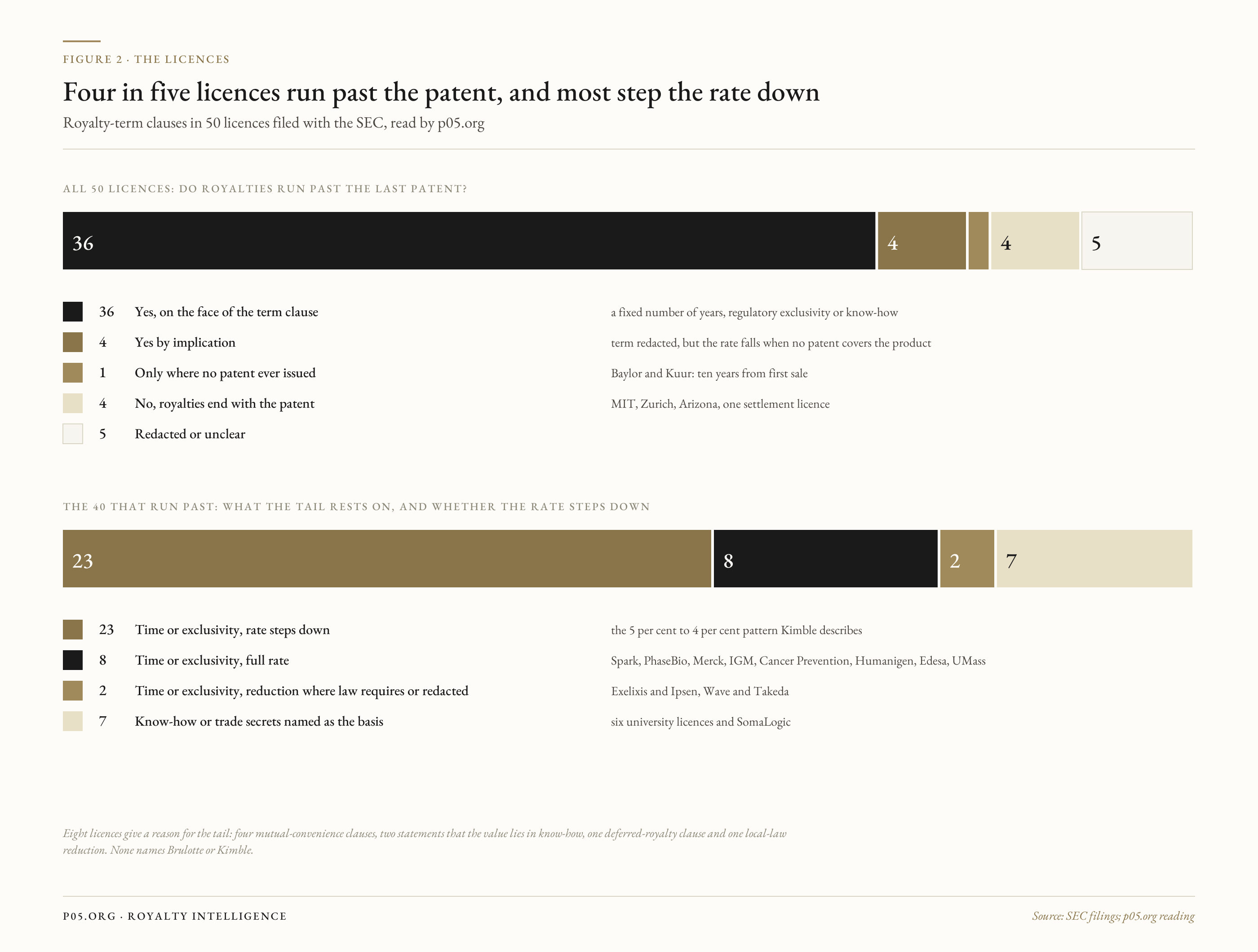
Royalty-term clauses in 50 licences filed with the SEC, read by p05.org.
What the drafting is worth
Take a licence paying 10 per cent on $1B of annual sales, half in the United States and half in Europe. The last patent expires at the end of year eight and the royalty term runs to year 12 on a fixed-years prong, with sales held flat under regulatory exclusivity. The tail is four years, worth $400M at the full rate.
Kept at full rate with no stated basis, the European half is lawful if the licensee can terminate, and pays $200M. The American half is claimed under the contract, but on ANI and Bayer v Corteva a court would likely bar it, and the holder collects $200M.
A step-down to half for know-how across the whole territory is safer in the United States and collects the same $200M, because it gives up half of the European royalty to secure the American one.
A full rate with a reduction only where the law requires it, as Exelixis drafted, collects $100M in the United States and $200M in Europe, $300M in all.
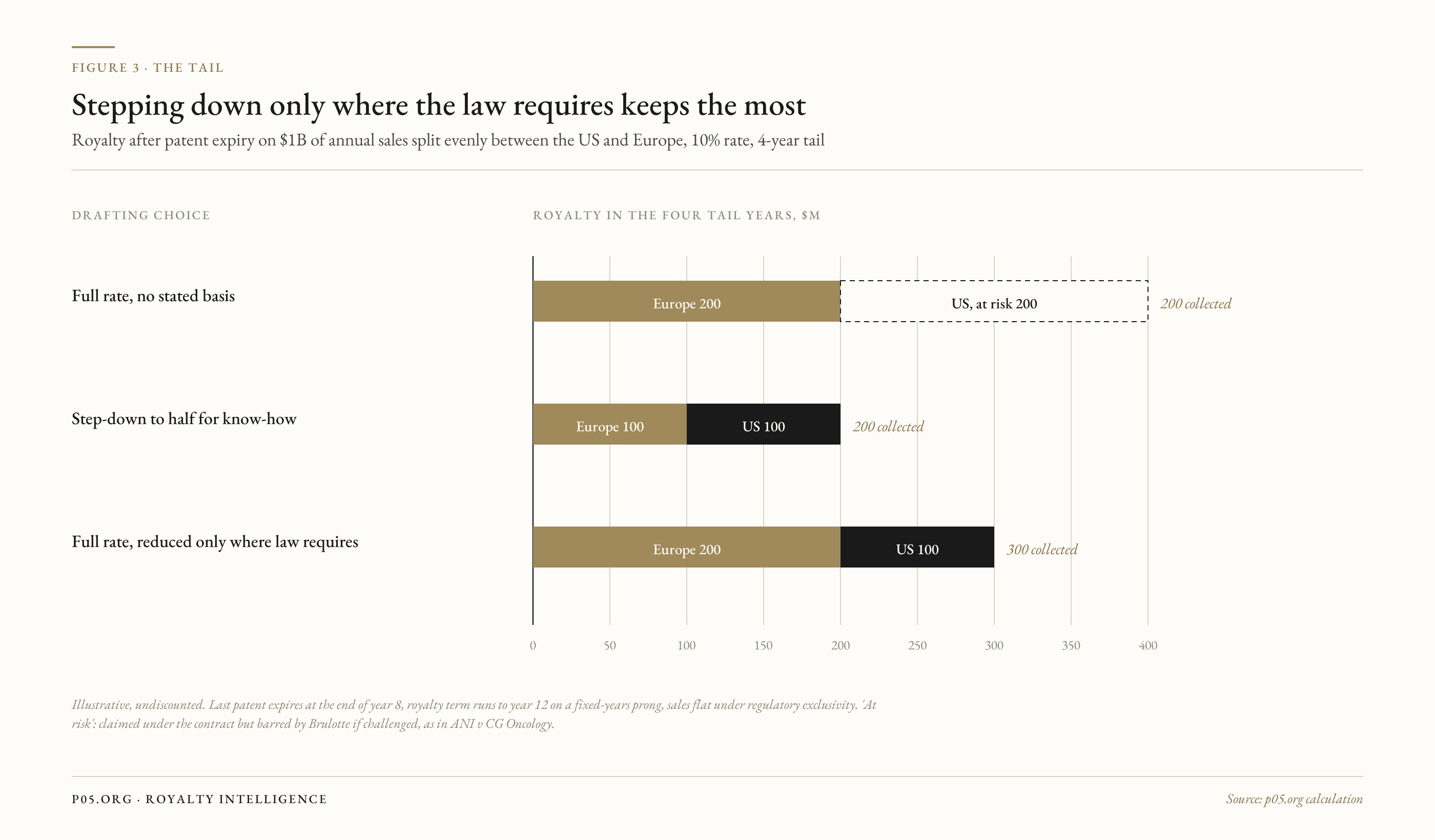
Royalty in the tail years under three drafting choices. Illustrative, undiscounted. p05.org calculation.
Implications for the Pharmaceutical Royalty Market
A buyer modelling a tail should read the royalty-term clause by territory. For American sales after the last patent, the questions are whether the rate steps down, what the lower rate is tied to, and whether non-patent rights were actually transferred and remain secret.
A tail at full rate with no stated basis is a claim that a licensee can stop paying and defend on Brulotte, as CG did. Bard means the licensor cannot rescue it with evidence of what the parties meant.
For European sales the questions are whether the licensee may terminate on reasonable notice and whether generics or biosimilars can enter after expiry.
A tail resting on regulatory exclusivity, with no competitor able to enter, is the case the 2026 guidelines leave open. Licences signed under the 2014 rules have until 30 April 2027 to be reviewed.
The redactions limit what a buyer can see. The step-down percentage is hidden in almost every company licence in the sample, and four royalty terms are hidden entirely. A seller can be asked for the unredacted text, and the step-down sets the value of the tail in both regimes.
Licensors negotiating now can draft for both. A territorial step-down that applies only where law requires one, a recital that identifies the know-how and its value, and a termination right for the licensee cost little and keep the European tail at full rate.
Conclusion
ANI's royalty was a single number with no end and no step-down. The appeal will test whether that is fatal in Delaware. In Europe the same clause would have been judged on whether CG could terminate and whether rivals could compete after expiry. Of the 50 licences, 40 run past their patents, and eight say what the tail pays for.
All information in this report was accurate as of the research date and is derived from publicly available sources including court opinions, regulatory guidance, academic literature, SEC filings, and financial news reporting. Information may have changed since publication. This content is for informational purposes only and does not constitute investment, legal, or financial advice. The author is not a lawyer or financial adviser.