
The Royalty Factory: How the Deprioritized-Asset NewCo Mints Private Royalties
A big pharma has an asset it no longer wants to carry. It does not shelve it and it does not sell it outright. It out-licenses it to a company built to advance it, and keeps a royalty. Every time this happens, a new private royalty is minted, on terms no one discloses.
A large pharma has an asset it no longer wants to carry. It is not a failure, it just lost a portfolio bake-off: a promising target that sits below the internal pay line, a preclinical program with good science and no home, a molecule orphaned when a therapeutic area was cut.
Shelving the asset is a write-off. Selling it outright brings one price and ends the relationship. So the company does a third thing: it out-licenses the asset to a company set up to advance it, lets that company raise its own money to fund the work, and keeps milestones and royalties, sometimes with an equity stake attached.
This is the deprioritized-asset NewCo, and it now runs often enough to be a standing source of new royalty interests. Each one leaves the originator holding a royalty on terms that rarely reach a public filing. Where a buyer of early royalties has to assemble a book out of what others have created, the deprioritized-asset NewCo is where those royalties are manufactured in the first place.
The strategy is not hypothetical, and it is not new. It runs at single-asset scale and at portfolio scale, from Western majors and from Asian originators, funded by dedicated life-sciences investors and by generalist private equity.
Two recent examples run the same structure at different settings: Eisai out-licensing a portfolio of preclinical oncology programs to the newly formed CORE Biomedicine, and Roche's deprioritized Angelman antisense oligonucleotide rugonersen moving into Oak Hill Bio and onward into a listing vehicle.
Oak Hill describes its own reason for existing as taking "the baton where others left off," picking up deprioritized late-stage rare-disease drugs that a corporate-strategy shift stranded mid-development. That is the structure stated plainly by one of the vehicles it produces.
The three design choices
Strip away the branding and every deprioritized-asset NewCo makes three near-independent choices.
- Retained economics. Royalty and milestones only, versus royalty and milestones plus an equity stake in the vehicle. The first is a licence; the second is a licence plus a call on the equity upside.
- Asset count. A single asset built into a company, versus a portfolio of several programs seeded at once. One is a bet on a molecule; the other is a diversified basket handed to one management team.
- Exit design. Build to partner (advance to a value inflection, then license or sell to a strategic), build to buy (the originator or a third party holds an option to reacquire at a preset price), or build to list (carry the vehicle to an IPO or a reverse merger).
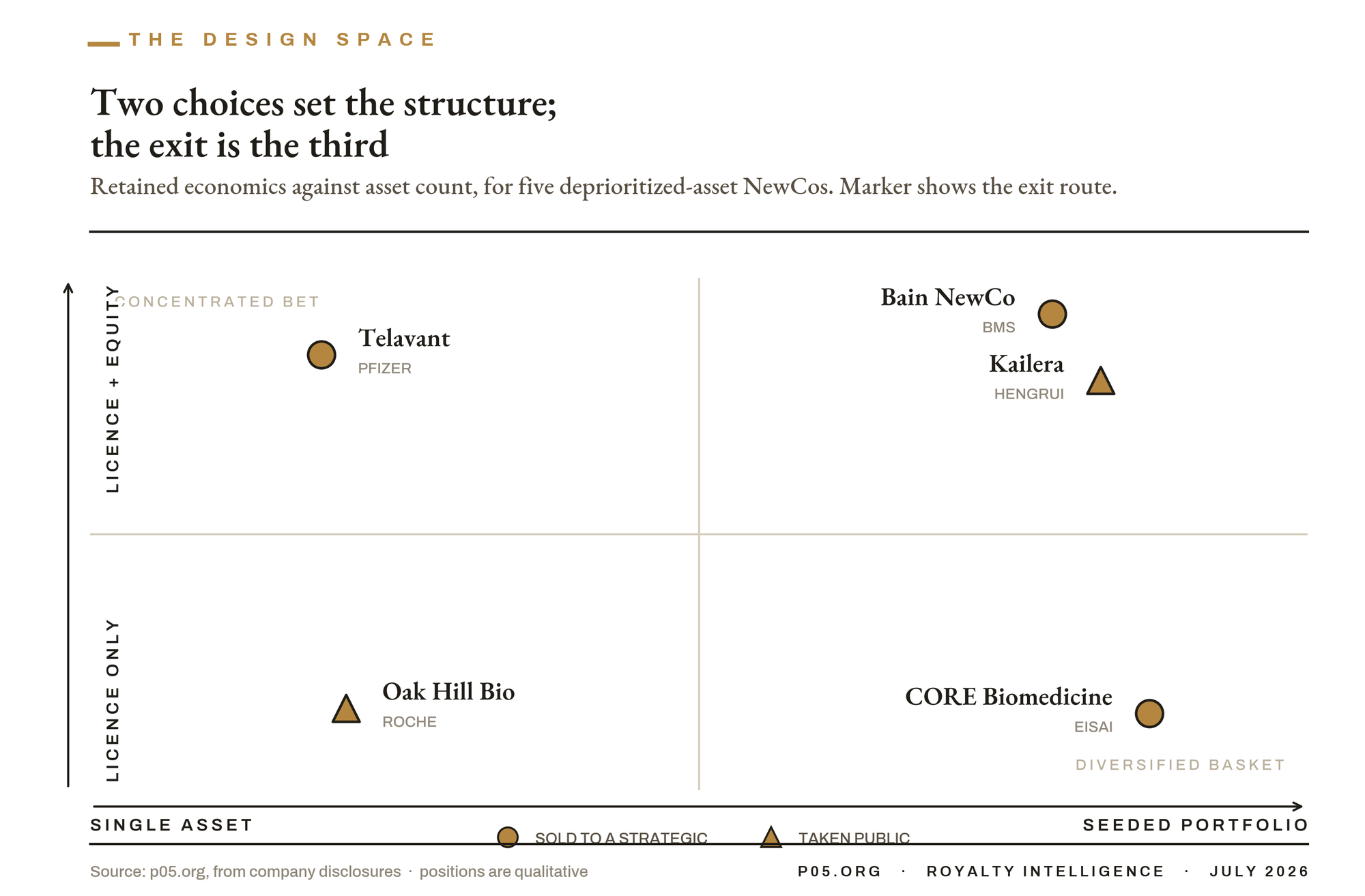
Where an implementation sits across those three choices governs the size and seniority of the originator's royalty, who carries the development cost, and how quickly the interest turns into cash.
Why the originator runs it
The driver is portfolio management rather than financing. Inside a large organisation a non-priority asset still consumes management attention, the scarcest resource, and carries a full load of corporate overhead.
Advisory shops that build these vehicles estimate that asset-centric NewCos reach a Phase 2 readout materially faster and at lower overhead than the same asset would inside a diversified parent, because a lean, CRO-centric team does nothing but advance the molecule. Every month of patent life recovered is worth real money on a drug that works.
Set against that, the originator gives up direct control and most of the upside. What it keeps is the shape of an option: no further development spend, a milestone-and-royalty claim if the asset succeeds, and, in the equity-carrying version, a stake that can appreciate if the vehicle is acquired or lists.
The parent turns a sunk cost into an off-balance-sheet claim on its own cast-off science and frees up capacity for the programs it does want to fund. For most deprioritized assets that beats shelving, and it keeps the upside an outright sale would give away, which is why originators reach for it so readily.
For royalty work, the relevant by-product is the receivable itself: a royalty held by the originator on an asset it no longer develops, disclosed almost nowhere.
The asset: a retained claim on someone else's development
At the point of the deal the asset is usually early, Phase 1 or Phase 2, occasionally preclinical. The originator holds no product and books no sales. It holds a contractual right to a future royalty and a ladder of milestones, contingent on a company it does not control clearing the clinic, a regulator, and a market.
Formally the retained tail is a compound call option written on another party's spending. Each clinical gate the NewCo clears buys the originator the right to the next contingent payment, and the terminal payoff is a fixed percentage of uncertain sales over a fixed patent life. Two features distinguish it from a royalty an aggregator buys in the market.
The originator pays nothing more and controls nothing. A developer funding its own trials keeps writing cheques; here the NewCo's investors fund the work and the originator's further outlay is zero. What it gives up in exchange is control. The value of the retained royalty now rides on a management team and a syndicate the originator picked once and then let go of.
The claim is only as good as the NewCo's balance sheet. A royalty on an asset that a thinly capitalised vehicle must still develop is exposed to the vehicle's solvency. If the NewCo runs out of money before an inflection, the retained royalty can evaporate or convert into a claim in a wind-down rather than paying anything.
"Pennies on the Dollar" flagged this payor-credit risk from the buyer's side; from the origination side it means the originator has traded development risk for counterparty risk on the entity it just created.
The valuation is a standard risk-adjusted net present value: weight each contingent cash flow by the cumulative probability of reaching its gate, and discount. What moves the number is the interaction of a low base rate with a high discount rate early, both improving as the NewCo advances the asset. The originator's tail is worth little at signing and can be worth a great deal at approval, on exactly the assets that survive.
The economics of the retained tail
The design choices decide the outcome through the numbers, so the model has to be explicit. The one that follows is illustrative, with every input stated so it can be changed, and values the originator's retained claim on a single deprioritized asset per one hundred million dollars of NewCo development spend that the originator does not fund.
One asset, in expectation
Write the expected present value of the originator's retained tail at signing as:
E[V] = Σ(m·π) + p·ρ·S·κ·δ + e·q·X
The first term sums each milestone times the probability of reaching its gate. The second is the terminal royalty: probability of approval (p), royalty rate to the originator (ρ), expected peak sales given approval (S), the ratio of royalty present value to peak-year royalty (κ), and the discount factor from signing to approval (δ).
The third term, present only in the equity-carrying version, is the retained equity fraction (e) times the probability of an exit (q) times the exit value attributable to the asset (X).
Base case, per deprioritized Phase 1 asset, from the originator's seat:
| Component | Weighted PV at signing |
|---|---|
| Milestones, probability-weighted | +$18m |
| Terminal royalty (p 10%, ρ 5%, S $1.0bn, κ 3.5, δ 0.5) | +$88m |
| Retained equity (e 20%, q 25%, X $1.2bn) | +$60m |
| Total retained tail, royalty-and-milestone only | ≈ +$106m |
| Total retained tail, with equity | ≈ +$166m |
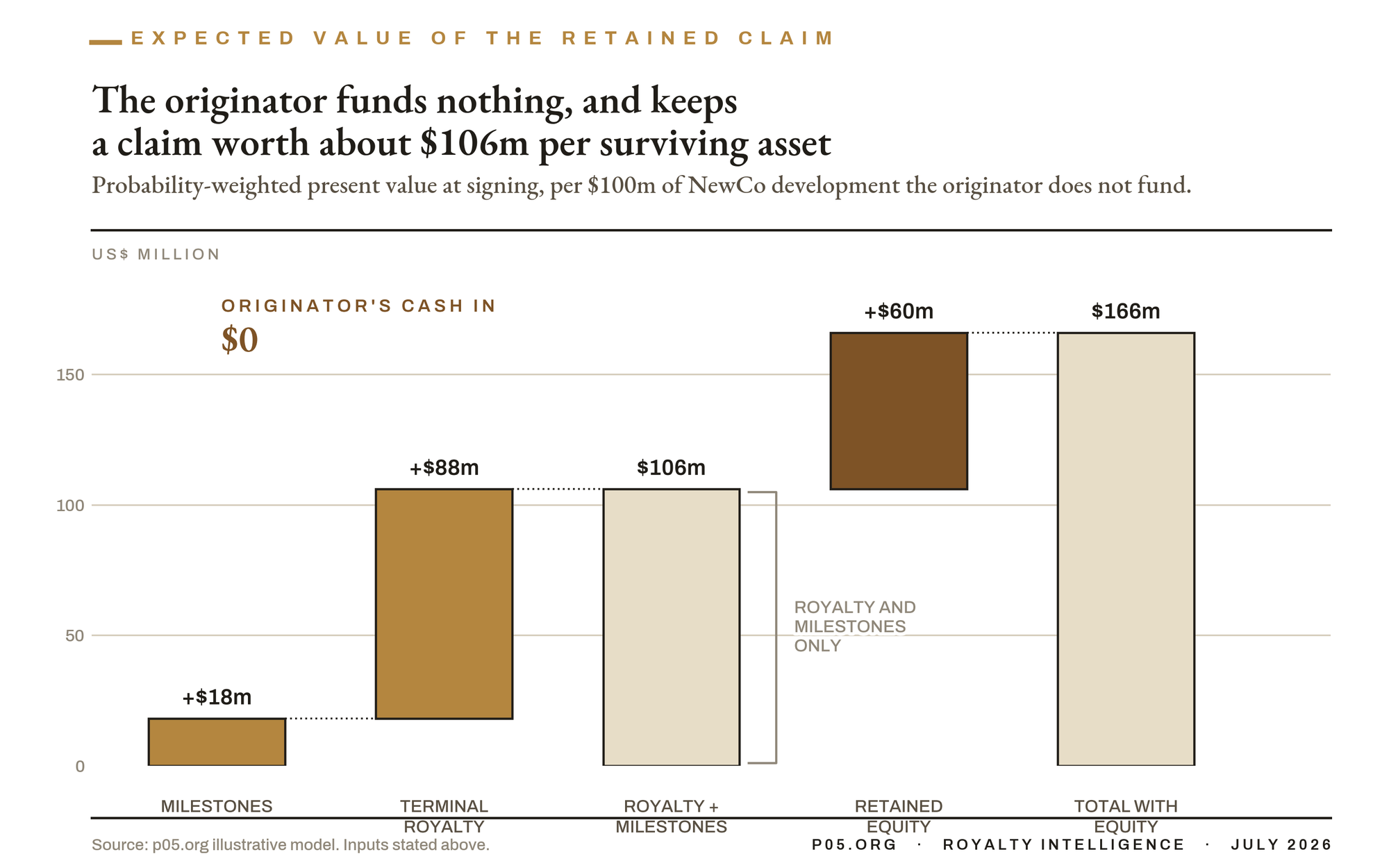
So the originator spends nothing further and holds a claim worth, in expectation, on the order of a hundred million dollars per surviving asset before any equity. That average is misleading for any single asset. Most fail, paying a partial run of milestones and then stopping, and the mean is held up by the minority that reach approval, plus, in the equity version, the smaller number that reach a sale or listing.
Because the originator puts in no capital, there is no return to measure in the usual sense; the question is only what it managed to keep for free. The nearest analogy is a landlord collecting rent on a field it stopped farming.
Milestones front-load the tail
Because the originator paid nothing, the internal-rate-of-return framing that governs a buyer does not bind it; any positive cash on a zero basis is an infinite rate. What matters instead is how much of the tail arrives early, because early cash is worth more and, more importantly, is collected before the NewCo's solvency is tested.
A tail weighted toward approval and sales royalties is exposed to a decade of NewCo execution risk. A tail with meaningful development and regulatory milestones draws cash at each gate, from winners and failures alike, and reduces the originator's dependence on the vehicle surviving all the way to market.
The equity option is the asymmetry
The equity term is what separates the modern NewCo from a plain out-licence. On a $1.2bn asset-attributable exit, a 20 percent retained stake is worth $240m undiscounted; probability-weighted and discounted it still contributes tens of millions, on top of a royalty the originator keeps regardless.
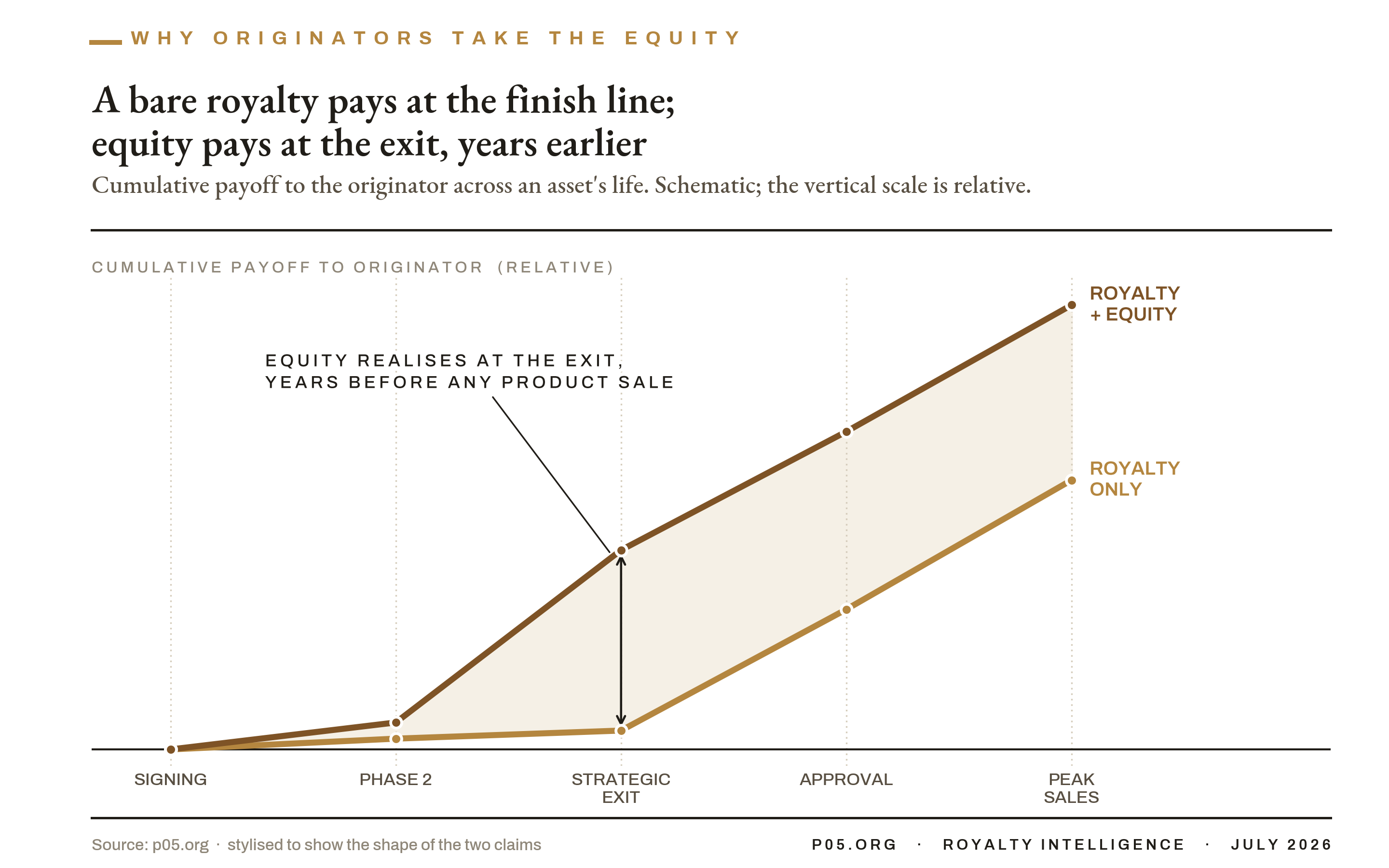
A bare royalty pays only if the drug reaches market. The equity can pay years earlier, on an acquisition or a listing, and often at a multiple of what the royalty is worth in present-value terms. Originators have learned to ask for the stake, and it is the equity-carrying vehicles, not the plain licences, that have produced the headline returns.
The range of outcomes
The average sits on top of a wide spread, from near-total loss of the retained interest to several times its expected value:
- Asset approves and sells well, equity exits high: the full stacked tail, royalty plus milestones plus equity, several times the expected value.
- Asset approves, no strategic exit: royalty plus milestones only, a durable annuity but no equity pop.
- Asset fails after two gates: a partial milestone run, then nothing; the royalty never turns on.
- NewCo fails financially before an inflection: the tail can convert to a wind-down claim, and the retained royalty may not survive at all.
Which of these a given retained interest becomes turns on two things the originator no longer controls after signing: whether the molecule works, and whether the vehicle survives long enough financially to find out.
Retained economics: licence, or licence plus equity
Royalty and milestones only is the classic out-licence, and it is what the Eisai/CORE print discloses on its face: exclusive global rights to a portfolio of preclinical oncology programs pass to CORE, and Eisai, as licensor, retains milestone and royalty economics. Terms are undisclosed, which is the norm. The originator's claim is linear in commercial success and carries no exposure to a strategic exit it does not participate in.
Royalty and milestones plus equity is the structure that has come to define the category. When Bristol Myers Squibb and Bain Capital stood up an independent immunology company in mid-2025 around five in-licensed BMS assets, on a $300m financing led by Bain, BMS retained a stake of nearly 20 percent alongside royalties and milestones tied to each asset, and put its chief research officer on the board.
The retained equity lets the originator share in an acquisition or listing, not only in eventual product sales, and keeps the parent aligned with the vehicle it seeded.
The Asian-originator variant makes the same choice explicit, and it is the one deal in this set whose royalty terms are actually public.
When Hengrui licensed its ex-Greater-China GLP-1 portfolio in May 2024 into the Delaware vehicle Hercules CM NewCo, later Kailera Therapeutics, funded with a $400m round from Bain, Atlas, RTW and Lyra, it took $110m in upfront and near-term payments, up to $200m in development and regulatory milestones, up to $5.725bn in sales milestones, tiered royalties running from low single digits to low double digits on ex-China net sales, and a 19.9 percent equity stake.
That is the full stacked tail itemised: a modest upfront, a long milestone ladder, a real royalty band, and a fifth of the equity. When Kailera later listed, the equity leg alone re-rated, which is the outcome the stake is there to capture, and Hengrui has since run the same play again with Braveheart Bio for a cardiac myosin inhibitor.
Hengrui disclosed all of this only because a Nasdaq-bound vehicle forced it into a filing. Eisai, BMS and Roche kept the same categories of term behind the word "undisclosed."
The two are not interchangeable. A licence-only interest behaves like a credit instrument tied to one probability of success. Add equity and you bolt a call on a corporate event onto that annuity, and anyone later buying or lending against the originator's position has to underwrite them separately.
Asset count: single asset, or seeded portfolio
A single asset built into a company concentrates everything on one molecule. Roivant's vant model is the archetype, and its Telavant instance is the showcase: in December 2022 a single Pfizer asset, the TL1A antibody PF-06480605, was built into a vehicle owned 75 percent by Roivant and 25 percent by Pfizer, with Pfizer also keeping ex-US and ex-Japan rights.
Eleven months later Roche acquired Telavant for $7.1bn upfront plus a $150m near-term milestone, and Pfizer's retained 25 percent stake in a molecule it had cast off was worth roughly $1.7bn.
The upside is clean and large; the risk is that a single-asset vehicle has no diversification, so the retained tail is a binary on one clinical program. Telavant is the deal that taught every subsequent originator to hold out for the equity stake.
A seeded portfolio hands several programs to one team at once, which is the Eisai/CORE and BMS/Bain shape. The originator's retained tail is now a small book rather than a single bet, and the vehicle can prioritise internally as data arrive.
For a royalty holder this is the more robust structure: the originator's claim is spread across several shots, so the failure of any one does not extinguish the whole tail, and the vehicle is less likely to hit a financing wall on a single disappointing readout. The trade is dilution of the concentrated upside a single breakout would deliver.
Both configurations have worked, and the choice tracks how many stranded assets an originator is clearing at once. One orphaned molecule tends to go into a single-asset vehicle; a therapeutic-area retreat that cuts several programs together tends to go into a seeded portfolio.
Exit design: partner, buy, or list
Build to partner advances the asset to a value inflection and then licenses or sells it to a strategic. The originator's retained royalty rides through the transaction, and its equity, if any, is realised at the sale. This is the default, and Telavant is its showcase outcome.
Build to buy gives the originator or a funding partner a contractual option to reacquire the asset at a preset price after a defined inflection, usually Phase 2. It is how a great deal of deprioritized science gets a second life on a leash: the parent externalises the cost and risk of the next stage, and keeps the right to take a winner back at a known price. The retained royalty is, in effect, a rent collected until the buy-back call is exercised.
Build to list carries the vehicle to public markets, through an IPO or a reverse merger into a listed shell or SPAC. The Oak Hill Bio path takes this route.
Roche had walked away from rugonersen in June 2023, not for safety but because it missed an internal efficacy bar, and went looking for an external partner; Oak Hill took an exclusive global licence in February 2025, published supportive Phase 1 data in Nature Medicine that July, dosed the first Phase 3 BEACON patient in July 2026, and days later agreed a business combination with an RA Capital-sponsored acquisition vehicle to reach Nasdaq.
Roche keeps its licence royalty on an asset it chose not to fund; the SPAC route, cheaper and faster to market than an IPO, supplies the roughly $175m that runs the Phase 3 Roche declined. The originator's tail is unchanged by the listing mechanics, but the vehicle's solvency risk falls once public capital arrives, which is precisely when the retained royalty becomes materially safer.
That Roche's royalty terms remain undisclosed, confirmed only as an exclusive global licence, is the norm this whole channel runs on.
An asset can move through more than one of these over its life, and from the originator's seat the distinction is secondary. What each exit does is put enough capital into the vehicle to keep the retained royalty alive to the next gate.
Why the terms stay hidden
One feature is common to every structure above, and it is the one that matters most for royalty intelligence: the retained interest is almost never disclosed in a way that lets it be priced from public sources.
The originator side is opaque. A large pharma out-licensing a deprioritized asset discloses, at most, that it retained "royalties and milestones," and in the equity cases a stake it rounds to "nearly 20 percent." The royalty rate, the milestone schedule, the sales thresholds, none of it appears.
Eisai's economics on the CORE portfolio are undisclosed; BMS's rate on the Bain vehicle is undisclosed; the precise terms of Roche's rugonersen royalty are undisclosed, confirmed only as an exclusive global licence with the economics withheld. The originator has no obligation to break out a contingent claim on an entity it no longer consolidates, and it does not.
The NewCo side is dark. The vehicle that owes the royalty is private, often single-purpose, and files nothing until it lists, if it ever does. Until a build-to-list exit forces an S-1 or a proxy, there is no public window into the payor at all. Even at listing, the originator's royalty is disclosed as a licence obligation in the risk factors, rarely with a clean rate.
A royalty on a public asset can usually be reconstructed from the licensee's filings. A deprioritized-asset NewCo royalty cannot, because neither the originator nor the private vehicle has to show it.
These deals close regularly, across majors, mid-caps and Asian originators, and each one adds a receivable that a filings-only researcher never sees. Knowing who holds which retained interest, at roughly what seniority and stage, on which private payor, is the kind of map a competitor working from public filings has no way to build.
The record, across the design space
The components are all executed, repeatedly. What varies is the configuration, and the configuration decides the originator's exposure.
| Originator | Vehicle (year) | Retained economics | Asset count | Exit realised or intended |
|---|---|---|---|---|
| Pfizer | Telavant / Roivant (2022) | ~25% equity worth ~$1.7bn at exit, plus ex-US/Japan rights | Single asset (TL1A) | Sold to Roche for $7.1bn + $150m, 2023 |
| Bristol Myers Squibb | Bain-backed immunology NewCo (2025) | Nearly 20% equity, plus royalties and milestones (rate undisclosed) | Seeded portfolio (five immunology assets) | Build to partner or list |
| Hengrui | Kailera, ex-Hercules (2024) | $110m upfront, up to $5.925bn milestones, low-single to low-double-digit royalties, 19.9% equity | Seeded portfolio (GLP-1) | Listed (Kailera IPO), 2026 |
| Roche | Oak Hill Bio (2025) | Exclusive global licence royalty, terms undisclosed | Single asset (Angelman ASO) | Build to list (~$175m SPAC combination) |
| Eisai | CORE Biomedicine (2026) | Milestones and royalty, terms undisclosed | Seeded portfolio (preclinical oncology) | Build to partner or list |
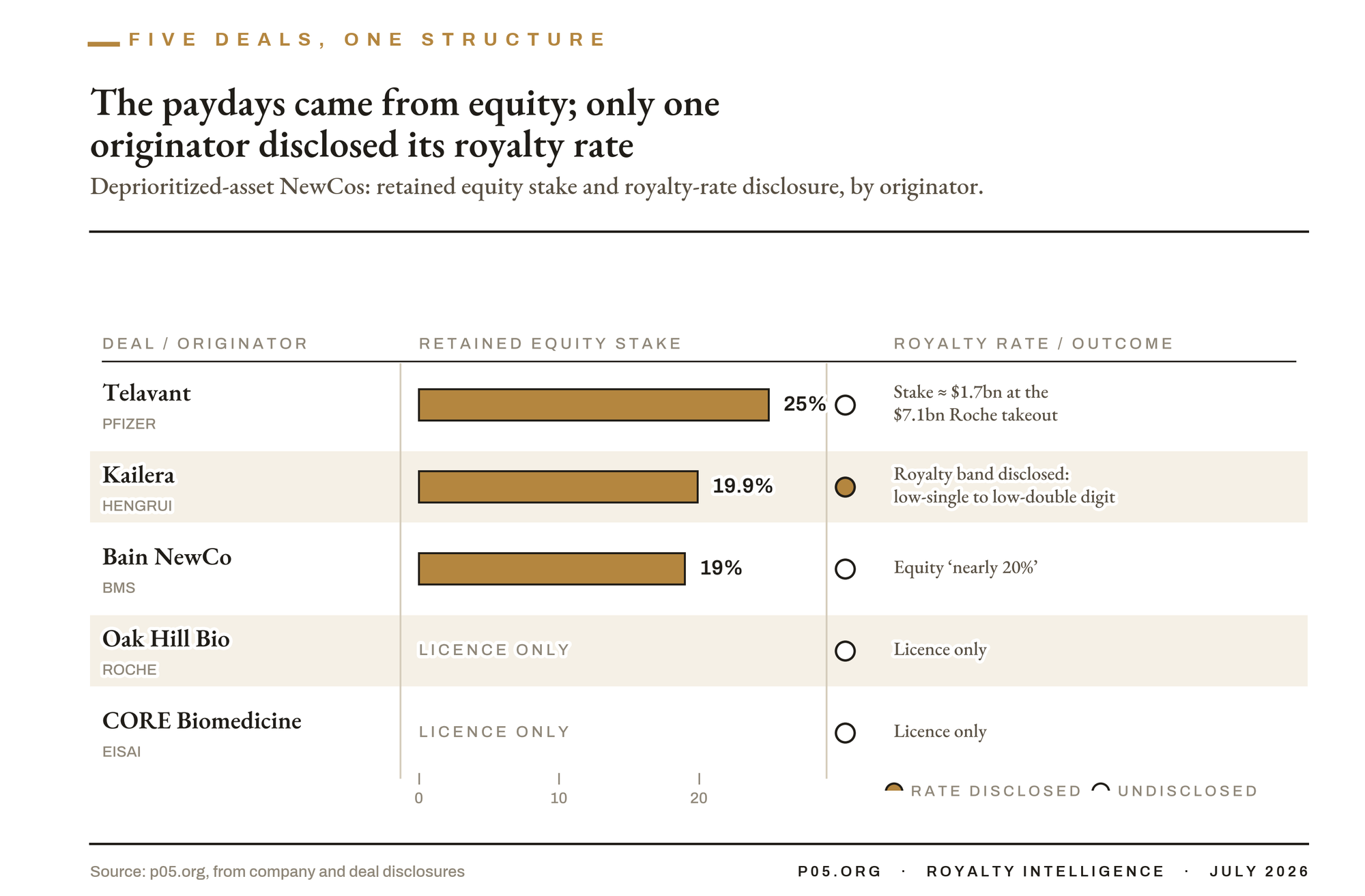
Three patterns run through the table. The originators that extract the most take equity alongside the royalty, converting a linear licence into a convex claim: Telavant turned a cast-off Pfizer molecule into a roughly $1.7bn stake in under a year, and Kailera's listing re-rated Hengrui's 19.9 percent the same way.
The seeded-portfolio structures spread the originator's tail across several programs and hold up better than a single-asset bet, at the cost of the concentrated upside a single winner delivers.
And disclosure is the exception: only the Hengrui deal itemises a royalty band, while BMS, Roche and Eisai withhold the rate entirely. The Eisai and Roche deals sit at that low-disclosure end, which is exactly why they are hard to price from public sources.
What the adjacent structures share. The deprioritized-asset NewCo is the mirror image of the "royalty spin-off": there, a company separates its own royalties from its own pipeline; here, a company externalises a pipeline asset and keeps a royalty on it. Both create a standalone royalty claim; the NewCo version creates it on a payor the originator does not control, which is the harder credit and the darker data.
Where the structure points
A few things follow for anyone deciding how to hold, structure, or track one of these interests.
Take equity when you can. A bare royalty pays only on commercial success. Adding equity attaches a claim on a strategic exit that can pay earlier and larger, and the more active originators now insist on the stake. Anyone underwriting the resulting position has to treat it as two instruments, not one.
Seed a portfolio when you are clearing several assets, a single vehicle when you are rehoming one. The seeded portfolio is the more resilient royalty position and the more common when a therapeutic area is cut; the single-asset build is the higher-variance one and the source of the outlier outcomes.
Underwrite the vehicle, not just the molecule. The retained royalty only survives if the NewCo stays solvent to the next inflection, so the exit design is mostly a question of when the payor stops being financially fragile. A build-to-list royalty gets safer the day public money arrives; a build-to-partner royalty stays exposed until a strategic takes the asset out.
And accept that the terms will be dark. This channel produces private royalties at scale on terms neither side discloses. Better filings-reading will not fix that, and for a data business the opacity is the point of the exercise rather than an obstacle to it. The originator keeps a rent it never has to itemise, on a payor that files nothing, so the only way to know a given interest exists, let alone its rough shape, is to follow these deals one at a time as they close.
The deprioritized-asset NewCo has become one of the default fates of a good asset that loses an internal contest, common enough that a week rarely passes without one. Each deal leaves a private royalty behind. For anyone assembling a map of who owns what, the royalties plainly exist; the only real choice is whether to build the map from the thin public record these deals leave or from tracking the deals themselves, which is where the terms actually sit.
Standard disclaimer
All information in this article was accurate as of the research date and is derived from publicly available sources including company press releases, SEC filings, regulatory guidance, and financial news reporting. The worked model is illustrative and based on stated assumptions; it is not a forecast. Information may have changed since publication. This content is for informational purposes only and does not constitute investment, legal, or financial advice. The author is not a lawyer or financial adviser.