The exchange rate in the royalty report: how ex-US sales become dollars
A licensee's choice of rate, date and order of conversion can move a euro royalty by several per cent in a year in which the currency moves. Most licences leave that choice to the licensee's own accounts.
On 30 June 2025 the European Central Bank fixed the euro at $1.1720, the highest rate at the end of any quarter since June 2021. On the first trading day of April it had stood at $1.0788. A licensee converting its second-quarter European sales at the quarter's average used $1.1338.
One converting at the closing rate used $1.1720, and one using a rate fixed the previous November used about $1.056. On €25M of royalties for the quarter, the three methods give $28.35M, $29.30M and $26.41M. These figures are p05.org calculations from ECB reference rates.
Royalty holders felt the move in their receipts. Royalty Pharma translates the foreign-currency sales its partners report at the average rate for each quarter, and its guidance of 11 February 2026 assumed a positive currency effect of about 1 per cent on its receipts for the year. The rate behind each payment is set in each licence.
p05 covered the path from net sales to the wire in What actually gets wired, which lists currency conversion as one line of the royalty report. This piece looks at that line.
What the licences say
p05 read the conversion clauses in the 50 licences used for the audit piece and the pieces since. Twenty-eight of them let the licensee use the method in its own financial statements. Lilly's licence with Precision BioSciences is typical: Lilly's "then-current standard exchange rate methodology" applies, provided Lilly uses it for its own operating results under American accounting rules. Some add a guard.
Pfizer's licence with Voyager requires the practice to use a widely accepted source of published rates.
Eleven name a published rate on a fixed date, usually the last business day of the quarter, from the Wall Street Journal or the Federal Reserve. Most of these are licences from universities and research institutes.
Three use a published average. The Rallybio licence from Sanofi's Kymab takes the mean of the Wall Street Journal rates on the last business day of each month in the quarter. Two clauses are redacted and four licences say nothing.
Deferring to the licensee's accounts does not settle the rate. It hands the choice to the licensee's treasury, and the methods differ widely between companies. AstraZeneca's 2021 licence with Ionis describes its own practice at signing as the Reuters rate at 8.00 am London time on the 25th day of the previous month.
Roche's 2023 agreement with Alnylam used a year-to-date average rate reported by Reuters, and converts through Swiss francs. Otsuka's 2026 licence with 4D Molecular Therapeutics uses Mizuho Bank's rates averaged over the quarter.
Two Johnson & Johnson licences go furthest. Janssen's 2021 licence with Cidara converts net sales at a "Currency Hedge Rate", a weighted average of the rates on Johnson & Johnson's outstanding forward contracts, set once a year before the year begins. The royalty for the whole year uses that rate, whatever the currency does after it is set.
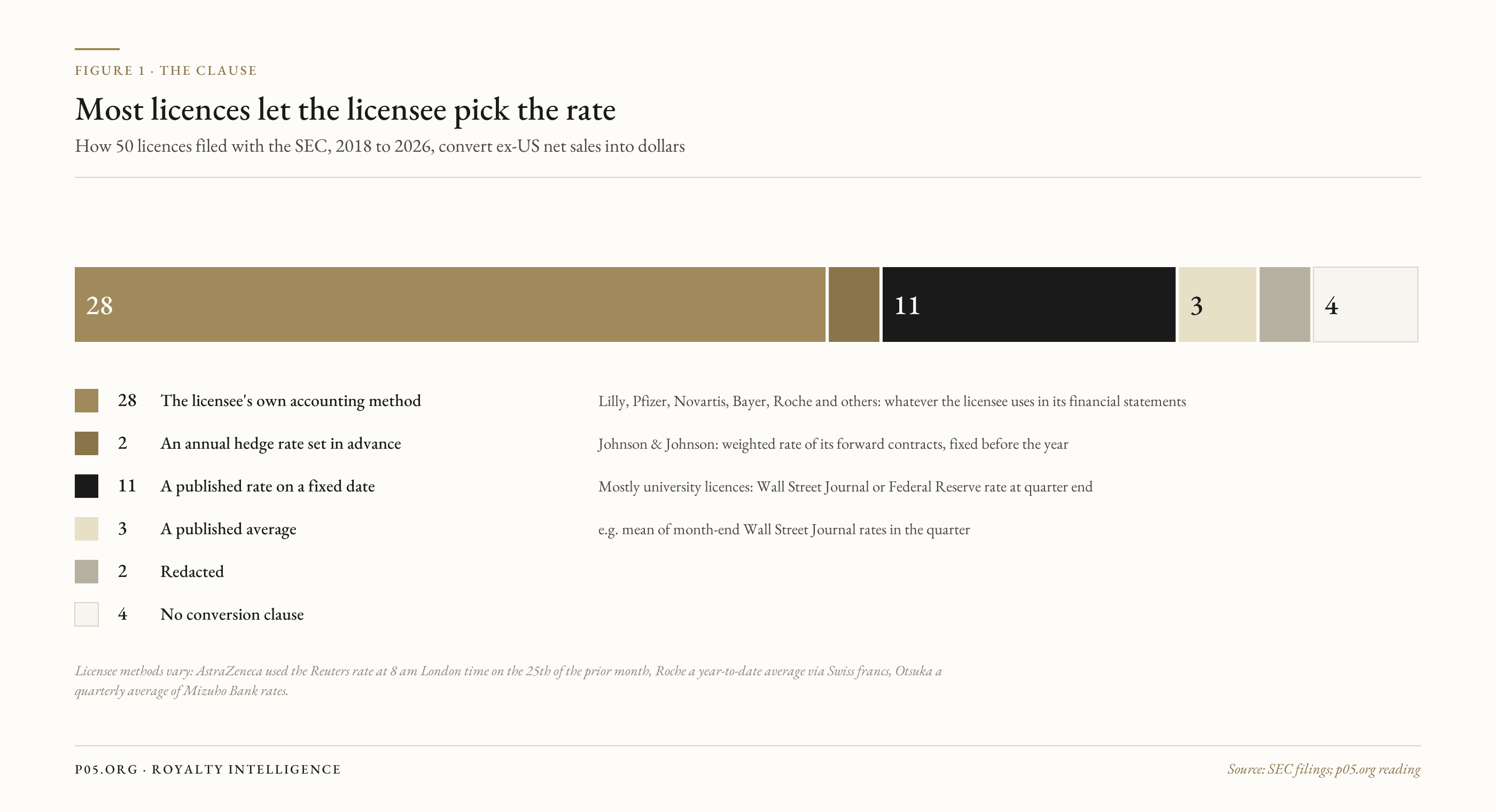
Which rate converts ex-US net sales under 50 licences filed with the SEC. p05.org reading of the filed agreements.
Rate, date and order
The clause makes three choices. The first is the source of the rate. The second is the date or period: a quarterly average, a closing rate, the rate on the payment date, a rate fixed in advance, or the closing rate of the previous quarter.
UMass Chan's 2026 licence to Tonix uses the Wall Street Journal rate on the last working day of the quarter before the royalty period, so each quarter's sales convert at a rate three months old.
The third is the order of conversion. Roche's licence with Recursion determines net sales outside the United States first in the currency of sale and then converts them. Bayer's licence with Eidos converts into euros and then into dollars, and Boehringer Ingelheim's licence with Cue Biopharma calculates the royalty on the euro equivalent and pays it in dollars, without saying which rate takes it from euros to dollars.
With a flat rate the order makes no difference. With tiers it does, because tier thresholds are set in dollars and the converted figure decides which tier applies. Kura's agreement with Kyowa Kirin states that conversion applies both to the royalty and to the test of whether a net sales milestone has been reached.
Bayer's licence converts each quarter's sales at that quarter's rate when it measures them against the annual thresholds. Vertex's sublicence with Entrada excludes gains and losses from Vertex's hedging programme from net sales, so the licensor shares neither.
What the choice is worth
Take a royalty of 10 per cent on €250M of quarterly sales, about €1B a year, and convert it under each method using ECB reference rates. In 2024, when the euro moved within a narrow range, the methods land within about 1.3 per cent of the quarterly average of $108.2M. In 2025 they spread.
Against a quarterly-average total of $112.9M, conversion at each quarter's closing rate gives 1.9 per cent more, and at the rate 45 days after the quarter ends 2.7 per cent more. A rate fixed in November 2024 gives $105.6M, 6.5 per cent less. These figures are p05.org calculations.
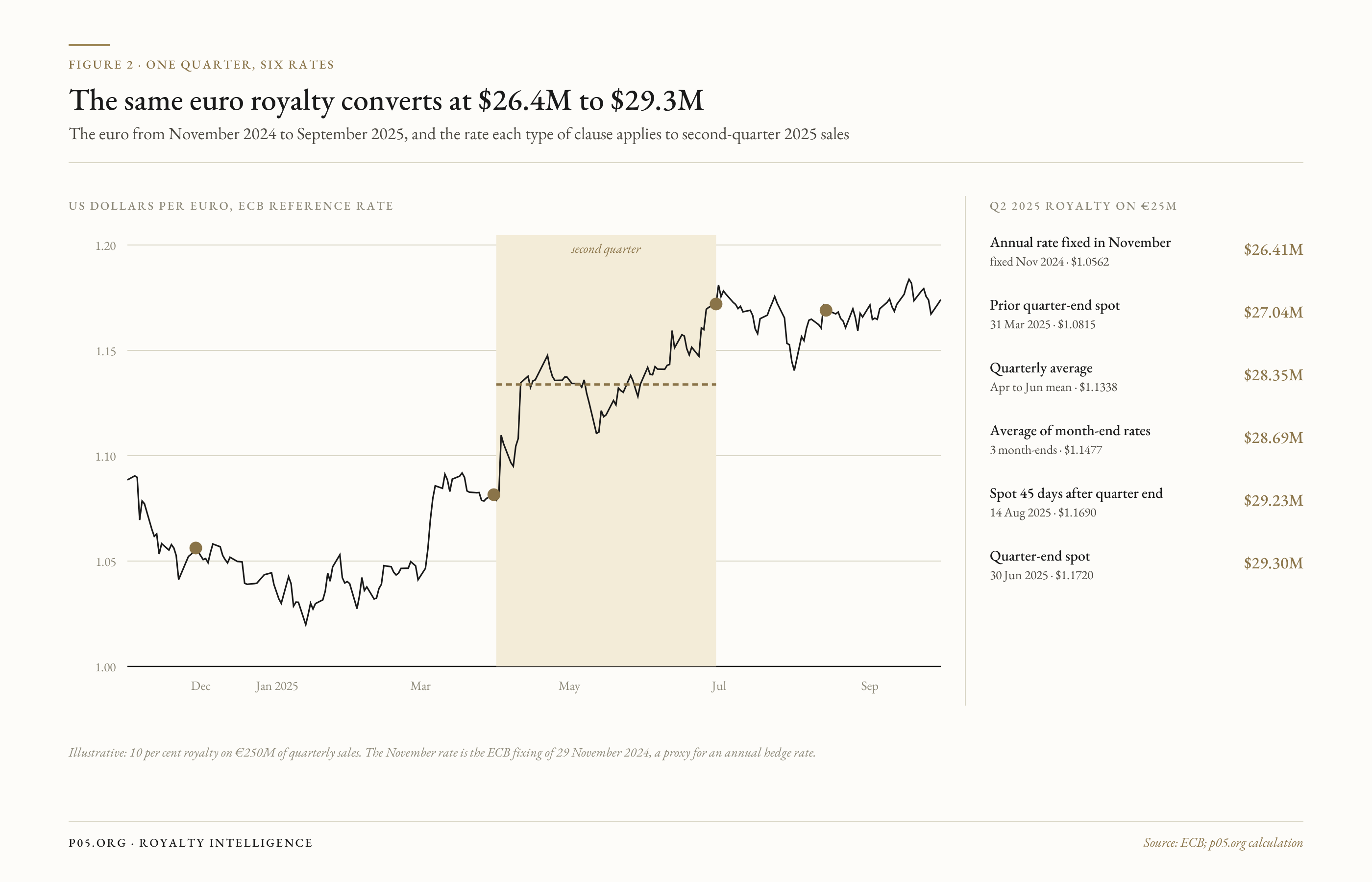
The euro in 2025 and the rate each type of clause applies to second-quarter sales. ECB reference rates, p05.org calculation.
A fixed annual rate behaves like a hedge for the licensee and a lag for the licensor. A holder of a royalty converted at a hedge rate received none of the euro's rise in 2025 until the rate was reset for 2026, and it will give up little of the fall in 2026. The ECB rate stood at $1.1179 on 3 November 2026, below the third quarter's average of $1.1505.
The yen gives a different picture. On ¥40bn of quarterly sales at 10 per cent, the methods differed by at most 0.5 per cent in 2025 and by 2.6 per cent in 2024, when the yen fell past ¥160 to the dollar at the end of June. These are p05.org calculations.
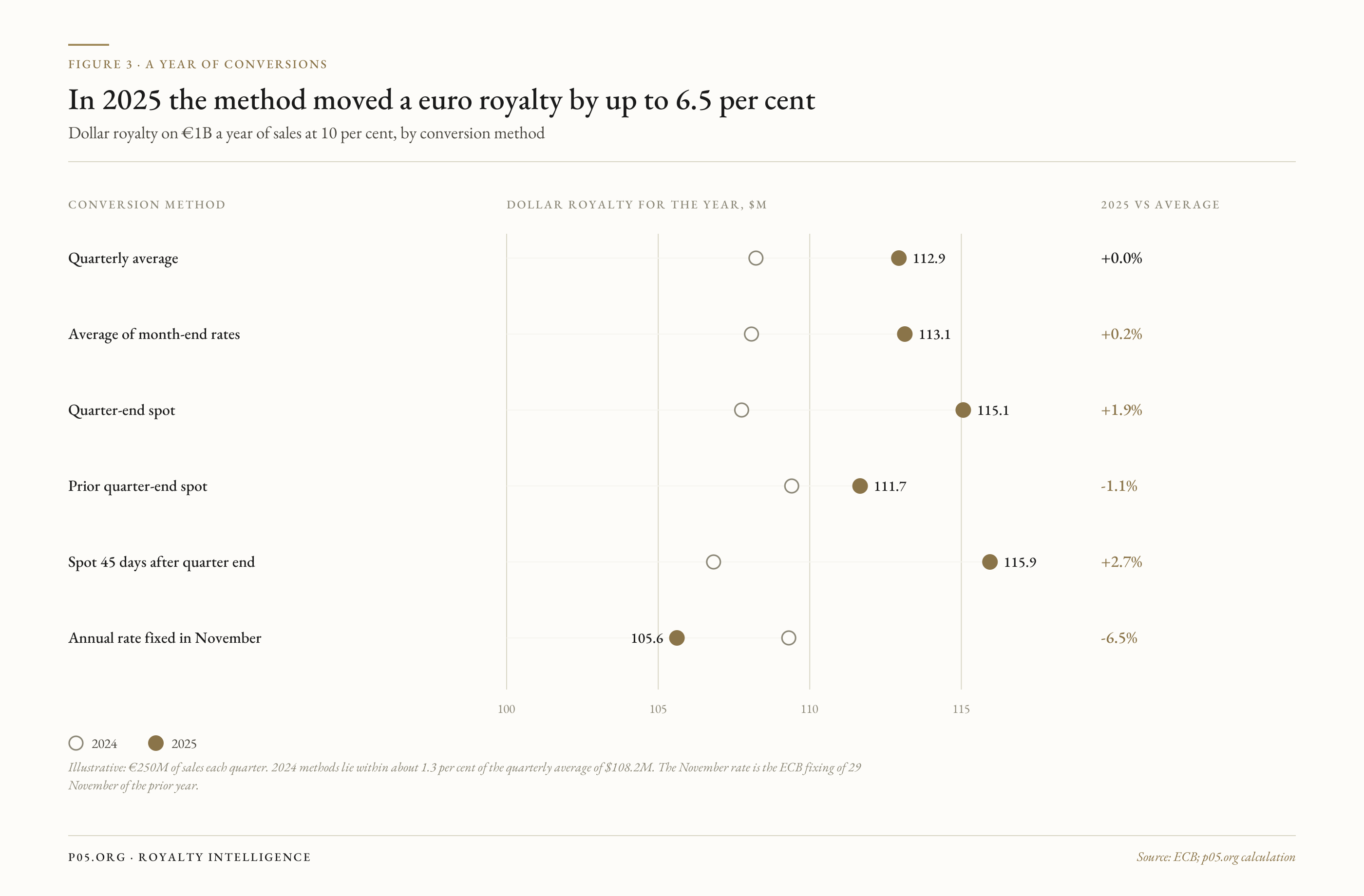
Dollar royalties on €1B a year of sales at 10 per cent, by conversion method, in 2024 and 2025. ECB reference rates, p05.org calculation.
Thresholds in dollars
Currency also moves tiers and milestones that are set in dollars. €900M of annual sales was $974M at the euro's average rate for 2024 and $1,017M at its average for 2025. A sales milestone set at $1B would have been reached in 2025 on euro sales that did not change. A tier that cuts the rate above $1B would have applied in the same year. These are p05.org calculations.
Two licences in the sample avoid the effect by setting thresholds in the currency of sale. One 2026 filing sets Canadian tiers and a milestone in Canadian dollars, and another licence sets its tiers in euros and pays in dollars. A holder of such a stream bears currency risk on the payment but not on the tier.
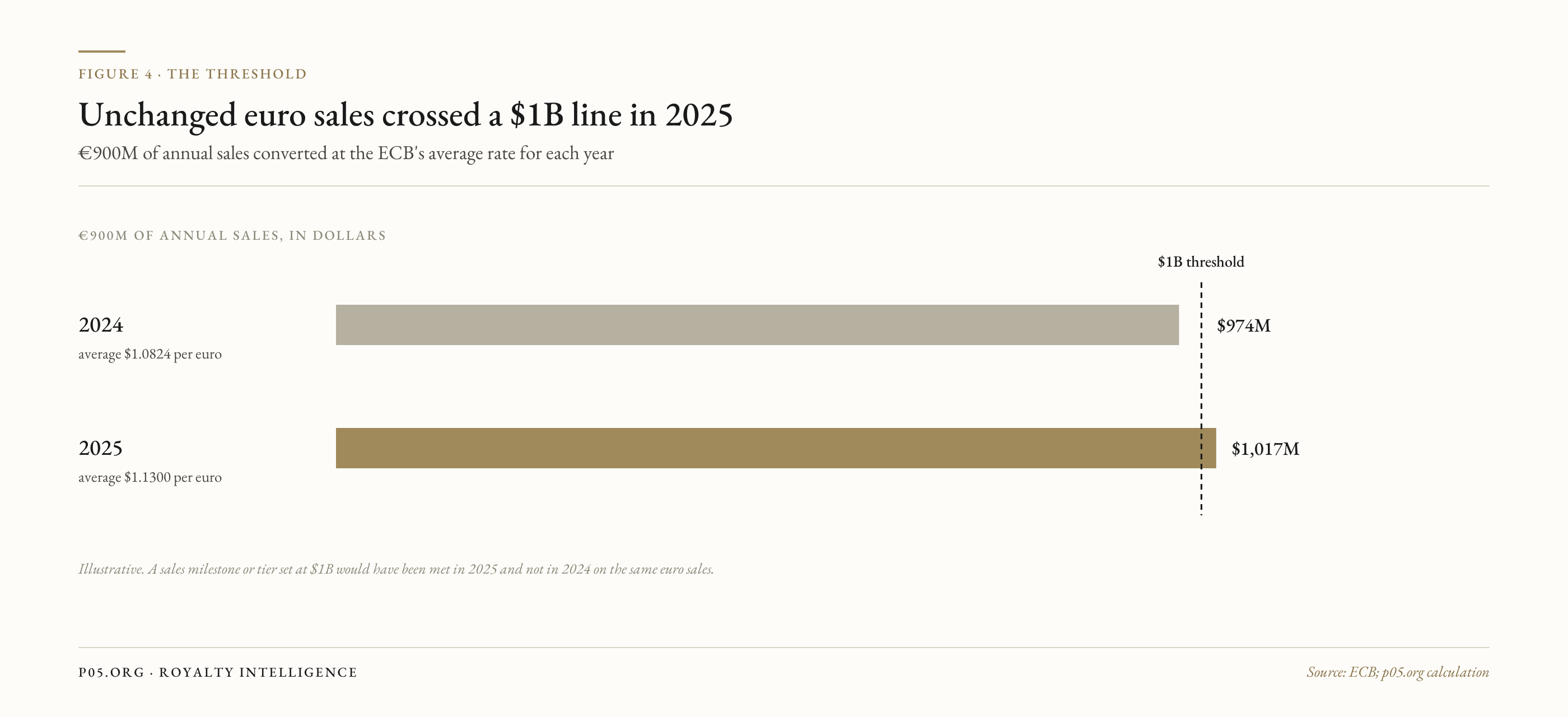
€900M of annual sales converted at the ECB's average rate for each year, against a $1B threshold. p05.org calculation.
What the buyer holds
Royalty purchase agreements rarely add anything. Infinity's 2019 sale to HealthCare Royalty applies the conversion section of the underlying licence to the purchased royalties, and most of the other purchase agreements in the sample define the royalty by reference to the licence.
KalVista's 2024 agreement with DRI, which covers sales by KalVista and its licensees, converts at the rate each uses for its annual financial statements. Zenas' synthetic royalty with Royalty Pharma states that net sales "shall be determined in U.S. dollars". None of the agreements allocates currency risk between buyer and seller. The buyer holds whatever the licence gives the licensor.
A buyer's model usually converts forecast sales at a single rate, often the forward curve or the rate on the pricing date. The licence may convert at a different rate, on a different date, in a different order.
For a stream with a large share of European or Japanese sales, the gap between the model's rate and the clause's rate is a source of variance that an audit will not correct, because the licensee applied the clause as written.
Implications for the Pharmaceutical Royalty Market
Holders should read the conversion clause with the royalty report. A clause that defers to the licensee's accounts changes when the licensee changes its method. A request for the rates used, which most reporting clauses already require, shows whether the method has moved.
The method matters most for streams with heavy ex-US sales and tiers or milestones in dollars. A holder can model a hedge-rate clause as a one-year lag on the currency, a closing-rate clause as exposure to a single day, and a quarterly average as the smoothest of the three.
Buyers can price the difference. In a year like 2025, a fixed-rate clause cost the holder of a euro stream about 6.5 per cent of the royalty against a quarterly average, and a closing-rate clause gained it about 2 per cent. In a year like 2024 the difference was about 1 per cent. Where the clause is redacted, a buyer can ask the seller for the royalty reports, which show the rate applied.
Drafting can remove the choice. A named published source, a stated period and a statement that tiers and milestones are tested on converted dollar sales leave less to the licensee's treasury, and a clause on the order of conversion closes the remaining gap.
Conclusion
The ECB's fixing of $1.1720 on 30 June 2025 reached each royalty holder at a different rate. A holder on a quarter-end clause received it in full, one on a quarterly average received most of it, and one on a hedge rate received none of it until 2026.
All information in this report was accurate as of the research date and is derived from publicly available sources including court opinions, regulatory guidance, academic literature, SEC filings, and financial news reporting. Information may have changed since publication. This content is for informational purposes only and does not constitute investment, legal, or financial advice. The author is not a lawyer or financial adviser.