Fund of the Week: NovaQuest Capital Management
NovaQuest has paid for late-stage trials since its years inside Quintiles. When a trial fails it recovers nothing, and when a drug is approved it collects milestones and royalties up to a cap.

NovaQuest has paid for late-stage trials since its years inside Quintiles. When a trial fails it recovers nothing, and when a drug is approved it collects milestones and royalties up to a cap. Since 2021 its contracts have added minimum payments and fixed dates, and in September it agreed to sell the later part of its largest disclosed royalty.
In the last week of September 2026 the Food and Drug Administration approved Juvmo, AbbVie's name for tavapadon, a once-daily pill for Parkinson's disease. The approval met the condition of a sale agreed a week earlier. DRI Healthcare Trust had offered $316M for royalty participation rights in American sales of the drug, payable at closing, from funds managed by Bain Capital and NovaQuest Capital Management.
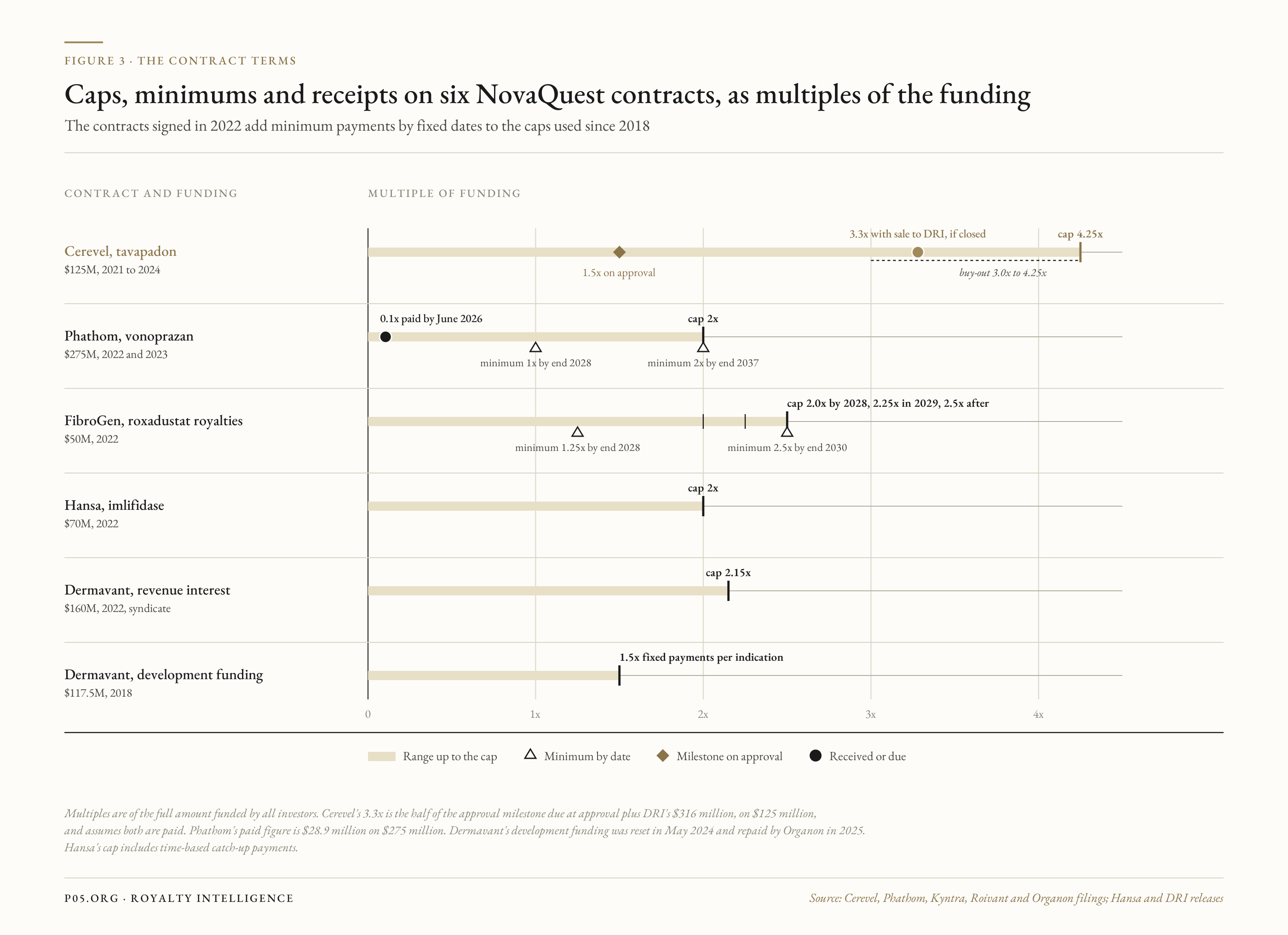
The two funds had paid for the trials. In April 2021 they agreed to give Cerevel Therapeutics $125M for the Phase 3 programme, in four tranches over three years. In return Cerevel owed them 1.5 times their money on approval, sales milestones, and tiered royalties on American sales, all capped at 4.25 times. AbbVie took on the obligation when it bought Cerevel in 2024, and carries it as a liability.
Tavapadon is one of four drugs that NovaQuest funded before approval and that have since been approved in America. The record also holds funded programmes that failed, among them a Pfizer drug for sickle-cell disease for which NovaQuest committed up to $200M and was owed nothing when the trial failed. Its contracts since 2022 also set minimum sums that the company must pay by fixed dates, whatever the product sells.
The Weekly Term Sheet covered the tavapadon sale in week 39 and week 40. This profile covers the firm behind it.
At a Glance
- What it is: a Raleigh investor that funds late-stage clinical trials and launches of drugs in return for milestones and royalties, which it calls Product Finance, and which also invests in animal health
- Manager: NovaQuest Capital Management, L.L.C., spun out of Quintiles in 2010 after a decade as its investment arm, at 4208 Six Forks Road, Raleigh, North Carolina
- Ownership: PharmaBio Development, controlled by Dennis Gillings, the founder of Quintiles, holds 50 to 75 percent, and MBK PharmaPartnering, owned by Mitsui & Co., holds 10 to 25 percent
- Regulatory assets under management: $1.48B across 14 accounts at the March 2026 filing. The firm gives more than $2.5B raised since 2010
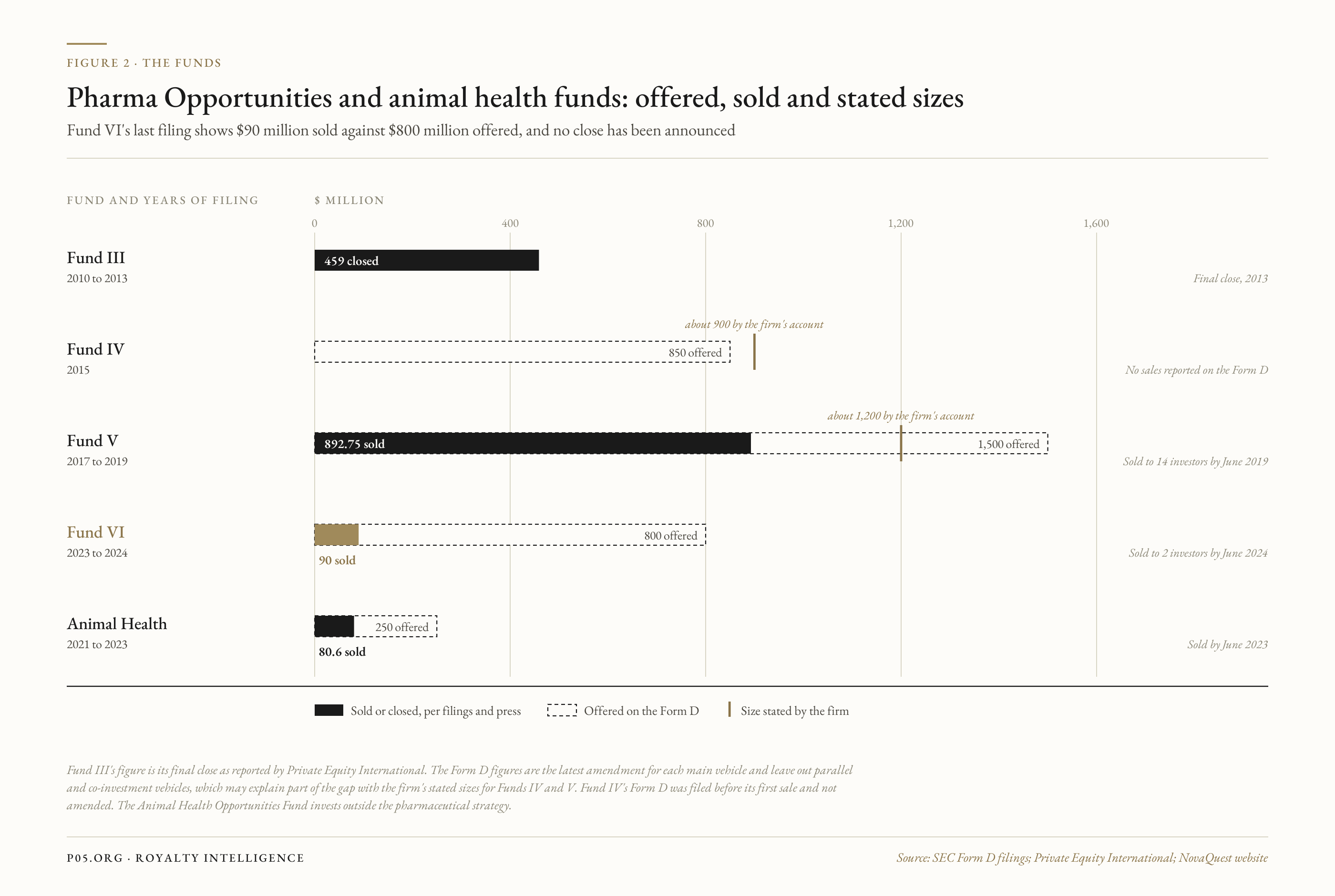
- Pharmaceutical funds: Pharma Opportunities Fund III, $459M in 2013; Fund IV, about $900M by the firm's account; Fund V, $892.75M sold by June 2019; Fund VI, $90M sold against $800M offered at its last filing in June 2024
- Other fund: Animal Health Opportunities Fund, $80.6M sold against $250M offered by June 2023
- Former affiliate: the private equity business, renamed QHP Capital in October 2022 and now a separate adviser
- Leaders: Patrick Jordan, managing partner since April 2021, and Michael Bologna, chief investment officer since July 2023
- Staff: 18 employees, all in investment advisory roles
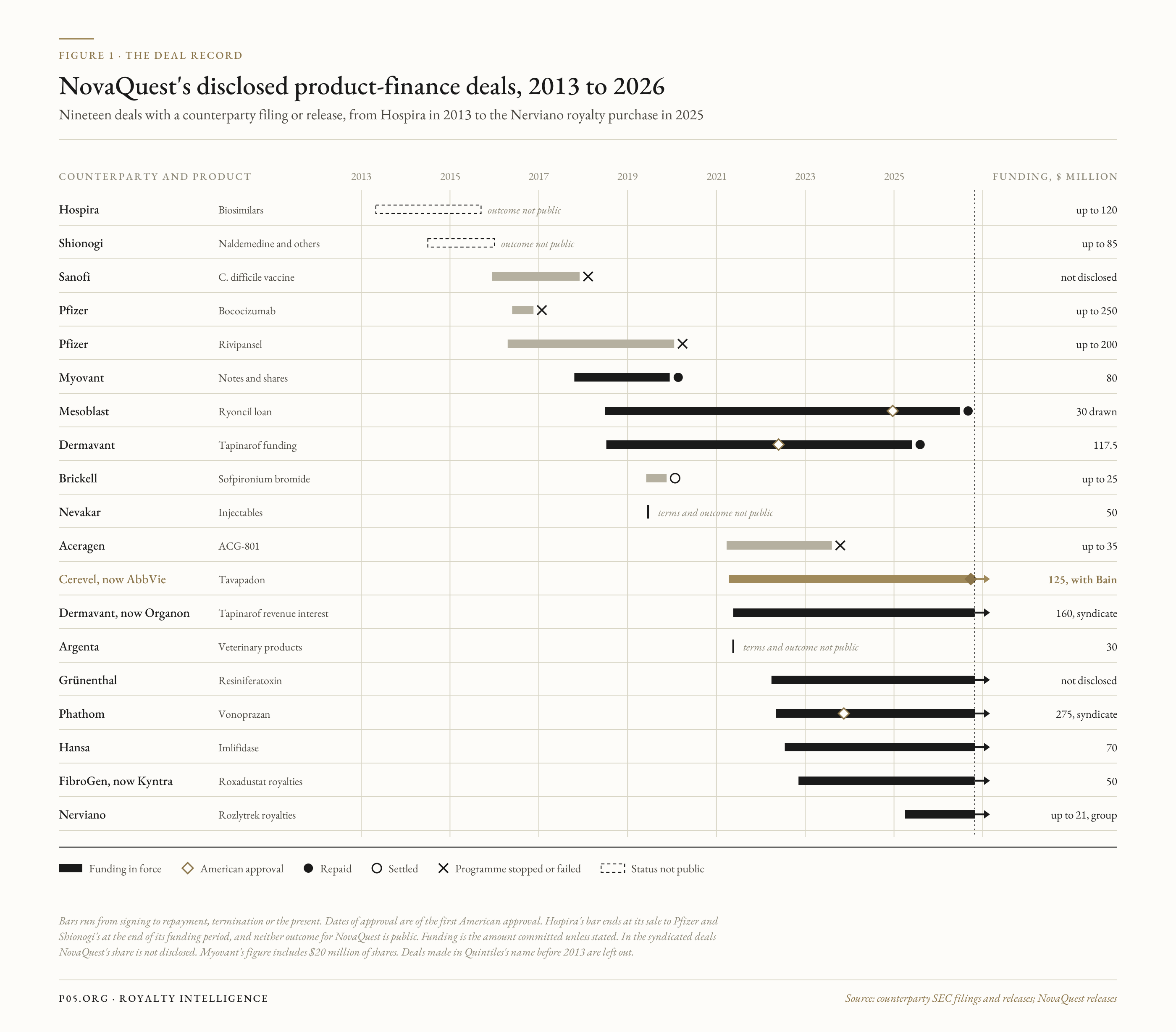
- Disclosed product-finance deals since 2013: 19 with a counterparty filing or release, of which tavapadon, Phathom's vonoprazan, Dermavant's tapinarof, and Mesoblast's Ryoncil reached the American market
- Royalty interests sold: tavapadon, to DRI, agreed in September 2026 and conditional on approval
A Note on Scope
This profile covers the pharmaceutical strategy, run through the Pharma Opportunities funds and through co-investment vehicles formed for single deals. The animal health fund appears where it has a product deal. QHP Capital is left out.
NovaQuest publishes no portfolio and no returns. Deal terms come from the counterparties' filings and releases. In syndicated deals, among them Phathom, the Dermavant revenue interest, and Nerviano, NovaQuest's share of the money is not disclosed. The profile mentions deals made in Quintiles's name before 2013 only where a filing describes them.
The Weekly Term Sheet for week 39 describes the tavapadon sale in more detail, and an October piece on make-whole terms covers Phathom's minimum payments.
Investment Thesis and Mandate
Quintiles, a contract research organisation in North Carolina, began investing in its clients' drugs in 2000. In May 2006 it gave the business the NovaQuest name and reported more than $1.5B invested or committed to such partnerships since 2000. Ron Wooten, its head of corporate development, led it. The team left Quintiles in 2010 and held the first close of Fund III the same year.
The firm describes its strategy as product-based investment in late-stage clinical and commercial programmes. Its founders designed the instrument more than 20 years ago to pay for late-stage trials and launches, and the firm takes no equity and no control. It publishes no target size for an investment and no return cap.
The early deals were of that kind. Pfizer's 2016 agreement on rivipansel had NovaQuest paying about 100 percent of the Phase 3 costs, up to $200M over about 13 quarters. Pfizer would have owed fixed milestones of up to about $267M on approval and sales, and royalties for about eight years. Shionogi took up to $85M in 2014 for naldemedine and other compounds, against success payments on development milestones.
Since 2018 the counterparties have mostly been smaller companies, and the contracts have changed. Mesoblast took a loan repayable from sales, and Dermavant agreed to fixed payments on approval. Phathom, FibroGen, and Hansa owe capped royalties with minimum sums by set dates.
How Capital Enters and Returns
The Pharma Opportunities funds are Delaware partnerships with feeder, parallel, and co-investment vehicles. Fund V's main vehicle reported gross assets of $603.4M for 19 owners at the March 2026 filing, and its Delaware feeder $376.7M for seven. Fund IV's main vehicle held $125.7M for 37 owners. Fund VI held $73.9M for three.
Many deals run through a co-investment fund formed for the purpose. NovaQuest Co-Investment Fund VIII funded Dermavant, Fund XV Aceragen, Fund XVI Cerevel, and Fund XVII the Dermavant revenue interest, according to those companies' filings. A fund usually pays in tranches tied to the trial's progress. At Cerevel the tranches were 25, 30, 25, and 20 percent between April 2021 and April 2024.
At Cerevel a milestone on approval repays a multiple of the funding. At Phathom royalties on sales run until a cap is reached, and at Dermavant a fixed schedule of payments replaced both. If the programme fails or is dropped, the contract usually ends with nothing owed.
Financial Profile and Assets
| Item | Amount | Source and Date |
|---|---|---|
| Regulatory assets under management | $1.48B, 14 accounts | Form ADV, Mar 2026 |
| Capital raised since 2010, firm's figure | more than $2.5B | Firm website, Oct 2026 |
| Pharma Opportunities Fund III, final close | $459M | Private Equity International, Oct 2013 |
| Pharma Opportunities Fund IV, offering | $850M offered | Form D, Jun 2015 |
| Pharma Opportunities Fund V, sold | $892.75M to 14 investors | Form D/A, Jun 2019 |
| Pharma Opportunities Fund VI, sold | $90M of $800M offered, 2 investors | Form D/A, Jun 2024 |
| Animal Health Opportunities Fund, sold | $80.6M of $250M offered | Form D/A, Jun 2023 |
| Cerevel funding, with Bain Capital | $125M | Cerevel 10-Q, 31 Mar 2021 |
| DRI purchase of tavapadon royalty rights | $316M at closing | DRI release, 21 Sep 2026 |
| Phathom revenue interest, all investors | $275M funded | Phathom 10-Q, 30 Jun 2026 |
| Phathom payments to investors | $28.9M | same |
| FibroGen royalty financing | $50M | Kyntra 10-K, 31 Dec 2025 |
| FibroGen liability to NovaQuest | $70.7M | Kyntra 10-Q, 30 Jun 2026 |
| Hansa product financing | $70M, capped at $140M | Hansa release, 18 Jul 2022 |
| Dermavant development funding | $117.5M | Roivant 10-K, 31 Mar 2024 |
| Dermavant revenue interest, all purchasers | $160M, capped at $344M | same |
| Mesoblast loan drawn at closing | $30M | Mesoblast release, 29 Jun 2018 |
| Mesoblast borrowing from NovaQuest | $59.1M | Mesoblast report, 31 Dec 2025 |
| Rivipansel funding, Pfizer | up to $200M | Pfizer annual report, 2019 |
Portfolio Book
Approved and marketed, with outcome: tavapadon (Cerevel, now AbbVie; approved September 2026, royalty rights agreed for sale to DRI); vonoprazan (Phathom; revenue interest outstanding); tapinarof (Dermavant, now Organon; funding agreement repaid in 2025, revenue interest outstanding); Ryoncil (Mesoblast; loan repaid in 2025 and 2026)
Royalty purchases: roxadustat royalties from Astellas (FibroGen, now Kyntra Bio, outstanding); Rozlytrek royalties (Nerviano Medical Sciences, with other investors, 2025)
Awaiting approval: imlifidase (Hansa Biopharma, American decision due 19 December 2026); resiniferatoxin (Grünenthal, Phase 3)
Credit with equity: Myovant notes and shares (2017, repaid December 2019)
Development stopped or failed: rivipansel (Pfizer, 2020); bococizumab (Pfizer, 2016); a Clostridium difficile vaccine (Sanofi, 2017); ACG-801 (Aceragen, which assigned its assets for creditors in 2023)
Terminated by settlement: sofpironium bromide (Brickell Biotech, 2019)
Terms not published: Nevakar injectables (2019); Argenta veterinary products (2021); Hospira biosimilars (2013); Shionogi naldemedine (2014)
Investors
Few investors are named. Quintiles, later IQVIA, committed to three of the funds, according to its filings: $60M to Fund III, later cut to $50M, then $20M to Fund IV and $45M to Fund V, or 7.9 percent of it. PharmaBio, the Gillings company, committed $60M to Fund III and later sold $40M of it.
Fund III's launch release described strategic and corporate cornerstone investors, pension funds, family offices, and a university endowment. No pension board paper or endowment report reviewed for this profile names a commitment to a Pharma Opportunities fund. The Pharma Opportunities Form D filings list Japanese individuals among the related persons of the general partner.
Co-investors appear deal by deal. Bain Capital split the Cerevel funding equally. Sagard and Hercules funded Phathom beside NovaQuest, and Marathon the Dermavant revenue interest. TPG-Axon was Quintiles's partner on the 2008 Lilly deal for two Alzheimer's drugs.
Governance and Team
The Gillings family controls the manager through PharmaBio, and Mitsui holds a minority through MBK PharmaPartnering. The March 2026 Form ADV lists a management committee that includes Ernest Brown and Yoshitaka Oshiba, who joined it in August 2024.
Patrick Jordan, the managing partner, spent about 20 years at Quintiles, was an original member of the NovaQuest unit, and rejoined in 2017. Michael Bologna, the chief investment officer, joined the unit in 2007 from Merck KGaA's American business and Eli Lilly. Ryan Wooten, a managing director, came from Citigroup's healthcare banking group in 2013. Brian Axe, a partner, runs animal health after 15 years at Lilly and Elanco. Robert Hester is chief financial officer.
Regulatory note: The March 2026 Form ADV reports no disciplinary disclosures for the firm, and no SEC order or litigation release naming it has been found.
IP, Royalties and Return Economics
Cerevel, Tavapadon, and the Sale to DRI
The 2021 contract set out the return in stages. On approval Cerevel would pay 1.5 times the funding, or $187.5M, half at once and 12.5 percent a year for four years. Sales milestones and tiered royalties on American sales, at mid single digits to low double digits, would follow. Total payments were capped at 4.25 times, or $531.3M. Cerevel could buy the obligation out from approval or 1 May 2025, at 3.0 times rising to 4.25.
DRI's purchase takes the later part of that schedule. It buys the royalties, the sales milestones, and four annual payments of $23.4M on the first four anniversaries of approval, with its receipts capped at $437.5M. The four payments are the deferred half of the approval milestone. The cap equals $531.3M less $93.75M, the half paid on approval, which by this reading stays with Bain and NovaQuest.
On that reading, and if the sale closes and AbbVie pays the first half of the milestone, the two funds receive about $409.8M on $125M, or 3.3 times, between April 2021 and closing. If the split is equal, NovaQuest's share is about $204.9M on $62.5M. No filing yet confirms the payment or the closing.
Phathom and the Minimum Payments
Phathom's 2022 agreement brought up to $260M from NovaQuest, Sagard, and Hercules, $100M at signing and $160M on approval of vonoprazan in erosive oesophagitis. An additional investor later took the total funded to $275M. The investors receive 10 percent of net sales, stepping down above annual thresholds, until they have 2.0 times their money. Phathom must pay at least 1.0 times by the end of 2028 and 2.0 times by the end of 2037. By 30 June 2026 it had paid $28.9M.
FibroGen and the Roxadustat Royalty
FibroGen, renamed Kyntra Bio, sold NQ Project Phoebus, L.P. a share of the royalties that Astellas pays it on roxadustat in Europe and Japan. For $50M NovaQuest takes 22.5 percent of that revenue and 10 percent of Astellas milestones, rising to 20 percent from 2028. Its receipts stop at $100M if reached by the end of 2028, $112.5M in 2029, and $125M after that. Kyntra must pay at least $62.5M by the end of 2028 and $125M by the end of 2030. It carried the liability at $70.7M at 30 June 2026.
Hansa and the Approval Still Pending
Hansa took $70M in July 2022 for imlifidase, a treatment for patients who are highly sensitised before a kidney transplant. NovaQuest receives a mid-single-digit royalty on worldwide sales and milestones on American approval, capped at $140M, with time-based catch-up payments. In July 2025 the two restructured the debt. Hansa issued shares to settle $14.9M and owes the rest in fixed instalments in June 2027, 2028, and 2029. The FDA has set 19 December 2026 for its decision.
Dermavant and Mesoblast
Two deals of 2018 closed on terms other than royalties. NovaQuest gave Dermavant $117.5M for tapinarof in return for fixed payments of $176.3M for each approved indication, paid quarterly over six years. Psoriasis was approved in May 2022. In May 2024 the parties removed the payments for atopic dermatitis and $141M of sales milestones, and set the remaining obligation at $122.5M. Organon, which bought Dermavant that October, repaid the agreement in 2025 and recorded a gain of $4M on a balance of $103M.
Mesoblast drew $30M of an eight-year loan in June 2018, with interest of 15 percent deferred until first sale and repayment limited to 25 percent of paediatric sales of Ryoncil. Ryoncil went on sale in March 2025. Mesoblast repaid $25M in December 2025 from a new facility and drew $50M more in June 2026 to repay the rest.
Absent from the Surveys
NovaQuest is not named in Gibson Dunn's 2026 royalty market update, which covers 133 transactions from 2020 to 2025, or in the firm's report on 2020 to 2024. Most NovaQuest contracts fund development before approval. The FibroGen and Nerviano deals are purchases of royalties on products already on sale.
Blue Team
- Four funded drugs approved in America since 2022: tapinarof, vonoprazan, Ryoncil, and tavapadon
- A buyer for its largest royalty within a week of approval, at $316M for the later part of a contract funded with $125M
- Repayments in full from Myovant in 2019, from Organon in 2025, and from Mesoblast in 2026
- Minimum payments by fixed dates at Phathom and FibroGen, which return capital if sales are slow
- Counterparties that include Pfizer, Sanofi, Shionogi, AbbVie, and Grünenthal
- A record that runs from 2000, with one owner group since the spin-out and no disciplinary disclosures
- Co-investment vehicles beside the main funds, such as the $75M Fund IV co-investment vehicle, and single-deal funds used at Cerevel and Dermavant
Red Team
- No fund return is published, and the firm's own figures for Funds IV and V, about $900M and $1.2B, are higher than the sums in their Form D filings
- Fund VI's last Form D shows $90M sold against $800M offered, and no close has been announced
- Development funding carries the trial risk. Rivipansel failed in Phase 3 after up to $200M, and Lilly's two Alzheimer's drugs funded in 2008 failed
- Aceragen assigned its assets for creditors in 2023 with NovaQuest as first-lien holder, and Brickell's funding ended in a dispute and a settlement in 2019
- Dermavant's payments were cut in 2024 when the atopic dermatitis indication and the sales milestones were removed
- Phathom had paid $28.9M on $275M by June 2026, against a minimum of 1.0 times by the end of 2028
- Hansa's American decision is due in December, after a restructuring that converted part of the debt to shares
- The DRI sale had not been confirmed as closed by late October, and NovaQuest's share of the syndicated deals is undisclosed
Implications for the Pharmaceutical Royalty and Biotech Capital Markets
Tavapadon shows how a development fund can hand its position to a royalty fund. NovaQuest and Bain took the trial risk from 2021 to 2026. On approval they keep the first half of the milestone and sell the rest of the schedule, which now depends on sales, to a buyer that prices launches. DRI pays for a stream with a cap of $437.5M and four fixed payments from AbbVie at its front.
The funds paid $125M for a contract whose total cap was $531.3M. Five years later the part of it that remained after approval sold for $316M. DRI's cap of $437.5M is 1.38 times its price, and how fast it reaches the cap depends on sales.
NovaQuest's newer contracts sit between a royalty and a loan. At Phathom and FibroGen the investor receives a share of sales up to a cap. The company must also pay fixed minimums by set dates, which makes part of the return independent of sales. A royalty buyer reviewing such a contract would price the floor as credit on the company and the royalty above it as exposure to the product.
Under the older contracts a failed programme cost the investor what it had paid. When Pfizer stopped rivipansel, NovaQuest recovered nothing. When Dermavant's second indication was dropped, its fixed payments were renegotiated down. The minimum-payment clauses written since 2022 change what an investor recovers in those cases, and they make the company a debtor if sales are slow.
Fund VI's last filing records $90M of an $800M offering. The firm has made one new pharmaceutical deal in the public record since 2023, the Nerviano royalty purchase of 2025, and it has realised Cerevel, Dermavant, and Mesoblast in the same period.
Recent Developments
- The FDA approves tavapadon as Juvmo for Parkinson's disease in the last week of September 2026
- DRI Healthcare agrees to buy tavapadon royalty rights from Bain Capital and NovaQuest funds for $316M on 21 September 2026
- Mesoblast draws $50M to repay the rest of its NovaQuest debt in June 2026
- The FDA accepts Hansa's application for imlifidase on 18 February 2026, with a decision due on 19 December
- Mesoblast repays $25M of its NovaQuest debt from a new facility on 30 December 2025
- Hansa restructures its NovaQuest financing, settling $14.9M in shares, on 17 July 2025
- Organon repays the Dermavant funding agreement in the second quarter of 2025
- Nerviano sells part of its Rozlytrek royalties for up to $21M to investors including NovaQuest on 31 March 2025
- No new Pharma Opportunities fund close has been announced since Fund V
Financial History and Recent Developments
| Date | Event |
|---|---|
| 2000 | Quintiles begins investing in clients' drugs |
| May 2006 | Quintiles names its partnering group NovaQuest |
| Jul 2008 | Lilly deal on two Alzheimer's drugs, with TPG-Axon |
| 2010 | Spin-out from Quintiles, first close of Fund III |
| Apr 2013 | Hospira biosimilars, up to $120M |
| Oct 2013 | Fund III closes at $459M |
| 2014 | Shionogi, up to $85M |
| Jun 2015 | Fund IV files its Form D, $850M offered |
| Dec 2015 | Sanofi Clostridium difficile vaccine, ended 2017 |
| Apr 2016 | Pfizer rivipansel, up to $200M |
| May 2016 | Pfizer bococizumab, up to $250M, ended November 2016 |
| Jun 2017 | Fund V files its Form D, $1.5B offered |
| Oct 2017 | Myovant notes and equity, repaid December 2019 |
| Jun 2018 | Mesoblast loan, $30M drawn |
| Jul 2018 | Dermavant development funding, $117.5M with October amendment |
| Jun 2019 | Fund V Form D shows $892.75M sold, Brickell funding of up to $25M, Nevakar, $50M |
| Jan 2020 | Rivipansel discontinued after Phase 3 |
| Apr 2021 | Cerevel, $125M with Bain Capital, Aceragen, up to $35M |
| May 2021 | Dermavant revenue interest signed, Argenta, $30M |
| Mar 2022 | Grünenthal resiniferatoxin |
| May 2022 | Phathom, up to $260M with Sagard and Hercules, tapinarof approved |
| Jul 2022 | Hansa, $70M |
| Oct 2022 | Private equity business renamed QHP Capital |
| Nov 2022 | FibroGen roxadustat royalties, $50M |
| Apr 2023 | Fund VI first sale |
| Aug 2023 | Aceragen assigns its assets for creditors |
| May 2024 | Dermavant obligation reset at $122.5M |
| Jun 2024 | Fund VI Form D/A, $90M sold |
| Mar 2025 | Nerviano Rozlytrek royalties, up to $21M |
| 2025 | Organon repays the Dermavant funding, Hansa restructuring |
| Dec 2025 | Mesoblast repays $25M |
| Jun 2026 | Mesoblast repays the rest |
| 21 Sep 2026 | DRI agrees to buy tavapadon royalty rights for $316M |
| Sep 2026 | Tavapadon approved as Juvmo |
| 19 Dec 2026 | FDA decision due on imlifidase |
Conclusion
NovaQuest has funded drug development for 26 years, first inside Quintiles and since 2010 through its own funds. The record shows four disclosed programmes approved in America since 2022 and several funded programmes that failed. The firm holds no equity in its counterparties and recovers its money through milestones, royalties, and fixed payments.
The contracts have changed with the counterparties. Pfizer and Shionogi took development money against success payments. Phathom, FibroGen, and Hansa took capital that they must repay at minimum sums by set dates, whatever their products sell.
Tavapadon's approval in September makes the first half of the Cerevel milestone due to Bain and NovaQuest. If AbbVie pays it and DRI's purchase closes, the rest of the schedule passes to a royalty fund, and the two funds will have received about 3.3 times the $125M they paid in 2021 and after.
All information in this report was accurate as of the research date and is derived from publicly available sources including court opinions, regulatory guidance, academic literature, SEC filings, and financial news reporting. Information may have changed since publication. This content is for informational purposes only and does not constitute investment, legal, or financial advice. The author is not a lawyer or financial adviser.