
The instrument set: what royalty capital was written as in 2025 and 2026
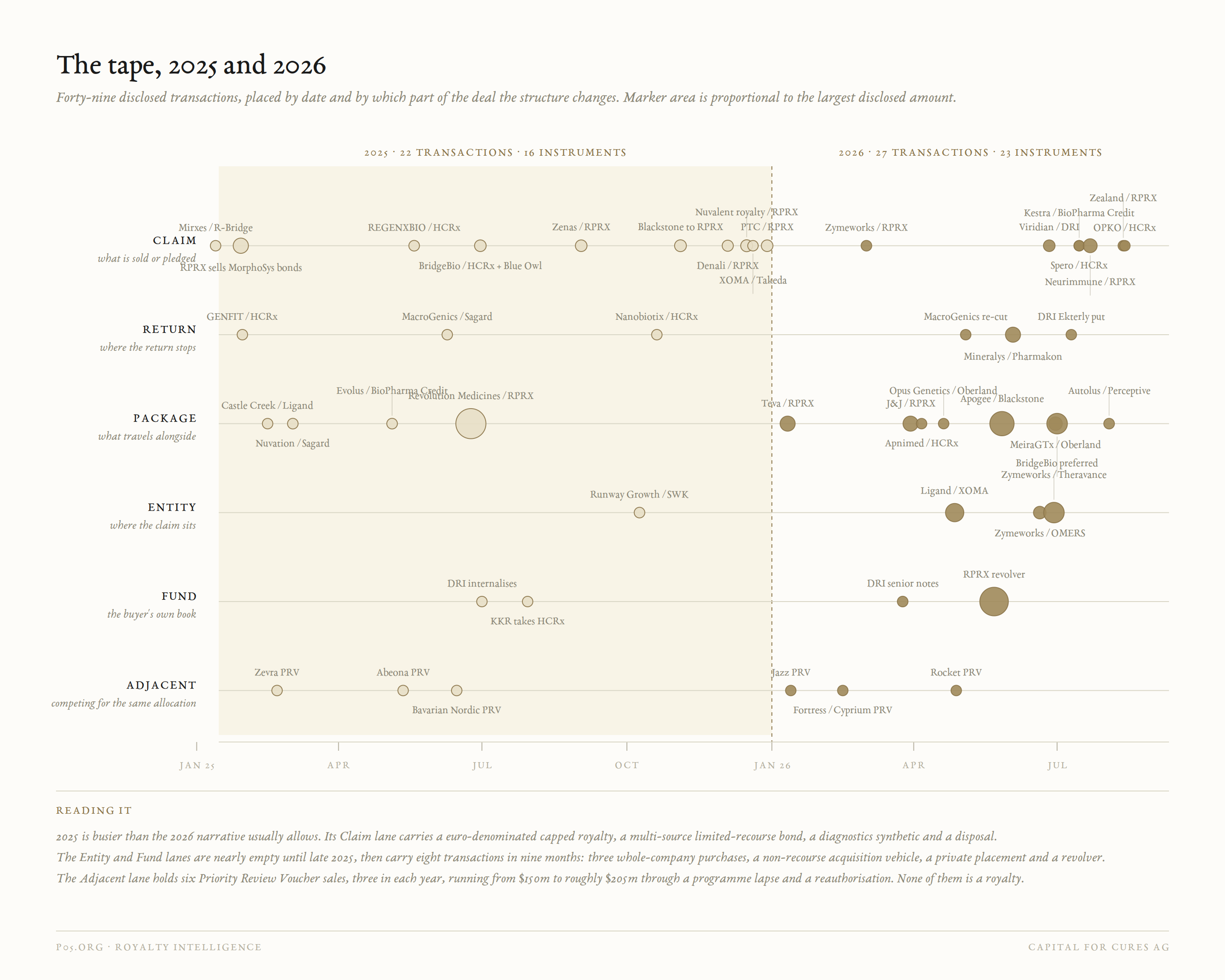
Two years, forty-nine transactions, thirty-four structures. In 2025 the market did its volume in a converging form. In 2026 it wrote fifteen things it had not written the year before, and each one removes a specific blockage rather than adding a flourish.

The buyer map sorts the market by who writes the cheque. The recourse ladder sorts the 2026 cohort by how much of the borrower stands behind the money. This is the instrument catalogue and the tape behind it.
The baseline is measured, and it describes convergence. Covington's third annual monetisation study covers 54 transactions from 2019 through 2025 at a $15 million threshold, with 16 unique investors, a median upfront of $131 million, a median commitment of $200 million, and a median capped multiple of 2.13 times against a range of 1.3 to 3.4 times, with 44 percent capped, 52 percent uncapped and 4 percent capped with a tail. Gibson Dunn's tracker counts 133 transactions from 2020 through 2025, annual value rising from $5.2 billion to $7.1 billion, deal count stable at 25 to 27 a year, median deal size $221 million in 2025, true sales at 71 percent of synthetic deals and 91 percent of synthetic value in 2024 and 2025, and a median cap on capped synthetics of 1.9 times within a 1.43 to 4.0 range.
The largest buyer's published taxonomy lists four partnership types: existing royalties, synthetic royalties, launch and development funding, and facilitating M&A.
The short version
- 2025 was a volume year in a standard form. Four synthetic true sales from one buyer, a flat-cap purchase, a territory split, two royalty-plus-loan packages. Ten structures printed that year and have not printed since.
- 2026 wrote fifteen instruments with no 2025 precedent. The retained sliver, the limited-recourse royalty note, the buy-back option, the buyer's change-of-control put, the debt-funded repurchase, the mid-market credit-plus-synthetic facility, R&D co-funding with large pharma, structured preferred, the IRR floor, enrolment tranching, the guaranteed subsidiary issuer, the non-recourse acquisition vehicle, the whole-company acquisition, the fund-level private placement and the fund-level revolver.
- Eight instruments span both years and are the working set. Partial pledge, dated cap ladder, synthetic true sale, flat cap, royalty plus equity strip, rate schedule zeroing out, the PRV monetisation, and the synthetic royalty written outside biopharma.
- The regulatory-asset sale is now the second most repeated structure on the tape. Six Priority Review Voucher sales printed across the two years at $150m to $205m, through a programme lapse and a reauthorisation, without a royalty, a cap or a coupon between them.
- Each 2026 addition answers a blockage. Consent-blocked streams, fund-life duration, covenant floors, the liability line, assets not for sale individually, the buyer's own exit, and its cost of funds.
- The counter-current is in the same data. The instrument at the centre is standardising while its periphery diversifies. A third of the catalogue has one disclosed example.
Five coordinates
Every instrument below is profiled on the same fields. They are close to independent, which is why the set grew faster than the deal count.
- Attaches to. A whole stream, a fraction of one, product sales, a basket of contracts, or a company. Sets the diligence and the comparables.
- Sits. Above the liabilities as a first claim on gross sales, inside them as a deferred royalty obligation, below them as junior equity, at a subsidiary, or at the fund. Sets the accounting and the ranking.
- Recourse. Full, limited, or none. Sets the price, on the ordering the recourse ladder established.
- Stops at. Never, a multiple, a dated multiple, a rate of return, or a sales threshold in the rate schedule. Sets the duration, and whether a finite-life fund can recycle.
- Answers. The constraint the instrument removes. This is the field that explains why 2026 looks the way it does.
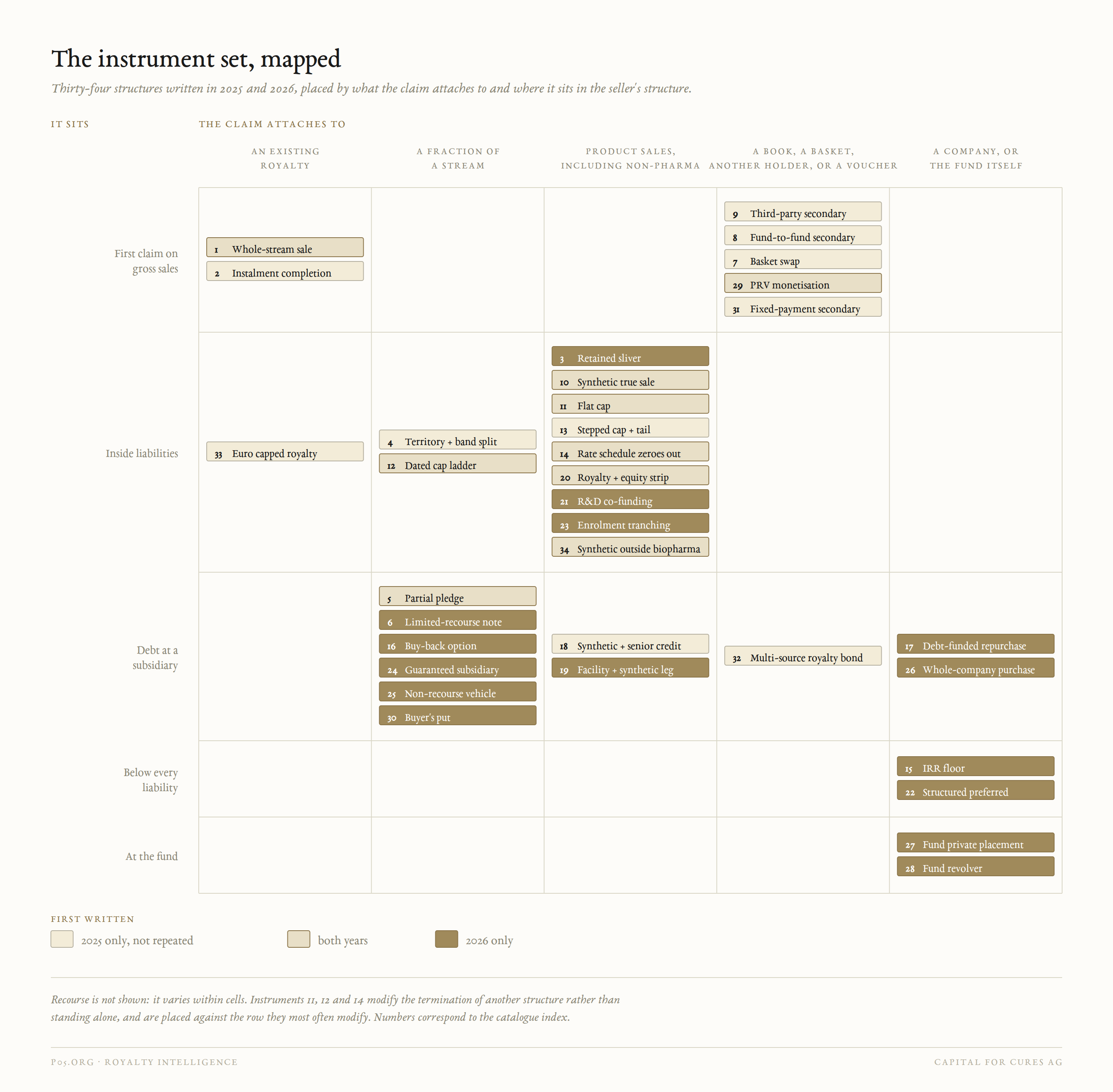
Figure 1. The instrument set on five coordinates. Each structure placed by what it attaches to and where it sits, with recourse encoded by shade. Instruments first written in 2026 are marked; those with a single disclosed example are outlined rather than filled.
The index
| # | Instrument | Attaches to | Sits | Recourse | Stops at | 2025 | 2026 | Status |
|---|---|---|---|---|---|---|---|---|
| 1 | Whole-stream true sale | Existing royalty | Off BS for a passive holder | None | Never, or a multiple | Several | 1 | Category |
| 2 | Instalment completion | Part of a partly sold stream | Off BS | None | Final tranche | 1 | 0 | Emerging |
| 3 | Near-total sale, retained sliver | Product economics above a threshold | Liability | None | Threshold | 0 | 1 | Single |
| 4 | Territory and sales-band split | Fraction of a territory inside a band | Liability | None | Multiple | 1 | 0 | Category |
| 5 | Partial-percentage pledge | Defined fraction of a stream | Debt at a subsidiary | None | Dated multiple | 1 | 2 | Category |
| 6 | Royalty-secured note, limited recourse | Whole stream until repaid | Debt | Limited | Repayment, then reversion | 0 | 2 | Emerging |
| 7 | Basket swap | Contracts in a licensor's book | Not applicable | None | Each contract | 1 | 0 | Single |
| 8 | Fund-to-fund secondary | A royalty already held by a fund | Not applicable | None | Inherits | 1 | 0 | Emerging |
| 9 | Third-party secondary, unapproved assets | Pre-existing royalty, undisclosed holder | Not applicable | None | Inherits | 1 | 0 | Single |
| 10 | Synthetic royalty, true sale | The seller's own product sales | Liability | None | Multiple or rate schedule | 4 | 1 | Category |
| 11 | Flat cap | As underlying | As underlying | As underlying | A multiple, undated | Several | Several | Category |
| 12 | Dated cap ladder | As underlying | As underlying | As underlying | Multiple stepping on dates | 2 | 2 | Category |
| 13 | Timing-stepped cap with tail | Milestones and royalties | Liability | None | Multiple by timing, then a tail | 1 | 0 | Emerging |
| 14 | Rate schedule zeroing out | Product sales | Liability | None | A sales threshold | 2 | 1 | Emerging |
| 15 | IRR floor on redemption | The company | Below every liability | Full but junior | A rate of return | 0 | 1 | Single |
| 16 | Buy-back option | A stream | Debt at a subsidiary | Limited | Company repurchase | 0 | 1 | Emerging |
| 17 | Debt-funded royalty repurchase | Removing a licensor's claim | Corporate secured debt | Full | Loan amortisation | 0 | 1 | Single |
| 18 | Synthetic plus syndicable senior credit | Product sales and product assets | Split across the stack | Full on the loan leg | Multiple, and amortisation | 2 | 0 | Category |
| 19 | Credit facility with synthetic component | Product sales and product assets | Split | Full on the facility | Tranche schedule | 0 | 2 | Emerging |
| 20 | Royalty plus equity strip | Product sales plus common stock | Split | None on the royalty leg | Multiple, plus equity | 1 | 1 | Category |
| 21 | R&D co-funding with large pharma | A programme in development | Contra-R&D for the funded party | None | Royalty on approval | 0 | 2 | Emerging |
| 22 | Structured convertible preferred | The company | Below every liability | Full but junior | IRR floor or redemption ladder | 0 | 1 | Single |
| 23 | Tranching against enrolment and data | A pre-Phase 3 programme | Liability | None | Rate schedule and term | 0 | 1 | Single |
| 24 | Subsidiary issuer, obligor guarantees | Three product royalties | Debt at a subsidiary, guaranteed upward | Full via guarantees | Capped, with buy-back | 0 | 1 | Emerging |
| 25 | Non-recourse vehicle funding an acquisition | A profit share | Debt at an acquirer's subsidiary | None to the acquirer | Repayment | 0 | 1 | Single |
| 26 | Whole-company acquisition | A company and its book | Acquirer's balance sheet | Full | Not applicable | 0 | 3 | Category |
| 27 | Fund-level fixed-rate private placement | The fund's portfolio | Fund liabilities | Full at the fund | Maturity | 0 | 1 | Single |
| 28 | Fund-level revolver, portfolio cash flow covenant | The fund's portfolio | Fund liabilities | Full at the fund | Maturity | 0 | 1 | Category |
| 29 | Priority Review Voucher monetisation | A transferable regulatory asset | Not applicable | None | On sale; there is nothing after | 3 | 3 | Category |
| 30 | Buyer's change-of-control put | A stream the buyer already holds | As underlying | As underlying | The put price | 0 | 1 | Single |
| 31 | Secondary sale of fixed development-funding payments | Fixed contractual payments, not sales | Not applicable | None | The remaining schedule | 1 | 0 | Single |
| 32 | Multi-source limited-recourse royalty bond | Royalties, milestones and platform fees across several licensees | Debt | Limited | Principal and accrued interest | 1 | 0 | Single |
| 33 | Capped royalty denominated in euros | An existing royalty on a European asset | Liability | None | A cumulative cap stepping on dates | 1 | 0 | Single |
| 34 | Synthetic royalty outside biopharma | Device or diagnostic product revenue | Liability or debt | None to limited | Multiple or repayment | 1 | 1 | Emerging |
Counts are disclosed transactions in this catalogue, not the whole market: instruments 1, 10 and 11 print many times a year and are marked "Several" where the catalogue samples rather than enumerates. Instruments 29 to 34 sit at the edge of the asset class and are catalogued because a royalty desk competes for the same capital, not because they are royalties. Status: Category means three or more disclosed examples across different counterparties over the two years. Emerging means two. Single means one, and is a data point rather than a market.
The tape
2025
2026
What the two tapes say
2025 was a volume year in a standard form. Read the first table straight through and the pattern is a market doing its ordinary business well. Four synthetic true sales, all from one buyer. A flat-capped purchase of a third-party royalty. A territory split. Two royalty-plus-loan packages, one of them the largest of the period.
The exceptions cluster at the edges rather than the centre, and there are more of them than the 2026 narrative usually allows. A basket swap with a licensor. A secondary bought from an undisclosed holder on unapproved assets. A euro-denominated capped royalty on a French issuer's stream. A limited-recourse bond serviced by royalties, milestones and platform licence fees across three separate licensees. A synthetic royalty written on a Singaporean diagnostics company.
And a buyer selling, rather than buying, when Royalty Pharma monetised the remaining fixed payments on the MorphoSys Development Funding Bonds for $511 million at a 5.35 percent discount rate. The bonds behind that last one were bought in September 2022, so the 2025 event is the exit. It sits on the tape as a disposal.
The pressure was building inside that year. What set up 2026 happened in 2025 and had nothing to do with instruments. KKR took majority control of HCRx in July, placing a royalty book inside an asset-based finance platform whose mandate is credit. DRI internalised its manager on 1 July and Royalty Pharma completed its own internalisation, removing a fee layer from two of the largest bids.
And the marketed centre kept crowding, to the point that the buyer map records DRI describing its own pipeline as skewed pre-commercial.
By the end of 2025 stage had stopped being an edge. The frontier had already moved through Phase 3 and, in May 2026, to pre-Phase 3. When stage stops differentiating and price is competitive, the remaining variable is structure.
2026 is what that produced. Fifteen instruments in this catalogue have their only disclosed examples in 2026. Reading them as invention misses the point. Each answers a constraint that was already there and had been costing deals.
- The seller will not, or cannot, part with the stream. Covington finds 70 percent of underlying licences require consent for assignment of payment rights and 37 percent for information sharing, with consents specified as obtained in only 40 percent of cases. The UCC section 9-406 override reaches the payment right and not the confidentiality provision. The answers are the partial pledge (5), the limited-recourse note with reversion (6), the buy-back option (16) and the retained sliver (3). All four leave the seller as counterparty of record.
- The fund needs capital back on a date it can model. An uncapped royalty is a hold whose duration is set by patent life. The answers are the dated cap ladder (12) and, at the extreme, the IRR floor (15), which replaces a multiple with a rate of return.
- The seller's balance sheet gets a liability whichever document is signed. The balance-sheet piece established that for an operating company the default is a deferred royalty obligation. The answer, and the only one on the tape, is the structured preferred (22), which escapes the line on two omissions: no holder put and no scheduled maturity.
- The asset is not for sale individually. The answers are the whole-company acquisition (26), used three times in 2026, and the CVR that carves out what the acquirer does not want.
- The buyer wants an exit it controls rather than one the product delivers. The answer is the change-of-control put (30), which DRI exercised on its Ekterly participation right in July 2026 at approximately $178 million, a stated 1.5x return and a high-20s IRR, triggered by Chiesi's acquisition of KalVista. It is the mirror of the buy-back option at 16: there the company holds the option, here the buyer does.
- The buyer's own cost of funds sets its bid. The answers are the fund-level private placement (27) and the revolver with a portfolio cash flow covenant (28).
Ten 2025 instruments have not repeated. Instalment completion, the basket swap, the fund-to-fund secondary, the third-party secondary, the timing-stepped cap with a tail, the territory and sales-band split, the royalty-plus-syndicable-credit package, the euro-denominated capped royalty, the multi-source limited-recourse bond, and the development-funding-bond secondary. Some of those are absence of occasion rather than abandonment: a fund-to-fund secondary needs a fund that wants to sell, and a development-funding-bond secondary needs a licensee to be acquired.
Eight instruments span both years and are the working set. The partial pledge, the dated cap ladder, the synthetic true sale, the flat cap, the royalty-plus-equity strip, the rate schedule that zeroes out, the Priority Review Voucher sale and the synthetic royalty written outside biopharma. A seller asking for one of these is asking a buyer to adapt a precedent. A seller asking for anything in the 2026-only list is asking one to draft.
One structure ran through both years without being a royalty. Six Priority Review Vouchers changed hands between February 2025 and April 2026, at $150 million, $155 million, $160 million, $180 million, $200 million and roughly $205 million. There is no cap, no coupon and no reversion in any of them. It sits in this catalogue because it competes for the same allocation on the same balance sheets, and because its price moved through a programme lapse and a reauthorisation while every royalty structure on the tape was being negotiated on cash-flow terms.
The counter-current runs through all of it and comes from the same dataset. True sales at 71 percent of synthetic deals and 91 percent of value, capped synthetics clustering at a 1.9 times median, deal count stable at 25 to 27 a year. The instrument at the centre is converging while its periphery diversifies. On a two-year window, a fifteen-to-ten split is consistent with a market adding formats faster than it retires them, and equally consistent with a run of one-off drafting that will not recur. The 2027 tape decides which.
Instruments that change the claim
The unit of trade used to be a stream in a covered territory. Five of the ten instruments below cut it smaller, and four of those five reach the same result by a different route: the seller keeps something, and stays in the contract. That is the family the consent problem produced.
1. Whole-stream true sale
Attaches to a licensor's existing royalty · Sits off balance sheet for a passive holder · Recourse none · Stops at never, or a multiple · Seen at $100m to $1bn+ · Used 2026 ×1 in this catalogue, many times a year in the market · Category
The baseline. A licensor sells its entitlement outright and the buyer holds product risk.
- Neurimmune / Royalty Pharma, 22 Jul 2026. Up to $425 million including $125 million upfront for a portion of the royalty interest in AstraZeneca's cliramitug.
Answers nothing; it is the baseline the rest depart from. Costs the seller the tail, and, where uncapped, every dollar the product ever pays.
2. Instalment completion
Attaches to part of a stream already partly sold · Sits off balance sheet · Recourse none · Stops at the final tranche · Seen at $100m to $300m · Used Dec 2025 ×1 · Emerging
Buying a stream in pieces across separate agreements and years, rather than in one transaction.
- PTC Therapeutics / Royalty Pharma, 29 Dec 2025. $240 million upfront and up to $60 million in sales-based milestones for the final portion of the remaining Evrysdi royalty.
Answers a seller that monetises to a funding need rather than to a valuation, and does so more than once. It reprices the same asset against a moving sales record, which is the buy-side counterpart of fragmentation.
3. Near-total sale with a retained sliver
Attaches to product economics above a threshold · Sits as a liability for an operating seller · Recourse none · Stops at the threshold · Seen at around $100m · Used Aug 2026 ×1 · Single
The mirror of a capped purchase. The buyer takes the body of the distribution; the seller keeps a thin call on the right tail.
- Zealand Pharma / Royalty Pharma, 12 Aug 2026. $100 million for Zealand's economics related to rusfertide, with the seller retaining 0.25 percent of net sales above $1.5 billion.
Answers a seller that wants finality while its board wants a visible upside participation. The buyer takes the body of the distribution and gives up nothing it was likely to receive.
4. Territory and sales-band split
Attaches to a fraction of a territory's stream inside a sales band · Sits as a liability · Recourse none · Stops at a multiple · Seen at $200m to $400m · Used Jun 2025 ×1 · Category
Three cuts in one instrument: a territory, a percentage of the entitlement inside it, and a ceiling on the sales base the percentage applies to.
- BridgeBio / HealthCare Royalty and Blue Owl, 30 Jun 2025. $300 million for 60 percent of the European BEYONTTRA royalty on the first $500 million of annual net sales, capped at 1.45x. The seller keeps the United States, the European stream above $500 million of annual sales, and 40 percent of the covered band.
Answers a buyer that wants a defined, modellable slice and a seller that will not part with its largest market.
5. Partial-percentage pledge
Attaches to a defined fraction of an existing stream · Sits as debt at a subsidiary · Recourse none to the parent · Stops at a dated multiple · Seen at $100m to $350m · Used 2025 ×1, 2026 ×2 · Category
A fraction of a stream is separable and repledgeable in a way a whole stream is not, and the seller stays counterparty of record. Four transactions across three buyers in a year make it the most repeated of the 2026 additions.
- Zymeworks / Royalty Pharma, 2 Mar 2026. $250 million non-recourse note secured by 30 percent of the worldwide tiered royalties on Ziihera owed by Jazz and BeOne, ceasing at 1.65x by 31 December 2033 or 1.925x thereafter, full rights reverting on repayment. Zymeworks keeps 70 percent throughout. Under the Jazz collaboration the underlying runs 10 percent to high teens on annual sales to $2.0 billion and 20 percent above; the pledged fraction resolves to a low-to-mid single digit effective rate.
Why it exists. Covington finds 70 percent of underlying licences require consent for assignment of payment rights and 37 percent for information sharing, with consents specified as obtained in only 40 percent of cases. The UCC section 9-406 override reaches the payment right and not the confidentiality provision. A pledge sidesteps both.
Open question. The unencumbered 70 percent. Whether the first agreement permits a later sale of it, and where a second buyer ranks, is a pledge-document question the priority piece frames and no disclosed deal has tested.
6. Royalty-secured note with limited recourse
Attaches to the whole stream until the buyer is repaid · Sits as debt · Recourse limited · Stops at repayment, then reversion · Seen at $105m to $125m · Used Jul 2026, Aug 2026 · Emerging
The buyer takes the stream until made whole, then hands back a share of it. Priced either as an original issue discount or as a stated spread with a cap, which makes it the rung of the recourse ladder between a product-secured loan and a non-recourse pledge.
- Spero Therapeutics / HealthCare Royalty, Jul 2026. $105 million at closing net of original issue discount and fees against the GSK payments on Utebzi, repaid as quarterly principal and interest solely out of those payments, with Spero retaining 35 percent of subsequent payments once the balance is retired.
- OPKO Health / HealthCare Royalty, 13 Aug 2026. $125 million of additional senior secured notes secured by mazdutide royalty interests and the EirGen profit share, at SOFR plus 7.50 percent on a 4.00 percent floor, due 2044, capped at 1.5x funded.
Both are 2026. Neither has a 2025 precedent in this catalogue.
7. Basket swap
Attaches to nine contracts in a licensor's externalised book · Sits not applicable · Recourse none · Stops at each underlying contract · Seen at no headline cash · Used Dec 2025 ×1 · Single
Portfolio construction executed inside a contract, with the licensor on the other side.
Valuation note. The consideration is the concentrated position, not cash. Neither block's rate band describes the trade.
8. Fund-to-fund secondary
Attaches to a royalty already held by a fund · Sits not applicable · Recourse none · Stops at whatever the underlying says · Seen at around $310m · Used Nov 2025 ×1 · Emerging
- Blackstone Life Sciences to Royalty Pharma, 4 Nov 2025. The Alnylam AMVUTTRA royalty interest for $310 million.
Consequence. A functioning secondary changes the hold assumption behind every uncapped position underwritten since.
9. Third-party secondary on unapproved assets
Attaches to a pre-existing royalty from an undisclosed holder · Sits not applicable · Recourse none · Stops at whatever the underlying says · Seen at up to $315m · Used Dec 2025 ×1 · Single
- Royalty Pharma, 16 Dec 2025. A pre-existing royalty interest in Nuvalent's neladalkib and zidesamtinib acquired from an undisclosed third party for up to $315 million.
Distinct from 8 on two counts: the seller here is an undisclosed holder rather than a fund, and the underlying assets were unapproved. Both bear on what the buyer could diligence.
10. Synthetic royalty, true sale
Attaches to the seller's own product sales · Sits as a deferred royalty obligation · Recourse none · Stops at a multiple or a rate schedule · Seen at $100m to $1.25bn · Used 2025 ×4, 2026 ×1 · Category
The standardising centre of the market. True sales reached 71 percent of synthetic deals and 91 percent of synthetic value in 2024 and 2025.
- Denali Therapeutics / Royalty Pharma, 4 Dec 2025. $275 million on future net sales of tividenofusp alfa.
- Viridian / DRI Healthcare, 2026. Up to $300 million on US net sales of veligrotug and VRDN-003, with a $75 million milestone paid on 10 July 2026 following FDA approval of Lumvoa. A synthetic written before approval by a buyer whose historic book is marketed royalties.
- Zenas BioPharma / Royalty Pharma, 2 Sep 2025. Up to $300 million against a royalty on obexelimab sales.
Instruments that change where the return stops
Half the market is uncapped and holds for patent life, which suits permanent capital and suits nothing else. Every instrument in this family exists because someone needed to know when the position ends. The variable they terminate on differs, and so does who controls it.
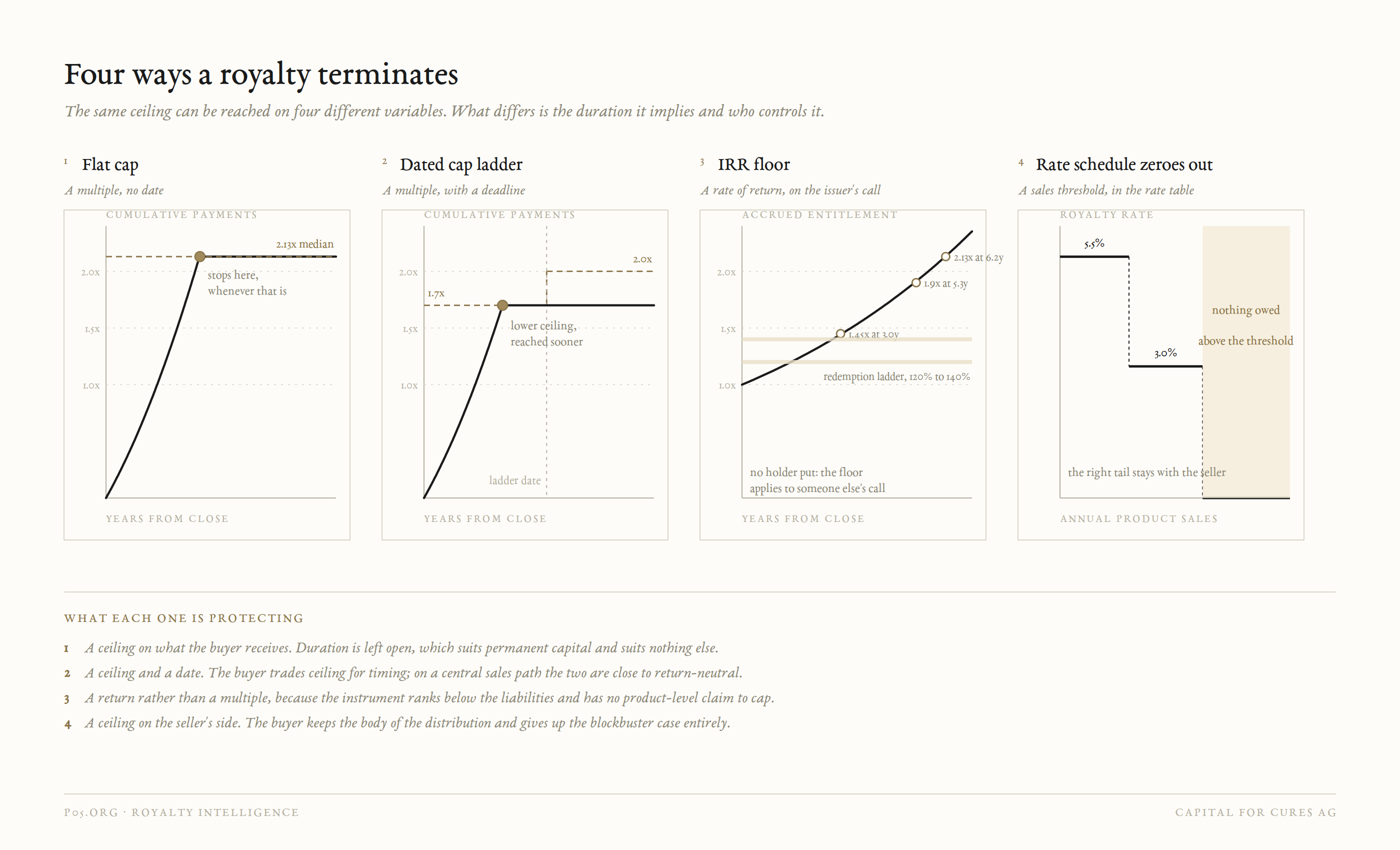
Figure 2. Four ways a royalty terminates. Flat multiples, dated ladders, IRR floors and rate schedules that zero out, plotted as cumulative payments against time, with the Covington median of 2.13x marked. They terminate on different variables and are not comparable on ceiling alone.
11. Flat cap
Stops at a multiple, whenever the product delivers it · Used throughout 2025 and 2026 · Category
The Covington sample runs 44 percent capped, 52 percent uncapped and 4 percent capped with a tail, median 2.13x, range 1.3x to 3.4x. Gibson Dunn puts the median on capped synthetics at 1.9x, range 1.43x to 4.0x.
Answers the simplest version of the problem: a buyer that wants a ceiling. Leaves open the duration, which is the feature the next instrument removes.
12. Dated cap ladder
Stops at a multiple that steps on dates · Used 2025 ×2, 2026 ×2 · Category
The buyer accepts a lower ceiling in exchange for a deadline.
- Nuvation Bio / Sagard, Mar 2025. 1.6x by June 2031, 1.75x by June 2034, 2.0x thereafter, on a $150 million royalty tiered at 5.5 percent of US net sales to $600 million and 3.0 percent from $600 million to $1 billion.
- Zymeworks / Royalty Pharma, Mar 2026. 1.65x by 31 December 2033, 1.925x thereafter.
- MacroGenics / Sagard, May 2026. Reset from a flat 2.0x to 1.7x by 30 September 2032, 2.0x thereafter.
Worked. Take the ZYNYZ reset, treating the multiple as a single payment on the ladder date, which understates the return because royalties arrive as a stream. May 2026 to 30 September 2032 is about 6.4 years, and 1.7x over that implies roughly 8.6 percent. The original flat 2.0x implies the same 8.6 percent only if it arrives in about 8.4 years, and less if it takes longer. The buyer traded ceiling for timing at close to return-neutral on a central path, and removed the scenario in which the multiple arrives in 2040.
Answers a fund that must return capital inside a fund term, by converting an open-ended hold into a modellable one. Avoided by permanent-capital buyers, who are paid to hold the tail.
13. Timing-stepped cap with a tail
Stops at a multiple set by timing, then continues at a reduced capped rate · Used late 2025 ×1 · Emerging
- Nanobiotix / HealthCare Royalty, late 2025. Up to $71 million, stepping from 1.75x to 2.5x depending on timing, then a capped royalty tail.
Answers a buyer taking pre-commercial risk who wants compensation for delay rather than protection against it. Slow performance raises the ceiling here and lowers it under instrument 12, which is the opposite incentive.
14. Rate schedule zeroing above a threshold
Stops at a sales level written into the rate table · Used 2025 ×2, 2026 ×1 · Emerging
Answers a seller unwilling to share the blockbuster case. A cap expressed in the rate schedule rather than in a multiple clause leaves the right tail entirely with the seller while preserving the buyer's claim on the body of the distribution.
- Apogee / Blackstone, 27 May 2026. Low-to-mid single digit tiered rates over a fifteen-year term, stepping down as sales rise, with nothing owed above $8 billion of annual global sales.
- Nuvation Bio / Sagard, Mar 2025. Nothing above $1 billion of annual US net sales.
- Revolution Medicines / Royalty Pharma. The daraxonrasib synthetic starts at 4.55 percent on annual net sales to $2 billion against $500 million invested to date, stepping down above.
15. IRR floor on redemption
Stops at a rate of return on a call the issuer holds · Used Jul 2026 ×1 · Single
- BridgeBio / Sixth Street and HealthCare Royalty, 1 Jul 2026. Redemption from year three at the greatest of as-converted value, 120 percent of issue price plus accrued balance rising by five points annually to 140, and, where cash dividends have gone unpaid for more than eight quarters or redemption falls on or after year seven, an amount producing a 13 percent pre-tax internal rate of return.
Worked. Compounding at 13 percent reaches 1.45x in about 3.0 years, 1.65x in about 4.1, 1.9x in about 5.3 and 2.13x in about 6.2. Those durations bracket the entire Covington cap range, so the floor is competitive with a capped royalty on any path shorter than roughly six years and dearer beyond it.
Answers a buyer writing junior paper with no product-level claim, which needs a return floor because it has no cap to rely on. The difference is control. A capped royalty retires when the product delivers. This retires on a call the buyer does not hold, so the protection is a floor on someone else's option.
16. Buy-back option on a note
Stops at a company repurchase · Used Jun 2026 ×1 in a note; Jun 2026 ×1 against a licensor (instrument 17) · Emerging
- MeiraGTx / Oberland, 30 Jun 2026. An option for the company to buy back the funded royalty note.
30. Buyer's change-of-control put
Attaches to a stream the buyer already holds · Sits as underlying · Recourse as underlying · Stops at the put price · Used Jul 2026 ×1 · Single
Answers a buyer that wants an exit it controls rather than one the product delivers. It is the mirror of instrument 16: there the company holds the option to repurchase, here the buyer holds the option to force one.
- DRI Healthcare / KalVista, exercised 10 Jul 2026. A contractual put on the royalty participation right in Ekterly (sebetralstat), exercised at a net repurchase price of approximately $178 million, triggered by the completion of Chiesi Group's acquisition of KalVista on 11 June 2026; the royalty purchase agreement terminates on receipt. The buyer described the outcome as a 1.5x return and a high-20s internal rate of return on its first pre-approval transaction.
Why the trigger matters. A change of control is the one event on which a pre-approval royalty's underwriting is most likely to be overtaken: the acquirer reprices the asset, and the royalty holder either rides the new owner's plan or exits. Writing the exit into the agreement converts a change of control from a risk into a realisation date.
17. Debt-funded royalty repurchase
Attaches to removing a licensor's claim · Sits as corporate secured debt · Recourse full · Stops at loan amortisation · Used Jun 2026 ×1 · Single
Answers a company that judges its own royalty obligation dearer than senior secured debt. Running the recourse ladder in reverse: borrow at the cheapest rung to retire an obligation near the most expensive one.
- Mineralys Therapeutics / Pharmakon, 3 Jun 2026. $200 million upfront and up to $100 million on commercial milestones to repurchase all future royalty payments due to Tanabe on lorundrostat, funded by an up to $500 million senior secured term loan, first tranche $100 million at closing, five-year term to June 2031, at SOFR plus 5.50 percent on a 3.25 percent floor, alongside a $150 million equity offering.
Instruments that add a second leg
Above roughly $250 million the single-instrument royalty deal is now the minority case, and in several transactions the royalty is the smaller leg. The second leg is where the counterparty's mandate shows: a credit fund adds a secured loan, an aggregator adds equity, and in one 2026 case a royalty acquirer added paper that ranks below every liability in the stack.
18. Synthetic royalty plus syndicable senior credit
Sits split across the stack · Recourse full on the loan leg · Seen at $650m to $2bn · Used 2025 ×2, plus earlier vintages · Category
Answers a company that needs more capital than one instrument can carry, and a buyer that wants enforcement rights the royalty leg does not provide. The syndication right does the structural work: it makes the credit leg a warehouse position.
- Revolution Medicines / Royalty Pharma, 24 Jun 2025. Up to $1.25 billion of synthetic royalty on daraxonrasib plus a senior secured term loan of up to $750 million at SOFR plus 5.75 percent on a 3.5 percent floor, three $250 million tranches gated on approval and trailing sales milestones, maturing six years after first draw, with syndication rights retained.
- Nuvation Bio / Sagard, Mar 2025. $150 million royalty plus up to $100 million of five-year senior secured term loan at SOFR plus 6.00 percent on a 4.00 percent floor, no amortisation, bullet at maturity.
- Blueprint Medicines / Sixth Street. Up to $1.25 billion combining a royalty on Ayvakit with senior secured credit.
Ranking effect. A royalty alone carries almost no enforcement: Covington finds put rights in monetisations at 6 percent for bankruptcy, 6 percent for covenant breach, 2 percent for representation breach and zero for material adverse effect. Adding a secured loan gives the same counterparty security, covenants, an intercreditor position and an acceleration right against the same product.
19. Credit facility with a synthetic component, mid-market
Sits split · Recourse full on the facility · Seen at around $150m · Used Apr 2026 ×2 · Emerging
Answers the same need one size down. The shape is no longer reserved for billion-dollar programmes.
- Apnimed / HealthCare Royalty, 6 Apr 2026. A senior secured credit facility of up to $150 million in three tranches with a synthetic royalty component on future AD109 net sales, for commercial readiness and a planned US launch.
- Opus Genetics / Oberland, 2026. A senior secured note facility with the third tranche contingent on a regulatory milestone.
- Evolus / BioPharma Credit, 5 May 2025. An existing $125 million facility upsized to $250 million, Tranche A $150 million, with two further $50 million tranches drawable to 31 December 2026.
- Autolus / Perceptive Advisors, 3 Aug 2026. Up to $250 million, five-year, interest-only senior credit facility against the AUCATZYL commercial ramp.
20. Royalty plus equity strip
Sits split · Recourse none on the royalty leg · Used 2025 ×1, 2026 ×1, plus 2024 vintage · Category
Answers a buyer that wants exposure to an outcome the royalty cap forecloses. Not new in venture lending, newly routine at royalty-fund scale, and it changes the buyer's position on a change of control.
- MeiraGTx / Oberland, 30 Jun 2026. An initial $135 million comprising $125 million of royalty financing and $10 million of equity, three further $50 million tranches at the company's option against 2027 and 2028 milestones, a further $100 million on mutual agreement, and low single-digit capped royalties on three gene therapy products with rates adjusting after 31 December 2031 based on cumulative repayments.
- Cytokinetics / Royalty Pharma, 22 May 2024. A $50 million equity purchase in a concurrent secondary offering alongside launch funding repayable over ten years at 1.9x and a royalty restructuring.
- Castle Creek / Ligand, Feb 2025. $50 million of a $75 million syndicated round against a high-single-digit royalty.
21. R&D co-funding with large pharma
Attaches to a programme in development · Sits as contra-R&D for the funded party · Recourse none · Used Jan 2026, Mar 2026 · Emerging
Answers a large, well-capitalised pharma company managing an R&D line. Nothing is monetised: the company sells a share of an asset's future economics to lay off development cost, and the contra-R&D treatment is the accounting reason it works for a party with earnings to protect.
- Teva / Royalty Pharma, 11 Jan 2026. Up to $500 million to accelerate clinical development of the anti-IL-15 antibody TEV-'408.
- Johnson & Johnson / Royalty Pharma, 30 Mar 2026. $500 million across 2026 and 2027 on JNJ-4804.
22. Structured convertible preferred
Attaches to the company · Sits below every liability · Recourse full but junior · Stops at an IRR floor or a redemption ladder · Seen at around $930m · Used Jul 2026 ×1 · Single
Answers the liability line. It is the first structure on the tape written by a royalty acquirer that ranks junior to everything, and the only one that keeps the proceeds out of a deferred royalty obligation for an operating seller.
- BridgeBio / Sixth Street and HealthCare Royalty, 1 Jul 2026. 933,900 shares of Series A Cumulative Convertible Participating Preferred at $1,000 per share, $800 million and $133.9 million respectively, with a further $66.1 million available to Sixth Street subject to board approval. Dividends accrue daily at 7.00 percent on the Accumulated Amount, cash or PIK at the issuer's election, stepping 500 basis points at year seven and 125 at year eight and each quarter after to a 17.00 percent cap, with 300 added during a Triggering Event and 200 on a surviving change of control. Conversion at $137.79, then $153.10 from year five, for an initial 6,777,705 shares. No holder put, no maturity. Holders participate in any common dividend on an as-converted basis and block the common from receiving one otherwise.
Context. HealthCare Royalty had bought the European BEYONTTRA royalty from the same issuer thirteen months earlier. KKR Genetic Disorder L.P. sold 5,000,000 common shares at $78.00 in an August 2026 secondary from which the issuer received nothing, against a $137.79 conversion price and a forced-conversion trigger at $275.58.
Covenant effect. The investment agreement restricts the incurrence of certain indebtedness and certain restricted payments without majority preferred consent. Whether a true-sale synthetic royalty falls inside that definition decides whether the preferred holders hold a veto over the next product-level financing. That is the mirror of the Permitted Royalty Transaction carve-outs the recourse ladder piece documents, sitting one rung lower and running the other way.
23. Tranching against enrolment and data
Attaches to a pre-Phase 3 programme · Sits as a liability · Recourse none · Used May 2026 ×1 · Single
Answers a buyer willing to fund before Phase 3 data but not to fund it all at once. Enrolment completion as a funding trigger is the earliest gate disclosed, and it converts a stage judgment into a schedule.
- Apogee Therapeutics / Blackstone, 27 May 2026. Up to $1.3 billion: up to $800 million of synthetic royalty funding tranched $100 million at signing, $100 million on completion of Phase 3 enrolment, $200 million on positive Phase 3 data and up to a further $400 million on FDA approval of which $150 million is at Apogee's option, plus up to $500 million of senior corporate debt by mutual consent.
Instruments that move where the claim sits
These move the seat without moving the claim. A note at a non-recourse subsidiary is the same fraction of the same royalty as a note at the parent; what changes is the recovery set on default. That is the variable the recourse ladder priced, and it is why this family shows the widest pricing spread for the smallest change in economics.
Covington finds SPV structures required in only 3 percent of synthetic royalty deals and 15 percent of monetisations, so the structures below run on something lighter than the classic bankruptcy-remote vehicle.
24. Subsidiary issuer with obligor guarantees
Sits as debt at a subsidiary, guaranteed upward · Recourse full via guarantees · Seen at up to $400m · Used Jun 2026 ×1 · Emerging
Answers a lender that wants a defined issuer and a borrower that cannot offer isolation. Guarantees reach upward from a subsidiary issuer, which puts the structure mid-ladder rather than at either end.
- MeiraGTx / Oberland, 30 Jun 2026. MeiraGTx, LLC as issuer, the parent and subsidiaries as obligors, and Maverick SA LLC as purchaser agent for funds managed by Oberland. Optional tranches, capped royalties, buy-back option.
25. Non-recourse vehicle funding an acquisition
Attaches to a US profit share · Sits as debt at an acquirer's subsidiary · Recourse none to the acquirer · Used Jun 2026 ×1 · Single
- Zymeworks / OMERS, Jun 2026. $350 million secured solely by the US profit share on YUPELRI, with no recourse to the rest of the acquirer's balance sheet, to help fund the roughly $929 million acquisition of Theravance Biopharma, alongside roughly $219 million of Zymeworks cash and an expected $360 million of Theravance net cash at closing.
Note. The same company appears as borrower in both directions inside four months, using ring-fenced paper to bring cash in (instrument 5) and to fund an acquisition out.
26. Whole-company acquisition for royalty economics
Attaches to a company and its book · Sits on the acquirer's balance sheet · Recourse full · Used 2026 ×3, one of them pending · Category
Answers a book that is not for sale asset by asset. It captures tax attributes and contingent items a stream purchase cannot, and prices against a public market instead of a cohort. It also imports an operating business, which is why the CVR carries the weight.
- Ligand / XOMA Royalty, closed 14 Jul 2026. $39.00 per share, about $739 million of equity value, plus a non-transferable contingent value right entitling holders to a portion of 75 percent of the net proceeds of certain pending litigation. More than doubled the portfolio, to over 200 assets.
- XOMA / Generation Bio, Feb 2026. A completed tender offer.
- Runway Growth Finance / SWK Holdings, agreed Oct 2025, closed 6 Apr 2026. Approximately $249 million, $75.5 million in stock and $173.5 million in cash, for SWK's royalty and structured-finance platform. The one 2026 example that removes a buyer from the market rather than adding assets to one.
- Zymeworks / Theravance Biopharma, agreed 29 Jun 2026, not closed. $17.00 per share, roughly $929 million, plus a CVR on 80 percent of net proceeds from any monetisation of ampreloxetine over ten years. The target is a 35 percent US profit share on YUPELRI, ex-US royalties, a near-term $100 million TRELEGY milestone owed by Royalty Pharma and expected in Q1 2027, a VIBATIV royalty, and roughly $2.5 billion of Irish tax attributes.
Adjacent. Deal Point Data counts 27 completed or pending CVR transactions in 2025 against 7 in 2024. In this context the CVR is a claim-splitting device on the sell side, mirroring what the partial pledge does on the buy side.
Instruments at the fund
The last family sits above every claim above it and below none. It is corporate paper against a diversified book, priced tighter than any single position in it, and the spread between what a fund borrows at and deploys at is the business. What changed in 2026 is that the mid-market reached the same market as the large caps, at a fixed coupon and without a bank syndicate.
These sit above every claim above and below none of them. They are corporate paper against a diversified book, priced tighter than any single position in it.
27. Fixed-rate private placement
Attaches to the fund's portfolio · Sits in fund liabilities · Recourse full at the fund · Used Mar 2026 ×1 · Single
- DRI Healthcare, closed 25 Mar 2026. $250 million of senior secured notes in a first US private placement: $106 million at 5.35 percent due 24 March 2031 and $144 million at 5.65 percent due 24 March 2033, semi-annual, pari passu with the existing credit agreement, secured on substantially all assets. In the same quarter it exchanged $79.7 million of Series C preferred securities for C$108.7 million of convertible unsecured subordinated debentures, leaving long-term debt of $389.0 million at 31 March 2026.
Consequence. A 5.35 percent five-year coupon sets a floor under what that portfolio can bid on any asset.
28. Revolver with a portfolio cash flow covenant
Attaches to the fund's portfolio · Sits in fund liabilities · Recourse full at the fund · Used May 2026 ×1, on a lineage running back to 2004 · Category
- Royalty Pharma, 22 May 2026. $1.8 billion unsecured revolver maturing 22 May 2031, with a consolidated leverage ratio at or below 4.00 to 1.00, a portfolio cash flow ratio at or below 5.00 to 1.00 and a coverage ratio at or above 2.50 to 1.00. Fitch upgraded the company to BBB from BBB- in Q1 2026; management has described available capital of roughly $4 billion including the undrawn revolver.
The portfolio cash flow ratio is the covenant specific to this asset class, and it exists because a royalty book's earnings and its collections diverge.
Adjacent: manager internalisation
Not an instrument, but it moves the same variable. DRI internalised DRI Capital on 1 July 2025, terminating the management agreement for a $48 million payment and buying the relevant assets for $1 million. Royalty Pharma completed its own internalisation in 2025. Removing an external fee lowers the gross return a portfolio needs to clear, and that shows up in the bid.
Instruments adjacent to the royalty
None of the four below is a royalty. Each competes for the same allocation on the same balance sheets, and a royalty desk that ignores them is mispricing its own pipeline. Three of the four printed in 2025.
29. Priority Review Voucher monetisation
Attaches to a transferable FDA regulatory asset · Sits nowhere; it is a disposal · Recourse none · Stops at the sale; there is nothing after · Seen at $150m to $205m · Used 2025 ×3, 2026 ×3 · Category
Answers a company that needs non-dilutive cash and holds a saleable regulatory asset rather than a saleable cash flow. No royalty, no cap, no coupon, no reversion. The entire instrument is a single price.
- Zevra Therapeutics, 21 Feb 2025. $150 million.
- Abeona Therapeutics, 12 May 2025. $155 million for the ZEVASKYN Rare Pediatric Disease PRV, with Stifel as lead financial adviser.
- Bavarian Nordic, Jun 2025. $160 million for the Vimkunya tropical-disease PRV, with the NIH receiving 20 percent of proceeds.
- Jazz Pharmaceuticals, disclosed 13 Jan 2026. $200 million for the Modeyso PRV, executed during 2025, with Jazz retaining half the gross proceeds.
- Fortress Biotech / Cyprium Therapeutics, Feb 2026. Approximately $205 million.
- Rocket Pharmaceuticals, 28 Apr 2026. $180 million for the KRESLADI PRV, extending the cash runway into Q2 2028.
The regulatory frame is the price. The Rare Pediatric Disease programme expired in December 2024 for designations after 20 December, and was reauthorised in February 2026. Prices through that window ran from $150 million to roughly $205 million against a longer-run average nearer $100 million. Buyers have been undisclosed in every one of the six.
A second voucher exists and does not trade. The FDA introduced the Commissioner's National Priority Voucher in June 2025. It is not transferable, so it produces no instrument.
31. Secondary sale of fixed development-funding payments
Attaches to fixed contractual payments rather than sales · Sits nowhere; it is a disposal · Recourse none · Stops at the remaining schedule · Used Jan 2025 ×1 · Single
Answers a holder of a fixed payment stream with no upside left, when an event removes the reason to keep it. Distinct from every royalty above because the payments do not track sales.
- Royalty Pharma sells the MorphoSys Development Funding Bonds, 29 Jan 2025. $511 million upfront for the remaining fixed payments, priced at a 5.35 percent discount rate, taking total proceeds to $530 million on a $300 million investment.
Date discipline. The bonds were purchased in September 2022 and the wider MorphoSys partnership dates to 2021. Only the disposal falls in this window, and it is catalogued as a disposal. Novartis's acquisition of MorphoSys in 2024 is what made a fixed stream with no potential for outperformance worth converting to cash.
32. Multi-source limited-recourse royalty bond
Attaches to royalties, milestones and platform licence fees across several licensees · Sits as debt · Recourse limited · Stops at principal and accrued interest · Seen at up to $250m · Used May 2025 ×1 · Single
Answers an issuer whose economics are spread thinly across several counterparties, where no single stream is large enough to finance on its own.
- REGENXBIO / HealthCare Royalty, 19 May 2025. Up to $250 million of limited-recourse royalty bond, $150 million funded at close against a 2.25 percent original issue discount, at SOFR plus 9.75 percent; serviced by Zolgensma royalties from Novartis, RGX-121 and RGX-111 royalties and certain milestones from Nippon Shinyaku, and NAV platform licence fees. The company retained its PRV, its AbbVie milestones and a majority of Nippon Shinyaku's development milestones outside the agreement.
Distinct from 6 because the collateral is a basket drawn from three licensees and two payment types, rather than one stream from one payer.
33. Capped royalty denominated in euros
Attaches to an existing royalty on a European asset · Sits as a liability · Recourse none · Stops at a cumulative cap stepping on dates · Seen at up to €185m · Used Jan 2025 ×1 · Single
Answers a European issuer whose royalty and reporting are both in euros, removing the currency mismatch a dollar-denominated monetisation would introduce. It is the only non-USD instrument in the catalogue, and the only one used to retire a convertible.
- GENFIT / HealthCare Royalty, 30 Jan 2025. Up to €185 million of Royalty Financing Bonds against GENFIT's royalties on Ipsen's Iqirvo (elafibranor): €130 million on approval by the 2025 OCEANE bondholders, €30 million on an Iqirvo sales threshold by 31 December 2025, and €25 million on a further threshold by 31 December 2026, the last two at GENFIT's discretion. The buyer's share is subject to an annual cap set by the royalties on a maximum of €600 million of annual net sales, and to a cumulative cap of €277.5 million, €351.5 million or €453.25 million depending on timing and events, with a long-stop of 31 March 2045, after which all royalties revert. The €30 million instalment was triggered in February 2026 when Ipsen reported $208 million of full-year 2025 Iqirvo net sales.
It stacks two termination mechanics. An annual cap expressed as a ceiling on the sales base, which is instrument 14, sits on top of a three-step dated cumulative cap, which is instrument 12. The proceeds were used alongside a repurchase offer to the 2025 OCEANEs, so the royalty financed the retirement of a convertible rather than an operating plan.
34. Synthetic royalty written outside biopharma
Attaches to device or diagnostic product revenue · Sits as a liability or as debt · Recourse none to limited · Stops at a multiple or repayment · Seen at $40m to $150m · Used Jan 2025 ×1, Jul 2026 ×1 · Emerging
Answers a commercial-stage company outside drug development whose revenue is contractual and forecastable but whose equity is expensive. The mechanics are unchanged from instruments 10 and 6; what is new is the asset.
- Mirxes / CBC Group's R-Bridge, 13 Jan 2025. US$40 million synthetic royalty-backed financing on GASTROClear and the miRNA cancer-test pipeline. A molecular diagnostic, financed from Singapore.
- Kestra Medical Technologies / BioPharma Credit, 15 Jul 2026. Up to $150 million senior secured, $45 million from BioPharma Credit PLC and $105 million from BioPharma-V, in three tranches with $22.5 million at signing, repaid from cash flows on the ASSURE wearable cardioverter defibrillator.
Depth. The buyer map records roughly fifteen disclosed medtech royalty deals against dozens in oncology, and near-zero in diagnostics. Two transactions do not make a franchise, and both came from funds with existing device or Asia mandates.
How rare each one is
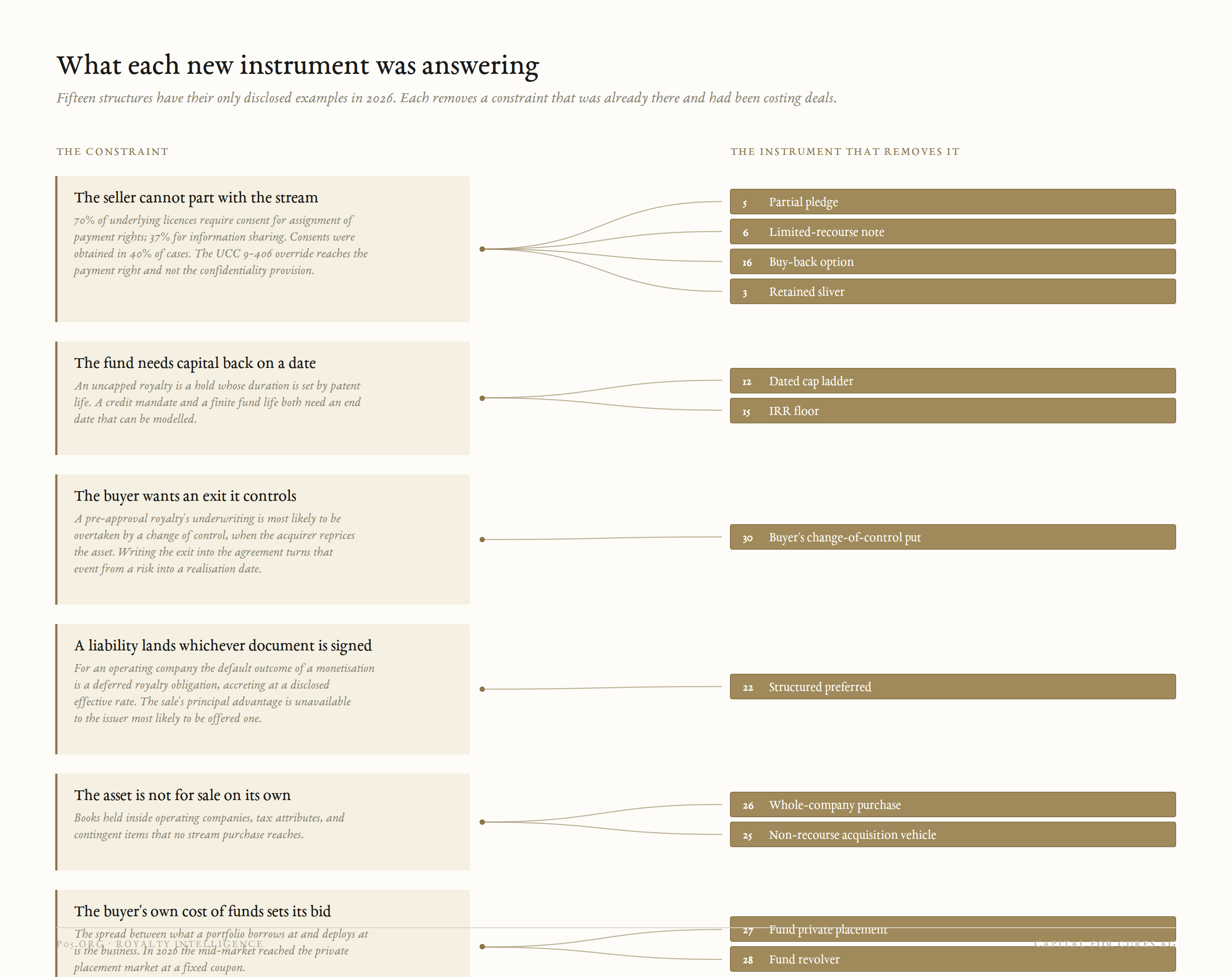
Figure 3. Disclosed examples per instrument, drawn to a common scale. Around a third of the set has one.
Read the count column before the rest of the catalogue.
- Used in both years. Partial pledge, dated cap ladder, synthetic true sale, flat cap, royalty plus equity strip, rate schedule zeroing out, Priority Review Voucher monetisation, synthetic royalty outside biopharma. These are the working set.
- 2026 only. Retained sliver, royalty-secured note with limited recourse, buy-back option, buyer's change-of-control put, debt-funded repurchase, mid-market credit facility with a synthetic component, R&D co-funding, structured preferred, IRR floor, enrolment tranching, subsidiary issuer with obligor guarantees, non-recourse vehicle funding an acquisition, whole-company acquisition, fund-level private placement, fund-level revolver.
- 2025 only, not repeated since. Instalment completion, basket swap, fund-to-fund secondary, third-party secondary on unapproved assets, timing-stepped cap with tail, territory and sales-band split, royalty plus syndicable senior credit, euro-denominated capped royalty, multi-source limited-recourse bond, development-funding-bond secondary.
The asymmetry. Fifteen instruments here have their only disclosed examples in 2026 and none in 2025. Ten printed in 2025 and have not repeated. Eight span both years. On a two-year window that split is consistent with a market adding formats faster than it retires them, and it is also consistent with a run of one-off drafting that will not recur. The 2027 tape decides which.
Why it matters practically. A seller asking for a structure with one precedent is asking a buyer to draft rather than to adapt, which costs time and negotiating capital, and usually price. A seller asking for a partial pledge or a dated ladder is asking for something three or four desks have already papered. That gap is wider than the gap between the structures themselves.
The counter-current. True sales at 71 percent of synthetic deals and 91 percent of value, capped synthetics clustering at a 1.9x median, and deal count stable at 25 to 27 a year all describe convergence. The instrument at the centre is standardising while its periphery diversifies, and both claims come from the same dataset.
Choosing among them
In order:
Do you want the asset back? Yes points at 5, 6, 16 or 24. No points at 1, 3 or 26.
Can you sell it at all? With 70 percent of licences requiring consent for assignment of payment rights and the section 9-406 override not reaching confidentiality provisions, a blocked sale points at the pledge family.
What does the existing paper permit? The covenant carve-outs set the minimum viable deal size before any buyer is contacted: Dyne's Permitted Royalty Transaction definition, MoonLake's threshold reduced from $300 million to $200 million, Spero's 35 percent cap on pledged capital stock, UroGen's outright consent requirement. Instrument 22 adds the mirror case, where a junior instrument holds the veto.
What balance-sheet outcome are you paying for? For an operating company the default is a liability whatever the document says. BridgeBio carried $879.4 million of deferred royalty obligations net of current portion at 30 June 2026, $29.3 million more in other current liabilities, total liabilities of $3.72 billion and a stockholders' deficit of $2.50 billion, with $81.2 million of non-cash interest in H1 2026 on effective rates of 22.4 percent and 10.7 percent for its two royalty transactions.
Those rates move with the forecast: MannKind discloses 8.8 percent on the Sagard Tyvaso DPI liability at 30 June 2025 on a transaction of broadly similar legal form. Only instrument 22 escapes the line, and it escapes on two omissions: no holder put and no scheduled maturity.
Who should control the timing? A multiple retires when the product delivers. A dated ladder retires on a date the seller can influence. An IRR floor retires on a call the issuer holds. Three duration profiles behind similar-looking ceilings.
What would make this reading wrong
- The counts cover disclosed deals only. Several instruments rest on one example, and private transactions below the threshold are invisible. A family that looks like innovation may be a drafting habit at two firms.
- Convergence may finish the job. True-sale share at 91 percent of value points the other way. If it keeps rising, this catalogue is a decorated periphery around an instrument becoming a commodity.
- Related-party history explains instrument 22. KKR held BridgeBio common before HealthCare Royalty bought the preferred, HealthCare Royalty held the European royalty, and related-party deferred royalty obligations stood at $206.2 million at 30 June 2026. A second preferred, to an unrelated issuer, is the test.
- Instruments 25 and part of 26 have not closed. The Zymeworks and Theravance transaction remains subject to shareholder and regulatory approval.
- Fund-level pricing assumes conditions hold. DRI's 5.35 percent coupon and Royalty Pharma's covenant grid both rest on the current cost of asset-based finance. A repricing there moves what every instrument above can be bid at, in the same direction at once.
The verdict
The instrument most people mean by a royalty deal is more standardised than it has ever been, and the data says so plainly. Everything else moved.
The claim now comes in percentages, territories, sales bands, post-repayment retentions and slivers above thresholds. The cap acquired a date, and once a rate of return. The package routinely carries a second leg that is frequently larger than the royalty and has been senior debt, equity, development funding and perpetual preferred. The claim moved into subsidiary issuers, non-recourse vehicles and, three times, whole companies bought for their economics.
Positions began trading between funds, and in one case a buyer forced its own exit on a change of control. The funds refinanced themselves and internalised their managers. And the same desks competed against six sales of a regulatory asset that carries no cash flow at all.
The first question is no longer which fund to call, because several of them will now write several of these. The first question is which of the five coordinates needs moving, because that selects the instrument, and the instrument selects the short list of desks that have papered it before.
All information in this article was accurate as of the research date and is derived from publicly available sources including SEC filings, issuer press releases and investor materials, law firm studies and market surveys, and financial news reporting. Study percentages are drawn from samples of publicly filed agreements with differing inclusion thresholds and are not directly comparable across studies. Market size figures differ between sources depending on scope and are presented with that difference noted. Instrument counts reflect disclosed transactions only and are indicative. Implied returns are derived from disclosed terms on stated assumptions and are illustrative. Balance-sheet classification of instruments issued after the most recent filing date is inferred from disclosed terms and is not confirmed. Pending transactions are identified as such. Information may have changed since publication. This content is for informational purposes only and does not constitute investment, legal, accounting, tax, or financial advice. The author is not a lawyer, accountant, tax adviser, or financial adviser.