
Pre-merger financing: funding the interval between signing and closing

A pharmaceutical merger agreement fixes the price on the signing date and delivers it on the closing date. Between the two sit the tender offer clock, the shareholder vote, and the merger control timetable, and the interval runs from weeks to more than a year.
Two financing problems live in that interval. The buyer must show at signing that the cash will exist at closing, because the merger agreement will not contain a financing condition. The target must reach closing on whatever balance sheet it signed with, under covenants that suspend its ordinary financing options the moment the agreement is executed.
This is an account of the instruments that solve both problems, worked through the 2025 and 2026 filings: the committed bridge on the buyer's side, the acquirer note on the target's side, the interim covenants that freeze the target's assets, the merger control standstill that limits what either party can do across the gap, and the royalty monetisations that have started to fund it. The insolvency overlay on these structures is the subject of the section 365 piece; the priority questions are in the encumbrances piece. Everything below is the interval itself.

1. The buyer's side: the committed bridge
Vertex Pharmaceuticals / Crinetics Pharmaceuticals, signed 6 July 2026
Vertex agreed to pay $85.00 per share in cash, roughly $10B in equity value. Concurrently with the merger agreement it entered a debt commitment letter with Bank of America and Morgan Stanley Senior Funding for a $4.5B unsecured 364-day bridge loan facility, available if permanent financing is not in place at closing. Vertex held $13.0B in cash and marketable securities at 31 March 2026; the merger agreement contains no financing condition, and the proxy sets the outside date at 6 January 2027 with extension mechanics for the regulatory conditions, which include HSR plus clearances in Austria, Germany, and Australia.
BioMarin / Amicus Therapeutics, signed 19 December 2025, closed April 2026
The complete sequence, from commitment to takeout, sits in three filings.
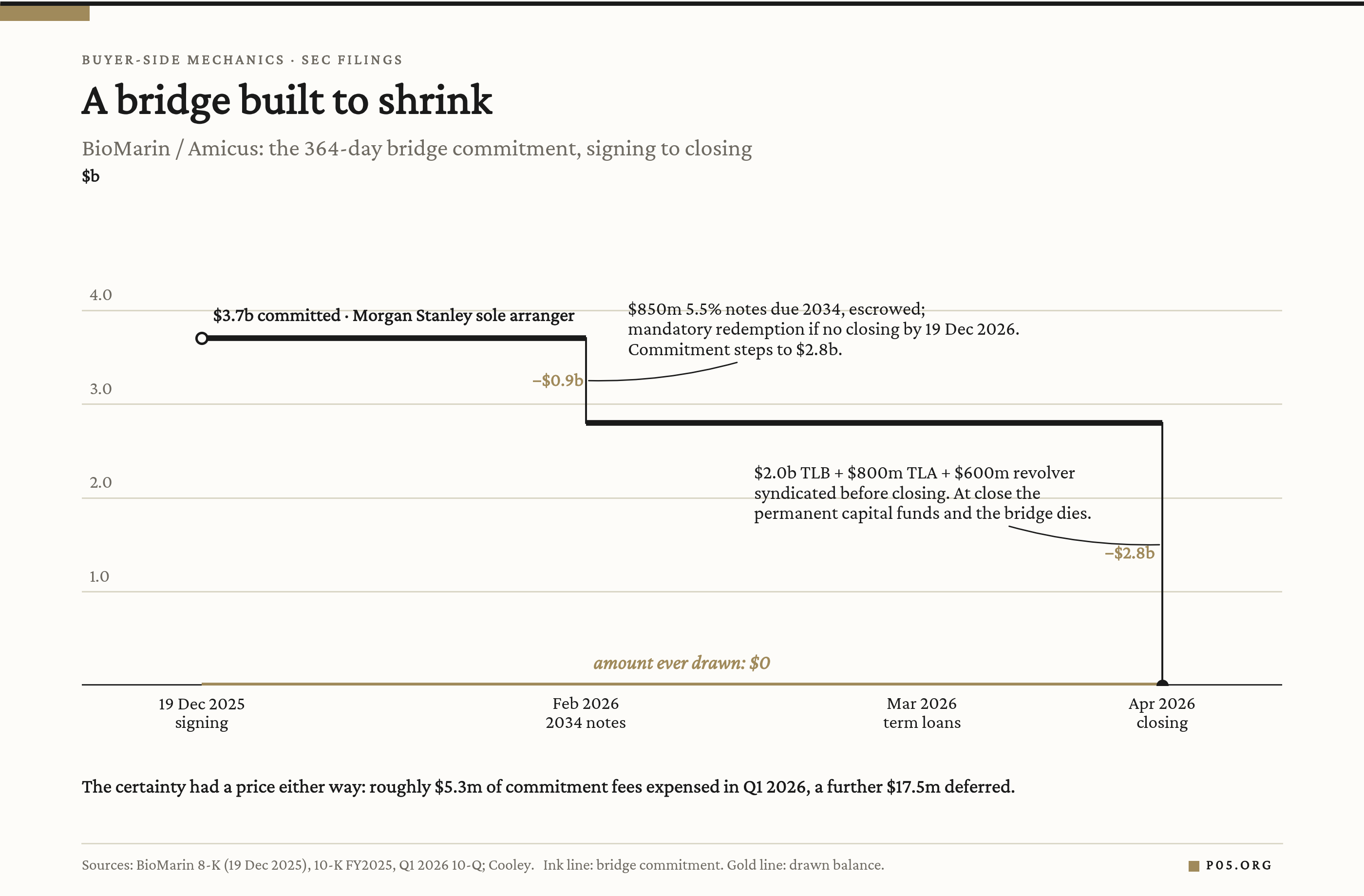
- At signing, BioMarin committed to pay $14.50 per share, roughly $4.8B, and entered a commitment letter for a $3.7B 364-day senior secured bridge with Morgan Stanley Senior Funding as sole lead arranger.
- In February 2026 it issued $850M of 5.5% senior unsecured notes due 2034 at par, placed into escrow, with mandatory redemption at par if the acquisition failed to close by 19 December 2026. Per the 10-K, "the Bridge Commitment was reduced from approximately $3.7 billion to $2.8 billion" on the notes issuance.
- The rest of the takeout was a $2.0B seven-year term loan B, an $800M five-year term loan A, and a $600M revolver, syndicated before closing with Citibank as administrative agent. The bridge never funded. The Q1 2026 10-Q shows what the certainty cost: roughly $5.3M of bridge commitment fees expensed as interest in the quarter, with a further $17.5M deferred.
That is the standard large-cap mechanic. The bridge exists to make the no-financing-condition representation true, the permanent tranches reduce it dollar for dollar as they price, and the escrow-and-mandatory-redemption structure on the bonds lets the buyer issue early without carrying deal risk into the indenture.
Sun Pharma / Organon, signed April 2026. Sun Pharma agreed to acquire Organon at $14.00 per share, an enterprise value of $11.75B, with an initial underwritten bridge from Citi, JPMorgan, and MUFG.
By 30 June the syndicate had reportedly widened to eleven banks funding over $10B, at commitments of roughly $1B each, with Sun Pharma contributing $2.0B to $2.5B from reserves. The bridge terms sit outside the US disclosure regime because the acquirer is Indian-listed; the syndication detail is press-sourced rather than filed.
The UK compression. Under the Takeover Code the same economics are a condition of announcing at all. Rule 2.7(a) permits a firm offer only when the bidder has every reason to believe it can and will continue to be able to implement it, and Rules 2.7(d) and 24.8 require a cash confirmation from the financial adviser, who takes responsibility to the Panel and can be required to produce the cash itself if it failed to take all reasonable steps.
Financing conditions are not normally permitted. Certain-funds documentation for a Code offer is therefore negotiated to funding certainty before announcement, not before closing.
2. Financing that re-cuts the deal: the pre-closing dividend
Indivior / Supernus, announced 3 August 2026
The all-stock merger of equals, at 1.5401 Indivior shares per Supernus share, includes a term that is pre-merger financing in a different register: Indivior stockholders receive a one-time special cash dividend of $1.0B in aggregate immediately prior to closing, funded by cash on hand and a $650M term loan commitment from Citibank.
No acquisition consideration is being financed; the exchange ratio is fixed. The term loan funds a leveraging dividend, timed to the closing, that rebalances the split between the two shareholder bases and delivers the combined company at roughly $878M pro forma net debt. The debt commitment is nonetheless an interval instrument: it exists from signing, and it funds only if the merger closes.
3. The target's side: the acquirer note
Eli Lilly / Adverum Biotechnologies, signed 24 October 2025
The reference transaction for the interval's other financing problem. Lilly's tender offer was $3.56 per share in cash plus one CVR worth up to $8.91, and Adverum's disclosed position at signing was that its remaining cash covered only October 2025 operations and wind down activities. The target could not reach its own closing.
Concurrently with the merger agreement, Adverum issued Lilly a secured promissory note, filed as Exhibit 10.1 to the 8-K:
- Up to $65M in four scheduled advances: $5M on 28 October, $15M on 7 November, $20M on 21 November, $25M on 5 December 2025.
- Each advance conditioned on adherence to an agreed funding plan and the absence of a change in the board's recommendation. No advances after termination of the merger agreement.
- Interest at SOFR plus 10.0%, compounded bi-weekly. Maturity 22 January 2026, the same date as the merger agreement's outside date.
- A first-priority lien on substantially all assets of Adverum and its guarantor subsidiaries, including intellectual property, accounts, inventory, and equipment.
- Covenants restricting additional indebtedness, liens, investments, and asset transfers. Acceleration on any termination of the merger agreement, with a 5.0% prepayment premium on any prepayment or acceleration.
- Proceeds restricted to the itemised funding plan and the ARTEMIS Phase 3 programme.
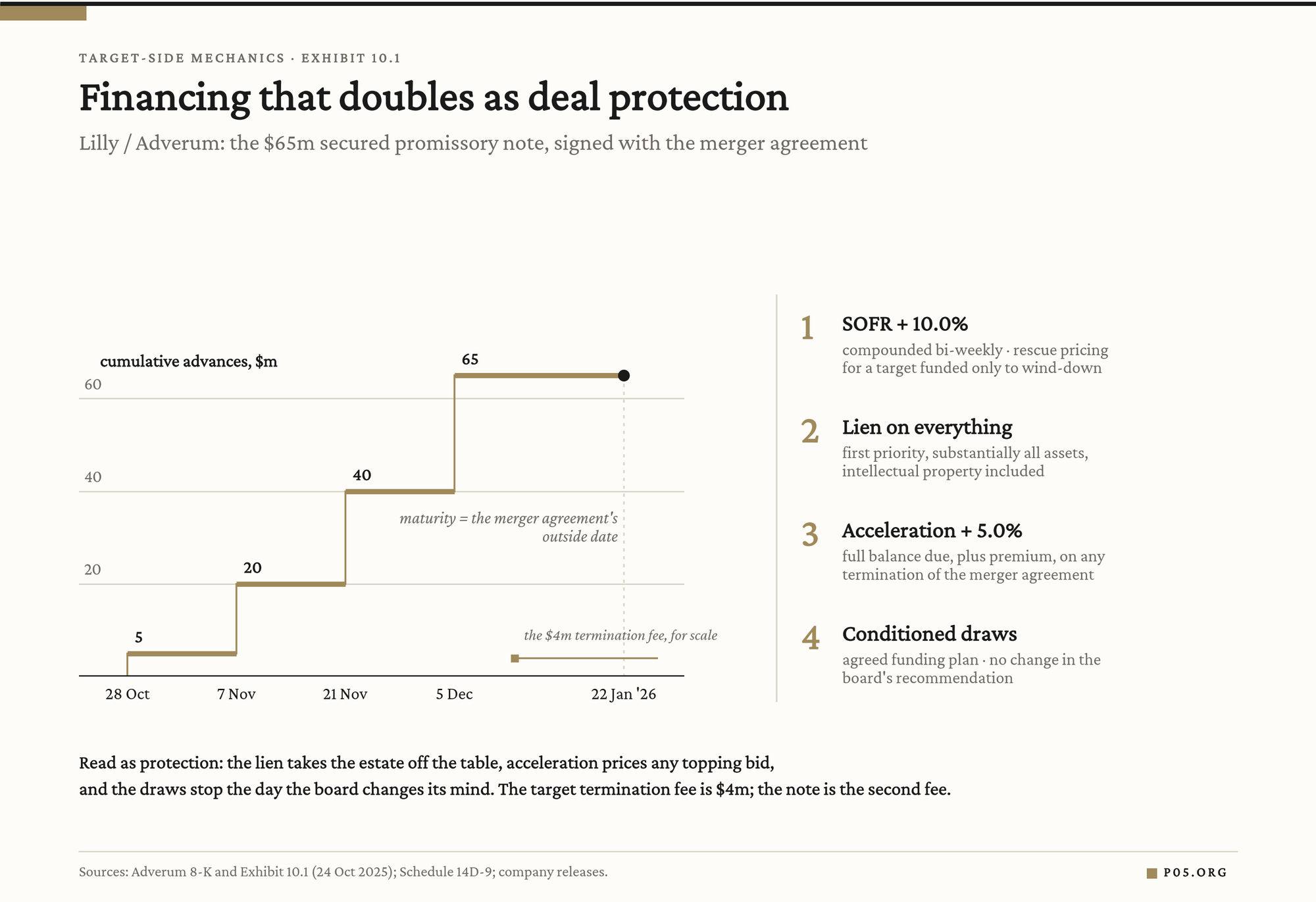
The note is financing, and it is also the second deal-protection layer on top of a $4M target termination fee. The blanket lien takes the entire estate, IP included, off the table for any interloper or royalty investor. Acceleration plus the premium means a topping bidder funds Lilly's repayment on day one. The draw conditions tie the money to the board's recommendation.
And if the deal breaks and Adverum cannot repay, the SC 14D-9 states the consequence plainly: Lilly pursues foreclosure remedies as a secured creditor, which would likely result in Adverum's bankruptcy, with Lilly positioned as senior lender over the asset it wanted.
The other pricing philosophy. In June 2026 Lixte Biotechnology agreed to acquire NOMAD Transportable Power Systems and lent the target $6.5M under a secured note filed as Exhibit 10.1.
The stated rate is 15%, but no interest accrues until the earlier of closing and termination, the maturity auto-extends in 30-day increments while the merger agreement is in force, and at closing the principal is offset dollar for dollar against the merger consideration. Acceleration is asymmetric: six months to repay if the deal dies through the lender's breach, three days if through the borrower's.
The two notes share the skeleton, a merger-linked first-priority all-asset lien with acceleration on termination, and differ entirely on price. Lilly priced a genuine standalone credit that fails without the loan. Lixte structured a prepayment of its own purchase price, free while the deal is alive, punitive only against the borrower's default. Where a note prices on an announced deal tells you whose risk it is.
For a royalty holder the note changes the target's capital structure on the day the deal is announced, not the day it closes.
A pre-existing monetisation secured on product assets must now be reconciled with the buyer's blanket lien, which is intercreditor work of the kind the royalty interest agent piece documents; a true-sale stream is not primed as a matter of priority, but for anything not conveyed outright the holder now stands behind a fully encumbered operating company, the position the encumbrances piece maps, with the section 365 piece describing where it leads if the deal breaks and the note forecloses.
4. Interim covenants: the target's assets freeze at signing
The Vertex / Crinetics merger agreement, section 5.01, is a current statement of market interim covenants, and it is worth reading against the royalty deals this publication tracks. During the pre-closing period, without Vertex's consent, not to be unreasonably withheld, Crinetics may not:
- incur or materially modify any indebtedness for borrowed money, guarantee such indebtedness, issue debt securities, or "enter into any arrangement having the economic effect of any of the foregoing." There is no dollar basket; the only carve-out is intercompany.
- sell, licence, transfer, pledge, or encumber any properties or assets other than intellectual property, outside ordinary-course inventory and existing contracts, above $2M in aggregate fair market value.
- sell, assign, licence, or otherwise transfer any material owned intellectual property, except non-exclusive ordinary-course licences to service providers and distributors.
- encumber any company intellectual property other than through non-exclusive licences ancillary to ordinary-course development and commercialisation.
- exceed $2M in aggregate capital expenditure, or settle litigation above $1M per matter and $2M in aggregate.
There is no royalty-monetisation carve-out, and none is customary. A royalty sale is simultaneously an asset disposition against the $2M basket, an encumbrance of IP-adjacent rights, and, in a capped or debt-like structure, an arrangement having the economic effect of indebtedness. Three separate clauses reach it.
The operational rule follows directly. A stream that is monetisable on the Friday before signing is not monetisable on the Monday after, except with the consent of a buyer who is weeks from owning it outright and has no reason to give away a piece of it. Royalty transactions in a sale process happen before the merger agreement or not at all, which is one reason monetisations cluster immediately ahead of strategic announcements, and why a monetisation can itself be read as process signal.
5. The standstill: money may move, control may not
Every interval instrument operates inside merger control's prohibition on early implementation. The current enforcement position, as of August 2026:
- Altice remains the governing EU authority on pre-closing conduct. The Court of Justice's November 2023 judgment upheld both infringements, closing before notification and before clearance, and confirmed that overly broad pre-closing covenants and early involvement in the target's business are themselves gun jumping, with final fines of roughly €115M.
- Illumina / GRAIL is no longer a fine at all. The Commission's July 2023 penalty of approximately €432M for closing during review, the largest ever imposed, fell when the Court of Justice ruled in September 2024 that the Commission lacked jurisdiction over the Article 22 referral, and the Commission withdrew its enforcement decisions days later. The episode's surviving lesson is procedural, not substantive: holding the target separate did not cure the standstill breach while jurisdiction stood, and only the jurisdictional defect saved the acquirer.
- In the US, the FTC's January 2025 settlement with XCL Resources, Verdun, and EP Energy set the record gun-jumping penalty at $5.6M, for a purchase agreement whose approval rights over the seller's ordinary-course well development, exercised for 94 days of the HSR waiting period, amounted to acquiring beneficial ownership before expiry.
The line the practice draws runs between funding and control. A loan from buyer to target moves money, not beneficial ownership; the Adverum note, drawn in tranches against objective conditions, sits on the funding side. What crosses is financing operated as a control channel: draw conditions requiring buyer approval of commercial conduct, information rights delivering competitively sensitive data outside a clean team, covenants directing pricing or pipeline decisions before clearance.
The tension is real in the acquirer-note structure, because a lender's covenant package and a buyer's control rights are drafted from the same vocabulary. The XCL consent rights that drew the FTC's penalty would read as ordinary loan covenants in a credit agreement. The same words carry different consequences on either side of a merger agreement, and the interim covenants in section 4 are calibrated to the value-protection line for exactly this reason.
6. Royalty monetisation inside the interval
Esperion Therapeutics / Corstasis Therapeutics, signed 2 March 2026, closed 2 April 2026
The current reference for royalty capital as acquisition financing, executed on the merger timetable.
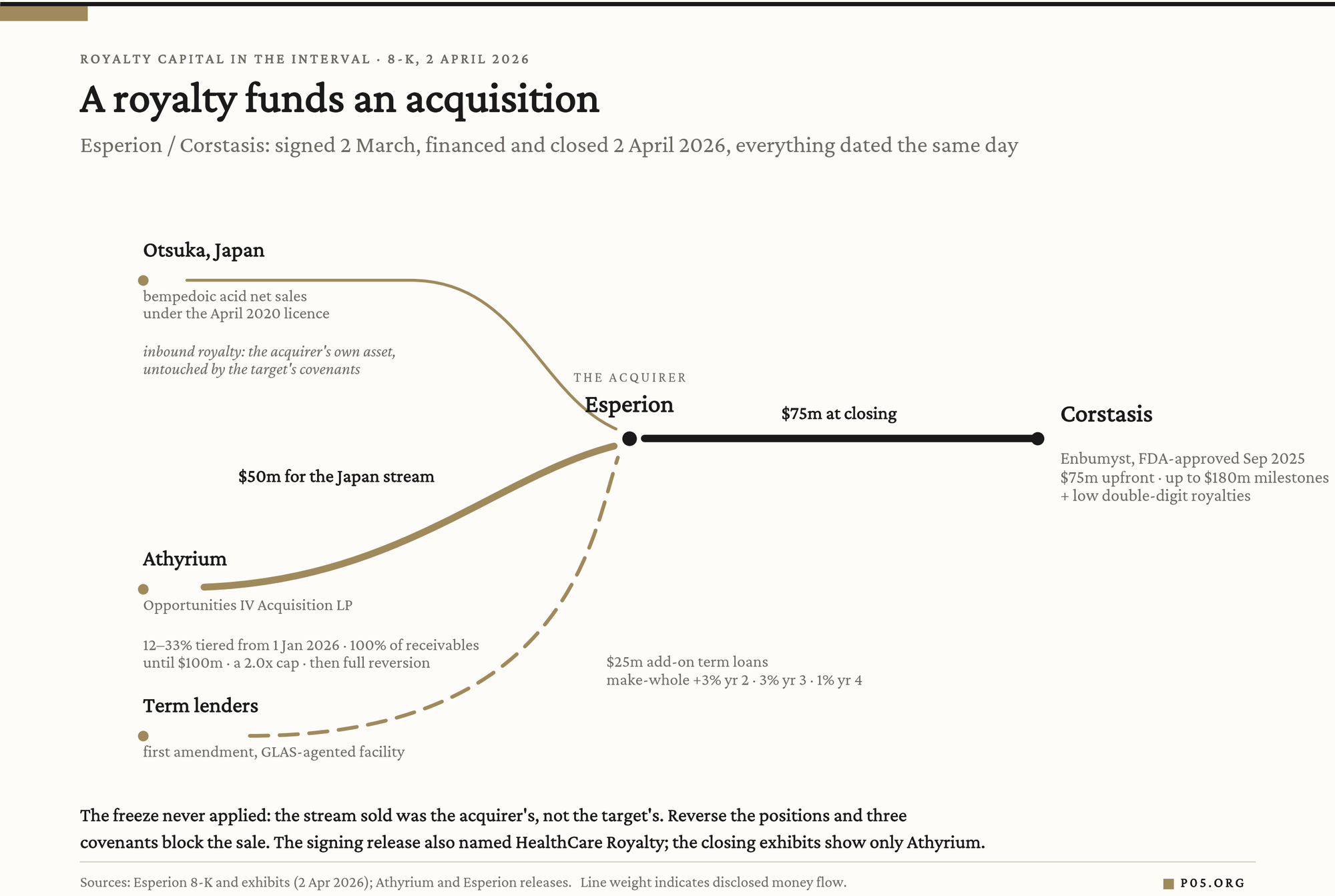
At signing, Esperion agreed to pay $75M upfront for Corstasis and its approved product Enbumyst, plus up to $180M in milestones and low double-digit royalties, and named the financing in the announcement: existing credit facilities and royalty monetisation of its Japanese royalties with funds managed by Athyrium Capital Management and HealthCare Royalty.
The executed financing appears in the closing-date 8-K, everything dated 2 April 2026:
- A royalty purchase agreement with Athyrium Opportunities IV Acquisition LP: $50M for a portion of the royalties payable to Esperion on Otsuka's Japan net sales of bempedoic acid products under the April 2020 licence, at tiered rates of 12% to 33% on sales from 1 January 2026, plus related milestones. Athyrium takes 100% of the specified receivables until it has received $100M, a 2.0x cap, after which everything reverts to Esperion.
- A first amendment to the December 2024 credit agreement adding $25M of term loans, borrowed in full at closing, with reset call protection: make-whole plus 3% through year two, 3% in year three, 1% in year four.
One discipline point: the signing announcement named both Athyrium and HealthCare Royalty, but the closing filings document only the Athyrium purchase and the term loan add-on under the existing GLAS-agented facility. Whether HealthCare Royalty's involvement runs through that existing facility or fell away is not stated, and no separate HCRx tranche appears in the exhibits.
The structure reads cleanly against sections 3 and 4. The stream sold was the acquirer's own inbound royalty, an asset untouched by the target's interim covenants, so the freeze did not apply; had the positions been reversed, a target selling the same stream after signing, three covenants would have blocked it. And the royalty investor underwrote and papered a $50M purchase inside a one-month merger interval, which is the operational bar for participating in this use of the instrument at all.
The postscript compresses the whole market into one name. Within a month of closing Corstasis, Esperion itself agreed to be taken private by ARCHIMED, and its SEC registration terminated in July 2026. The company that used a royalty sale to fund its last acquisition became, in the same season, the target whose royalty stack a buyer diligenced.
Where this article stops: the structure in which a royalty investor co-funds the purchase price itself, taking a synthetic royalty on the target's asset as part of the acquisition financing, is the subject of this publication's piece on synthetic royalties inside M&A, and the instrument it grew into is the development funding bond.
The cap-and-reversion grammar Athyrium used is catalogued in the anatomy survey. What belongs here is the timing constraint those pieces take for granted: every co-funded structure must sign and fund on the merger timetable, under the covenants in section 4 and the standstill in section 5.
7. The remedies floor under everything
The interval instruments are only worth their fees if the merger agreement binds across it. The enforceability question was reopened and resolved inside the last three years.
Consolidated Edison v. Northeast Utilities, 426 F.3d 524 (2d Cir. 2005), held that a target's shareholders could not recover the lost deal premium from a breaching buyer, and that the target itself had suffered no premium loss. Crispo v. Musk, 2023 WL 7154477 (Del. Ch. Oct. 31, 2023), suggested in dicta that the standard Delaware workarounds failed too, where the agreement disclaimed stockholder third-party beneficiary status.
Delaware answered by statute. New DGCL section 261(a)(1), effective 1 August 2024, expressly permits a merger agreement to provide for damages based on lost premium, without making stockholders third-party beneficiaries; section 261(a)(2) codifies the stockholders' representative.
The White & Case survey of agreements signed in the amendment's first five months found 22 with lost-premium provisions and a striking spread in drafting quality: only two expressly cited section 261, and only six made stockholders express third-party beneficiaries. The remedy exists; the drafting has not yet converged.
The rest of the remedies stack is visible in the deals above. Vertex / Crinetics carries a target termination fee of $350,474,425, roughly 3.5% of equity value, against a strategic-deal market median near 2.7% to 2.9%. Lilly / Adverum carries a $4M fee plus the note's acceleration-and-premium economics, which function as a second fee, scaled to the drawn balance, that no fee cap negotiates away.
What changes a party's position across the interval, and what only appears to
Terms that move the position:
- A committed bridge whose conditions mirror the merger agreement's own, reduced dollar for dollar by each permanent tranche, with escrowed bonds carrying mandatory redemption if the deal fails.
- A cash confirmation regime, on a Code offer, that moves the funding certainty question to the announcement date.
- An acquirer note with a blanket first-priority lien, scheduled advances conditioned on the board's recommendation, and acceleration plus premium on termination.
- A royalty monetisation executed before the merger agreement, or over the acquirer's own unfrozen assets after it.
- Interim consent rights drawn to the value of the bargain and no wider, with objective draw conditions on any interval loan.
- A lost-premium provision drafted to section 261(a)(1), expressly.
Terms that only appear to:
- A no-financing-condition recital over a commitment letter with broad market outs, which relocates the same condition into the financing.
- A hold-separate arrangement treated as licence to close early. Illumina's fine fell on jurisdiction, not on the merits of holding separate.
- Approval rights over the target's ordinary-course operations dressed as loan covenants: the XCL settlement priced 94 days of them.
- A plan to monetise a target royalty after signing. Three covenants reach it and the consent is a fiction.
- A lost-premium clause drafted to the pre-2024 workarounds in a post-Crispo world.
What each side should ask
For the buyer
- Does the bridge's conditionality actually collapse into the merger agreement's conditions, and what do commitment and duration fees cost across the realistic range of interval lengths?
- If the target needs interval funding, are the note's draw conditions objective, and would its covenant package survive review as funding rather than control?
- If bonds are issued early, does the escrow-and-mandatory-redemption structure keep deal risk out of the indenture?
For the target
- What does the acquirer's note cost fully drawn through the longest plausible interval, including the premium on a broken deal, and what does the board's record say about the alternatives?
- Does acceleration plus the blanket lien foreclose any topping bid in substance, and was that priced into the premium?
- Should a monetisation be executed before signing, while the covenants do not yet apply and the assets are unencumbered?
For the royalty investor
- On an announced deal, what did the merger agreement and any concurrent note do to the priority picture behind an existing stream?
- Can diligence, documentation, and funding actually run on a merger timetable, and what happens to the instrument if the merger terminates?
- When a stream comes to market immediately before a strategic announcement, what does the timing say about the process behind it?
Pre-merger financing is the capital structure of the interval: the buyer's committed bridge making the no-financing-condition representation true, the acquirer's note carrying the target to a closing it could not reach alone, the interim covenants and the standstill fixing what may move across the gap, and the remedies stack making the whole arrangement worth relying on.
Vertex committed $4.5B it expects never to draw. BioMarin paid $5.3M in a quarter for a commitment it retired tranche by tranche. Adverum borrowed to its own closing against every asset it had, on terms that doubled as deal protection. Crinetics signed away the ability to monetise anything for six months. Esperion sold a Japan royalty to buy a diuretic, then became a target itself.
The price is fixed at signing. Whether it arrives is decided in the interval, in the commitment letter, the note, the covenants, and the docket, and pre-merger financing is where that is tested.
All information in this article was accurate as of the research date and is derived from publicly available sources including SEC filings, issuer press releases, court decisions, the Takeover Code, European Commission and FTC materials, and legal and financial commentary. Information may have changed since publication. This content is for informational purposes only and does not constitute investment, legal, accounting, tax, or financial advice. The author is not a lawyer, accountant, tax adviser, or financial adviser.