
The milestone left behind: what a bankrupt estate sells after the drug has gone

14 November is the date the Food and Drug Administration (FDA) set for its decision on at-home use of Igalmi, the dexmedetomidine film for agitation in schizophrenia and bipolar disorder. Teva has owned the drug since 26 October, when it closed its purchase from BioXcel Therapeutics in a Delaware bankruptcy sale.
The decision will still be paid for in BioXcel's case. Teva owes the estate $67.5M if approval comes by 21 November, $55M if it comes by the end of February, and $5M if it comes in the second half of 2027.
Sangamo Therapeutics is in the same position with a larger sum. PTC Therapeutics bought Sangamo's Fabry gene therapy, isaralgagene civaparvovec, out of its Chapter 11 case and closed on 17 September. It paid $111M in cash and owes up to $100M more: $80M on accelerated approval and $20M on full approval. The estate still holds that right.
In both cases the court sold the drug and left the estate with a claim on a solvent buyer. Whoever ends up holding that claim, by purchase from a trust or by assignment under a plan, takes it on the terms of an asset purchase agreement written for an auction.
Those terms differ from a royalty purchase agreement on information, efforts, set-off and recourse. The price of the right is set twice: once inside the operating buyer's bid for the drug, and again whenever the estate turns the right into cash or hands it to creditors.
The market's earlier court sales were covered in the October 2025 piece on bankrupt royalty auctions and the December 2025 guide to stalking-horse sales. This piece follows the contingent part of the price after the sale closes.
How the milestones reached the estates
Sangamo filed on 23 June with two stalking-horse agreements signed. Astellas had offered $25M up front and up to $25M in milestones for the Fabry programme, and a Lilly subsidiary $50M for the platforms. The company reported $153M of total assets and $130.4M of liabilities at 30 June.
The court approved bidding procedures on 14 July and the auction opened on 10 August. PTC's chief executive said it ran over two days. PTC won against Astellas and TerSera, with TerSera named as backup bidder. The cash price rose to 4.4 times the stalking-horse figure, and the milestones to four times. Lilly took the platforms at its $50M floor after no other qualified bid. The court entered the sale order on 2 September.
BioXcel filed on 27 August, with Teva's stalking-horse bid of $57.5M in cash and up to $67.5M in development milestones, and up to $20M in sales milestones if approval came late. The lenders that financed the case, funds of Oaktree and the Qatar Investment Authority, were the same lenders whose 2022 revenue interest in Igalmi had already become a term loan, as traced in the Oaktree profile in October. No other qualifying bid arrived. The debtors cancelled the auction, the court approved the sale on 21 October, and the company is changing its name to BX Liquidation.
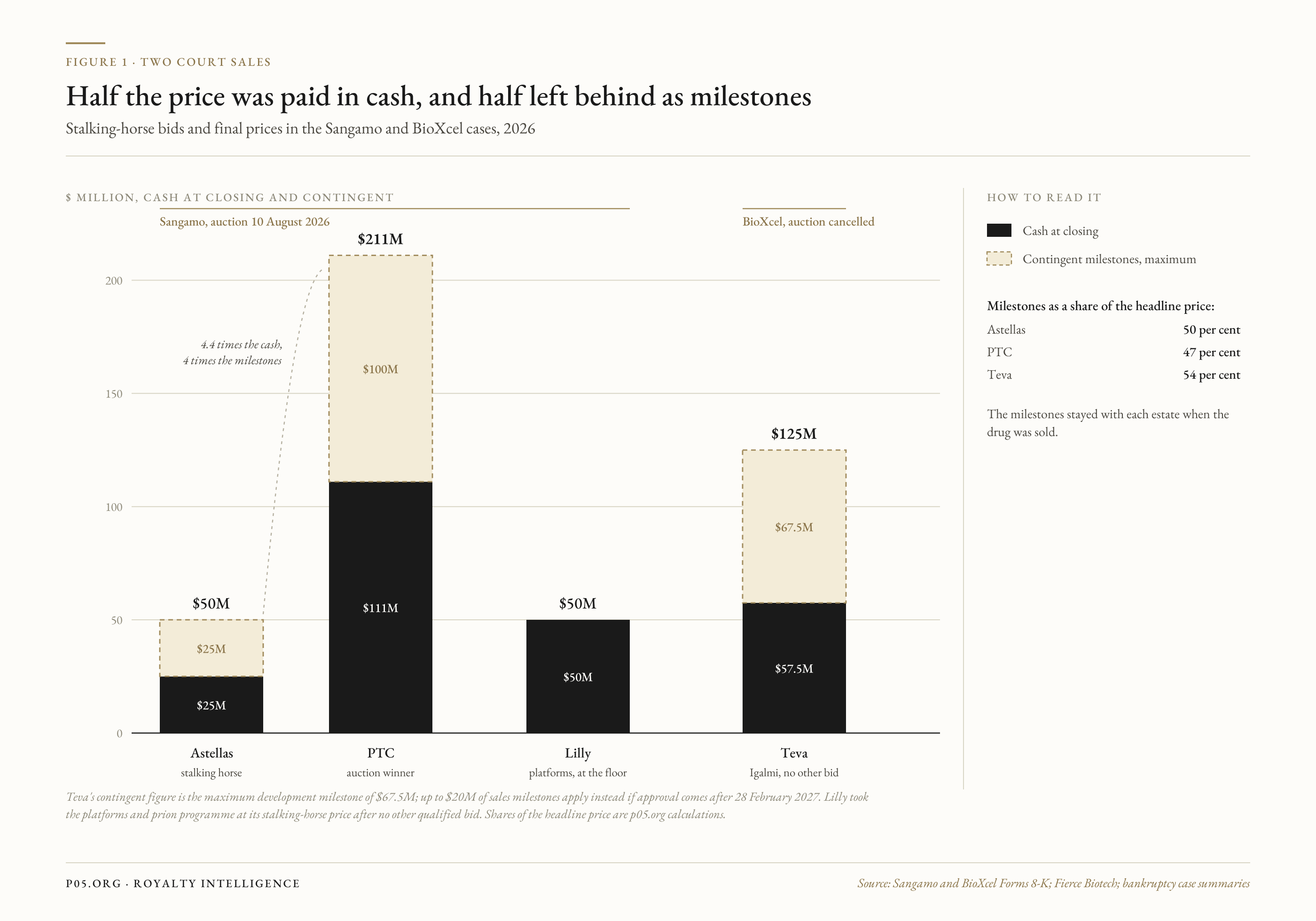
The two court sales, from stalking-horse bid to closing, split into cash at closing and contingent payments.
The contingent share of each price was close to half. Milestones made up 47 per cent of PTC's headline of $211M, half of Astellas's $50M, and 54 per cent of Teva's $125M. Those percentages are p05.org calculations from the disclosed figures.
What the right says
The purchase agreements were drafted for buyers of drugs. A later holder of the milestone right inherits whatever protection they gave the seller, and in both cases that protection is thin.
PTC must use commercially reasonable efforts to reach the milestones, but it need not run any trial beyond the STAAR studies, may run the business as it sees fit, and owes Sangamo no fiduciary duty. The agreement states that there is no assurance any milestone will be paid.
One covenant protects the smaller payment: PTC may not delay the filing for full approval with the primary purpose of avoiding it. The agreement sets no end date for the milestones and gives no right of set-off beyond tax withholding. PTC's only reporting duty is to notify the seller within 15 business days of a milestone event.
The right is fully and freely assignable at the seller's discretion, including to a liquidating trust, with advance written notice to PTC.
Teva's terms move the other way on effort. Under its agreement Teva makes no guarantee that a milestone will be reached and carries no diligence obligation, beyond a narrow bar on acts aimed at delaying or avoiding a payment.
It may deduct from any unpaid milestone half of what it pays third parties after closing for intellectual property needed for the at-home product, up to half of the milestone. Disputes go to arbitration in New York. Teva's parent, Teva Pharmaceutical Industries, signed the agreement only to guarantee the milestone payments.
The development milestone falls with time. It pays $67.5M for approval by 21 November 2026, $55M by 28 February 2027, $20M by 31 May 2027 and $5M by 30 November 2027. The sales milestones, $10M each at at-home net sales of $250M and $500M a year by the end of 2035, apply only if approval comes after February. Existing hospital sales of Igalmi earn nothing.
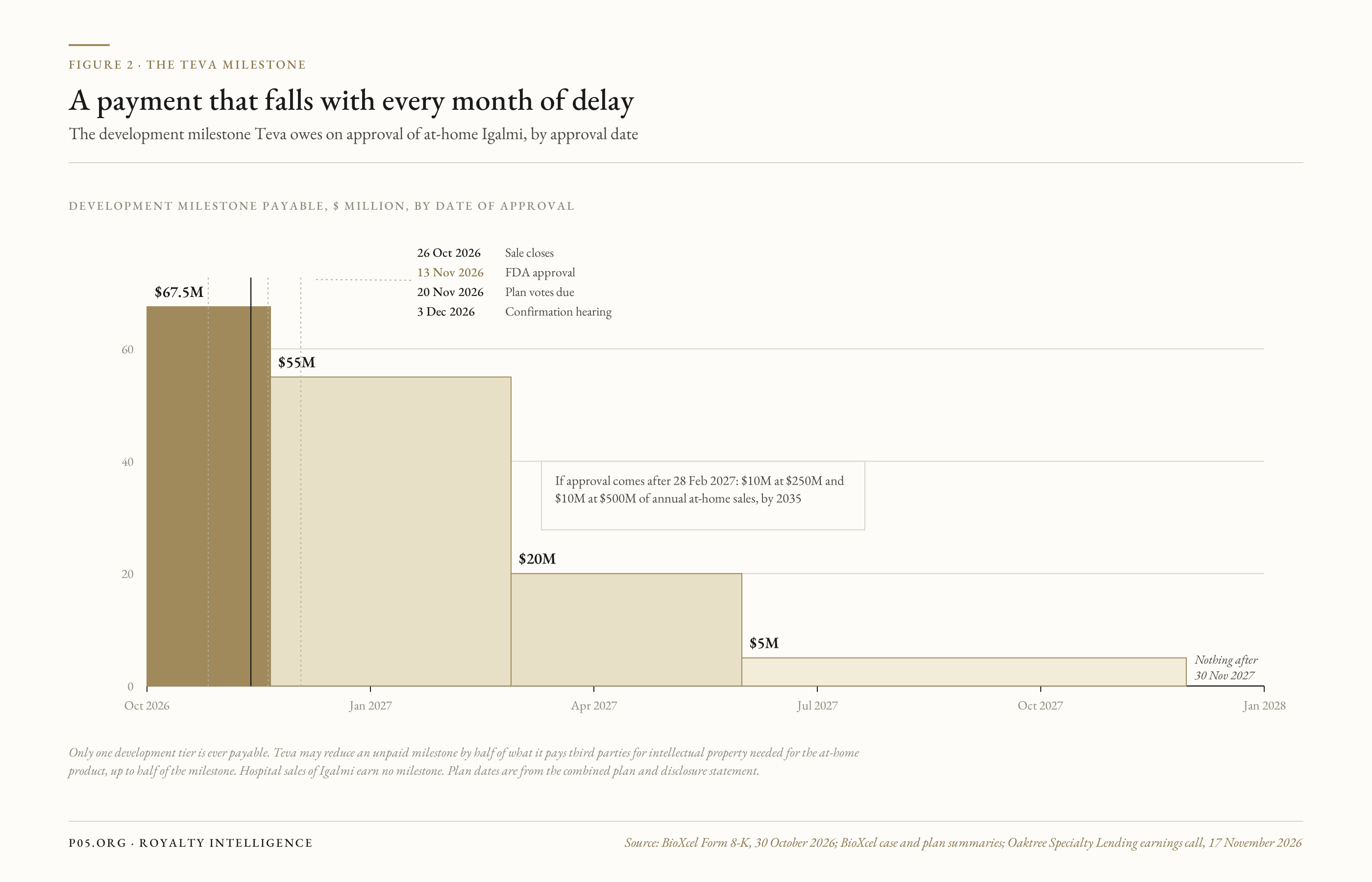
The Teva development milestone by date of approval, against the target action date of 14 November 2026 and the BioXcel plan dates.
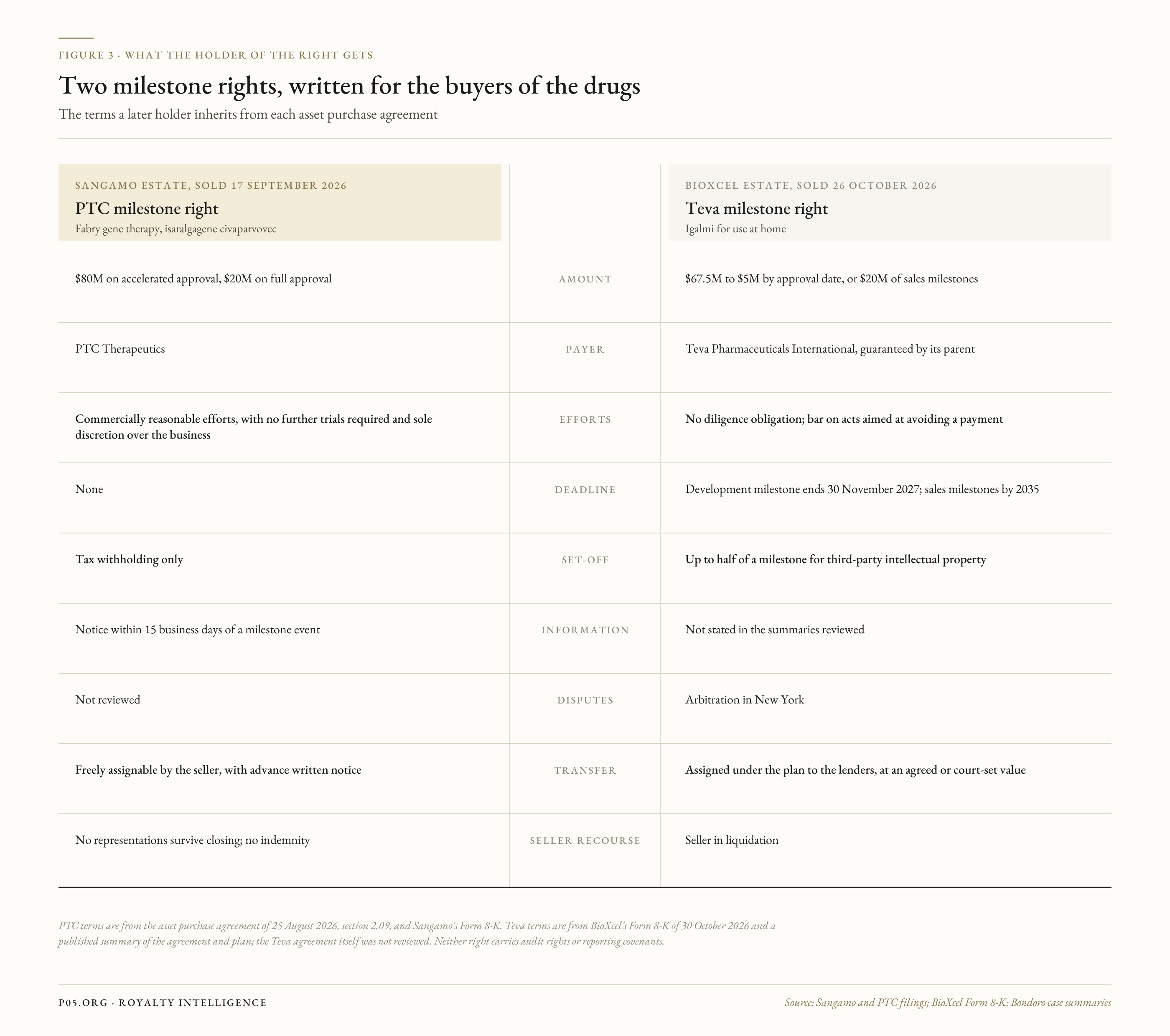
The two milestone rights term by term, from the purchase agreements and the published case summary.
A sale order gives the operating buyer a good-faith finding under section 363(m) and title free and clear of liens, which attach to the sale proceeds.
Those protections sit with Teva and PTC. A fund that later buys the milestone right from a trust buys a contract claim against them. The PTC agreement provides that none of the seller's representations survive closing and that no indemnity is available, and a seller that is winding down has no balance sheet behind a new warranty.
Who holds the right, and who could sell it
The two estates differ on who owns what is left.
BioXcel is insolvent. Its combined plan and disclosure statement assigns the milestone rights to the bankruptcy lenders' agent if their loan is not repaid in cash at closing, and otherwise to the prepetition secured lenders.
The rights pass outside the liquidation trust. Their value is agreed between the debtors and the lenders' agent, or set by the court, and is credited against the lenders' claims. The plan projects a recovery of 84.4 per cent for the secured class and 0 to 2.9 per cent for general unsecured creditors, whose reserve is capped at $1M. The closing proceeds repaid the bankruptcy loan, with some cash kept for the wind-down.
On the plan as summarised, the milestone right therefore goes to the Oaktree and Qatar Investment Authority funds that hold the prepetition loan.
The plan contains no provision for selling the right. Its value enters the case as a credit against a claim, and the dates line up with the milestone schedule.
Votes are due on 20 November, the day before the top tier of the milestone expires, and the confirmation hearing is on 3 December.
Sangamo's estate is closer to solvent, and its shareholders have an official committee, which has retained its own transaction adviser. The company had no funded debt when it filed, and Northridge ATM provided its bankruptcy loan. After the August auction the estate adjourned the sale of its remaining assets, the neuropathic pain, haemophilia A, sickle cell and regulatory T cell programmes, along with bids from parties offering to sponsor a plan.
It later extended the deadline for both kinds of bid to the confirmation of a plan. On 13 November a committee in the case objected to the debtor's request for more time to file one. The milestone right can be sold, assigned to a trust or kept by a reorganised company, and the filings so far do not say which.
How the price compares
Inside an auction, the milestone is priced by a strategic bidder that controls the outcome. PTC set its own $80M payment against its own view of approval. It also controls the filing, the timing and the label. A royalty buyer prices the same right from outside, with the efforts clause above as its only lever.
The value of the PTC right depends on two numbers that no filing gives: the chance of accelerated approval and its date. PTC has said it expects to complete the application this quarter and could launch in 2027.
At a 15 per cent discount rate, with accelerated approval between August 2027 and August 2028 at a probability of 40 to 85 per cent, and full approval two years later at 70 per cent, the right is worth between $28M and $69M today. These figures are p05.org calculations from stated assumptions, before transaction costs or any tax.
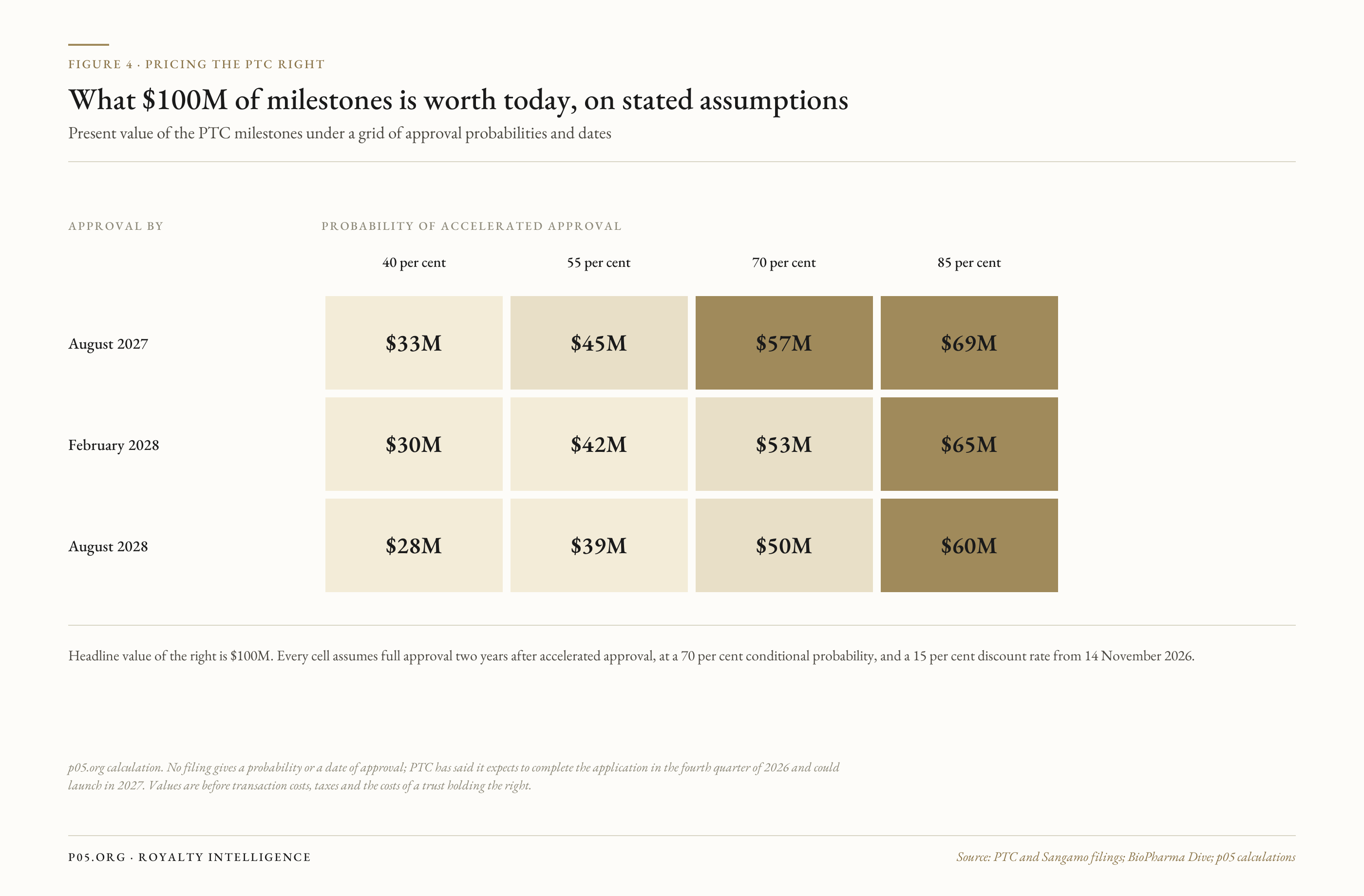
Present value of the PTC milestones at 14 November 2026 under a grid of probabilities and approval dates. p05.org calculation; assumptions in the caption.
Outside bankruptcy, buyers of development-stage milestones often pay part of the price only when the event occurs. XOMA paid BioInvent $20M for its mezagitamab royalty and milestone interests in 2025 and agreed to pay $10M more on a regulatory milestone, while Takeda ran the Phase 3 trials.
That structure moves part of the approval risk back to the seller. An estate that sells to close its case has less use for a deferred payment, because the trust that would collect it has to stay open to wait for it. Both the BioXcel plan and the Sangamo filings leave room to hold the right in kind and avoid a sale.
The BioXcel right shows how quickly the price moves. Before the FDA acts on the application, its development milestone is worth anything from $5M to $67.5M, or nothing. If approval came by 21 November, the credit the lenders take against their claim would rest on the top tier.
If approval slips past February, the right becomes a pair of sales milestones, the first at $250M of annual at-home sales. That threshold is about 300 times BioXcel's first-quarter Igalmi revenue of $206,000 taken at an annual rate, a p05.org calculation on the hospital product, which earns no milestone.
Implications for the Pharmaceutical Royalty Market
Both 2026 court sales split their price roughly in half between cash and milestones, and the milestone half stayed with the estate after the drug had gone. An estate is run to distribute what it holds and close, which sets a deadline on a right that may pay out years later.
The terms of that tail are set for the operating buyer. A holder of the PTC right has an efforts covenant with wide carve-outs and a notice of the event. A holder of the Teva right has no efforts obligation, an offset of up to half for third-party intellectual property and a payment that falls by date.
Neither carries the audit rights, reporting covenants or seller indemnities of a negotiated royalty purchase, as described in the October piece on royalty audits. A buyer underwriting such a right prices the counterparty's credit, the regulatory event and the contract, and gets nothing from a seller that has dissolved.
Who sells the right depends on the capital structure. In an insolvent estate the right goes to secured lenders at a negotiated credit, and no market price is struck.
Where shareholders may hold the residual, as in Sangamo's case, where they have an official committee, the estate has a reason to hold the right for its owners or to auction it, and the price of that sale is the first observable value of the claim.
Conclusion
The FDA's target date for Igalmi at home fell on 14 November. Teva owns the drug and the decision, and the funds that lent to BioXcel stand to collect between $5M and $67.5M on it, depending on the date of approval. The confirmation hearing on their plan is on 3 December.
In Sangamo's case PTC owes up to $100M on the gene therapy it bought in September, and the estate has not said whether it will sell that right or keep it.
All information in this report was accurate as of the research date and is derived from publicly available sources including court opinions, regulatory guidance, academic literature, SEC filings, and financial news reporting. Information may have changed since publication. This content is for informational purposes only and does not constitute investment, legal, or financial advice. The author is not a lawyer or financial adviser.