The withholding tax gross-up: who bears the tax on a cross-border royalty
Most licences leave the tax with the licensor, and a royalty buyer steps into the licensor's place. The yield on the stream then depends on where the buyer is resident.

On 20 June 2025 The United Bio-Technology (Hengqin), a subsidiary of the Hong Kong-listed United Laboratories, received $180M from Novo Nordisk. The headline upfront for the obesity drug UBT251 had been $200M. The missing tenth was Danish withholding tax.
Denmark withholds 22 per cent on royalties paid abroad, and its treaty with China cuts the rate to 10 per cent. United Laboratories' annual report for 2025 carries the result as a new line in its tax charge: RMB 143.4M of "Danish withholding tax on license fee income", against RMB 1,442.2M of licence fee income.
Six days later, on 26 June, the United States Treasury asked Congress to drop section 899 from the One Big Beautiful Bill. The provision would have raised American withholding on royalties paid to residents of countries whose taxes Washington deemed unfair.
Under the House text a royalty exempt under a treaty could have faced up to 50 per cent, and under the Senate text up to 15 per cent. Lenders and borrowers knew who would have paid.
Standard credit agreements put change-of-law risk on the borrower, which must gross up the lender for new withholding taxes. Pharmaceutical licences mostly put it on the licensor, and a royalty buyer inherits the licensor's position.
Earlier p05 pieces covered the domicile of royalty funds, the treaty rates and reclaim forms of the main European source countries, and intercompany royalties. This piece looks at the clause that decides who bears the tax on each payment, and what happens to it when the stream is sold.
Where the tax falls
p05 read the withholding clauses in the 50 licences used for the audit piece and the set-off piece, filed with the SEC between 2018 and 2026. Thirty-six of them put withholding on the licensor.
The licensee deducts what the law requires, pays it to the tax authority and sends the licensor a receipt, and the amount withheld counts as paid. Pfizer's licence with Sangamo states the rule in a sentence: withholding taxes "shall be an expense of, and borne solely by, the payee". The licence dates from 2017 and was filed in 2023.
Nine licences go the other way, and most of them are with universities. The University of Arizona's licence to Sunshine Biopharma increases the sum payable so that the university receives what it would have had without the deduction. UMass Chan's 2026 licence to Tonix says all amounts owed are net and "shall be grossed-up".
A tax-exempt university pays no tax at home and cannot use a foreign tax credit, so any withholding is a final cost to it. Three licences are silent, one is mixed, and in one the default is redacted.
The licensor's exposure has a carve-out. Twenty of the 36 make the licensee pay more when the licensee's own act raises the tax. The usual name is a withholding tax action, and the usual list is an assignment of the licence, a change in the licensee's tax residence, or payment through a branch or an affiliate in another country.
Bristol Myers Squibb's 2026 agreement with Janux grosses up for an increase that arises solely from its own assignment, transfer or change of control, and excludes a change of law. Two more licences take a different route to the same end. Moderna's licence with CytomX requires the payee's consent to an assignment that would create withholding, unless the paying party agrees to reimburse it.
Lilly's 2020 licence with Precision BioSciences shows the floor. If Lilly changes its tax residence and withholding rises, Lilly must give notice in advance so that Precision can file its forms. It owes nothing more. In no licence in the sample does the licensee gross up a rise caused by a change in the law alone, except where it already bears all withholding.
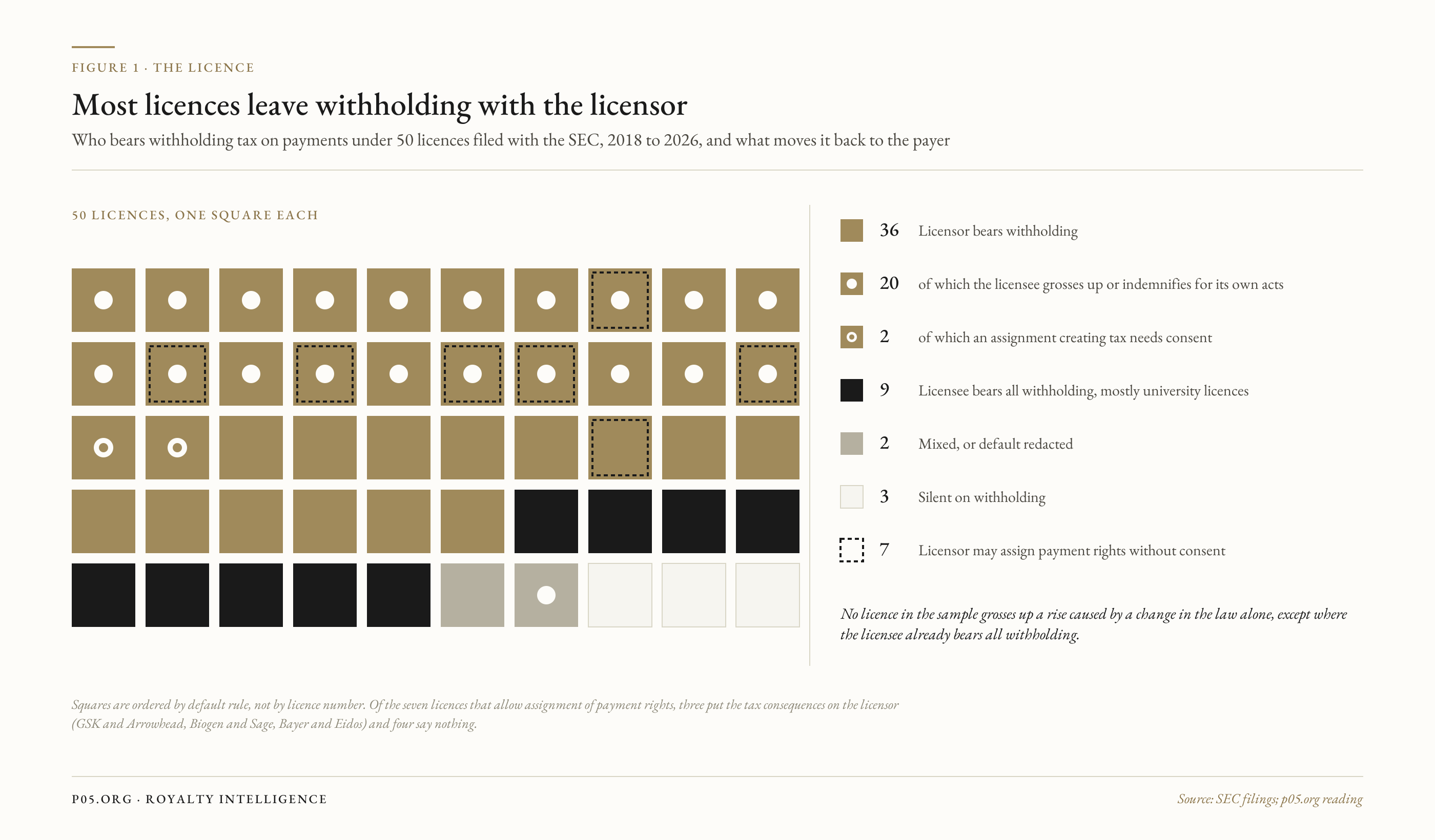
Who bears withholding tax under 50 licences filed with the SEC, and what moves it back to the payer. p05.org reading of the filed agreements.
What the seller can assign
A royalty sale changes the payee. The licensee's withholding depends on who receives the payment, so a buyer resident in another country can change the tax on the same royalty. Seven of the 50 licences let the licensor assign its payment rights without consent.
Three of them say who bears the tax consequences, and in each case it is the licensor. GSK's amended licence with Arrowhead allows an assignment in a "Securitization Transaction" at Arrowhead's "sole cost and expense", requires Arrowhead to tell GSK the assignee's tax domicile, and requires the assignee to supply tax information.
Sage's licence with Biogen lets it securitise royalties, subject to an indemnity for any incremental tax its action causes. Bayer's licence with Eidos pays only what it would have paid had Eidos not taken a withholding action. The other four say nothing on tax. Under their general rule the licensor bears withholding, and the buyer receives what the licensor would have received after it.
What the buyer takes on
The purchase agreement then decides what the buyer can recover from the seller. p05 read eight royalty purchase agreements and three synthetic royalty agreements, in which the company pays the buyer directly.
In seven of the eight purchase agreements the buyer bears the withholding the licensee applies. Arrowhead's 2022 sale to Royalty Pharma puts it most plainly: the seller "shall have no obligation to gross-up or otherwise pay the Buyer any amounts with respect to source withholding".
Omeros' 2022 sale to DRI of part of its Omidria royalties, for $125.0M, treats any amount the seller withholds and remits as paid to the buyer. Rayner, which bought Omidria in 2021, owes Omeros top-ups for withholding and indirect taxes under the asset sale, and the purchase agreement keeps those top-ups out of what DRI bought.
What the sellers do cover is their own conduct. LadRx's 2023 agreement with XOMA requires a true-up within five business days for "Seller Withholding Taxes", which arise from the seller's own assignment, redomicile or non-compliance.
PTC's 2020 sale to Royalty Pharma treats a Roche deduction as a permitted reduction unless it results from a change in the seller's jurisdiction or structure. MacroGenics' sale to DRI has a two-way gross-up on whichever party's action causes the tax, including a buyer that assigns or fails to deliver its forms.
Only one of the eight purchase agreements moves change-of-law risk to the seller. Infinity's 2019 sale to HealthCare Royalty defines an "Indemnified Tax" as non-American withholding imposed solely because of a change in tax law after closing or a seller redomicile. It contains no gross-up.
The tax is excluded when the buyer's receipts are counted against its cap, so the seller pays through a longer stream. Royalty Pharma's synthetic royalty with Zenas goes further in form. Zenas pays "without set-off, reduction or deduction, or withholding for or on account of any Taxes", provided the buyer has delivered its W-8BEN-E. The condition matters.
The Irish buyer certifies that it is exempt from American withholding, so the clause allocates a tax both sides expect to be zero.
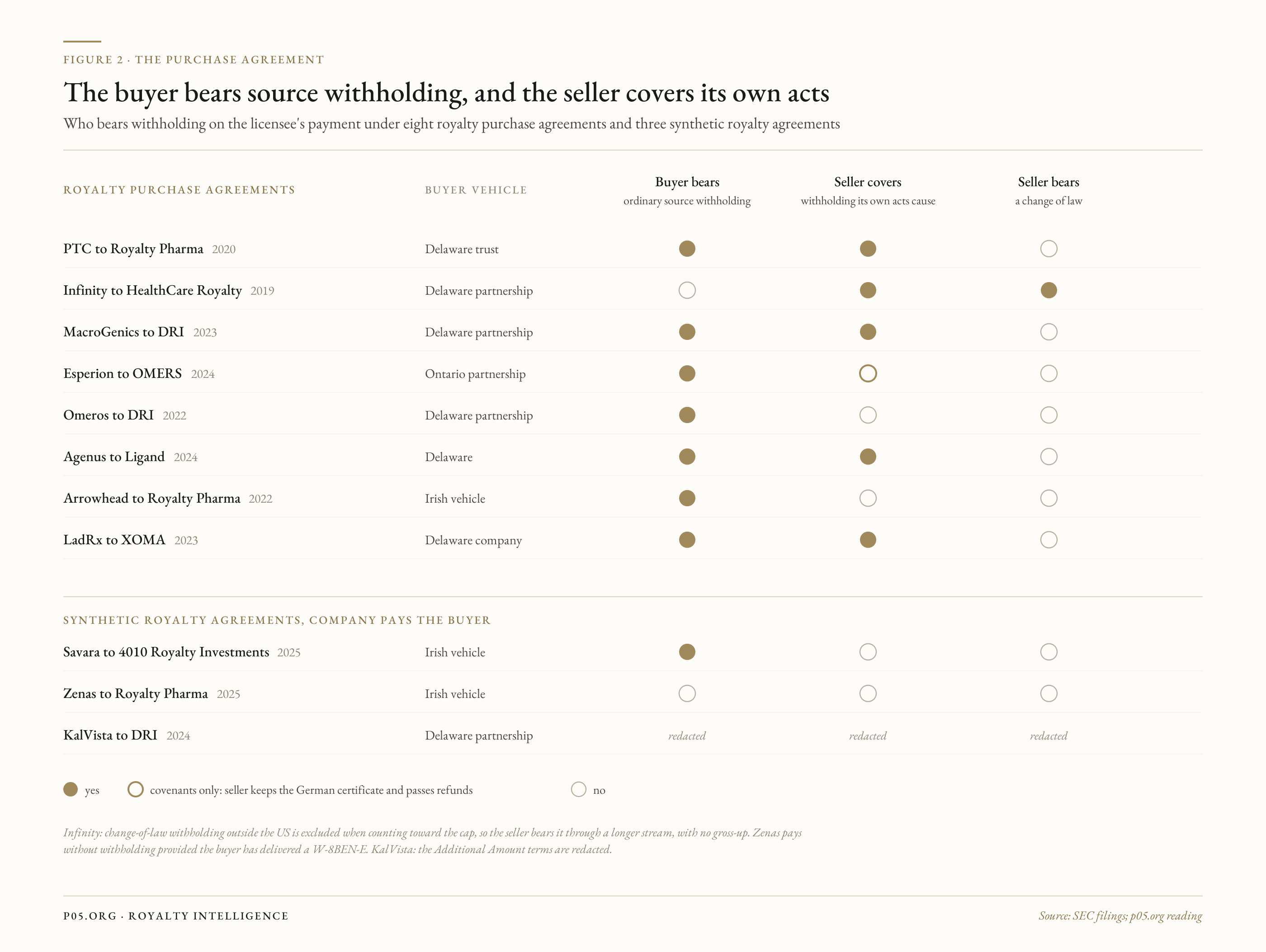
Who bears withholding on the licensee's payment under eight royalty purchase agreements and three synthetic royalty agreements, and which seller acts are covered. p05.org reading of the filed agreements.
The same royalty in different hands
Because the buyer usually bears source withholding, the price it can pay depends on its own residence. An American licensee paying a royalty abroad withholds 30 per cent unless a treaty reduces it.
The rate on industrial royalties is 0 per cent for residents of Ireland, Switzerland, the United Kingdom and Japan, 10 per cent for China, and 15 per cent for South Korea. A Cayman fund has no treaty and bears the full 30 per cent.
Consider a royalty of $100 a year for ten years, priced to return 10 per cent. An untaxed holder pays $614.5. A holder that bears 10 per cent withholding pays $553.0, and one that bears 30 per cent pays $430.1. A Cayman vehicle that paid the Irish price would earn about 2.4 per cent. These figures are our own calculations.
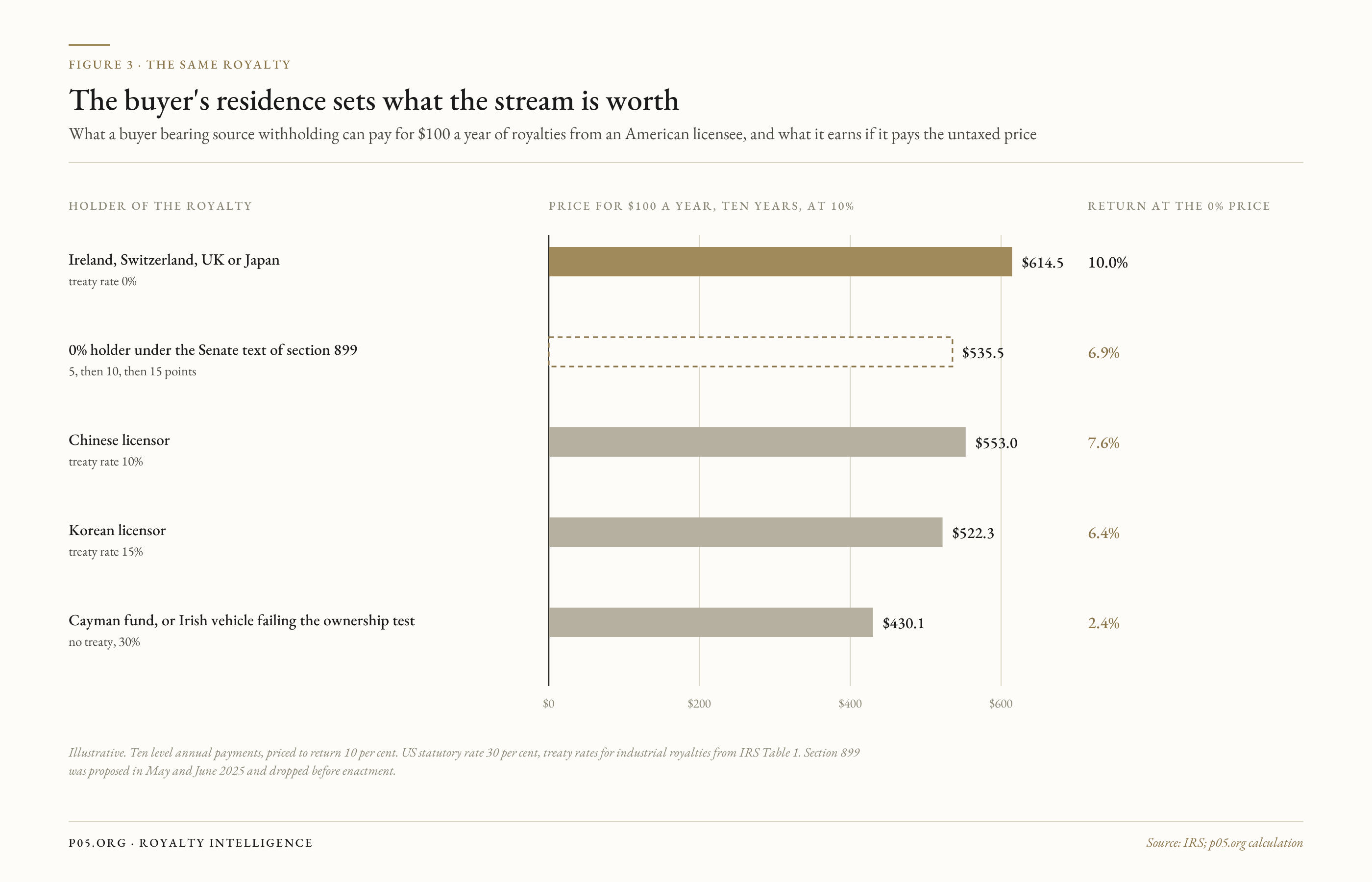
What a buyer can pay for $100 a year of royalties from an American licensee over ten years, priced at 10 per cent, by the rate it bears. p05.org calculation.
The tax also costs the seller and the buyer different amounts. A licensor that pays tax at home can usually credit the withholding against its own bill, so the deduction defers tax it would have paid anyway.
Arcutis was loss-making when Huadong paid its upfront in 2023. Of the $30.0M, $3.0M was withheld in China, and Arcutis recorded it as income tax expense. A royalty fund in a tax-neutral vehicle is in the same position as a loss-making biotech. It has no home tax to credit against, so any withholding it bears reduces its return in full.
A stream that loses little to withholding in a taxable licensor's hands can lose much more in a fund's, unless the fund's treaty access is at least as good.
This explains why buyers of American-source royalties sit in Ireland. Three of the eleven buyers in the sample are Irish collective asset-management vehicles. Royalty Pharma's annual report for 2025 sets out the cost of that position. Its subsidiaries rely on the Irish treaty's exemption, and the exemption depends on at least half of each subsidiary being owned by American citizens or residents.
If the test failed, royalties could bear 30 per cent. The same report notes that American authorities have considered protective measures against countries whose taxes they treat as extraterritorial, and that such measures could affect its treaty benefits.
A change of law
Section 899 would have reached exactly this position. Under the Senate text, a holder exempt under a treaty would have faced 5 points of withholding in the first year, 10 in the second and 15 thereafter. On the ten-year royalty above, that path cuts the price from $614.5 to $535.5, about 13 per cent, and the return on a stream bought at the untaxed price falls from 10 per cent to about 6.9 per cent.
These are p05.org calculations. The licence would have given the holder no claim against the licensee, and most purchase agreements none against the seller.
The threat ended with a political bargain. On 5 January 2026 the OECD's Inclusive Framework adopted the side-by-side package that exempts American-headed groups from most of the global minimum tax, the condition on which section 899 was dropped.
The package provides for a review in 2029. The last time the United States ended a treaty, with Hungary, royalties paid to Hungarian residents went from 0 to 30 per cent on 1 January 2024, after notice given in July 2022.
Relief that arrives late
A treaty rate of zero does not always mean nothing is deducted. Germany withholds 15.825 per cent on royalties paid abroad, and a German licensee can pay gross only if the payee holds an exemption certificate from the Federal Central Tax Office. Without one, the licensee withholds and the payee reclaims. An industry association whose members file under the same procedure reported in April 2024 that processing had grown to as long as 24 months.
Esperion's 2024 sale to OMERS of its royalty from Daiichi Sankyo Europe handles the point in detail. The buyer bears German withholding, and the agreement states that nothing in it requires the seller to pay more if Daiichi Sankyo withholds.
The seller must obtain and renew the exemption certificate, report a refusal within five business days and pass any refund to the buyer within ten. Withheld amounts count towards the buyer's cap of 1.7 times its $304.7M.
At a 10 per cent discount rate, a German deduction of 15.825 per cent that is refunded after twelve months without interest costs 1.4 per cent of the royalty. After 24 months it costs 2.75 per cent. These are p05.org calculations.
The German rule on registered rights is a separate matter. Since the Annual Tax Act 2022, royalties between unrelated non-residents for rights that are only entered in a German register are no longer taxed in Germany, and the change applies to all open years. Related-party and tax-haven cases remain.
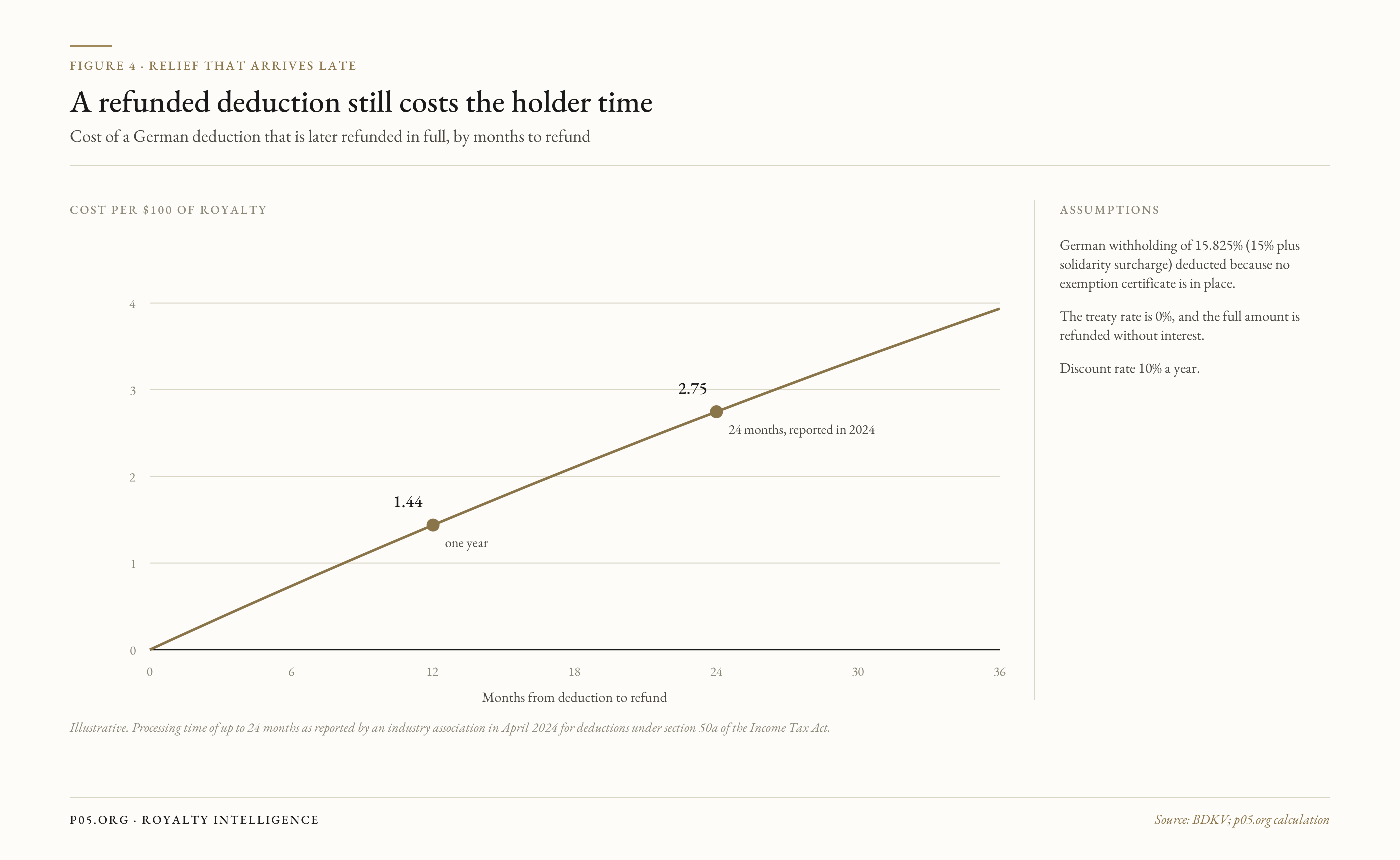
Cost of a German deduction of 15.825 per cent that is later refunded without interest, by months to refund, discounted at 10 per cent. p05.org calculation.
Implications for the Pharmaceutical Royalty Market
For a buyer the first question is how the licence allocates withholding, and the second is whether that allocation survives the assignment.
A clause that grosses up for the licensee's own acts protects the buyer only if it runs to assignees, as AbbVie's does in its licence with Harpoon, which names Harpoon "or its assignee". Most say nothing on the point.
The purchase agreement can only shift the tax between buyer and seller. The seller usually covers withholding its own acts cause, and the buyer covers the rest, including any change of law.
A buyer that wants change-of-law protection can follow the Infinity structure, which lengthens the stream when tax rises and needs no cash from the seller.
Sellers have a different exposure. A licensor that pays tax at home and sells to a fund loses its credit along with the stream, and the price reflects the withholding the fund will bear.
Where the buyer's treaty position is better than the seller's, as for a Chinese licensor selling an American royalty to an Irish vehicle, the sale can raise the after-tax value of the stream. Where it is worse, the seller pays for the difference in the price.
Relief also depends on paperwork. A W-8BEN-E for the United States or an exemption certificate for Germany has to be in place before the payment date, and most licences require the licensee to apply a reduced rate only when the forms arrive in time.
Conclusion
United Laboratories will receive its royalties on Novo Nordisk's sales from Denmark, subject to the same 10 per cent deduction that took $20M from its upfront. Denmark and China have a treaty, and United Laboratories pays tax in China.
Denmark's treaties with Switzerland and the United Kingdom set a rate of 0 per cent, so a buyer resident in either would receive more of each payment than the licensor does, on the same obligation from Novo Nordisk.
The milestones of up to $1.8B will be paid on the same basis. Whether any of them reach a third party depends on the assignment and tax clauses of a licence that United Laboratories has not published.
All information in this report was accurate as of the research date and is derived from publicly available sources including court opinions, regulatory guidance, academic literature, SEC filings, and financial news reporting. Information may have changed since publication. This content is for informational purposes only and does not constitute investment, legal, or financial advice. The author is not a lawyer or financial adviser.