Set-off: when the licensee pays the royalty net of its own claims

On 27 February 2025 the Fifth Circuit let Ovintiv keep more than $608,000 of royalties owed to two family companies in Karnes County, Texas. Ovintiv had misallocated gas flow between September 2016 and January 2018, which meant that it overpaid some royalty owners and underpaid others.
Among those overpaid were the Richters, who in December 2017 deeded their mineral interests to DDR Weinert and DDR Williams, two companies they controlled. In June 2018 Ovintiv told the new owners that it would take the Richters' overpayment out of their future royalties.
The court held that the overpayment and the later royalties arose from a single transaction, so equitable recoupment barred the owners' claim. Their remedy lay against the Richters.
The opinion is unpublished and turns on Texas oil and gas law. The structure is the one a pharmaceutical royalty buyer meets. A payer finds that it owes less than it paid, or that the seller owes it something. The stream has changed hands since, and the payer collects by deducting from the next payment.
The licence and the law of assignment decide what the licensee may deduct after a sale. The purchase agreement decides whether the seller makes up the difference. The licences filed since 2018 give large licensees several ways to net, and none of the 50 we read says what happens to those rights when the royalty is sold.
The purchase agreements fill that gap with a definition of the reductions the buyer accepts and a promise by the seller to pay back the rest.
The October piece on royalty audits followed the holder chasing money it was owed. This one runs the other way, with the payer holding money back.
What the licences allow
We read the set-off, credit, dispute, and assignment terms in the same 50 licence and collaboration agreements used for the audit piece, each with a different licensor and 47 of them signed since 2018. Twenty-eight have a large pharmaceutical or biotech company as licensee.
Third-party royalty credits, which almost all of them contain, are left out of what follows. The October piece on Keytruda's subcutaneous form covered how those work.
Eighteen of the 50 give the payer an express right to set off something other than an overpayment, and 15 of those are licences to large companies. Most name a single item. Pfizer may deduct the costs of curing Sangamo's breaches of its own third-party agreements, and its 2017 licence makes that offset run against payments to Sangamo "or any of its successor or assigns".
Novartis may set off the documented costs of taking over Spark's manufacturing, and Lilly the sums it must pay a counterparty if one of Precision's in-licences ends.
A few reach further. Moderna's 2022 licence from CytomX lets it offset any monetary payment still unpaid after its due date or the final resolution of a dispute about it. Biogen and Sage may each, on notice, set off undisputed overdue amounts, including indemnity payments, against undisputed amounts they owe.
In four licences to Bristol Myers Squibb, Astellas, AbbVie, and Otsuka the offset clause is blacked out in the filed copy.
Other licences bar the practice. Alfasigma's licence to PhaseBio gives the licensee "no right to offset, set off, or deduct" anything unless the supply agreement allows it. AstraZeneca's 2021 licence from Ionis bars either party from setting off any amount "it is owed or believes it is owed", with exceptions for listed credits, arbitral awards, and undisputed unpaid sums.
Bayer's 2024 licence from BridgeBio's Eidos makes royalties "not subject to set-off" apart from its royalty reconciliation and third-party credits.
Overpayment credits are more common than set-off rights. Eighteen licences let the payer take an overpayment back from later payments, 14 of them licences to large companies.
GSK's licence from Arrowhead makes overpayments found "by such audit or otherwise" fully creditable against what GSK owes. The University of Arizona's licence to Sunshine leaves the choice between refund and offset to the licensee.
Disputed amounts come next. In 24 licences the payer owes only the undisputed part of an invoice or report, or owes no interest on the disputed part until the dispute ends. Twenty of those are licences to large companies.
The Chinese licensee of Athenex goes furthest: after an audit, it pays nothing more "until there is a mutual agreement" on the amount, and no interest for the period of the dispute.
Seven licences let the licensor sell its payment rights without consent, among them Arrowhead's to GSK, Sage's to Biogen, Eidos's to Bayer, and Vir's 2026 licence to Astellas, which names the buyer a "Monetization Partner". None of the seven says whether the licensee keeps its set-off against that buyer.
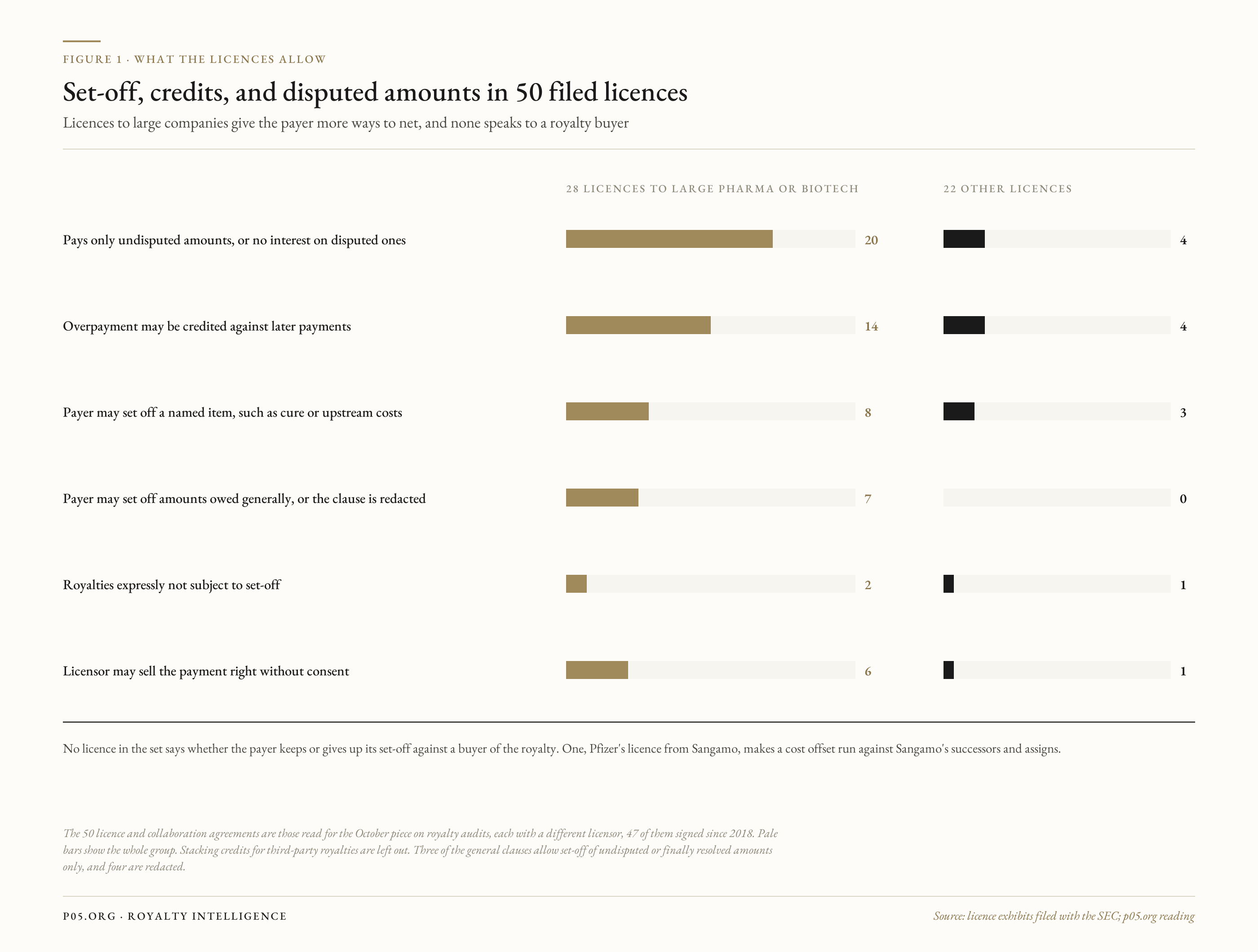
Set-off, overpayment credits, and treatment of disputed amounts in 50 licences filed with the SEC, by type of licensee.
Claims and credits
The deductions behave differently depending on their source. Some are claims the licensee says it holds against the licensor, usually for indemnity. Where the licence is silent, Delaware law does not let a payer net an unliquidated claim against a liquidated payment that is due.
The Court of Chancery restated the rule on 3 August in the Syntimmune earn-out: a possible liability that is not yet fixed cannot be set off against a sum already owed, unless the contract provides for it. The October piece on earn-outs set out what that rule did to the interest on a $130M milestone.
In the licences, the clauses that allow set-off of claims mostly wait for the claim to be fixed, by agreement, award, or final resolution, as Moderna's and Biogen's do.
Overpayment is the deduction most likely to follow the stream. A licensee that has paid on a reading of the licence it later abandons, or on a net sales figure later restated, takes the excess back from the next quarter where the licence allows. Masimo is pursuing such a claim.
In the arbitration that Willow Laboratories brought against it in May 2025 under their cross-licence, Masimo has counterclaimed for repayment of historical royalty overpayments, and Willow seeks a declaration that it owes none, alongside damages of at least $6.10M.
When Royalty Pharma sued Boehringer Ingelheim over linagliptin royalties, the licensee answered with an overpayment counterclaim, as the audit piece described.
Disputed amounts are held back while the parties argue. Withholding carries a price once the dispute is lost. Biogen stopped paying Genentech royalties on Tysabri when the Cabilly patents expired in December 2018, on the view that sales of vials made before expiry owed nothing.
On 30 September 2025 a federal court in California ordered it to pay $88,348,123 in royalties, and the parties stipulated to $35,903,701 of interest three days later. The interest added 41 per cent to the principal. A licence that suspends interest on disputed amounts, as 24 in our set do in one form or another, moves that cost onto the payee.
What the buyer inherits
A true sale changes who is owed the royalty. It leaves the licensee's defences in place. Under the Uniform Commercial Code as enacted in Delaware, an assignee takes subject to the terms of the contract and to any defence or claim in recoupment that arises from it, whenever it arises.
Other claims the licensee holds against the seller also survive if they accrue before the licensee receives notice of the sale. Until notice, the licensee may keep paying the seller and be discharged.
Section 9-403 allows the reverse. A licensee may agree not to assert its claims and defences against an assignee, and the agreement binds it where the assignee takes for value, in good faith, and without notice of certain competing claims. A licensee consent signed at closing can carry such an agreement.
Swiss law draws its line at the moment the debtor learns of the assignment. Under Article 169 of the Code of Obligations, the debtor may raise against the assignee any objection it had at that moment. It may also set off a counterclaim that was not yet due, provided that claim falls due no later than the assigned one.
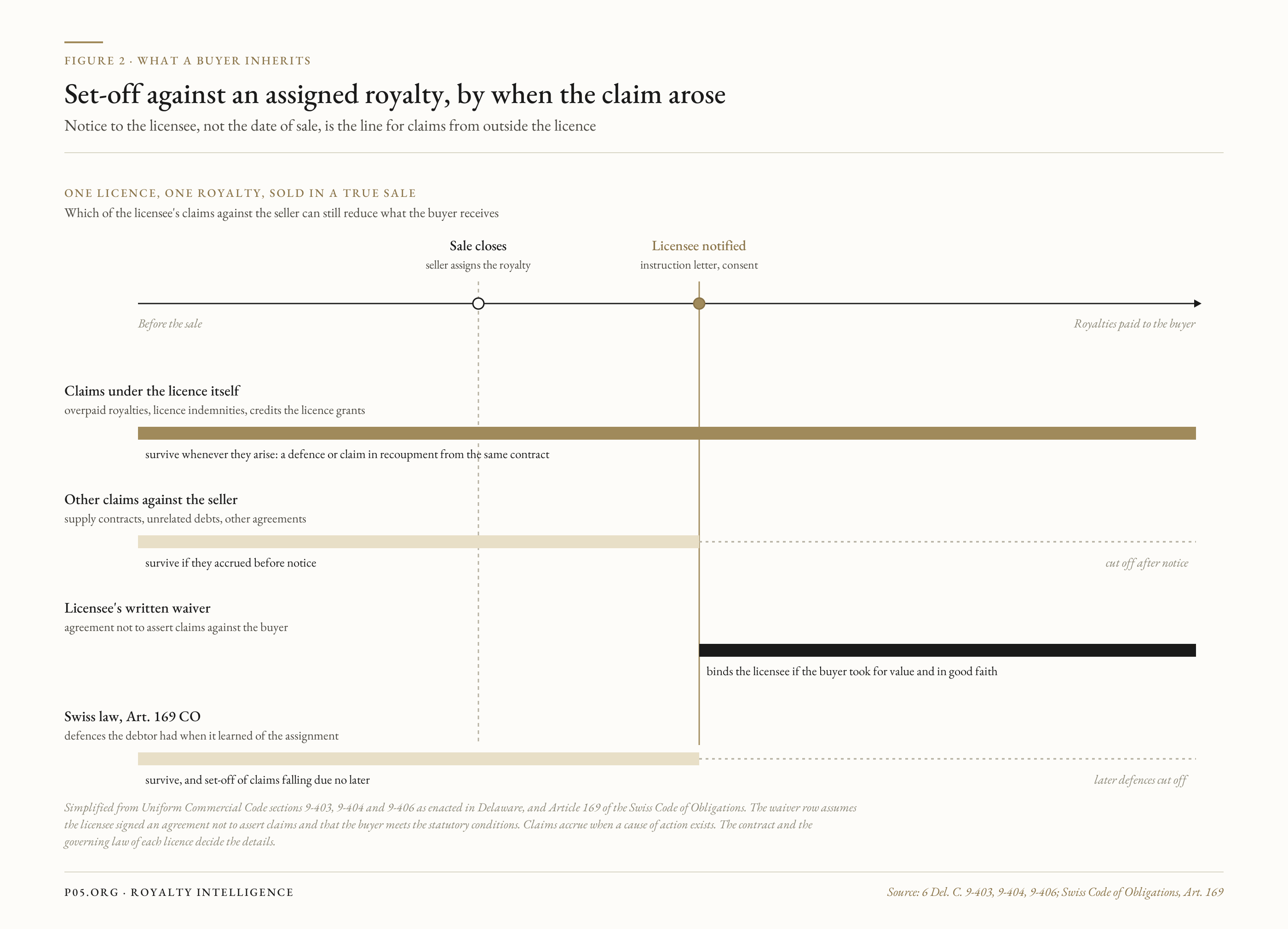
Which of the licensee's claims can reduce an assigned royalty, by when they arose.
Ovintiv's successors faced a claim from the same arrangement. It arose with the royalties themselves, so the transfer did not cut it off. A pharmaceutical licensee's overpayment credit is a term of the licence, and a buyer of the royalty takes it with the stream. An indemnity claim under the licence is of the same kind.
A claim under a separate supply agreement with the seller is not, and the buyer's protection against it starts on the day the licensee is told of the sale.
Bankruptcy keeps the distinction. Section 553 of the Bankruptcy Code preserves set-off of mutual debts that arose before the petition, subject to limits. The Fifth Circuit has treated recoupment of overpayments within a single transaction as a separate doctrine that the section does not bar.
If the seller of a royalty fails, a licensee's claim under the licence can still come out of the payments. The August piece on section 365 covered what rejection of the licence does to the stream itself.
Written into the purchase
The purchase agreements answer with definitions. Royalty Pharma's 2022 purchase from Arrowhead, on Amgen's olpasiran licence, calls any licensee set-off, counterclaim, credit, or deduction a "Royalty Reduction" and lists the ones the licence permits. The buyer's royalty is net of the permitted ones.
For any other reduction, the seller makes a true-up payment within ten business days. The seller has no liability for a permitted reduction or for a Credit Event, the licensee's insolvency or distress.
XOMA's 2023 purchase from LadRx works the same way on a five-day clock. A reduction that is not permitted "shall not reduce any payment" owed to the buyer, and LadRx may not forgive or compromise any amount the licensee owes.
ImmunityBio, the licensee, consented to the sale and agreed to pay XOMA directly. DRI's 2023 purchase of the Tzield royalty from MacroGenics gives the seller 30 days to true up a "Non-Permitted Reduction" by Provention.
The other purchase agreements use different labels for the same allocation. DRI's 2022 purchase of Omidria royalties from Omeros calls a licensee set-off of the seller's debts an "Out-of-Scope Set-Off" and makes Omeros pay it.
Ligand's 2024 purchase from Agenus requires the sellers to pay the amount of any counterparty set-off taken against the purchased receivables, and Ligand to return it if the sellers recover it. Oaktree's 2024 purchase from Esperion makes the seller fund an escrow for any "Licensee Deduction" against the purchased receivables.
Overpayments mostly fall the other way. In PTC's 2020 sale to Royalty Pharma, the seller may require the buyer to pay its pro rata share of a licensee overpayment or credit it against future payments. Esperion's buyer pays the seller the full overpayment of purchased receivables. Omeros bears an overpayment first out of the royalties it kept, and DRI only beyond them.
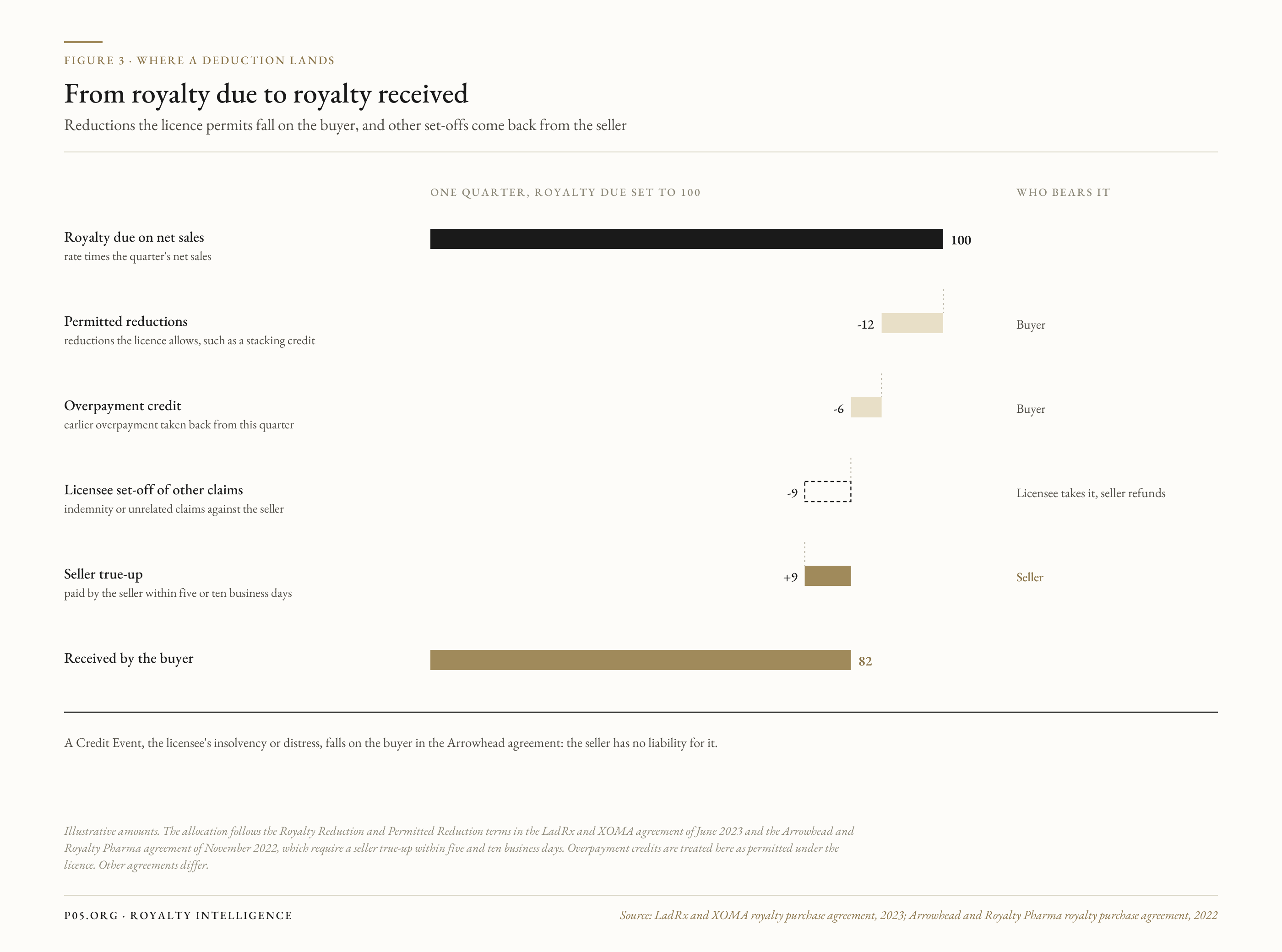
Where each deduction from one quarter's royalty lands under the Arrowhead and LadRx terms.
A seller's true-up is an unsecured promise unless the agreement says more. BeOne's 2025 sale of its Imdelltra royalty to Royalty Pharma backs its make-whole obligation with a first-priority security interest.
HealthCare Royalty's 2019 purchase from Infinity made a counterparty consent a condition of closing, and has the seller represent that the counterparty has no right of set-off against the royalties. The consent turns the statutory waiver of section 9-403 into a document the buyer holds.
Buyers also take set-off rights of their own. DRI may set off its indemnity claims against the milestone payments it owes MacroGenics. The Arrowhead agreement lets each side offset amounts the other owes it under the purchase agreement.
The earlier pieces on the consent gate and on chain of title dealt with the documents that bring a licensee into the transaction. The set-off terms are what those documents protect.
Synthetic royalties
Where the seller sells the product itself, there is no licensee between the payer and the buyer, and the seller's own claims are the risk. All three synthetic agreements in our set bar the payer from netting. Savara pays its buyer, 4010 Royalty Investments, "without any setoff or offset", subject to tax.
Zenas pays Royalty Pharma without set-off, reduction, or deduction, and its indemnity is the buyer's exclusive remedy. KalVista's 2024 agreement with DRI carries the same bar but lets the seller credit an overpayment against later royalty payments.
Each of the three treats the transaction as a true sale and grants a back-up security interest in case a court recharacterises it as a loan. The August piece on the recourse ladder set out what that choice does in insolvency.
Implications for the Pharmaceutical Royalty Market
The licence sets the size of the deductions a buyer accepts. A royalty on a licence to a large company carries, on our count, an overpayment credit in half the cases and a rule that disputed amounts wait in most.
Those are permitted reductions in the purchase agreement, and the buyer bears them. A model that takes reported royalties as final omits the restatements that a credit clause lets the licensee recover from later quarters.
The purchase agreement decides who carries the rest. The definitions in the Arrowhead, LadRx, MacroGenics, Omeros, and Agenus agreements put licensee set-off of the seller's other debts on the seller, with five to 30 days to pay where the period is stated.
That leaves the buyer with the seller's credit for the true-up. Where the seller is a small company with one asset, the true-up is worth what the seller can pay, and BeOne's grant of security is one answer to that.
Notice is the line a buyer can move. Claims from outside the licence stop accruing against the buyer once the licensee is told of the sale. An instruction letter delivered at closing starts that protection.
A licensee consent with an agreement not to assert defences goes further, and covers claims under the licence as well. None of the 50 licences we read addresses the point, so it is negotiated deal by deal, or left to statute.
The disputed-amount clauses shift the cost of time. Genentech recovered 41 per cent on top of its principal because nothing in its licence stopped interest running. Where a licence suspends interest during a dispute, a buyer holds a claim that does not grow while it is contested.
Bristol Myers Squibb's 2026 licence from Janux pays no interest on disputed or audited amounts until they are resolved in the payee's favour.
Overpayments that predate the sale travel with the stream, as at Ovintiv. A buyer pricing a royalty after a restatement, a reconciliation, or an audit can ask the seller to represent that no overpayment is outstanding. The PTC and Esperion agreements tie the buyer's share of an overpayment to the royalties it bought.
Conclusion
The Richters' successors lost the $608,000 because the overpayment and their royalties came from one arrangement. The court sent them to the Richters for the money, the same route a royalty fund takes when it calls on a seller's true-up. The difference in pharmaceutical deals is that the route is written down in advance. Whether it leads to cash depends on the seller still being there when the licensee deducts.
All information in this report was accurate as of the research date and is derived from publicly available sources including court opinions, regulatory guidance, academic literature, SEC filings, and financial news reporting. Information may have changed since publication. This content is for informational purposes only and does not constitute investment, legal, or financial advice. The author is not a lawyer or financial adviser.