The royalty a court sets: financing a judgment with no contract behind it

On 14 October the Patent Trial and Appeal Board issued its final written decision on remand from the Federal Circuit. It held that Guardant Health had not shown any of the 30 challenged claims of US patent 10,760,127 to be unpatentable.
The University of Washington owns the patent and has licensed it exclusively to TwinStrand Biosciences, the Seattle company that announced the result the next day.
The decision and the judgment behind it were reported in the Weekly Term Sheet for week 42.
The '127 patent is one of two on which the District of Delaware entered final judgment on 21 August. The judgment rests on three claims, claim 1 of the '631 patent and claims 24 and 30 of the '127 patent, and awards more than $245.2M for infringement through 31 May 2026. It also orders Guardant to pay 6 per cent of its sales of what the judgment calls the Royalty Bearing Instrumentalities, quarterly from 1 June 2026 until the two patents expire, which TwinStrand puts at 15 March 2033.
The term covers nine assays "as those products existed at the time of trial", from the Guardant360 laboratory test and Guardant360 CDx to Guardant Reveal under its earlier name LUNAR-1 and Shield as LUNAR-2, together with the Companion and Explore services. Guardant must give the plaintiffs a quarterly accounting of its US sales of each of them, product by product and service by service.
None of it has been paid. Guardant says that execution of the judgment and collection of royalties are stayed pending its appeal. Its quarterly report to 30 June says it has made no payment on the judgment or the royalties and carries a liability of $83.4M, the jury award of 2023.
The same report shows Guardant holding $109.4M of restricted cash as collateral under surety bond requirements tied to the dispute, and puts the possible loss to 30 June at between zero and $250M. The bond predates the August judgment. The court entered a first judgment for the $83.4M in February 2024. On 19 March 2024 Guardant secured a bond of $100,080,000, 120 per cent of that judgment, running through appeal, and moved for a stay of execution of that judgment and of any amended one.
The plaintiffs had asked for 150 per cent. Guardant argued that no larger bond was needed because it was a large public company able to pay, which it said the plaintiffs had acknowledged.
The order has the working parts of a royalty: a rate, a base, a term, and a reporting duty. No contract stands behind them. The payer never agreed to the rate, and the payer decides which tests it sells. On the record so far, a holder could finance the accrued judgment as a litigation claim with a surety behind it.
The forward stream is harder to price. It depends on three pending proceedings, any of which could end it, and on how far Guardant can redesign its tests out of the order.
Six per cent of what
In November 2023 the jury awarded $83.4M. Its verdict form records a rate of 6 per cent on a revenue base of $1.39B, of which $106M came from services. The form asked one damages question for both patents together.
TwinStrand says the products and services in the order produced about 90 per cent of Guardant's revenue during the infringement period.
The rate was argued from both sides. The plaintiffs asked for between 9.5 and 13 per cent, built from an effective rate of 4.5 per cent at the highest sales tier of the tiered structure their expert said the parties would have agreed, multiplied by two to three.
Guardant first proposed no more than 4.5 per cent and then, in supplemental briefing, no more than 1.5 per cent, citing two licences signed after the date of the post-verdict negotiation.
Judge Gregory Williams kept the jury's 6 per cent in his opinion of 16 June. To the extent Guardant's sales kept growing, he wrote, the plaintiffs would be compensated through a larger royalty base.
The accrued royalty in the judgment gives a run rate. The $119.4M covers sales from 5 February 2024 to 31 May 2026, a period of about 28 months. At 6 per cent it implies about $2.0B of covered sales, or roughly $860M a year.
Puneet Souda of Leerink estimated the royalty for 2026 at about $45M, which implies a base of about $750M. Guardant reported revenue of $636.6M for the first half of 2026, of which $219.1M in the second quarter came from oncology.
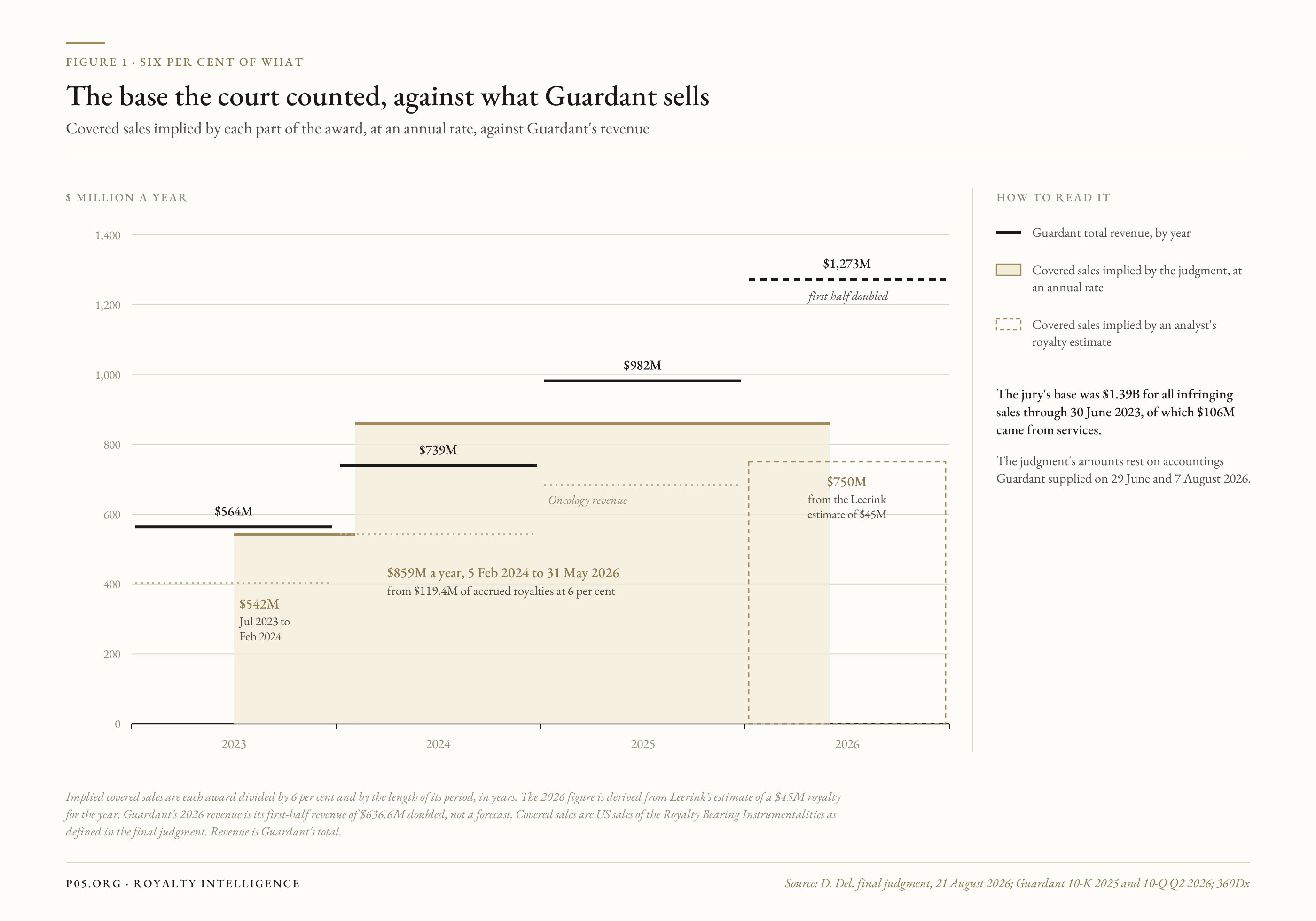
The covered sales implied by each part of the TwinStrand award, annualised, against Guardant's total revenue. The jury base is the court's figure. The supplemental and accrued periods are derived by dividing each award by 6 per cent and by the length of its period, and the 2026 point is derived from the Leerink estimate.
The base is defined by product, as the products stood at trial. Guardant says the order covers tests that existed in 2023, many of which it has since discontinued or upgraded, and that the current versions of Guardant Reveal and Shield fall outside it.
It also says it has validated design changes to Guardant360 and its related services that would take them out as well. Souda reported that the changes should bring the royalty down to a de minimis amount over time.
The claims concern a method. The same opinion locates the infringing steps in two modules of Guardant's bioinformatics pipeline, which it calls the variant caller and the digital BAM. The test a patient orders can keep its name as the code beneath it changes.
Guardant's latest report describes a portfolio now run on its Smart Platform, which adds methylation and RNA data to genomic sequencing. How a manufacturer's choice of process sets the value of a royalty on a method patent was traced in a piece earlier this month.
The plaintiffs saw the redesign coming. Their complaint of August 2021 asked, if no injunction issued, for an ongoing royalty on each product or service found to infringe and on future products and services not colourably different from them. The final judgment drew the line the other way.
Paragraph 10 excludes any version released after trial that Guardant "has represented is more than colorably different" from the version tried, including products that run on Guardant's EP1 platform without the somatic calling module. It names Guardant Reveal as of 3 December 2024 and Shield as of 22 July 2026.
Paragraph 11 also excludes most services sold from July 2023, from reanalysis reports to separately priced add-on modules, leaving only Companion and Explore in the base.
The exclusions are without prejudice to a new action. A holder who thinks a redesigned test still infringes must sue again on it. In the Labcorp earn-out examined on 20 October, a dispute over the arithmetic goes to an accounting firm sitting as an expert.
Under the TwinStrand judgment the scope of the base turns first on what Guardant represents, and a challenge to it starts a new case. The figures already in the judgment come from the same place: the amounts rest on accountings Guardant provided on 29 June and 7 August 2026.
Three proceedings that could end it
Guardant has said it will appeal the judgment to the Federal Circuit. Two proceedings at the Patent Office run beside the appeal, one for each patent. Neither is closed.
The '127 patent has been through the Board twice. The Board first upheld it in an inter partes review in October 2023, a month before the jury verdict. On 23 January 2026 the Federal Circuit vacated that decision. The Board had required Guardant to show a motivation to combine and a reasonable expectation of success, and the court held that neither was needed where a single embodiment in one prior reference disclosed the claimed steps.
It sent back the university's alternative argument, that the embodiment was not enabled, for the Board to decide first. The Board's decision of 14 October rejected Guardant's challenge in full. Guardant has until 16 December to file a notice of appeal, under the 63-day rule for appeals from Board decisions.
The '631 patent is moving the other way. On 16 June, the day the court ruled on the post-trial motions, the examiner in an ex parte reexamination issued a final office action rejecting every claim of the patent over prior art. The patent owner can appeal that rejection within the Office and then to the Federal Circuit.
Each track can reach the judgment. In Fresenius v Baxter in 2013, the Federal Circuit held that claims cancelled in reexamination must be given effect in an infringement case whose judgment is not yet final.
Baxter lost its damages award on that ground. TwinStrand's judgment will not be final until the appeal is decided.
The jury found both patents willfully infringed and returned one award for both. The ongoing royalty carries the same rate on the same products, and the 16 June opinion sets it as one rate with no split between the patents. Guardant had already tried to shed the '631 patent from the ongoing royalty. It moved under Rule 60(b), citing statements the university made in October 2024 in a petition asking the Office to vacate its order for reexamination.
The court held that the statements were at most ambiguous and amounted to no clear disclaimer of claim scope, and it denied the motion. The examiner's rejection of the '631 patent covers claim 1, the one claim of it in the judgment. If that rejection holds, claims 24 and 30 of the '127 patent, both among the 30 the Board has now upheld, would be the only support left for the rate. The record leaves open whether the 6 per cent would stand on them alone.
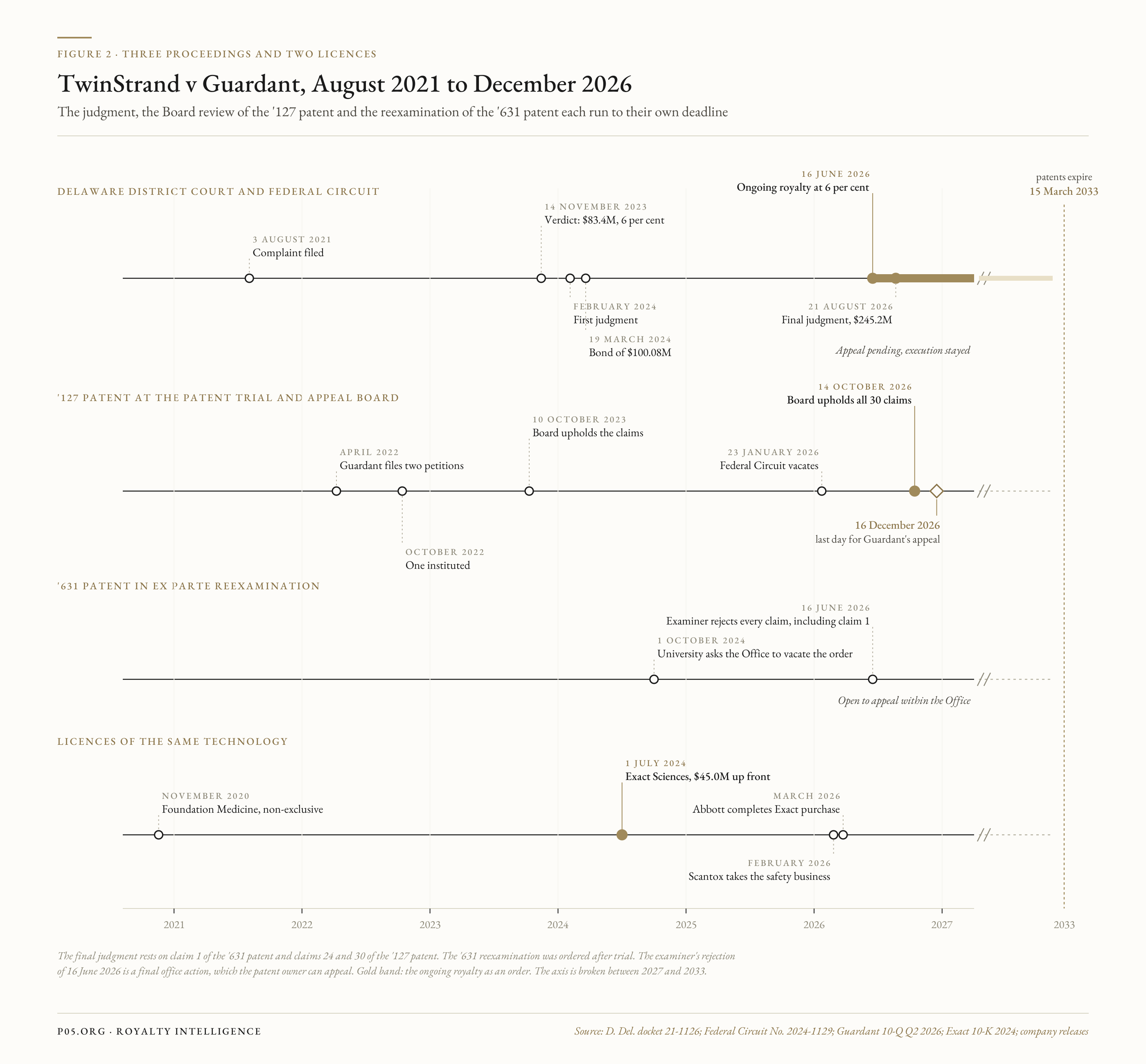
TwinStrand v Guardant from the complaint to the appeal deadline of 16 December 2026, in four lanes: the district court and the Federal Circuit, the Board review of the '127 patent, the reexamination of the '631 patent, and the licences of the same technology.
The order is the whole document
A licence would tell a buyer how net sales are measured, who may audit them, what happens on a missed payment, and whether the right to payment can be sold. The TwinStrand order is silent on most of it. It sets the rate, names the products and services, fixes the term, and requires the quarterly accounting of US sales.
It is silent on an audit right. Interest continues to accrue on the unpaid judgment. The judgment adds pre-judgment interest of $13.4M at the prime rate, compounded quarterly, and post-judgment interest at 4.76 per cent, a rate Guardant did not dispute, which came to $9.5M on the jury award to 31 May 2026. From 21 August the 4.76 per cent runs on the whole amount until it is paid.
The order's silence also helps a seller. Nothing in it stops the plaintiffs from selling what the judgment gives them, and Guardant has no consent to give. The federal rules let an action continue in the name of the original party after an interest is transferred, unless the court orders the buyer substituted or joined.
Under a licence the same question turns on consent clauses, which a piece in September traced from the licensor's side.
There are two plaintiffs. The university owns the patents and TwinStrand holds them under an exclusive licence. How the money divides between them is set by that licence, and neither side's releases describe it. Guardant has tried to reach the patents through it before.
The complaint alleges that around the launch of its first accused product Guardant made several unsuccessful attempts to license the patent family, and then tried and failed to have the exclusive licence between the university and TwinStrand cancelled. A buyer of TwinStrand's share would need to read that licence before reading the judgment, the step set out in the chain-of-title piece earlier this month.
TwinStrand itself has changed since the verdict. In February 2026 it transferred its DuplexSeq nonclinical genomic safety business to Scantox under a technology transfer and licence agreement.
The same technology carries negotiated royalties as well. In November 2020 Foundation Medicine took a non-exclusive licence to two patent families covering Duplex Sequencing, on terms neither party disclosed.
The larger contract came five months after the first judgment. On 1 July 2024 Exact Sciences took a licence to TwinStrand's error-correction technology for next-generation sequencing, broadly exclusive for cell-free nucleic acid sequencing and subject to certain non-exclusive relationships in that field.
Exact paid $45.0M up front and agreed to a low-single-digit royalty on its own net sales of licensed products and services, and, by its later reports, on those of any sublicensee. To 30 September 2025 it had recorded no royalty charge. Exact has been a wholly owned subsidiary of Abbott since March 2026.
Guardant tried to use the Exact licence against the rate. In a reply of December 2024 it called the agreement a licence to the patents in suit, on the same technology and with one of the same parties as the hypothetical licence, and argued that it made the jury's award unsupportable.
TwinStrand answered that the implied rate in the Exact deal would likely be far higher than 6 per cent. The June opinion kept the jury's rate. TwinStrand therefore holds two royalties on the same patents. One is a low-single-digit contract royalty owed by an Abbott subsidiary, with the definitions and remedies a contract carries. The other is a 6 per cent court-set royalty owed by Guardant under a judgment that is stayed.
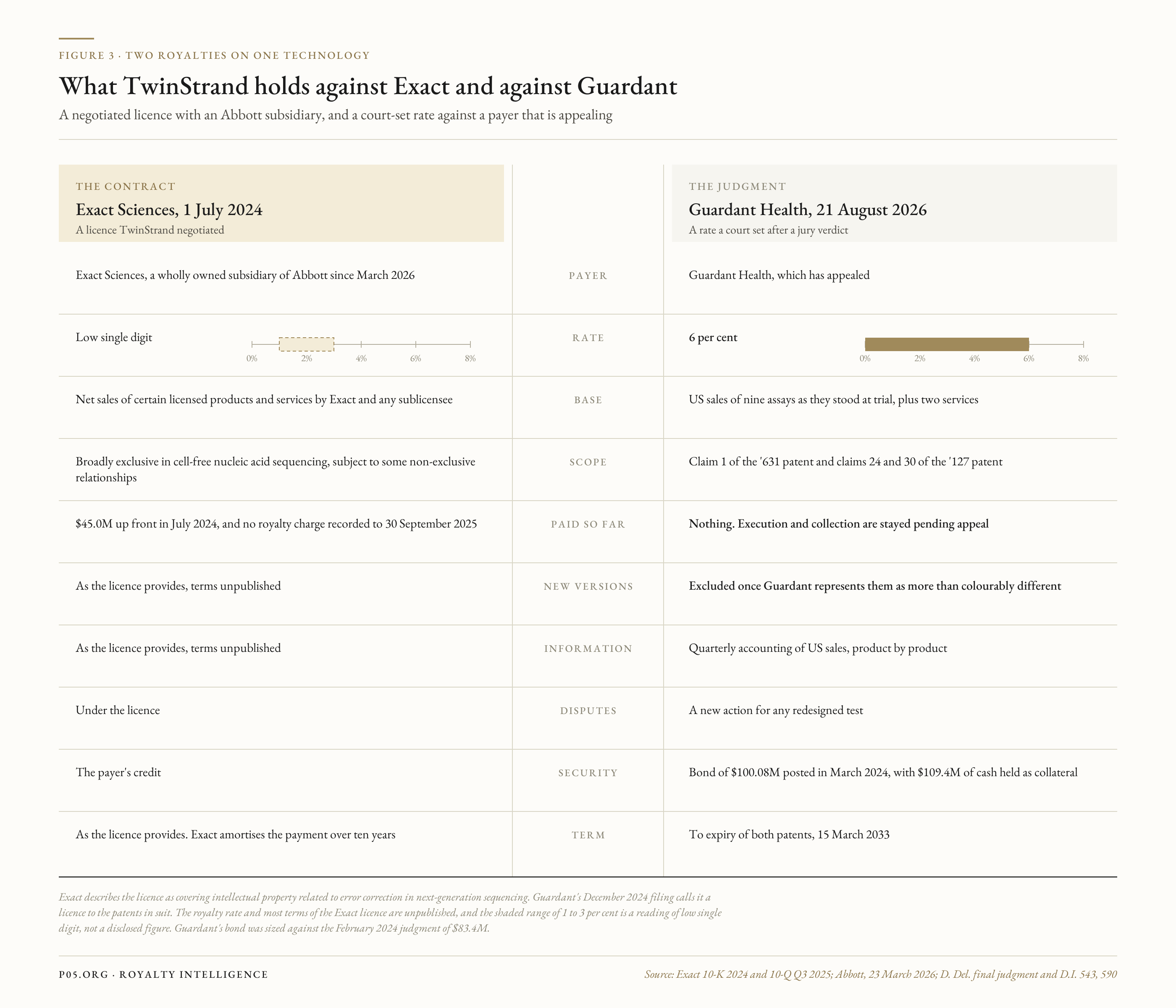
The Exact licence and the Guardant judgment set against each other, term by term, as far as each is public.
Two running royalties a court set before this one
Juno Therapeutics and Sloan Kettering sued Kite Pharma over Yescarta in October 2017. In December 2019 a jury found that Kite had willfully infringed US patent 7,446,190 and awarded a reasonable royalty of $585M up front and 27.6 per cent of Yescarta sales.
The patent expired in August 2024. In April 2020 the court entered judgment for about $1.2B in royalties, interest, and enhanced damages, and set the 27.6 per cent royalty on sales from 13 December 2019 to expiry.
Gilead, Kite's parent, weighed the verdict and its chances on appeal and concluded that a material loss was not probable. It recorded no liability. In August 2021 the Federal Circuit reversed and held the patent invalid.
Rehearing was denied in January 2022, and the Supreme Court refused to hear the case on 7 November 2022. The court-set royalty had run for about 16 months as an order when the reversal removed it.
Ravgen, a small diagnostics company in Baltimore founded in 2000, began suing test makers in 2020 over two patents on methods for detecting genetic disorders. In September 2022 a jury in the Western District of Texas found that Labcorp had willfully infringed one of them and awarded $272.0M.
The court added $100.0M of enhanced damages in May 2023, and on 23 January 2025 it awarded $2.6M of supplemental damages and an ongoing royalty of $100 per test for the life of the patent.
Labcorp appealed and filed an appeal bond on 18 March 2025 to stay enforcement. Its report for the second quarter of 2026 still describes the appeal as pending.
The Federal Circuit has meanwhile upheld Board decisions in Ravgen's favour on both patents. Ravgen has settled with Illumina, Quest Diagnostics, Myriad Genetics, PerkinElmer, Biora Therapeutics, and Roche's Ariosa, and it pays for its litigation and operations out of licence income.
A second verdict, against Natera, became a $57.0M judgment in March 2026, and Natera has appealed parts of it.
The same Natera report records another route into a patent dispute. Invitae had sued Natera on three patents in 2021 and then filed for Chapter 11. Labcorp acquired the patents, substituted as plaintiff, and settled with Natera in September 2025. It bought the claim by buying the patents, which made it the party with standing to settle.
| Case | Patentee | Payer | Court-set running royalty | Ordered | Runs to | Status at 20 October 2026 | Source |
|---|---|---|---|---|---|---|---|
| Juno and Sloan Kettering v Kite | Juno (Bristol Myers Squibb), Sloan Kettering | Kite (Gilead) | 27.6 per cent of Yescarta sales | Apr 2020 | Aug 2024 | reversed Aug 2021, patent invalid, certiorari denied Nov 2022 | BMS 10-K 2022 |
| Ravgen v Labcorp | Ravgen | Labcorp | $100 per test | Jan 2025 | life of patent | on appeal, bond filed Mar 2025 | Labcorp 10-Q Q2 2026 |
| TwinStrand and University of Washington v Guardant | University of Washington, TwinStrand | Guardant | 6 per cent of sales of nine assays as they stood at trial and two services | Jun 2026, judgment Aug 2026 | 15 Mar 2033 | appeal pending, execution stayed, '127 upheld on remand, '631 claims finally rejected in reexamination | Guardant 10-Q Q2 2026 |
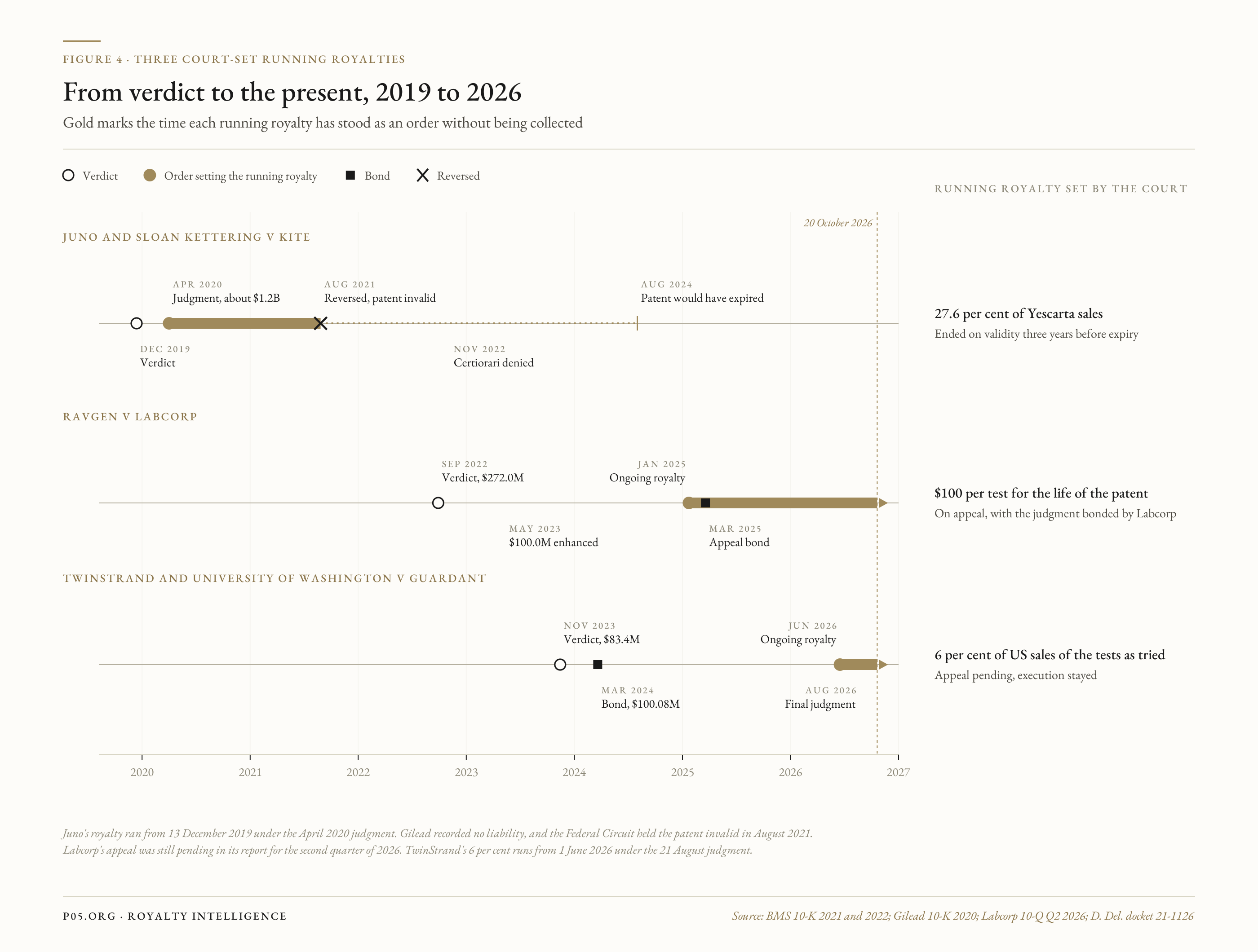
Three court-set running royalties from verdict to 20 October 2026, with the time each has stood as an order, the bonds, and the one reversal.
Pricing the two parts
The judgment holds two assets of different shape. The first is the accrued sum of $245.2M, which grows with interest. Guardant had $1,053.5M in cash and cash equivalents at 30 June, and holds $109.4M as bond collateral.
The bond Guardant posted in March 2024 was sized at $100.08M against the first judgment, about 41 per cent of the $245.2M now owed, and the public record is silent on whether it has been raised since. Payment turns on the appeal and on the Patent Office tracks, and hardly at all on Guardant's capacity to pay.
The June piece on litigation sales placed claims of this kind at the mature end of its spectrum, where funders buy a judgment at a discount to face.
The second asset is the forward stream from 1 June 2026 to 15 March 2033, about 6.8 years. Its size depends on the base, and the base depends on Guardant. Held flat at the run rate implied by the accrued royalty, about $51.5M a year, the stream would pay about $350M before discounting.
At the Leerink estimate of $45M a year, it would pay about $305M. If the redesign took the covered base down in a straight line to zero over two years from June 2026, the stream would pay about $52M, and about $77M if the decline took three years. Each figure must then be weighted by the chance that the judgment survives in its present form.
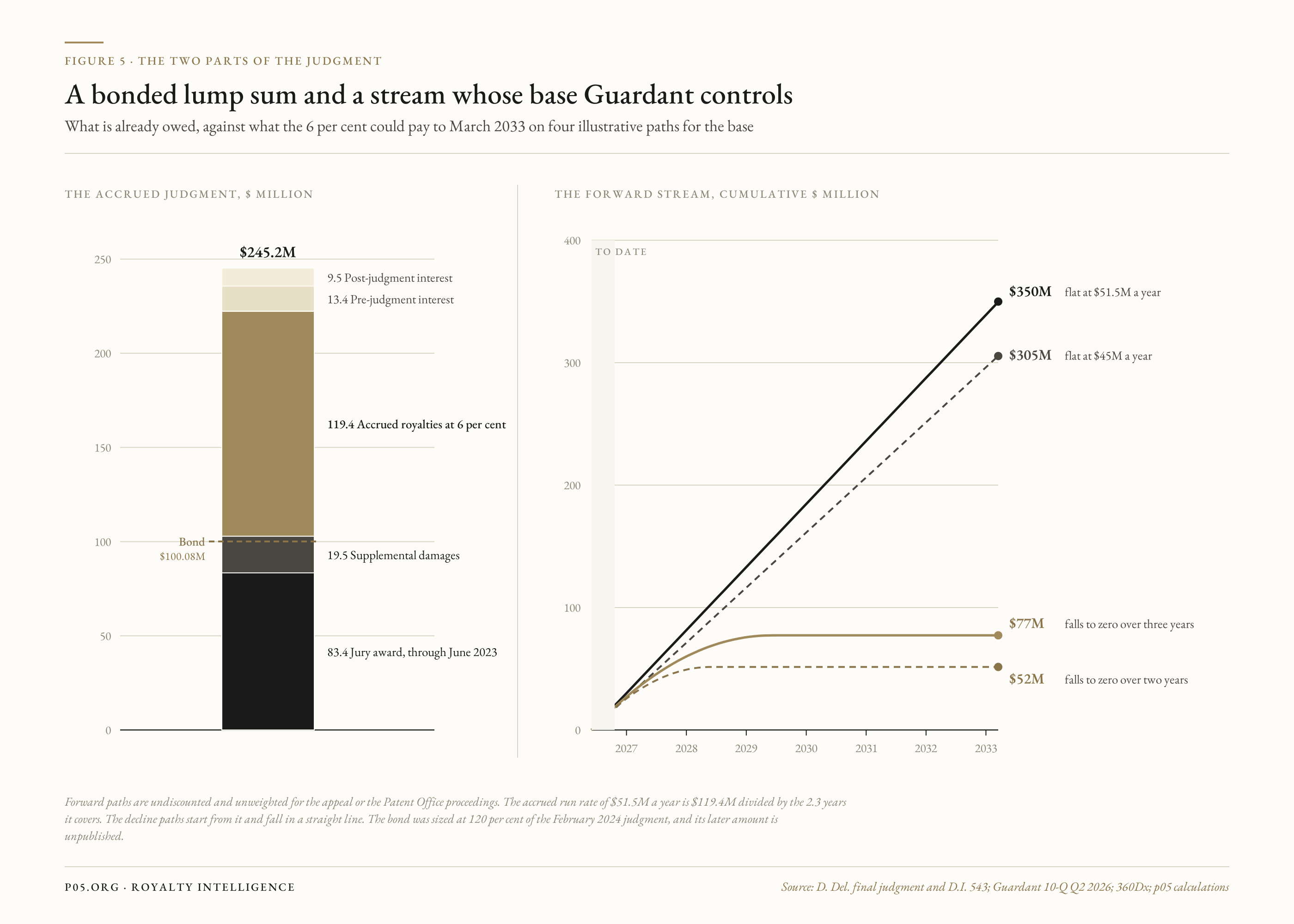
Left, the $245.2M already owed, by component, against the $100.08M bond. Right, cumulative payments on the forward stream to 15 March 2033 under four illustrative paths for the covered base, undiscounted and before any weighting for the appeal.
The flat paths pay between about $230M and $300M more than the declining ones. Guardant's engineering sets where the stream falls inside it. A buyer would price the forward stream with the redesign path weighted most heavily, because that is the path Guardant has said it is taking.
The judgment already excludes the versions Guardant has represented as different, and the plaintiffs can contest that only by bringing a new action on the redesigned tests. Until they do, the stream has no measured base beyond the quarterly accounting Guardant supplies.
How capital enters and returns
For the accrued judgment the buyers are the litigation funders and the specialist judgment buyers. They underwrite a binary outcome on appeal, they are paid by Guardant, with the bond behind it, if the appeal goes the holders' way, and the rules on transfer let them take an interest without Guardant's consent.
Bristol Myers Squibb and Sloan Kettering show what that outcome can be. Their April 2020 judgment stood at about $1.2B plus the running royalty, and the reversal in August 2021 left nothing to collect.
For the forward stream, the instrument a royalty buyer knows would exist only after a settlement. A settlement turns the order into a contract, with defined terms, an audit right, a transfer clause, and the payer's signature.
The 8 September piece covered that kind of royalty and why funds have not bought one. The court-set rate would be the starting point for that negotiation, and the redesign the payer's counterweight.
TwinStrand has already shown the other route with its own patents. The Exact licence has what the Guardant order lacks: a written grant, a defined base of net sales, an upfront payment of $45.0M, and a low-single-digit royalty owed by a subsidiary of Abbott. It has yet to produce a royalty charge, so a buyer would be underwriting Exact's launch of products on the technology.
It can be valued and sold on the contract's own terms.
Ravgen has taken the settlement route. It has settled with six defendants and has funded itself from the licences, while the two judgments it won go through appeal. The Labcorp substitution in the Invitae case shows a second exit, where a buyer takes the patents themselves and with them the right to settle.
For TwinStrand that route runs through the University of Washington, which owns the patents.
Cash would return in one of two ways. If the judgment is affirmed and the patents survive, Guardant pays the accrued sum with interest, and the quarterly royalty from June 2026 falls due, on whatever base the court accepts. If the parties settle first, the price and the terms of any continuing royalty replace the order.
Implications for the Pharmaceutical Royalty Market
The three orders in the table span six years, one in cell therapy and two in diagnostics. In both diagnostics orders the patentee is a small company, with a university in one, and the payer is a large laboratory group with cash. Each payer appealed. Labcorp bonded its judgment, Guardant holds bond collateral and has accrued only the jury award, and Gilead recorded no liability at all.
The June piece on the drug patent troll identified diagnostics as the corner of the life sciences where fragmented patent ownership makes assertion workable, and Ravgen and TwinStrand both hold their patents in that corner.
The time between verdict and cash is long. Ravgen's verdict against Labcorp came in September 2022 and its appeal was still pending in August 2026. TwinStrand's verdict came in November 2023 and the judgment in August 2026, and its appeal has yet to be decided. Neither judgment has yet been paid.
The rate itself sits between two kinds covered here before. A settlement rate is agreed by the parties under the threat of an injunction or an exclusion order. A compulsory licence rate is set by the state.
A court-set ongoing royalty is fixed by a judge after a jury has found infringement, in place of an injunction, and the payer keeps control of the products it applies to.
For a royalty fund, the base matters more than the rate. In the TwinStrand judgment it is a list of products as they stood in 2023, measured by sales that Guardant reports, and the judgment itself excludes any later version Guardant represents as more than colourably different.
In the Juno order it was one marketed therapy, and the stream ended on validity. The Ravgen order counts tests, and its value will depend on how many tests Labcorp still runs on the patented method once the appeal is decided.
Conclusion
The Board's decision of 14 October kept the '127 patent in place for now. Guardant can take it to the Federal Circuit until 16 December. The '631 patent stands rejected by the examiner, subject to appeal, and the judgment that rests on both waits for the Federal Circuit.
Until those proceedings end, the order gives TwinStrand and the University of Washington a 6 per cent claim on Guardant's US sales of its tests as they stood in 2023, payable quarterly from 1 June 2026, and stayed. Guardant has $109.4M set aside against it.
All information in this report was accurate as of the research date and is derived from publicly available sources including court opinions, regulatory guidance, academic literature, SEC filings, and financial news reporting. Information may have changed since publication. This content is for informational purposes only and does not constitute investment, legal, or financial advice. The author is not a lawyer or financial adviser.