Injunction or royalty: what Mallinckrodt gave up to keep a generic off the market

On 3 November Judge Richard Andrews of the District of Delaware upheld every finding a jury had made against Airgas over Mallinckrodt's nitric oxide patents, willful infringement included. In the same memorandum opinion he vacated the jury's damages award in full.
The jury had awarded two lump-sum royalties, about $3.3M and about $6.1M. The ruling was reported in the Weekly Term Sheet for week 45.
In their place the judge granted the remedy the Hatch-Waxman Act prescribes once an Orange Book patent is found infringed. He will order the Food and Drug Administration (FDA) to reset the approval date of Airgas's abbreviated new drug application to no earlier than the expiry of the two infringed Orange Book patents, 6 January 2031 for one and 19 February 2035 for the other.
The judge read the jury's award as the price of a fully paid-up licence for the rest of the patents' lives. A licence that runs to expiry authorises the sales that the order now blocks, so he held that Mallinckrodt could not keep both.
A week later the local division of the Unified Patent Court in The Hague applied the same logic in the other direction. Its injunction against Pfizer and BioNTech takes effect only if they fail to take a licence from GSK. In both courts the licence and the block cover the same future sales, and the patent owner gets one of them.
The case and the award
Mallinckrodt sells INOmax, inhaled nitric oxide for newborns with hypoxic respiratory failure, and sued Airgas in December 2022. The case is separate from the Chapter 11 in which the Third Circuit discharged Sanofi's Acthar royalty, covered in the piece on section 365.
Airgas's product has two parts: Ulspira, the drug in its abbreviated application, and the Ulspira TS delivery system, cleared separately. The FDA approved the application on 27 July 2023. Airgas launched in November 2023, the date the court later fixed for the hypothetical licence negotiation.
Mallinckrodt asked for a preliminary injunction and lost it in February 2025. The court found that Airgas had sold no units of Ulspira and earned no revenue from it by 1 October 2024, and that Mallinckrodt had renewed about 90 per cent of its hospital contracts.
The case went to a jury in September 2025 on three patents. Two of them, the '6794 patent on pre-use gas verification and the '9794 patent on sensor drift correction, are listed in the Orange Book. The third, the '118 patent, also on sensor drift, is not.
The jury found every asserted claim infringed and the infringement willful. It awarded about $3.3M for the '6794 patent and about $6.1M for the '9794 and '118 patents together, with no split between them.
Both sums were one-time payments from a hypothetical negotiation. Mallinckrodt told the jury that its theory related "to the parties' expectations of future sales". Its damages expert, Dana Trexler, worked from Airgas's forecast profits through 2031. Mallinckrodt also had Airgas's actual sales excluded from the trial.
The court had struck part of Trexler's first theory before trial, and a separate order issued the same day records that without her supplemental report Mallinckrodt would have had no damages theory for its Orange Book patents.
In October 2025 the judge entered judgment on the verdict and put off the injunction. Granting both, he wrote then, seemed like double-counting.
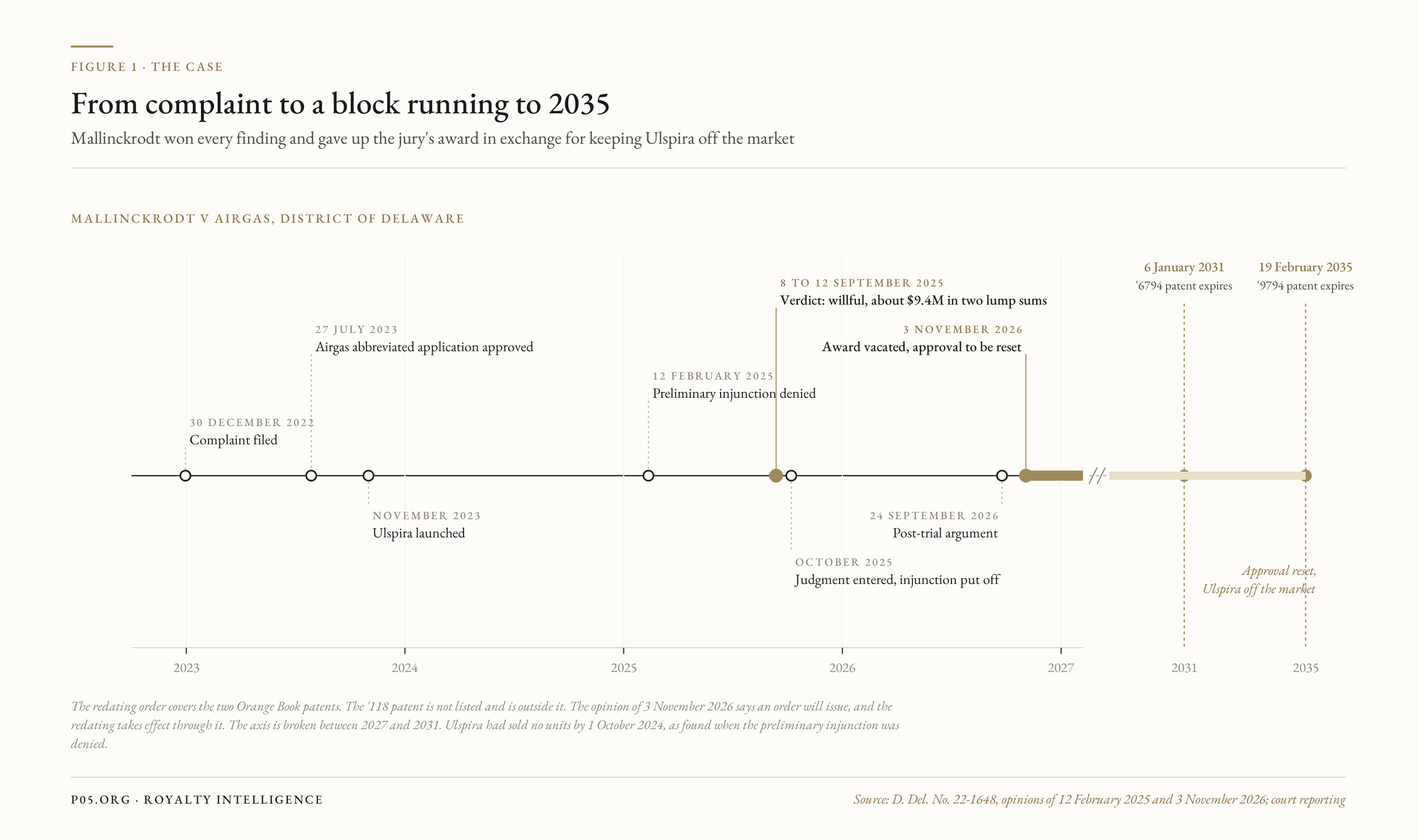
Mallinckrodt v Airgas from the complaint to the opinion of 3 November 2026, with the redating running to the expiry of the two Orange Book patents in 2031 and 2035.
Why the award went
Section 271(e)(4)(A) of the Patent Act says the court "shall order" the approval date reset once infringement by an abbreviated application is found.
The judge treated that as a mandate. He wrote that he was concerned about double recovery but could not disregard the statute. Mallinckrodt had already said in its brief that if forced to choose between the injunction and future damages, it wanted the injunction.
Mallinckrodt argued that the statute allows both, citing the 1984 House report on cases where the generic is already on sale. The judge agreed that damages and redating can sit together. The damages then have to cover the past, and the order the future.
He quoted the Federal Circuit in Trans-World v Al Nyman from 1984: "Where the damage award is based upon an assumed license for the life of the patent, there is no need to enjoin use, since the license fee authorizes use."
The record placed the award on the wrong side of that line. The jury heard no theory limited to past infringement and had none of the data to compute one, because Airgas's sales were kept out at Mallinckrodt's request. The judge found no principled way to turn a lifetime licence fee into a payment for the past.
The two sums fell for slightly different reasons. Mallinckrodt did not dispute that the $3.3M was a fully paid-up lump-sum royalty. For the $6.1M it argued that the figure measured the development costs Airgas had saved, and so was compensation already earned.
The judge held that it was still a lump-sum royalty from a hypothetical negotiation. It also covered the '118 patent, which the redating order does not reach because that patent is not in the Orange Book. The judge said he had no objection in principle to a lump sum for the '118 patent alone, but found "no methodical way" to separate it from the '9794 patent.
He vacated the whole award. Mallinckrodt remains entitled to damages for infringement of the two Orange Book patents up to the redating and for infringement of the '118 patent. Those damages now have to be proved again, this time on Airgas's actual sales. The motion for enhanced damages and interest fell with the award, so the willfulness finding stands with no sum to multiply.
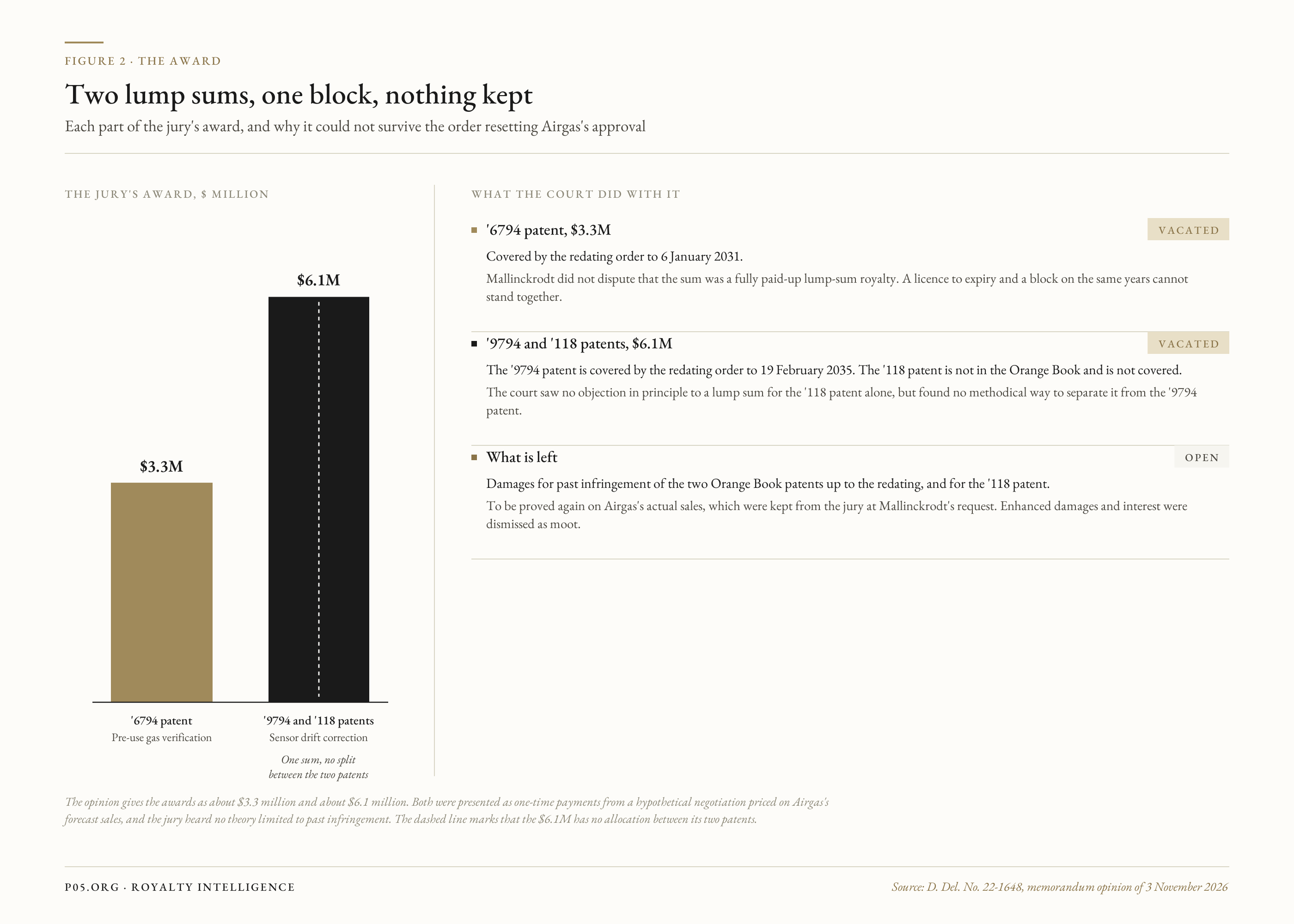
The jury's two lump sums, what the court did with each, and what is left to prove.
The Hague: a licence as the condition
GSK sued Pfizer and BioNTech at the Unified Patent Court in July 2025 over three patents it says Comirnaty infringes.
On 10 November the local division in The Hague, presided over by Edger Brinkman, held that the vaccine infringes EP 2 590 626, which covers liposomes for delivering RNA, and upheld the patent with the loss of one claim.
The injunction reaches every state of the European Patent Convention where the patent is in force except Ireland and the United Kingdom, according to JUVE Patent.
Enforcement waits for a final decision on validity. The injunction then takes effect only if Pfizer and BioNTech have not signed a licence with GSK within three months of that decision.
The panel noted that GSK does not sell a product using the invention and is seeking monetary compensation. It ordered interim damages of $2.24M (EUR 2M) and sales information back to January 2020, on a case valued at $56M (EUR 50M).
GSK already collects a royalty from Pfizer and BioNTech on other patents. Under the August 2025 settlement of CureVac's US case, which GSK joined, it received $370M and 1 per cent of US sales of their COVID-19 and influenza mRNA vaccines from the start of 2025, with $130M more and 1 per cent of sales elsewhere to follow BioNTech's acquisition of CureVac.
The September piece on settlement rates placed that deal among royalties paid by a marketed competitor.
GSK settled its parallel case against Moderna on 28 October with a cross-licence in infectious disease under which no payments are exchanged. Two more GSK patents against Pfizer and BioNTech wait in The Hague behind proceedings at the European Patent Office.
The two courts started from different places. Delaware had a licence that a jury had priced and a statute that required the block, and it removed the licence. The Hague had a patent owner with no sales to protect, and it made the block depend on the absence of a licence.
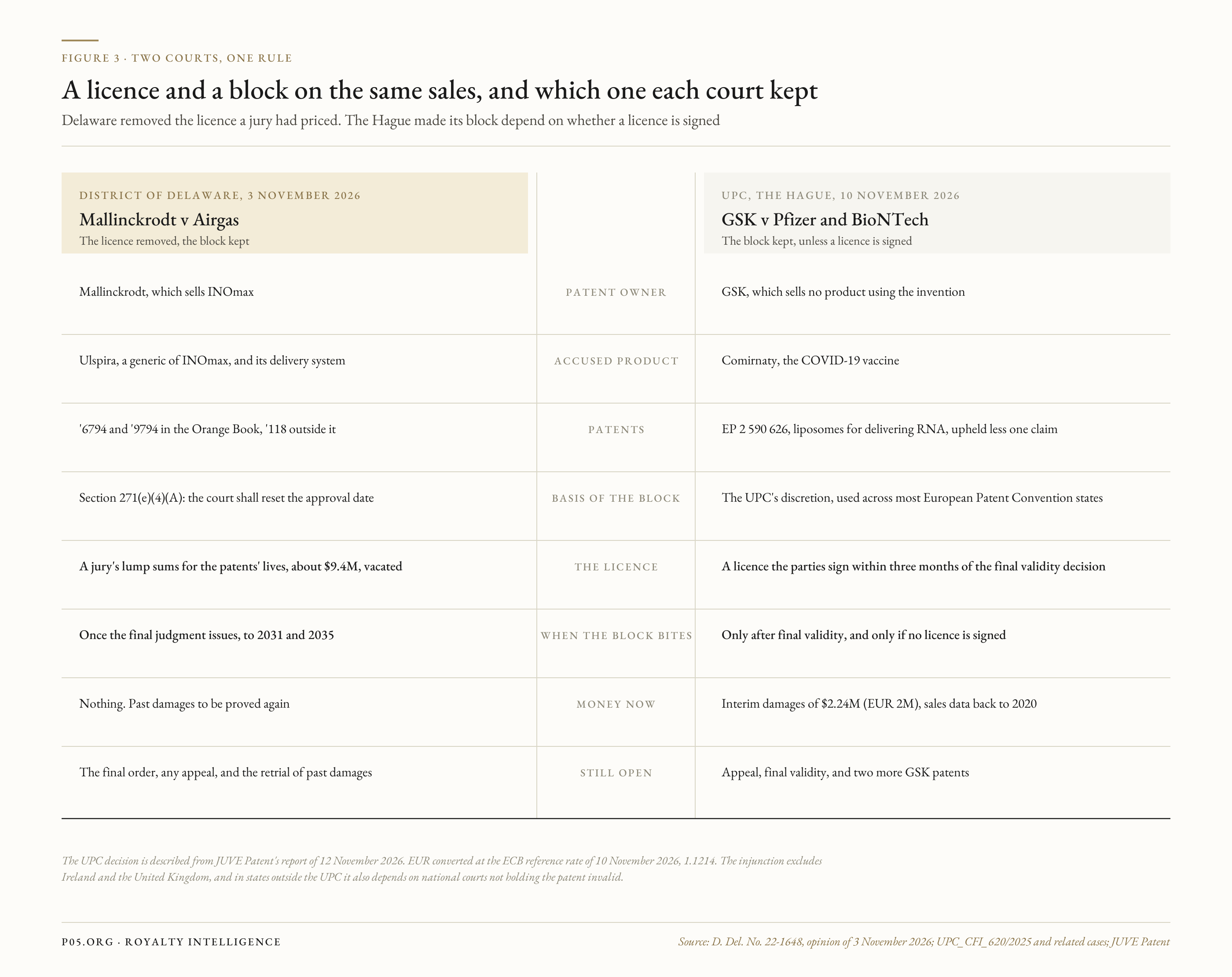
The two decisions side by side: patent owner, patents, the basis of the block, the licence, when the block takes effect, money now, and what is still open.
What reaches a royalty buyer
A patent win pays a royalty only if the patent owner elects one. Mallinckrodt chose exclusivity, so its return now comes through its own INOmax sales until 2031 and 2035, together with past damages still to be set.
Airgas pays no royalty for those years. A buyer holding a royalty on the patent owner's own sales gains from that choice. A funder of the case, or a buyer of a share of its proceeds, holds a claim on a lump sum that the plaintiff can give up.
The election sits with the plaintiff. Mallinckrodt's brief stated its preference before the court ruled. A purchase of litigation proceeds that is silent on remedies leaves that decision with the seller, and the June piece on non-recourse litigation sales placed claims of this kind at the stage where a verdict has been reached and cash has not.
A lump sum priced on forecast sales through expiry is a licence for the whole term, and a later injunction removes it. A verdict that splits past damages from a running royalty, or allocates damages patent by patent, leaves a court room to keep the past part. The jury in Delaware did neither, and the judge found nothing he could keep.
When no injunction issues, the court can set the royalty itself. The October piece on TwinStrand and Guardant followed an ongoing royalty of 6 per cent ordered in place of an injunction, with no contract behind it.
The Hague order points to the other route. If the patent survives and Pfizer and BioNTech sign, the outcome is a negotiated licence with a rate and a defined base, agreed under the threat of a multi-country injunction. That is the kind of stream the settlement-rate piece examined. Where the block falls on a licensed product, the licensor's royalty on that product stops, the case taken up in the piece on someone else's patent.
Implications for the Pharmaceutical Royalty Market
In abbreviated application cases the redating order is mandatory once infringement is found, so a brand owner who wins on an Orange Book patent gets the block whether it asks for it or not. A jury award for future years then sits on top of a remedy the statute has already granted.
Delaware has now held that a lump sum priced to expiry cannot survive alongside it. Damages for past sales by a generic already launched remain available, and they have to be proved on the generic's actual sales.
For a buyer underwriting a stream that depends on patent litigation, the questions follow the remedy. A diligence file needs to show whether the patents in suit are in the Orange Book and whether the damages theory covers the past, the future or both.
It also needs to show whether the verdict form splits the award by patent, and who decides which remedy to take. The answer to the last question decides whether a win pays a royalty at all.
The Hague decision shows a court using the injunction to produce a licence. For a patent owner with no product in the field, such as GSK here, whose position in the United States after eBay was traced in the piece on the drug patent troll, a conditional injunction moves the case toward a negotiated rate. That rate would be set before final validity is known, by parties who face a three-month deadline once it is.
Conclusion
Mallinckrodt left the courtroom on 3 November with the verdict intact and none of the $9.4M the jury awarded. Airgas's approval will be reset to 2031 and 2035 once the final judgment issues, and the damages for the years Ulspira was on sale must now be worked out from sales that Mallinckrodt kept from the jury.
In The Hague, Pfizer and BioNTech face an injunction across most of Europe that will not bite until the validity of EP 2 590 626 is settled. They can avoid it by signing a licence with GSK.
All information in this report was accurate as of the research date and is derived from publicly available sources including court opinions, regulatory guidance, academic literature, SEC filings, and financial news reporting. Information may have changed since publication. This content is for informational purposes only and does not constitute investment, legal, or financial advice. The author is not a lawyer or financial adviser.